Most Common Quiz Night Topics: Your 2026 Planning Guide
Discover the most common quiz night topics to elevate your next trivia event! From general knowledge to sports, plan a memorable night.
- interesting quiz categories
- frequently asked quiz questions
- common quiz topics
- trivia night categories
- best quiz night subjects
- most common quiz night topics
- popular quiz night themes
On this page

The most common quiz night topics are general knowledge, entertainment, science and nature, history, geography, and sports. These six categories appear in nearly every successful trivia format because they offer broad appeal across age groups, skill levels, and social settings. Whether you’re planning a pub night, a corporate event, or a family quiz night at home, knowing which trivia night categories consistently land well is the difference between a room full of energy and a room full of crickets.
1. Why general knowledge is the backbone of most quiz nights
General knowledge is the most reliable quiz category because it offers broad appeal and question flexibility that no other topic can match. It covers everything from world capitals to famous inventors, which means almost every player can contribute something.
The best general knowledge rounds mix easy, medium, and hard questions in roughly equal thirds. Easy questions keep newer players engaged. Hard questions give the trivia veterans something to chew on. That balance is what keeps a room competitive without making anyone feel left out.
Good general knowledge questions also avoid being too niche. “What is the capital of France?” is a classic for a reason. “Who was the third Prime Minister of New Zealand?” is not a general knowledge question. It’s a history specialist’s question in disguise.
Pro Tip: Aim for a 60/30/10 rule across your full quiz: 60% universal topics, 30% niche themes, and 10% skill-based rounds. This mix sustains interest from the first round to the last.
A standard quiz format runs 40–60 questions for a one-hour session and up to 100 questions for a two-hour event. General knowledge questions typically anchor the opening and closing rounds because they set the tone and send people home feeling smart.
2. Entertainment: movies, TV, music, and pop culture
Entertainment trivia is a crowd favorite because it taps into shared cultural memory. Everyone has watched something, listened to something, or followed someone famous. That common ground makes pop culture one of the best quiz night subjects for mixed groups.

The key is matching your entertainment subthemes to your audience’s age range. Research shows that demographic targeting boosts engagement significantly: players in their 20s tend to favor 2010s pop culture and Marvel, those in their 30s and 40s gravitate toward 90s nostalgia and sitcoms like Friends or The Office, and players 45 and older often respond best to classic rock and golden-age Hollywood.
Here are the entertainment subcategories that consistently perform well:
- Movies: Blockbusters, Oscar winners, and iconic quotes
- TV shows: Comfort series like Friends, Seinfeld, and Stranger Things
- Music: Chart-topping artists, album titles, and song lyrics
- Celebrities: Famous couples, career milestones, and viral moments
- Disney and Pixar: A reliable crowd-pleaser for family quiz night topics
Themed trivia nights drive attendance spikes when aligned with audience interests. Holiday-themed events generate 30–60% higher attendance, and comfort-show themes like Friends or Disney/Pixar see a 25–40% increase. That’s not a small bump. It’s the difference between a half-empty room and a waiting list.
Pro Tip: For office parties, lean into comfort-show categories like The Office or Parks and Recreation. These shows have broad recognition across age groups and avoid the hard age cutoffs that can leave some players feeling excluded.
3. Science and nature: the category that surprises everyone
Science and nature questions add a layer of genuine curiosity to any quiz. They challenge what people think they already know, which sparks debate and keeps energy high between rounds.
Science and nature questions frequently challenge common assumptions, which is exactly what makes them memorable. A question like “How many hearts does an octopus have?” (three) lands differently than a straightforward history recall. People argue, laugh, and remember the answer.
The main subcategories to pull from include:
- Biology: Human anatomy, animal behavior, plant science
- Astronomy: Planets, space exploration, famous astronomers
- Chemistry: Elements, reactions, everyday science
- Animals: Record holders, unusual species, wildlife facts
- Environment: Climate, ecosystems, conservation milestones
The trick with science questions is balancing niche content with accessible facts. “What is the chemical symbol for gold?” is accessible. “What is the atomic mass of Einsteinium?” is not. Stick to facts that feel surprising but are ultimately satisfying to learn.
Pro Tip: Pair science questions with a visual round. Show a photo of an unusual animal or a close-up of a natural material and ask players to identify it. Visual rounds break up the pace and give different types of learners a chance to shine.
4. History and geography: grounding your quiz in shared knowledge
History and geography are two of the most frequently asked quiz question categories because they draw on knowledge most people picked up in school. That familiarity creates a level playing field, which is exactly what you want in a social setting.
History and geography questions work best when they focus on widely taught events and recognizable locations. Questions about World War II, the American Revolution, or the fall of the Berlin Wall land well because they’re part of a shared cultural curriculum. Obscure questions about minor medieval treaties do not.
Here’s a quick comparison of how these two categories differ in practice:
| Category | Best question types | Audience sweet spot | Pitfall to avoid |
|---|---|---|---|
| History | Major wars, famous leaders, landmark events | All ages | Overly regional or obscure dates |
| Geography | Capitals, flags, continents, famous landmarks | All ages | Trick questions about disputed territories |
Geography questions also open the door to visual rounds. Showing a flag and asking players to name the country is a classic format that works at every skill level. If you want to go deeper, map-based quiz formats add a spatial challenge that keeps geography fans genuinely engaged.
Pro Tip: Customize your history round with one or two local history questions. A question about your city or region creates an instant connection and gives local players a moment to shine. Rotating themes that combine local history with pop culture balance niche and general interests for both novices and experts.
5. Sports and leisure: energizing the competitive crowd
Sports trivia is one of the most polarizing categories on this list. Done well, it energizes the room. Done poorly, it alienates half the table. The goal is broad coverage, not deep specialist knowledge.
Sports trivia centered on major leagues and events provides the widest appeal. Stick to questions about international sporting events like the FIFA World Cup and the Olympics, or to regional favorites like the NBA or NFL in the USA, for instance. These are events that even casual sports fans have heard of, which keeps the category inclusive rather than exclusive.
Popular sports topics that consistently perform well include:
- NFL and college football: Super Bowl history, famous quarterbacks, iconic plays
- NBA: Championship teams, record holders, legendary players like Michael Jordan and LeBron James
- World Cup: Host nations, top scorers, memorable upsets
- Olympics: Host cities, record-breaking moments, famous athletes
- General sports: Rules, equipment, and famous venues
One smart move is to include leisure and games alongside traditional sports. Questions about chess, poker, the Tour de France, or Formula 1 broaden the category beyond team sports and give non-sports fans a foothold. You can also learn quiz patterns and tricks to structure your sports round so it rewards both casual fans and dedicated followers without tipping too far in either direction.
The golden rule for sports rounds: never make more than 20% of your total quiz sports-focused if you’re running a mixed-audience event. Sports fans will survive. Non-sports fans will thank you.
6. Food and drink: the wildcard category everyone loves
Food and drink trivia is one of the most underused categories in quiz planning, and that’s a mistake. It’s accessible, culturally rich, and genuinely fun.
Questions can range from identifying cocktail ingredients to naming the country of origin for a dish. “What country does hummus originate from?” or “Which spirit is the base of a Negroni?” are the kinds of questions that spark table debates and laughter in equal measure.
Food and drink also pair naturally with themed events. A wine-tasting quiz night, a “cuisines of the world” round, or a cocktail-naming challenge adds an experiential layer that pure knowledge categories can’t replicate. For holiday party ideas, a festive food-and-drink round is an easy win that fits the mood without requiring specialist knowledge.
7. Picture rounds: the format that changes everything
A picture round is not a topic. It’s a format. But it belongs on this list because it transforms how any category lands with an audience.
Show a photo of a famous landmark and ask players to name the city. Show a close-up of a celebrity’s eyes and ask who it is. Show a logo with the brand name removed and ask players to identify the company. These formats work because they engage visual learners and create a different kind of challenge than text-based questions.
Picture rounds also slow the pace of a quiz in a good way. They give players time to discuss, debate, and collaborate. That social interaction is what makes trivia nights worth attending in the first place. Prioritizing categories that encourage collaborative answers maximizes participation across all skill levels.
Key takeaways
The most effective quiz nights combine general knowledge, entertainment, science, history, geography, and sports in a structured mix that serves every player at the table.
| Point | Details |
|---|---|
| Use the 60/30/10 rule | Build 60% universal topics, 30% niche themes, and 10% skill-based rounds for sustained engagement. |
| Match entertainment to demographics | Target 20s with 2010s pop culture, 30s–40s with 90s nostalgia, and 45+ with classic rock or historical themes. |
| Keep history and geography accessible | Focus on widely taught events and recognizable locations to maintain fairness across all skill levels. |
| Balance sports for mixed audiences | Cap sports questions at around 20% of total content when running events for non-specialist crowds. |
| Add picture rounds for variety | Visual formats encourage collaboration, break up pacing, and engage players who struggle with pure recall questions. |
Sharpen your geography game with Worldlecity
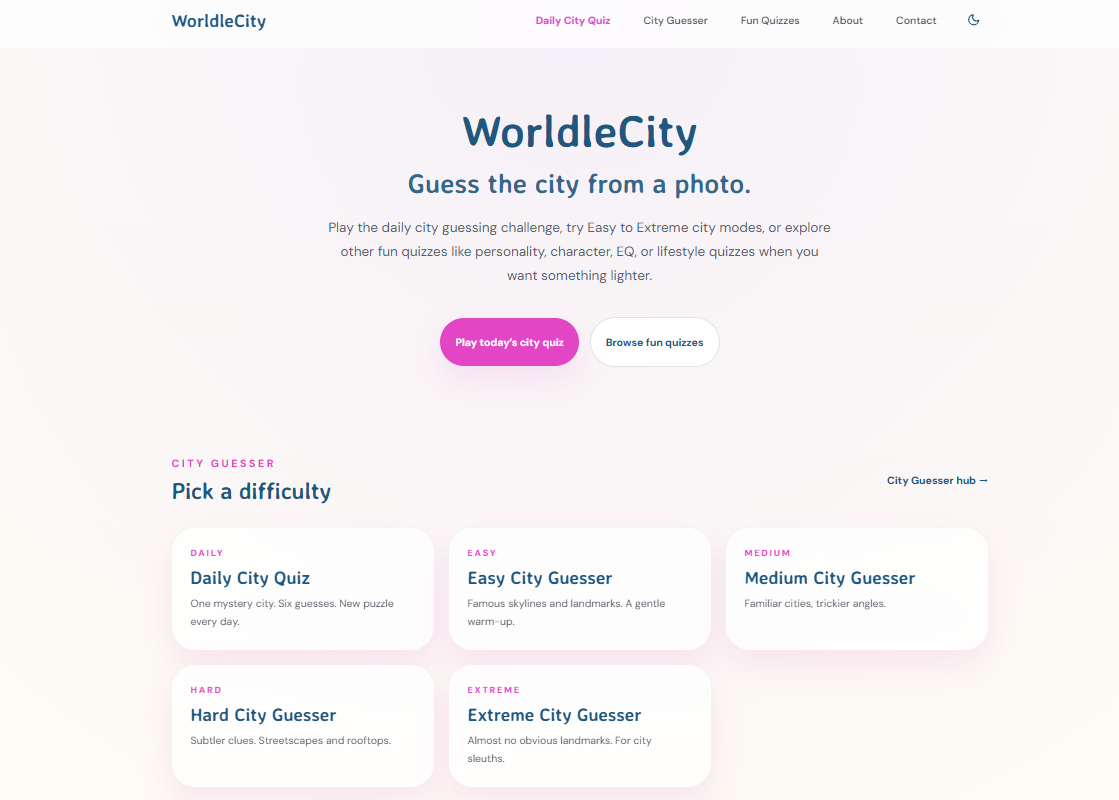
If geography is on your quiz night lineup, Worldlecity is the perfect warm-up. Each day, Worldlecity drops a photo of a mystery city and gives you six attempts to guess it, with proximity and direction clues after each guess. Worldlecity’s city guesser quizzes run across four difficulty modes, so you can go from a casual explorer to a genuine geography nerd at your own pace. It’s the kind of challenge that quietly builds the geographical knowledge you’ll need when someone asks, “Which city is home to the ‘Space Needle’?” and the whole table goes quiet. And if you are organizing a quiz event, the geography quizzes on Worldlecity act as a perfect direct source for picture-round quizzes. Beyond the daily city guessing game, Worldlecity offers personality quizzes and lifestyle quizzes with no account required. It’s low-pressure, genuinely fun, and a surprisingly good way to prep for your next trivia night.
FAQ
What are the most common quiz night topics?
The most common quiz night topics are general knowledge, entertainment, science and nature, history, geography, and sports. These categories appear in nearly every trivia format because they offer broad appeal across age groups and skill levels.
How many questions should a quiz night have?
A standard quiz night runs 40–60 questions for a one-hour session and up to 100 questions for a two-hour event. Spreading questions across six to eight categories keeps the pace varied and the audience engaged.
How do I pick quiz topics for a mixed-age crowd?
Use the 60/30/10 rule: 60% universal topics like general knowledge, 30% niche themes matched to your audience’s age range, and 10% skill-based or specialist rounds. This balance keeps both casual players and trivia veterans interested.
Are themed trivia nights worth the extra planning?
Yes. Holiday-themed trivia nights generate 30–60% higher attendance, and comfort-show themes like Friends or Disney/Pixar see a 25–40% attendance increase. The extra planning pays off in a noticeably more energized room.
What quiz category works best for family quiz nights?
General knowledge, Disney and Pixar trivia, food and drink, and picture rounds are the strongest family quiz night topics. They avoid hard age cutoffs and give players of every generation a fair shot at contributing.