What Is a Personality Quiz? Your Guide to Self-Discovery
Discover what a personality quiz is and unlock insights about yourself. Learn how these quizzes enhance self-awareness and growth!
- what is a personality quiz
- types of personality quizzes
- how to take a personality quiz
- how accurate are personality quizzes
- free online personality quiz
On this page

A personality quiz is a structured set of questions built to surface your traits, preferences, and behavioral tendencies — basically a mirror for how you think, feel, and deal with people. They run the full range, from rigorous academic instruments like the Big Five (OCEAN) model to the casual five-minute formats you’ll find on sites like 16Personalities. Chasing real self-awareness, or just curious which historical figure you’d be? Either way, there’s a quiz for it. They’ve become one of the most popular ways people reflect on themselves online — and knowing how they work makes your results a lot more useful.
What is a personality quiz and how does it work?
A personality quiz is a self-report tool — it asks you to describe yourself, then maps your answers onto a predefined framework of traits or types. Psychologists call the broad category personality assessment, and it stretches from peer-reviewed instruments all the way down to pop-culture fun. The common thread: you talk about you, the quiz sorts it.
The mechanism is simple. You answer a run of questions about your preferences, reactions, and habits. The quiz scores them and drops you into a profile, a type, or a spot on a spectrum. The Myers-Briggs Type Indicator (MBTI) hands you one of 16 types from four either/or pairs. The Big Five scores you across five sliding dimensions — openness, conscientiousness, extraversion, agreeableness, and neuroticism.

What separates a personality quiz from a clinical evaluation is context and intent. Clinical tools — the Rorschach inkblot test, the Minnesota Multiphasic Personality Inventory (MMPI) — get administered by licensed professionals to diagnose. Personality quizzes, even the serious ones, are self-administered and built for insight, not diagnosis. Keep that line in mind and you’ll know exactly how much weight to give your results.
What are the main types of personality quizzes?
Personality assessments fall into four main categories: trait-based, type-based, casual entertainment quizzes, and clinical projective tests. Each has a different job and a different level of scientific rigor.
| Quiz type | Example | Duration | Best for |
|---|---|---|---|
| Trait-based | Big Five (OCEAN) | 15 to 45 minutes | Research-backed self-understanding |
| Type-based | MBTI, 16Personalities | 10 to 30 minutes | Preference mapping and team dynamics |
| Casual/entertainment | Animal archetypes, pop culture | 2 to 10 minutes | Fun, ice-breaking, social sharing |
| Clinical projective | Rorschach, MMPI | 45 to 90+ minutes | Professional psychological evaluation |
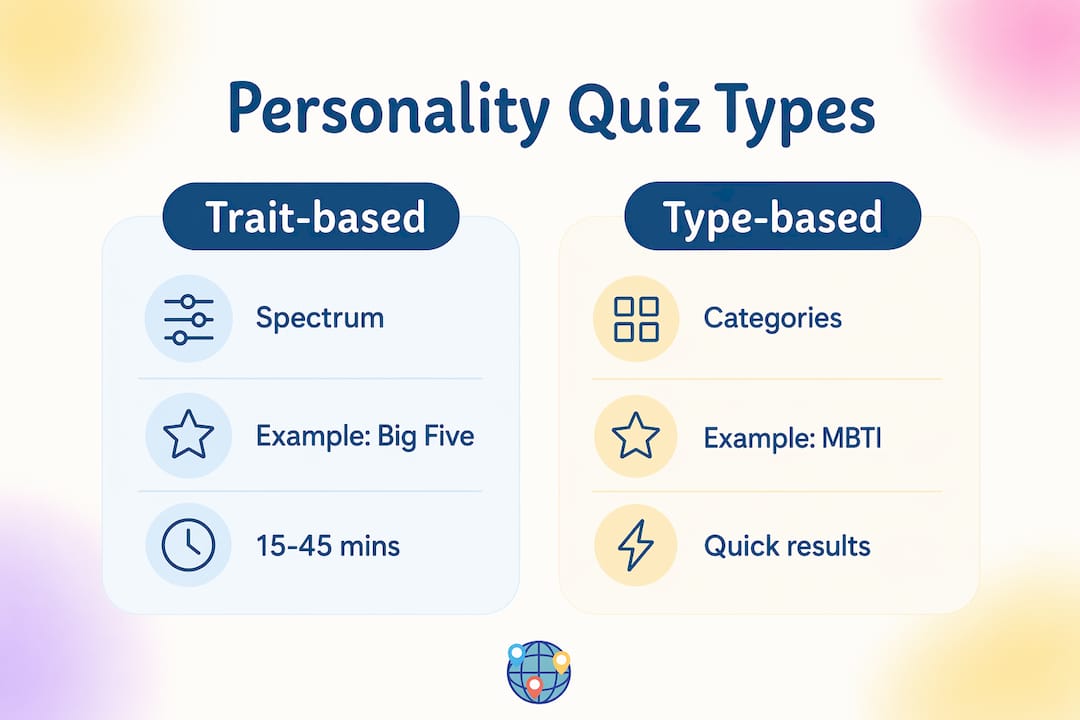
Trait-based quizzes put you on a sliding scale instead of in a box. The Big Five is the gold standard — it rates you low-to-high on each OCEAN dimension, so you get a nuanced profile rather than a single label.
Type-based quizzes sort you into a bucket. MBTI gives you one of 16 types — INFJ, ESTP, and so on — from four pairs of opposites. 16Personalities has been taken by over 190 million people and runs about 60 questions in roughly 10 minutes. That kind of scale tells you how badly people want self-knowledge they can grab quickly.
Casual entertainment quizzes put fun ahead of accuracy. “Which Hogwarts house are you?” energy, or “what does your morning routine say about you?” They’re built to share, not to diagnose — but they still earn their keep as conversation starters and low-stakes reflection prompts.
Clinical projective tests belong in a therapist’s office, not on your lunch break. They need professional interpretation and are designed to surface unconscious patterns, not just stated preferences.
Quick Tip: Skim the character quiz format first to see how questions get built. Once you know the structure, you answer more naturally — and the result actually reflects you.
How to take a personality quiz effectively
How much you get out of a personality quiz comes down almost entirely to how you take it. Most people tank their own results before they answer question one.
-
Answer as your private self, not your public persona. Many test-takers answer based on social or professional personas instead of who they really are. Accuracy jumps when you respond the way you act when nobody’s watching. The question to keep asking: how do I actually behave — not how do I wish I behaved?
-
Trust your first instinct. Over-analyzing individual questions reduces result accuracy. These tools work by reading patterns across lots of answers, not by you agonizing over any single one. Your gut read is statistically more reliable than your carefully reasoned one.
-
Define your goal before you start. Defining your goal before taking quizzes — and comparing across a few reputable tests — makes the whole thing more useful. Career fit, relationship dynamics, or just fun? Your goal points you to the right quiz type.
-
Take more than one quiz. No single test catches the whole picture. Score high on extraversion across the Big Five, MBTI, and a couple of casual quizzes, and that pattern means something. One outlier tells you far less than three that agree.
-
Treat results as a starting point, not a verdict. They show tendencies and archetypes, not fixed truths. Use them to open questions about yourself, not slam them shut.
Pro Tip: If a result surprises you, that’s useful data. Sit with the discomfort before you dismiss it — sometimes the slightly-off answer is the most revealing one.
What are the benefits and limitations of personality quizzes?
Used well, personality quizzes pay off. Treated as gospel, they backfire.
Benefits include:
- Self-awareness. Seeing your traits laid out can surface patterns you’d never consciously named. Plenty of people say their Big Five results finally explained why some work setups energize them and others drain them flat.
- Better communication. Knowing your own tendencies — and reading the people around you — makes conflict and collaboration easier to steer.
- Social engagement. Casual quizzes make great party entertainment and ice-breakers, sparking conversation without forcing anyone to overshare.
- Low-stakes reflection. Even a fun quiz nudges you to think about your own preferences. Mild, but real.
The limits matter just as much. The Barnum Effect causes people to perceive vague personality descriptions as highly accurate. Named after showman P.T. Barnum, it’s why a horoscope-style line lands as “wow, that’s so me” — the statement is written broadly enough to fit almost anyone. That illusion of precision is exactly what tips people into over-identifying with a casual label.
“Experts warn against pigeonholing yourself based on quiz results, as it can hinder personal growth. Personality evolves over time, and test results should be used for exploration rather than strict labeling.”
Scientific reliability swings hard by type, too. The Big Five is considered by experts the most accurate personality tool, built on large-scale data rather than tidy theory. MBTI is wildly popular but shakier on retests — About 37% of people receive a different type on retaking the MBTI. Not a reason to write it off, just a reason not to tattoo your four letters on your forearm.
How do popular personality tests like the MBTI and Big Five compare?
MBTI and the Big Five are the two names you’ll hit most, in pop culture and in research alike. They measure personality differently, and that difference is the whole point when you’re choosing one.
| Feature | MBTI / 16Personalities | Big Five (OCEAN) |
|---|---|---|
| Output | 16 discrete personality types | Five continuous trait scores |
| Scientific backing | Moderate, widely debated | Strong, research consensus |
| Test-retest reliability | Lower (37% retype rate) | Higher, more consistent |
| Accessibility | High, free versions widely available | High, multiple free versions |
| Best use case | Self-reflection, team communication | Research, career counseling |
| Duration | 10 to 30 minutes | 15 to 45 minutes |
MBTI splits personality into four either/or pairs — Introversion/Extraversion, Sensing/Intuition, Thinking/Feeling, Judging/Perceiving — and your combo lands you in one of 16 types like INTJ or ENFP. The draw is clarity: four letters are easy to remember, share, and argue about. 16Personalities took that format global with a free, polished version north of 190 million users.
The Big Five works the opposite way. Instead of a category, it scores you on five independent dimensions — maybe high openness, low conscientiousness — so your profile is genuinely yours, not one of 16 shared buckets. Researchers treat it as the most reliable way to measure how personality actually varies across people, and it’s the framework academic psychology and big workforce studies lean on.
Honest answer? Both earn a spot. Reach for MBTI or 16Personalities when you want a memorable, shareable hook for self-reflection or team talk. Reach for the Big Five when you want a grounded read on where you sit on each personality dimension.
Key takeaways
Personality quizzes pay off most when you treat them as mirrors for reflection, not definitive labels — pick the type that fits your goal, and answer as your real self.
| Point | Details |
|---|---|
| Four quiz categories exist | Trait-based, type-based, casual, and clinical tests each serve a different purpose and rigor level. |
| Big Five is most reliable | Researchers consistently rate the Big Five (OCEAN) as the most scientifically valid personality tool available. |
| Answer authentically | Responding as your private self, not your social persona, produces significantly more accurate results. |
| Results show tendencies, not truths | Personality is fluid and evolves over time, so treat quiz outcomes as starting points for reflection. |
| Compare multiple tests | Consistent patterns across several quizzes carry more meaning than any single result. |
Why I think most people misuse personality quizzes
I’ve watched personality quizzes go from niche psychology hobby to mainstream cultural fixture, and the same mistake keeps showing up — people treat a four-letter type or a single score as a permanent identity. They introduce themselves as “an INFJ” the way you’d state a blood type. That’s not self-awareness. That’s self-limitation wearing an insight costume.
The quizzes aren’t the villain. The Big Five, used honestly, surfaces real patterns. Even casual formats work as reflection prompts. The trap is the human reflex to grab a label and stop asking questions. Personality is genuinely fluid — the you at 22 scores differently at 35, and that’s not a glitch. It’s proof you grew.
What actually works is treating the result as a conversation with yourself. When an outcome surprises you, that’s the moment worth sitting with. Ask why it feels wrong, or why it feels uncomfortably right. The quiz isn’t the destination. It’s the question that gets you thinking.
I’d also learn how quizzes are built before you sink time into a long one. Knowing how questions are structured helps you answer more naturally, and that’s what makes a result worth reflecting on.
Explore personality quizzes on Worldlecity
 Worldlecity has a stack of personality and lifestyle quizzes you can take right now, purely for fun — no account, no friction. Playful questions paired with results that are actually worth a second thought, and a result you can share in a tap. And when you want to switch gears, there’s the daily city guessing game and geography challenges that sharpen your knowledge while keeping things light. Curious what a personality quiz might turn up about you? This is the place to find out.
FAQ
What does a personality quiz actually measure?
A personality quiz measures your self-reported preferences, behavioral tendencies, and psychological traits across a defined framework. Depending on the type, it may output a discrete personality type like an MBTI label or a scored profile across dimensions like the Big Five’s OCEAN model.
How accurate are free online personality quizzes?
Accuracy varies significantly by quiz type. The Big Five is considered the most scientifically reliable, while MBTI shows a 37% retype rate on retesting. Casual entertainment quizzes prioritize engagement over accuracy and should be treated as reflection prompts rather than definitive assessments.
Why do my personality quiz results change over time?
Personality is fluid and evolves with life experience, so results shifting between retakes is normal and expected. Experts recommend using quiz results for exploration rather than treating them as fixed labels, since personal growth naturally changes how you respond to questions.
What is the Barnum Effect in personality quizzes?
The Barnum Effect is a psychological phenomenon where people perceive vague, broadly written descriptions as highly personal and accurate. It explains why casual quiz results often feel surprisingly on-point, even when the descriptions apply to almost everyone.
Which personality quiz should I take first?
Start with the Big Five if you want a research-backed profile, or try 16Personalities for a quick, accessible type-based result. For casual, quick entertainment, WorldleCity is a solid pick. Define your goal first — self-reflection, career insight, or entertainment each points toward a different quiz format.