Why Guess-Based Games Feel Rewarding: the Psychology
Discover why guess-based games feel rewarding. Uncover the psychology behind quick feedback, dopamine responses, and the thrill of uncertainty.
- reasons to play guessing games
- guessing games and cognitive skills
- what makes guessing games fun
- why guess-based games feel rewarding
- why people enjoy guessing games
- how guessing games engage players
On this page

Guess-based games feel rewarding because your brain reduces uncertainty faster than it expected, and that speed gap triggers a genuine dopamine response. The core mechanisms are prediction-error reduction, intermittent reinforcement, immediate feedback, competence signals, flow, and low-stakes failure. Research from Frontiers in Psychology and the University of Chicago Booth backs these up as measurable behavioral effects, not just feelings.
Here is what this guide unpacks:
- Prediction-error reduction: why a correct guess feels like a small electric jolt
- Uncertainty and intermittent rewards: why not knowing the answer pulls you back
- Immediate feedback: how color changes and distance meters keep you locked in
- Competence and social validation: the quiet thrill of doing better than yesterday
- Flow: how a 90-second puzzle can absorb your full attention
- Safe failure: why missing a guess rarely stings for long
Why guess-based games feel rewarding: the prediction-error mechanism
Prediction-error reduction is what happens when your brain’s forecast turns out to be wrong in a good direction. You expected to need five guesses; you nailed it in three. That gap between expectation and outcome is not just satisfying, it is neurologically significant.
The Frontiers in Psychology predictive-processing study found that the greatest emotional reward comes from accelerating the rate of uncertainty reduction relative to your prior expectations. Once learning plateaus, the rush fades, which is exactly why designers keep adding new patterns and categories.
The nucleus accumbens, a small region deep in the brain’s reward circuitry, tracks exactly this gap. fMRI work published in Neuroimage found its signal scaling with the size of the reward prediction error, which is the same pathway dopamine uses in other reward contexts. So when you guess a city on Worldlecity and the answer pops up on attempt two, the “I knew it” feeling is not just ego. It is your brain’s reward system doing exactly what it was built to do.
How uncertainty and variable rewards keep you coming back
Not knowing whether you will succeed is, counterintuitively, more motivating than knowing you will. This is the core of intermittent reinforcement: rewards that arrive unpredictably drive repeat behavior more reliably than guaranteed ones.
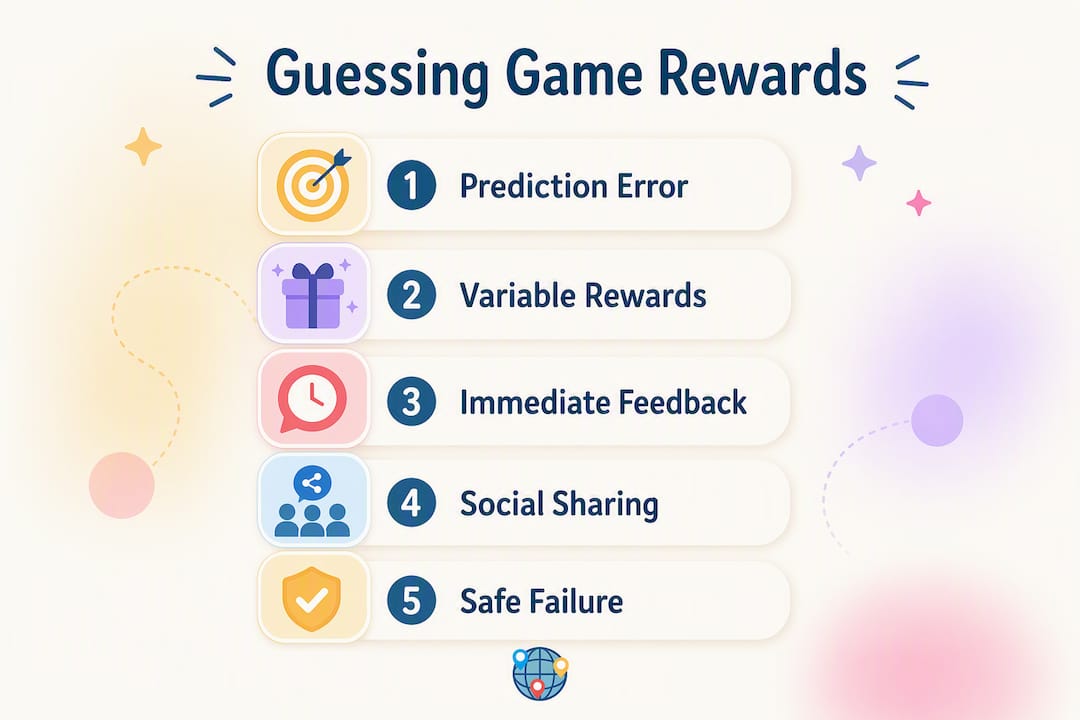
University of Chicago Booth research found that uncertain incentives motivate people to repeat tasks more than certain incentives, even when the expected payout is lower. The critical caveat: the uncertainty must resolve immediately after the action. Delay the result, and the effect collapses.
Near-misses amplify this further. When your guess lands one country off, or one letter wrong, your brain registers “almost” as meaningful progress. Such proximity reading keeps you engaged because closing a small gap feels achievable. It is not a consolation prize, but a behavioral hook.
How immediate feedback and proximity cues make guessing feel addictive
Feedback speed matters as much as feedback content. The faster you learn whether your guess was right, wrong, or close, the stronger the reward signal and the more attention you sustain.

Graded proximity cues, the kind that tell you “warmer” rather than just “wrong”, do something specific: they keep the prediction-error engine running between guesses. Each clue updates your mental model, which means each subsequent guess carries its own mini-reward potential.
Common feedback types that designers use to sustain this effect:
- Visual proximity indicators (distance in kilometers, color gradients from red to green)
- Hit/miss letter highlights (correct position, wrong position, absent)
- Incremental scoring that rewards early correct guesses more than late ones
- Directional arrows pointing toward the target location
The psychology of feedback in quiz games shows that graded responses outperform binary right/wrong signals for both motivation and skill retention.
How competence signals and social sharing amplify the reward
Feeling skilled is its own reward, separate from the win itself. When you solve a puzzle faster than yesterday, or score higher than your friends, you get a brief but real boost from what psychologists call self-enhancement, the confirmation that your mental model of the world is accurate and improving.
The “better-than-average” bias plays a role here too. Most people believe they are above average at pattern recognition and deduction. A correct guess validates that belief, which feels good. A wrong guess creates a small gap to close, which motivates another attempt.
Wordle’s viral spread illustrates the social layer clearly: shareable result grids let players broadcast competence without spoiling the puzzle. The comparison loop runs in both directions: players who did well come back to confirm it, and players who did badly come back for redemption. That is not a design accident.
Flow, focused attention, and the compact challenge loop
Flow is the state of complete absorption where challenge and skill are perfectly matched. Short guess-based puzzles are unusually good at producing it, precisely because the loop is compact.
A six-guess city puzzle takes roughly 60 to 90 seconds. The goal is clear, feedback is instant, and the difficulty is calibrated to feel achievable but not trivial. Those three conditions, a clear goal, immediate feedback and balanced challenge, are the textbook prerequisites for flow. You do not need an hour-long session to get there.
Novelty extends the flow window. When patterns rotate, categories shift, or new puzzle types appear, your prediction-error velocity resets. The learning curve reopens, and the absorbing quality returns. Understanding the difference between puzzles and quizzes helps clarify why short-loop formats hit the flow sweet spot more reliably than longer formats.
Why low stakes and safe failure make guessing games forgiving
Missing a guess costs you nothing outside the game. No money, no social consequence, no lasting record of failure. That low-stakes structure is what makes guess-based games psychologically safe to experiment in.
Hyde, Khanum and Spelke’s 2014 study in Cognition, reported by KQED MindShift, found that first graders who spent a few minutes approximating quantities without counting were faster on easy arithmetic than a control group, and more accurate on harder problems with no loss of speed. The mechanism is straightforward: repeated low-cost guessing builds mental models faster than passive study because each wrong answer is informative and not punishing.
Pro Tip: Design failures to be informative, not just negative. A guess that reveals “you were 800 km south” teaches you something specific. A guess that just says “wrong” teaches you nothing. The more a miss reveals, the faster the next attempt improves.
Design features that amplify the reward experience
The mechanisms above do not operate in a vacuum. Specific design choices activate them more reliably than others.
Core features that heighten the satisfying loop:
- Daily puzzle scarcity: one puzzle per day creates anticipation and makes each attempt feel meaningful
- Limited attempts: six guesses, not sixty, raises the stakes on each prediction
- Graded feedback: proximity meters and color coding sustain the prediction-error engine between guesses
- Social sharing: shareable result grids create a competence broadcast without spoiling the answer
- Incremental unlocks: harder difficulty modes reward returning players with new challenge levels
The most popular quiz game mechanics consistently combine scarcity with immediate resolution, exactly the pairing that game design research identifies as most effective for repeat engagement.
| Design feature | Primary psychological mechanism | Player outcome |
|---|---|---|
| Daily scarcity | Intermittent reinforcement | Habit formation |
| Limited attempts | Prediction stakes | Engagement per guess |
| Graded feedback | Prediction-error reduction | Learning and satisfaction |
| Social sharing | Social validation | Replay motivation |
| Incremental difficulty | Flow / challenge-skill balance | Long-term retention |
Worldlecity is built on this loop
If you want to feel the mechanisms in this guide rather than read about them, the Worldlecity daily game is a compact version of all of them at once.
- Daily scarcity. One capital city per day, revealed through a photo. When you are done, you are done until tomorrow, which is what makes the single attempt feel weighted.
- Six guesses, no more. A hard attempt limit is what turns each guess into a real prediction instead of a free sample.
- Graded feedback on every guess. Each wrong answer comes back with the distance to the target, a directional arrow, and a row color that shifts from deep red through orange and yellow to green as you close in. That is the prediction-error engine running between attempts, not just a verdict at the end.
- A shareable result grid. The share button copies an emoji grid of your guess colors, so you can post how you did without spoiling the city for anyone else.
- A streak that is yours alone. Worldlecity tracks your current and longest streak, but there is no public leaderboard, so the comparison you are chasing is with yesterday’s version of you.
The one mechanism the daily game deliberately leaves out is difficulty selection. If you want the challenge-skill dial from the flow section, that lives in the geography quiz library, where every quiz runs in Easy, Medium, Hard and Extreme modes and you can raise the ceiling whenever the current level stops surprising you.
What the research actually says
Three peer-reviewed studies anchor the claims in this guide.
| Study | Source | Year | Key finding |
|---|---|---|---|
| Mastering uncertainty: predictive processing in video game play | Frontiers in Psychology | 2022 | Faster-than-expected uncertainty reduction produces jolts of positive affect |
| The motivating-uncertainty effect | Journal of Consumer Research | 2015 | Uncertain rewards drive more repeat behavior than certain ones, but only when the uncertainty resolves immediately after the effort |
| Brief non-symbolic, approximate number practice enhances exact symbolic arithmetic | Cognition | 2014 | First graders who practiced approximating quantities were faster on easy arithmetic and more accurate on hard problems |
The reward-prediction-error literature adds a supporting layer: the nucleus accumbens responds to the size of the surprise itself, which is why solving under limited information feels satisfying independent of any external prize.
Practical tips for getting more out of every session
You do not need to redesign a game to get more from it. A few small shifts in how you play change the reward profile noticeably.
For players:
- Limit sessions to one puzzle per sitting. Scarcity preserves the anticipation that makes each guess feel weighted.
- Make one bold guess before refining. Committing to a prediction before you have all the clues sharpens your prediction-error response when the feedback arrives.
- Pay attention to graded feedback, not just the final result. The “800 km south” reading is where the learning happens.
- Mix difficulty levels. Rotating between easy and hard modes keeps the learning curve open and the flow window active.
For designers: immediate, graded feedback paired with daily scarcity is the single most reliable combination for building a satisfying habit loop. Mystery that resolves fast beats mystery that lingers.
Beyond dopamine: other brain chemicals at play
Dopamine gets most of the credit, but it is not working alone. Endorphins are released during moments of playful challenge and mild cognitive effort, contributing to the light, pleasant feeling that follows a satisfying guess. They are the same chemicals that produce a runner’s high, just at a much smaller scale.
Oxytocin enters the picture when social sharing is involved. Posting your result grid, comparing scores with friends, or seeing someone react to your streak activates the same bonding circuitry that oxytocin supports in social contexts. That is part of why sharing a Wordle result feels oddly warm, not just competitive.
Together, these neurochemicals create a layered reward state: dopamine for the prediction hit, endorphins for the playful effort, oxytocin for the social moment. Each one reinforces the others, which is why a shared daily puzzle can feel more satisfying than a solo one.
How guess-based games help you regulate stress
Short, absorbing puzzles are a surprisingly effective stress management tool. When your attention narrows to a single six-guess challenge, the mental chatter that feeds anxiety gets crowded out. Psychologists call this attentional displacement: focused cognitive engagement interrupts rumination.
The low-stakes structure matters here too. Because failure costs nothing, the game does not add to your stress load. It gives you a contained problem with a clear endpoint, which is almost the opposite of most real-world stressors. That combination of focus and safety is what makes a two-minute city guess feel like a genuine mental reset.
Nostalgia-driven quiz formats add another layer: familiar themes lower cognitive resistance and make the escapism feel comfortable rather than effortful.
Why narrative and thematic context deepen the reward
A guess does not happen in a vacuum. When a puzzle is wrapped in a compelling theme, whether a mystery city, a historical era or a film franchise, the emotional stakes of each guess rise. You are not just predicting a random answer; you are testing your knowledge of something you care about.
Thematic context also activates prior knowledge networks, which makes prediction-error reduction faster. If you know European architecture well, a photo of a Baroque city square narrows your options immediately. That faster narrowing produces a stronger reward signal than a cold guess would.
Narrative framing turns a correct answer into a small story: “I recognized the canal system, guessed Amsterdam, got it in two.” That story is shareable, memorable, and satisfying in a way that a bare score is not.
Cognitive biases that make the reward feel even bigger
Your brain is not a neutral judge of your own performance. Several well-documented biases inflate the satisfaction of a correct guess.
Confirmation bias is the most active one. When you commit to a guess, you unconsciously weight incoming clues toward confirming it. When the answer turns out to be right, the confirmation feels like proof of good reasoning, even when luck played a role. The result is a reward that feels earned, which is more satisfying than one that feels random.
The hindsight bias adds a second layer: after seeing the answer, you remember your reasoning as more logical than it was. “I always thought it looked like Lisbon” is a common post-hoc reconstruction. This makes the win feel like a skill demonstration, reinforcing the competence reward and increasing the likelihood you return tomorrow.
Key Takeaways
Guess-based games feel rewarding because they repeatedly trigger prediction-error reduction, intermittent reinforcement, and competence signals, all within a low-stakes, immediately resolved loop.
| Point | Details |
|---|---|
| Prediction-error reduction drives the rush | Faster-than-expected correct guesses activate the nucleus accumbens and release dopamine. |
| Uncertain rewards build habits | Immediate resolution of uncertainty motivates repeat play more than guaranteed outcomes. |
| Graded feedback sustains attention | Proximity cues and color indicators keep the reward engine running between guesses. |
| Low-stakes failure accelerates learning | Informative misses build mental models without the cost of real-world failure. |
| Social sharing multiplies satisfaction | Oxytocin and competence signals combine when results are shared with others. |
Useful sources
A short list of primary studies and reputable explainers for readers who want to go deeper:
- Mastering uncertainty: A predictive processing account of enjoying uncertain success in video game play, Frontiers in Psychology, 2022. The foundational paper on prediction-error reduction and positive affect in games.
- The motivating-uncertainty effect, Shen, Fishbach and Hsee, Journal of Consumer Research, 2015. Four experiments with real rewards showing uncertain incentives beat certain ones of higher expected value. Summarised by Chicago Booth.
- Brief non-symbolic, approximate number practice enhances exact symbolic arithmetic in children, Hyde, Khanum and Spelke, Cognition, 2014. Applied evidence that brief approximation practice improves arithmetic speed and accuracy.
- Why Is Wordle So Popular?, Psychology Today, 2022. Accessible breakdown of scarcity, social sharing, and daily habit formation in guess-based games.
- Worldlecity Daily City Guessing Game, a live example of the mechanisms above: daily scarcity, six attempts, proximity feedback, and shareable results.
FAQ
What makes a game feel rewarding?
A game feels rewarding when it reduces uncertainty faster than the player expected, triggering dopamine release in the brain’s reward circuitry. Immediate feedback, balanced challenge, and social sharing amplify that core effect.
What is the point of guessing games?
Guessing games train prediction and pattern recognition in a low-stakes environment. Research shows that short guessing practice improves related cognitive skills, including arithmetic speed and accuracy in children.
Do smarter players get more out of guess-based games?
Not necessarily. The reward comes from the rate of learning relative to your own prior expectation, not from raw ability. A player who improves quickly from a low baseline gets the same neurological reward as an expert who solves fast.
Why do near-misses keep you playing instead of quitting?
Near-misses signal that success is close, which the brain reads as meaningful progress rather than failure. That “almost” reading activates the same engagement loop as a partial reward, motivating one more attempt to close the gap.