Daily Brain Challenge Games: Mental Benefits for Adults
Discover the benefits of daily brain challenge games for sharper thinking and better mood. Learn how a few minutes a day can boost your mental fitness!
- benefits of daily brain challenge games
- cognitive benefits of puzzles
- brain exercise benefits
- how brain games improve thinking
- daily cognitive challenge
- brain games for daily mental health
On this page

Daily brain-challenge games can sharpen specific thinking skills and support your mood, but they aren’t a standalone fix for dementia. The benefits are real, task-specific, and strongest when you play varied games consistently. Here’s the short version of what to do:
- Play a few minutes of mixed puzzles or quizzes daily.
- Rotate between visual, verbal, and logic challenges across the week.
- Pair games with exercise and good sleep for the broadest mental-fitness effect.
What does the research actually say about brain challenge games?
The evidence base is bigger than most people realize, and more nuanced than most apps admit.
Meta-analyses of interventional studies show that multiple sessions per week produced small improvements in thinking and memory across many reviewed studies. Large online trials with thousands of participants found performance gains on trained tasks and, in some cases, measurable improvements in reasoning and word memory compared to control groups.
The prospective cohort data is striking. A UK Biobank study published in Alzheimer’s Research & Therapy found that high-frequency computer gaming was associated with a 19% decreased risk of incident dementia (HR 0.81), along with better scores on prospective memory, reaction time, fluid intelligence, and numeric memory. A Mendelian randomization analysis in the same study suggested a potential causal link, not just correlation.
The catch: observational designs can’t prove causation. People who game frequently may already have healthier lifestyles or higher baseline cognitive reserve. Harvard Health notes that well-controlled trials often show limited transfer beyond trained tasks, even when the games themselves are enjoyable and cognitively engaging.
| Study type | Key finding | Source |
|---|---|---|
| Meta-analysis (51 studies) | 3+ sessions/week, 30 min each: small gains in thinking and memory | Alzheimer’s Society |
| UK Biobank prospective cohort | HR 0.81 — 19% lower incident dementia risk for frequent gamers | Springer Nature / Alzheimer’s Research & Therapy |
| Large online RCTs | Gains on trained tasks; some transfer to reasoning and word memory | Alzheimer’s Society |
The honest summary: task-specific improvement is consistent and well-documented. Broad transfer to unrelated life skills is less reliable. Dementia prevention remains promising but unproven.
Which cognitive skills improve most reliably?
UCLA Health’s review of published studies identifies four domains where computerized brain games show the clearest gains in adults over 60:
- Processing speed: Timed pattern-matching and rapid-response tasks consistently show improvement. This is one of the most reliably trained skills across study types.
- Working memory: N-back style tasks and sequence-recall challenges show solid gains, especially with regular practice over several weeks.
- Verbal memory: Word-recall quizzes and crossword-style challenges support this domain, with some large trials showing transfer beyond the trained task.
- Executive function: Tasks requiring planning, switching between rules, or inhibiting wrong responses show moderate improvement, particularly in older adults.
Visuospatial skills are worth a mention. Experimental work cited in the UK Biobank study found structural brain changes after 3D-platform game training, including increased hippocampal volume and recognition memory gains after just two weeks. Spatial navigation, though, has weaker and more mixed evidence than speed or reasoning tasks.
The domain with the least consistent support? Broad “general intelligence.” Games make you better at the specific skills they train. That’s not a small thing, but it’s worth knowing before you expect a crossword to fix your parallel parking.
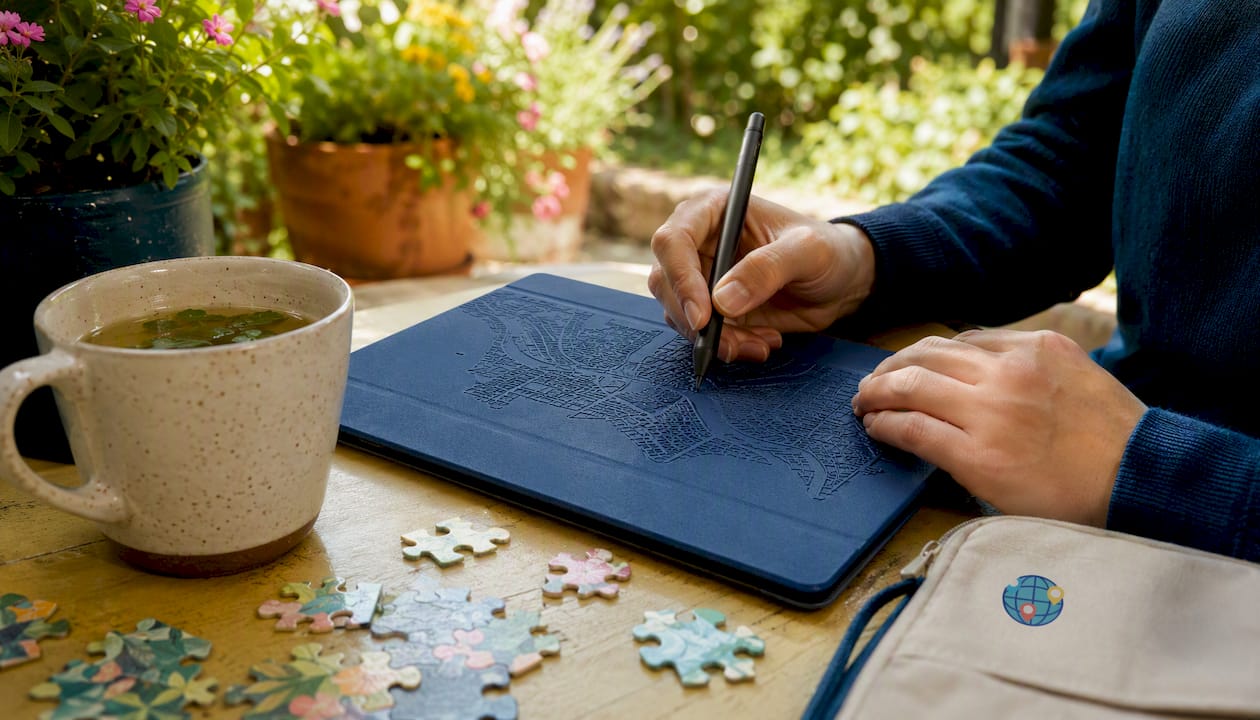
Mood, motivation, and everyday wins from daily brain games
The cognitive gains get most of the attention, but the emotional side of daily brain games is genuinely underrated.
Finishing a daily puzzle creates a small, reliable sense of mastery. That feeling compounds. Over weeks, it tends to build confidence in everyday mental tasks, from remembering names to staying focused during a long meeting. It’s not dramatic, but it’s consistent.
There’s also a motivation loop at work. When a game gives you immediate feedback and tracks your progress, you’re more likely to keep showing up. That consistency is what produces the cognitive benefits in the first place. The game doesn’t need to be hard to be useful; it needs to be engaging enough that you actually do it every day.

Pro Tip: Pair your daily brain game with a social element. Share your score, challenge a friend, or join a leaderboard at Squish Games. Social engagement independently supports mental health, and combining it with cognitive challenge gives you two benefits for the price of one habit.
What kinds of games actually produce real gains?
Genre labels (“brain training,” “puzzle,” “quiz”) predict very little. What matters is the mechanics inside the game.
The features most consistently linked to cognitive transfer are:
- Adaptive difficulty: The game gets harder as you improve. Static difficulty produces less transfer because your brain stops being challenged once it adapts.
- Immediate feedback: You find out right away whether you were right or wrong. This accelerates learning and keeps engagement high.
- Multi-task demands: Tasks that require you to hold information in mind while doing something else (dual-task formats) drive cognitive flexibility more than single-focus tasks.
- Novelty and variety: Rotating challenge types forces your brain to switch networks. Repeating the same puzzle daily produces diminishing returns.
Spatial and 3D games deserve a specific callout. Experimental studies found hippocampal volume increases after 3D-platform training, and action games have been linked to processing-speed gains in multiple study types. Image-based geography challenges, which require you to read visual cues and reason about spatial relationships, tap into similar mechanisms. Understanding the difference between puzzle and quiz mechanics helps you pick formats that target the skills you actually want to build.
Pro Tip: Across a week, mix at least three game types: one speed-based, one memory-based, and one that requires reasoning or spatial judgment. That rotation covers more cognitive ground than any single “brain training” app.
How to build a daily practice that actually works
Frequency and structure matter more than total time. Here’s a practical plan grounded in what the research supports.
Session length and frequency: Short daily sessions (5–15 minutes) are more sustainable than infrequent long ones. If you prefer longer blocks, three sessions of at least 30 minutes per week produced the clearest gains in meta-analysis summaries. Pick the format that fits your schedule and stick to it.
Habit anchoring: Tie your game to something you already do. Play after your morning coffee, during a lunch break, or right before bed. The habit is more likely to stick when it’s attached to an existing routine. Daily quizzes that reset every 24 hours, like Worldlecity’s daily city challenge, naturally reinforce this because the new puzzle is always waiting.
For readers who want to understand the psychology behind why daily formats work so well, the science behind daily quiz habits breaks it down clearly.
A six-to-eight-week starter plan:
- Week 1–2: Pick one game type and play 10 minutes daily. Focus on showing up, not performance.
- Week 3–4: Add a second game type on alternating days. Note whether your speed or accuracy on the first game has improved.
- Week 5–6: Introduce a third format (spatial, verbal, or logic — whichever you haven’t tried). Start tracking a simple personal metric: time to complete, score, or number of correct answers.
- Week 7–8: Evaluate. Are you faster? More accurate? Do you notice any carryover to daily tasks? Adjust difficulty upward if the games feel easy.
Unsupervised home training tends to show weaker effects than structured programs, so building in that self-monitoring step matters. You’re essentially creating your own progression system.
What brain games don’t reliably do
Setting realistic expectations isn’t pessimism. It’s what separates a useful habit from a disappointing one.
Task-specific improvement is the norm. You will get better at the games you play. Whether that improvement transfers to unrelated daily tasks depends heavily on how similar those tasks are to what you trained. A comprehensive review by cognitive scientists at Northwestern found that marketing claims have at times outpaced the science, and the Federal Trade Commission has taken action against misleading brain-training claims. Far transfer — the idea that playing a memory game will make you better at driving or learning a language — is uncommon and should not be your primary expectation.
Dementia prevention is not proven. The UK Biobank cohort data is encouraging, but observational studies can’t rule out confounding factors. Gaming frequency may correlate with other healthy behaviors, not cause lower dementia risk directly.
“Brain training apps can be enjoyable and support cognitive engagement, but well-controlled trials often show limited transfer beyond trained tasks. Lifestyle measures — exercise, diet, and socializing — have stronger and more consistent evidence for long-term brain health.” — Harvard Health
Methodological limits in the research: Many trials are short (under 12 weeks), use small samples, and struggle with placebo design. Home-based unsupervised training consistently shows weaker effects than lab or guided programs. Publication bias likely inflates positive findings in the literature.
The honest framing: brain games are a low-risk, enjoyable habit that supports mental engagement. They work best alongside exercise, quality sleep, a healthy diet, and social connection — not instead of those things.
How Worldlecity fits into a daily mental-fitness routine
Worldlecity maps naturally onto the game features that research links to cognitive benefit.
- Visual processing: Each daily challenge presents a real city photograph. Reading architectural style, vegetation, signage, and urban layout to make a guess actively engages visual analysis.
- Spatial reasoning: Proximity and directional feedback after each of your six guesses requires you to update a mental map in real time — a form of spatial working memory.
- Immediate feedback: You find out after every guess how close you are. That feedback loop is one of the mechanics most consistently linked to learning and skill transfer.
- Selectable difficulty: Beyond the daily puzzle, the city-guess quiz library adds four selectable difficulty modes, so you can raise the challenge as your skills grow.
- Low friction: No account required. The daily puzzle resets automatically. That structure removes the activation energy that kills most habits.
Visual clues in image-based quizzes do more cognitive work than they look like. Recognizing a city from a photo requires pattern recognition, memory retrieval, and spatial inference simultaneously — a multi-task demand that research associates with cognitive flexibility gains.
Key Takeaways
Daily brain-challenge games reliably improve task-specific skills like processing speed, working memory, and verbal memory, especially with varied, adaptive play practiced consistently.
| Point | Details |
|---|---|
| Session frequency matters | Three sessions of 30+ minutes per week, or short daily sessions of 5–15 minutes, produce the clearest gains. |
| Task-specific gains are reliable | You will improve at the skills you train; far transfer to unrelated tasks is uncommon. |
| Game features beat genre labels | Prioritize adaptive difficulty, immediate feedback, and multi-task demands over marketing claims. |
| Combine with lifestyle habits | Exercise, sleep, and social engagement have stronger evidence for long-term brain health than games alone. |
| Worldlecity for daily practice | Worldlecity’s photo-based city challenge covers visual processing, spatial reasoning, and immediate feedback in one low-friction daily habit. |
Useful sources
These are the strongest sources used in this article, worth bookmarking if you want to go deeper.
- Springer Nature / Alzheimer’s Research & Therapy — UK Biobank cohort study: The prospective cohort and Mendelian randomization analysis behind the HR 0.81 dementia-risk finding.
- Harvard Health — Brain training apps: Balanced expert commentary on what apps can and can’t do, with lifestyle recommendations.
- UCLA Health — Brain games for older adults: Domain-specific breakdown of which game types affect which cognitive skills.
- Simons et al. — Do ‘Brain-Training’ Programs Work? (Northwestern): The most thorough academic review of transfer evidence and marketing claims in the field.
- Worldlecity — Why daily quizzes build habits: Practical breakdown of habit science applied to daily quiz formats.
The UK Biobank cohort linked frequent gaming to a 19% lower risk of incident dementia (HR 0.81) — the largest prospective dataset on this question to date.
Worldlecity: a daily geography challenge worth adding to your routine
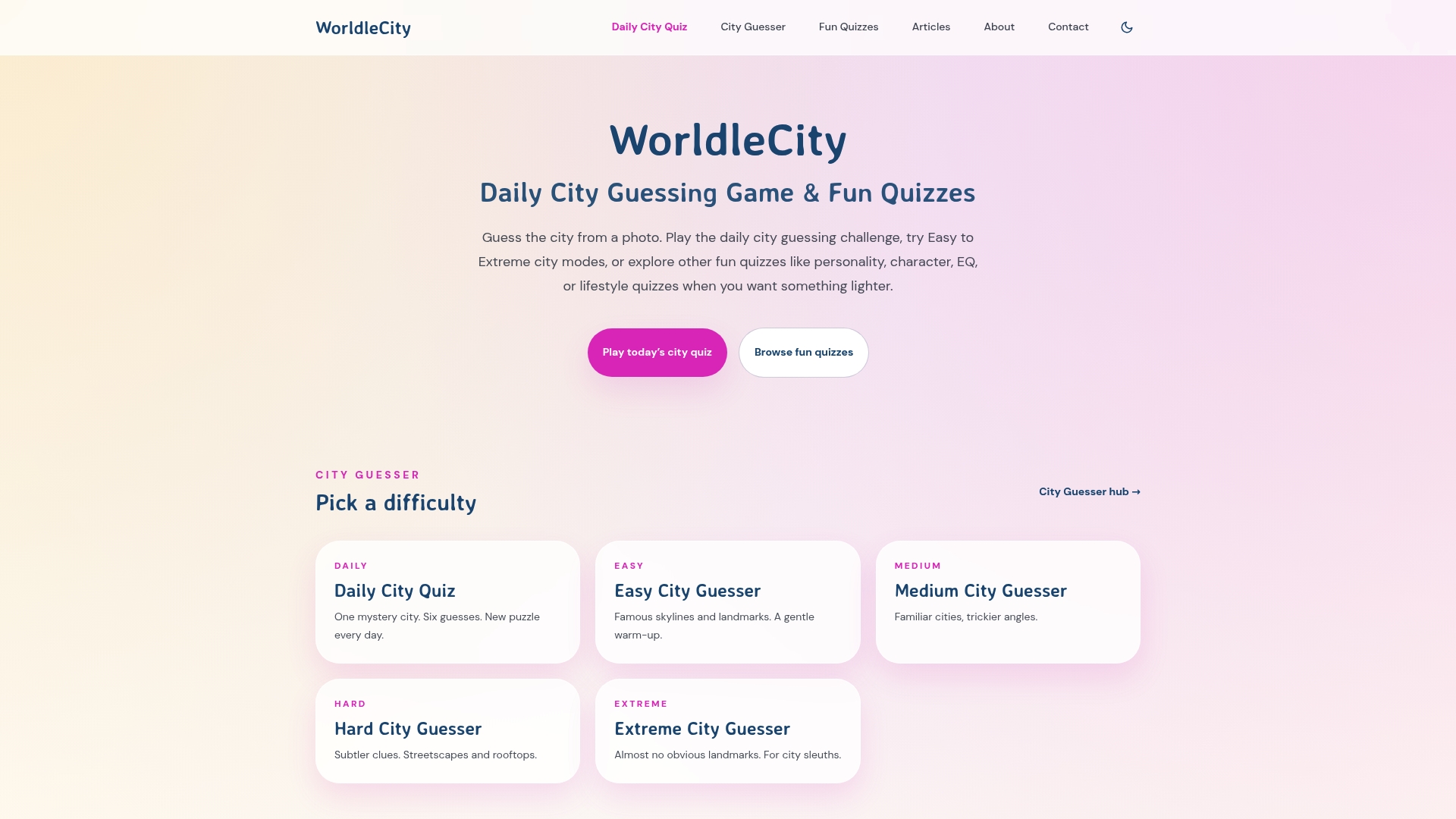
If you’ve read this far, you already know the formula: short daily sessions, adaptive challenge, immediate feedback, and variety across the week. Worldlecity checks every one of those boxes, and it takes about five minutes a day.
Each day, a new city photograph drops. You get six guesses. After each one, you learn how far off you were and in which direction, so every wrong answer is actually a micro-lesson in spatial reasoning. When you want to dial the challenge up or down, the city-guess quiz library adds four selectable difficulty modes. No account, no subscription, no friction.
It’s a genuinely different kind of daily mental challenge from a word puzzle or a number game, which makes it a useful addition to a varied weekly routine rather than a replacement for anything you already enjoy. Play the daily city challenge at Worldlecity and see how fast your geography instincts sharpen.
FAQ
Does playing brain games every day actually make a difference?
Yes, with a caveat: daily play reliably improves the specific skills a game trains, such as processing speed, working memory, and pattern recognition. Broad transfer to unrelated tasks is less consistent, so variety across game types matters more than volume within a single game.
What hobby is most linked to lower dementia risk?
Observational research, including the UK Biobank cohort, links frequent computer gaming and intellectually stimulating activities like puzzles and crosswords to lower incident dementia risk. No single hobby has been proven to prevent dementia, but mentally engaging leisure habits are consistently associated with better cognitive aging.
Do brain-training games really work, or is it just marketing?
Both, depending on the claim. Task-specific improvement is well-documented across meta-analyses and large online trials. Claims about broad cognitive enhancement or dementia prevention have outpaced the evidence, and the FTC has acted against misleading marketing in this space. Stick to games with adaptive difficulty and immediate feedback, and treat them as one part of a broader mental-fitness routine.
What is the best food for memory?
No single food is the top memory booster, but diets rich in omega-3 fatty acids (fatty fish, walnuts), antioxidants (berries, leafy greens), and low in ultra-processed foods are consistently linked to better cognitive aging in observational research. Harvard Health recommends a Mediterranean-style diet alongside physical activity as the strongest dietary approach for long-term brain health.