Types of Personality Quiz Styles: Your Self-Discovery Guide
Discover the types of personality quiz styles in this guide. Learn how to choose the right quiz to unlock insights about yourself!
- personality quiz formats
- what are personality quiz styles
- types of personality quiz styles
- popular personality quizzes
- types of personality assessments
- varieties of personality tests
- different personality test methods
On this page

Personality quiz styles are broadly divided into three core formats: trait-based, type-based, and casual exploratory quizzes, each built for a different purpose and a different kind of self-discovery. Whether you’re chasing a clinical-grade personality breakdown, figuring out your “Stranger Things character energy,” or just killing ten minutes before lunch, knowing which format you’re dealing with changes everything about how you read your results. This guide walks you through every major style, what makes each one tick, and how to pick the right one for what you actually want to know.
1. What are personality quiz styles, exactly?
Personality assessments are mainly grouped into self-report inventories and projective tests, with self-report formats dominating the quiz world you encounter online. That’s the formal industry term: self-report inventory. In everyday language, people call these “personality quizzes,” but the underlying format determines how seriously you should take the output.
The three practical categories you’ll run into are trait-based quizzes (scientific, scored against norms), type-based quizzes (narrative, sorted into defined personality buckets), and casual exploratory quizzes (fun, fast, and built for sharing). Each one has a different design logic, a different scoring method, and a different shelf life for the insight it gives you.

2. Trait-based personality quizzes: the scientific approach
Trait-based quizzes are the most empirically grounded of all the personality quiz formats. The Big Five (also called OCEAN, covering Openness, Conscientiousness, Extraversion, Agreeableness, and Neuroticism) is the gold standard here. These quizzes measure personality along continuous spectrums rather than slotting you into a fixed box, which makes the results more nuanced and more repeatable.
The scoring logic behind trait-based tests is worth understanding. Weighted scoring allows multi-faceted personality profiling, where a single answer can influence multiple trait dimensions simultaneously with different point values. That’s a far cry from “pick A, B, or C and see which pile you land in.” It means the results actually reflect the complexity of how personality works.
Typical use cases for trait-based quizzes include:
- Academic research and psychological studies
- Pre-hire personality screening in corporate settings
- Clinical or therapeutic contexts where baseline personality data matters
- Longitudinal self-tracking over months or years
The trade-off is time and engagement. Trait-based tests like the Big Five take 15 to 45 minutes to complete, which is a lot to ask of someone who just wants a quick read on themselves. They’re also less narrative, meaning the results feel more like a data report than a story about who you are.
One real limitation: self-report inventories depend heavily on respondent honesty and self-awareness, producing introspective snapshots that can be distorted by how you’re feeling that day or how you want to see yourself. That’s not a flaw unique to trait-based tests, but it matters more when you’re treating the results as clinically meaningful.
Pro Tip: If you’re taking a Big Five assessment for professional or research purposes, complete it in a neutral emotional state, not right after a stressful meeting or a great weekend. Mood skews self-report results more than most people realize.
3. Type-based personality quizzes: popular, narrative, and surprisingly sticky
Type-based quizzes sort you into a defined personality category rather than scoring you on a spectrum. The Myers-Briggs Type Indicator (MBTI) and the Enneagram are the two most recognized examples. MBTI gives you a four-letter code (INFJ, ENTP, and so on) while the Enneagram assigns you one of nine numbered types, each with its own motivational core.
These formats dominate team-building workshops, coaching programs, and casual self-discovery because the results are readable. You get a character, a story, a set of strengths and blind spots framed in plain language. That narrative quality is genuinely useful for sparking conversation and self-reflection, even if the science underneath is shakier than it looks.
And it is shakier. Up to 37% of people get a different MBTI result when they retake the test weeks later. That’s a significant retest reliability issue, meaning MBTI is better understood as a conversational framework than a fixed psychological portrait. It’s great for team-building and personal reflection. It’s not great for clinical diagnosis or high-stakes hiring decisions.
What type-based quizzes do well:
- Delivering results that feel personal and story-driven
- Sparking self-reflection without requiring a psychology background to interpret
- Building shared language in teams and coaching relationships
- Keeping engagement high because the “type” result feels like an identity, not a score
Pro Tip: When using MBTI or Enneagram results in a team setting, treat them as conversation starters rather than fixed labels. The value is in the discussion they generate, not the letter or number itself.
The Enneagram holds up slightly better for internal motivation mapping, since it focuses on core fears and desires rather than behavioral tendencies alone. If you want to understand why you do what you do (not just what you tend to do), the Enneagram often lands closer to the truth than MBTI.
4. Casual and exploratory personality quizzes: built for fun and sharing
Casual quizzes are the ones you find on entertainment sites, social feeds, and places like Worldlecity. They’re fast (usually 2 to 10 minutes), theme-driven, and designed to produce a result you want to screenshot and send to your group chat. Think “Which Stranger Things character are you?” or “What city matches your vibe?”
These quizzes work on archetype logic. Instead of measuring traits or assigning psychological types, they match your answers to a pre-built character or category that carries cultural meaning. The result isn’t a data point. It’s a mirror that reflects something you already half-believe about yourself, framed in a way that’s fun to share.
The engagement numbers back this up. Personality quizzes average 80 to 90% completion rates and generate two to three times more social shares than knowledge-based quizzes. That’s not a coincidence. The results feel personal, and personal things get shared.
What makes casual quizzes tick:
- Short, scenario-based questions that feel like choices you’d actually make
- Results tied to recognizable characters, places, or archetypes
- Low stakes and zero pressure, so you actually finish them
- Built-in shareability because the result says something about you
The honest limitation here is that casual quizzes carry low scientific validity. They’re not designed to measure anything replicable or clinically meaningful. Experts consistently caution against using casual quizzes for serious decisions like career choices or relationship compatibility. Use them for what they’re built for: entertainment, light self-reflection, and a reason to text your friends.
5. Comparing the three main personality quiz styles
Here’s how the three formats stack up across the factors that actually matter when you’re choosing one.
| Format | Time to complete | Scientific validity | Best use case | Biggest limitation |
|---|---|---|---|---|
| Trait-based (Big Five) | 15 to 45 minutes | High | Research, hiring, clinical use | Less engaging, longer format |
| Type-based (MBTI, Enneagram) | 10 to 20 minutes | Moderate | Coaching, team-building, self-reflection | Retest reliability issues |
| Casual exploratory | 2 to 10 minutes | Low | Entertainment, social sharing, light insight | Not suitable for serious decisions |
The pattern is clear: as scientific rigor goes up, entertainment value tends to go down. That’s not a design flaw. It’s a feature of what each format is optimized for. A Big Five assessment isn’t trying to be fun. A “Which city are you?” quiz isn’t trying to be clinically valid. Knowing which lane you’re in helps you get the most out of whichever quiz you take.
Behavioral assessments that observe actual behavior rather than self-descriptions exist too, and they’re even more rigorous than self-report inventories. But they’re almost never used in casual quiz contexts because they require controlled observation conditions. You’ll encounter them in clinical or organizational psychology settings, not on your phone at 11pm.
6. How to pick the right quiz style for your actual goal
Matching the quiz style to your objective is the single most important decision you make before taking any personality assessment. The format shapes the result, and the result is only useful if it fits what you were looking for.
Here’s a quick decision guide:
- You want to go viral or have fun with friends: Casual exploratory quizzes are your lane. Fast, themed, and built for sharing.
- You’re doing personal development or working with a coach: Type-based quizzes like the Enneagram give you a narrative framework that’s easy to work with over time.
- You’re in a research context or want data you can track: Trait-based assessments like the Big Five give you the rigor and consistency that serious analysis requires.
- You want layered self-understanding: Take a casual quiz first to warm up your self-reflection instincts, then follow it with a type-based or trait-based assessment for depth.
The layered approach is underused. Starting with a fun, low-stakes quiz actually primes you to answer the more serious questions more honestly, because you’ve already been thinking about yourself in a reflective mode. It’s a surprisingly effective way to get more out of a Big Five or Enneagram session.
Key takeaways
The most effective approach to personality quizzes is matching the format to your goal: trait-based for rigor, type-based for narrative insight, and casual formats for entertainment and social connection.
| Point | Details |
|---|---|
| Three core formats exist | Trait-based, type-based, and casual quizzes each serve a distinct purpose and audience. |
| Scientific rigor varies widely | Big Five assessments are highly valid; MBTI has retest reliability issues; casual quizzes have low scientific validity. |
| Casual quizzes dominate engagement | Personality quizzes average 80 to 90% completion rates and share two to three times more than knowledge quizzes. |
| Format shapes the result | Choosing the wrong format for your goal produces results that feel off or misleading. |
| Layered approaches work best | Starting casual and moving to trait-based or type-based assessments produces more honest, useful self-reflection. |
Explore personality quizzes on Worldlecity
If you’re ready to put this into practice, Worldlecity is a great place to start. The site offers a range of personality quizzes alongside its daily city guessing game, all accessible without creating an account. Whether you want a quick “what kind of friend are you?” result to share with friends or a more reflective quiz to spark some genuine self-discovery, Worldlecity keeps it fun, fast, and low-pressure.
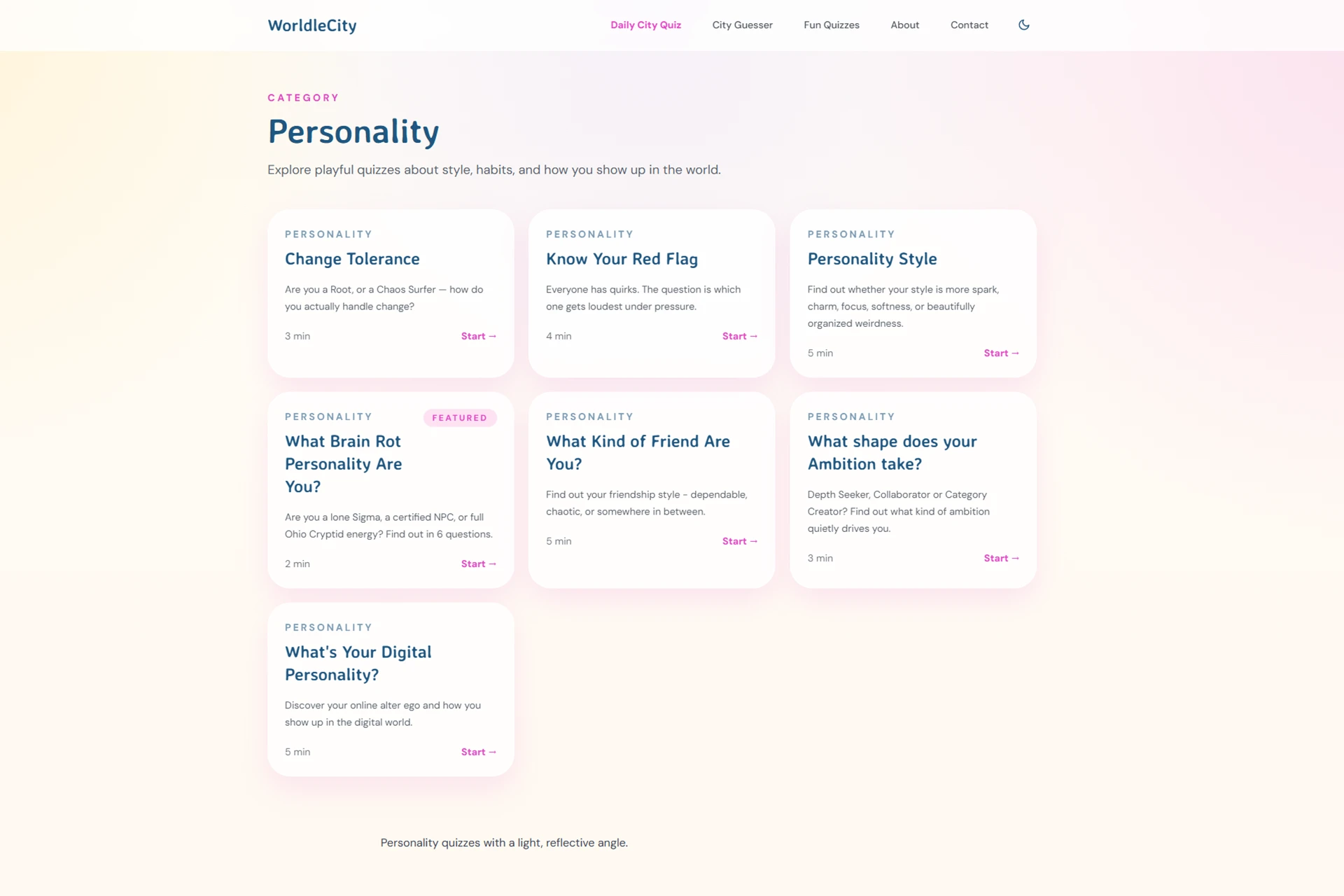
The quiz formats on Worldlecity are built for the casual exploratory end of the spectrum, which means they’re genuinely enjoyable to take and easy to share. And if geography is your thing, the daily city photo challenge adds a whole different kind of brain workout to your routine. No signup, no friction. Just pick a quiz that fits your mood and go.
FAQ
What are the main types of personality quiz styles?
The three main types are trait-based quizzes (like the Big Five), type-based quizzes (like MBTI and Enneagram), and casual exploratory quizzes. Each format differs in scientific rigor, time required, and intended use.
How long does each personality quiz format take?
Trait-based quizzes take 15 to 45 minutes, type-based quizzes take 10 to 20 minutes, and casual quizzes typically take 2 to 10 minutes to complete.
Is MBTI a reliable personality test?
MBTI has significant retest reliability issues, with up to 37% of people receiving a different result on retake. It works well for team-building and self-reflection but is not recommended for clinical or high-stakes decisions.
Which personality quiz style is best for self-discovery?
Type-based quizzes like the Enneagram are well-suited for personal development because they focus on internal motivations and produce narrative results that are easy to reflect on over time.
Can casual personality quizzes tell you anything real about yourself?
Casual quizzes have low scientific validity and are not designed for serious decision-making. They work best as light entertainment and conversation starters, not as substitutes for structured personality assessments.