What Is a Multiple Choice Quiz? A Guide for Students
Discover what a multiple choice quiz is, how it’s structured, and unlock tips to excel in assessments. Enhance your learning today!
- what is a multiple choice quiz
- types of multiple choice questions
- how to create a multiple choice quiz
- multiple choice quiz format
- tips for multiple choice quizzes
On this page

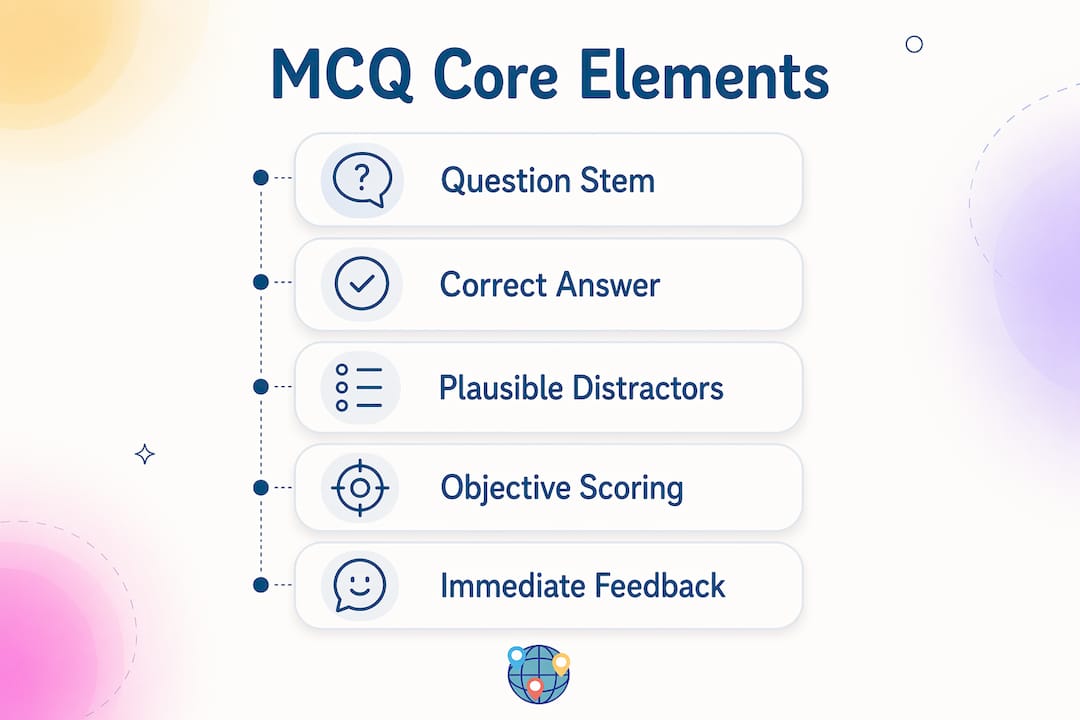
A multiple-choice quiz is a structured assessment built from questions, each pairing a stem with a set of preset answer options — and you pick the right one out of choices that include deliberate wrong answers called distractors. According to MCQ fundamentals, every question has three moving parts: a stem, answer options, and scoring rules that judge whether you got it right. It’s the backbone of standardized testing, classroom exams, and digital learning platforms everywhere. Studying for an exam or building one — either way, knowing how multiple-choice quizzes actually work hands you a real edge.
What is a multiple choice quiz and how is it structured?
A multiple-choice quiz is a stack of individual questions, each built from three core parts: the stem, the correct answer (called the key), and the distractors. The stem poses the question or sets up a scenario. The key is the one correct or best answer. The distractors are the wrong options — written to be plausible enough to trip up anyone who hasn’t fully mastered the material.

Formally, this is a multiple choice question assessment, or MCQ. That’s the standard term across education, psychometrics, and instructional design — you’ll see universities, certification bodies, and platforms like Google Forms all use it. The quiz itself can run from a five-question warm-up to a 200-question licensing exam, but the underlying structure never changes.
What makes the format powerful is objectivity. Every possible answer is predefined, so scoring doesn’t hinge on interpretation — you either picked the right option or you didn’t. That consistency is why MCQs show up in everything from the SAT to medical board exams.
What are the different types of multiple choice questions?
MCQ formats vary more than most people expect, and the type you pick shapes both the difficulty and the diagnostic value of your quiz.
- Single-answer MCQs give you one correct option among three to five choices. The most common format in classroom tests and standardized exams — you pick the single best answer.
- Multi-answer MCQs use a “select all that apply” instruction. Multi-answer scoring needs clear rules — usually partial or balanced credit — because you might nail some correct options while missing others.
- “None of the above” and “all of the above” variants add a layer of complexity. They test whether you’re confident enough to reject every presented choice or accept them all. Done badly, they’re guessing traps. Done well, they probe deeper reasoning.
- Scenario-based MCQs open with a short case study or situation before the question. Medical licensing exams like the USMLE lean hard on this because it tests applied knowledge, not bare memorization.
- Higher-order thinking MCQs ask you to analyze, evaluate, or synthesize rather than recall a fact. Bloom’s Taxonomy parks these at the top levels of cognitive demand.
True/false and matching questions are cousins, but not technically MCQs. True/false items are binary — a 50% coin-flip shot at guessing right — which caps their diagnostic value. Matching questions test associations across pairs but don’t isolate individual concepts the way an MCQ does.
How do multiple choice quizzes work as objective assessment tools?
The defining trait of an MCQ assessment is objective scoring. Automatic grading works because only one option, or a defined set, is correct — stripping out the subjectivity that dogs essay and short-answer marking. At scale, that’s huge. A teacher with 30 students grades a 40-question quiz in seconds with Google Forms. A certification body testing 50,000 candidates processes results overnight.
Here’s how it plays out in practice:
- The quiz creator writes each question with a clearly marked key answer and sets the answer key in the platform.
- Digital tools require you to switch on “quiz mode” and predefine answer keys at setup, or automatic grading won’t fire correctly.
- Students complete the quiz and submit their responses.
- The platform checks each response against the answer key and scores it instantly.
- Results come back right away, giving students feedback while the material is still fresh.
Distractors are what keep this system accurate. A well-written distractor pulls in students with partial or incorrect knowledge, which means a high score genuinely reflects mastery. A distractor that’s obviously wrong inflates scores and tells you nothing useful about what students actually know.
Objective scoring also wipes out grading bias, applying the same standard to every learner. That’s why MCQs are the go-to format for high-stakes certification and compliance training, where fairness and consistency aren’t optional.
Pro Tip: In Google Forms, switch on quiz mode before you add any questions. Setting the answer key after the fact can introduce grading errors that are a pain to untangle.
What are best practices for designing effective multiple choice questions?
Question quality decides whether your quiz measures real understanding or just the knack for eliminating obviously wrong answers. The gap between a good MCQ and a bad one comes down to a handful of specific design calls.
| Design element | Strong practice | Weak practice |
|---|---|---|
| Stem clarity | Poses a single, focused question | Vague or contains irrelevant background information |
| Distractor quality | Plausible, based on common misconceptions | Obviously wrong or grammatically inconsistent |
| Number of options | Three to five choices | More than five, which increases guessing fatigue |
| Answer length | Options are parallel in length and structure | One option is noticeably longer, signaling the correct answer |
| Cognitive level | Tests application or analysis | Tests only surface recall |
Distractor quality beats distractor quantity. Washington University CME’s advice: make each wrong option genuinely tempting to less-prepared learners instead of padding the question with extra choices. Three strong distractors outperform five weak ones.
The classic construction flaw is an unfocused stem that quietly turns your MCQ into a near true/false item. If a student can answer by reading the stem plus one option alone, the question has no discriminative power. The cover-up test fixes it: hide each option and check whether the stem by itself poses a clear, answerable question. If it doesn’t, rewrite it.
Distractors should also stay grammatically parallel — same form and length as the correct answer. When one option runs noticeably longer or reads differently, students flag it as the key without knowing a thing about the content. That defeats the purpose of the assessment entirely.
Adding justification prompts to MCQs — asking students to briefly explain why they chose their answer — improves both immediate and delayed test performance. This one small change turns a recognition task into active reasoning.
Pro Tip: Build distractors from real student errors. Mine past open-ended responses or the common misconceptions in your subject, then turn those wrong ideas into your options. They’ll be far more diagnostic than wrong answers you invent.
What are the educational benefits of multiple choice quizzes?
MCQs do more than measure knowledge. Designed well, they actively build it.
- Retrieval practice and the testing effect. MCQ testing produces stronger long-term retention than re-reading, especially when students get feedback after each question. Pulling an answer out of memory strengthens the neural pathway for that information.
- Diagnostic power. Effective MCQs surface student misconceptions when distractors are built around common errors. A student who keeps picking one particular wrong answer is showing you a specific gap, not just a vague lack of knowledge.
- Scalable feedback. In big classes or online courses, MCQs give every student immediate, personalized feedback without eating instructor time per head.
- Gamified engagement. Interactive quiz formats lift motivation and retention by mixing competition with learning. Platforms that run MCQs in game-style formats report higher completion rates and stronger recall.
- Accessibility and fairness. MCQs lower the barrier for students who struggle with written expression. Someone who knows the answer but can’t write it up in an essay can still show it by selecting the right option.
For educators building map-based quiz games or interactive classroom activities, MCQs slot naturally into group settings and competitive formats that raise engagement without dropping rigor.
“The testing effect is one of the most replicated findings in cognitive psychology. Quizzing yourself is not just a way to check what you know. It is a way to learn more deeply.” — Nature Communications Psychology, 2025
One limit worth naming: MCQs can lean too hard on recognition memory over active recall if you’re not careful. A student who spots the right answer on sight might not be able to produce it cold. Pair MCQs with short-answer follow-ups or justification prompts and you close that gap.
Key takeaways
A well-designed multiple choice quiz combines a focused stem, plausible distractors, and immediate feedback to produce both accurate assessment and genuine learning gains.
| Point | Details |
|---|---|
| Core structure | Every MCQ contains a stem, a correct key answer, and plausible distractors. |
| Objective scoring | Predefined answer keys enable automatic grading, removing bias and scaling to any class size. |
| Distractor quality | Distractors built from real misconceptions make quizzes diagnostic, not just evaluative. |
| Testing effect | MCQ-based retrieval practice improves long-term retention more than re-reading alone. |
| Design pitfall | Unfocused stems reduce validity; use the cover-up test to check every question before publishing. |
Why most educators underestimate the MCQ
A well-built MCQ is genuinely hard to write. Getting the stem focused, the distractors plausible, and the cognitive level above pure recall takes real skill and subject knowledge. When those pieces line up, an MCQ can show you exactly where a student’s understanding breaks down — something a percentage score alone never tells you.
The most underused move is the justification prompt. Asking students to write one sentence explaining their answer choice costs 30 seconds a question and pays off with dramatically better learning outcomes. Most quiz platforms support it. Almost nobody turns it on.
The future of MCQ assessment isn’t more questions. It’s smarter ones, paired with quiz patterns and strategies that make the experience feel less like a test and more like a challenge worth taking. Technology is making that possible. The educators who crack it first will have a real edge in student outcomes.
Put your knowledge to the test with Worldlecity
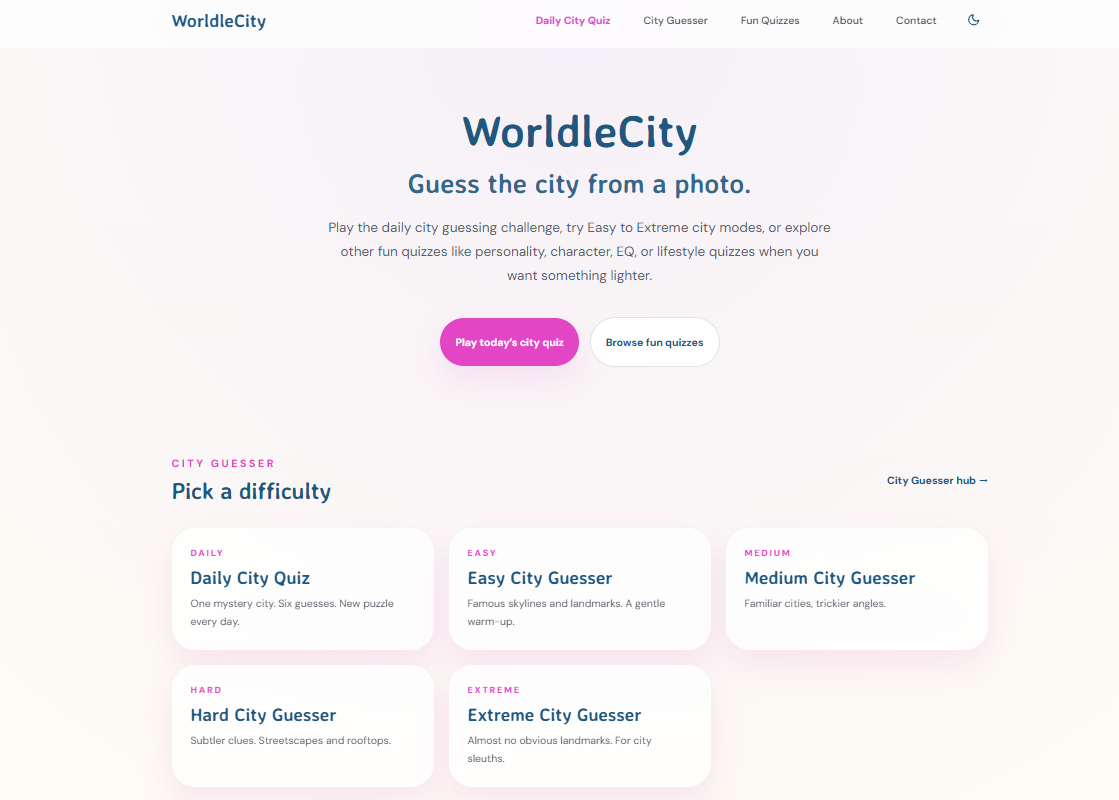
Worldlecity takes the multiple choice quiz format and makes it genuinely fun. Each day, you get a photo of a mystery city and six attempts to identify it, with directional feedback after every guess. Past the daily challenge, there are city guesser quizzes across four difficulty modes, plus personality and lifestyle quizzes that need no account. It’s the kind of interactive quiz experience that makes geography stick — because the feedback is immediate, the stakes feel real, and the results are shareable. Educator hunting for a low-friction engagement tool, or a student sharpening your world knowledge — either way, Worldlecity delivers a quiz format that rewards curiosity.
FAQ
What does a multiple choice quiz mean?
A multiple choice quiz is an assessment where each question presents a stem and several answer options, and the learner selects the correct or best answer. The format includes one key correct answer and multiple distractors designed to challenge less-prepared respondents.
How do you create a multiple choice quiz?
Write a focused stem for each question, identify the single correct answer, and build two to four plausible distractors based on common misconceptions. Use a platform like Google Forms, activate quiz mode, and configure the answer key before distributing the quiz.
What is the difference between single-answer and multi-answer MCQs?
Single-answer MCQs require selecting one correct option, while multi-answer versions use “select all that apply” instructions and require partial or balanced credit scoring rules to evaluate responses fairly.
Why are distractors important in multiple choice quizzes?
Distractors determine whether a quiz accurately measures knowledge or just rewards guessing. Plausible distractors built from real student errors reveal specific misconceptions and give the assessment genuine diagnostic value.
Do multiple choice quizzes actually help you learn?
Yes. Research published in Nature Communications Psychology in 2025 confirms that MCQ-based retrieval practice produces stronger long-term retention than re-reading, particularly when students receive feedback after answering each question.