Why Daily Quizzes Build Habits: The Science Behind It
Discover why daily quizzes build habits and enhance memory. Unleash the power of active recall to transform your learning routine!
- importance of daily quizzes
- benefits of daily quizzes
- daily quizzes for habit formation
- how quizzes create habits
On this page

Daily quizzes build habits by triggering active recall, a cognitive process that forces your brain to retrieve information rather than passively absorb it, and that retrieval effort is what makes memories stick. This mechanism, known in cognitive science as the testing effect, explains why spending just 3 to 5 minutes on a quiz each morning does more for your memory than rereading notes for an hour. Platforms like Teuteuf, Kahoot, Worldlecity, and QuizUp have built entire engagement models around this principle, layering in streaks, instant feedback, and daily challenges to keep you coming back. The result is a learning routine that feels less like studying and more like a habit you actually want.
Why daily quizzes build habits through the testing effect
The testing effect is the single most well-supported finding in memory research. When you retrieve information from memory, even imperfectly, you strengthen the neural pathway that stores it. Rereading a page feels productive, but it mostly activates recognition rather than recall. Recognition is shallow, whereas retrieval is deep.
The difference in outcomes is striking. Students who test consistently recall 80% of material after one week, compared to just 36% for those who don’t test. That 44-percentage-point gap means you are more than twice as likely to remember something a week later if you quizzed yourself on it rather than reviewed it passively.
“Retrieval practice using quizzes improves retention by 2 to 3 times compared to passive study over one week.” — Roediger and Karpicke, 2006
Here is what makes daily quizzes particularly effective for long-term memory:
- Spaced repetition: Returning to the same material across multiple days spaces out retrieval attempts, which research consistently shows deepens encoding.
- Desirable difficulty: Productive failures during recall prime stronger memory encoding than getting every answer right immediately. Struggle is the point.
- Immediate feedback: Knowing the correct answer right after a wrong guess closes the learning loop faster than delayed correction.
- Low-stakes repetition: Short daily quizzes reduce the anxiety that blocks memory consolidation during high-pressure tests.
The concept of desirable difficulty is worth pausing on. Techniques that feel harder during practice, such as retrieving an answer without cues, yield superior long-term learning compared to easier recognition tasks. Your brain encodes information more durably when it has to work for it. That mild frustration you feel mid-quiz? That is your memory getting stronger.
What psychological mechanisms make daily quizzes addictive?

Cognitive science explains why quizzes work. Behavioral psychology explains why you keep doing them. These are different questions, and both matter for habit formation.
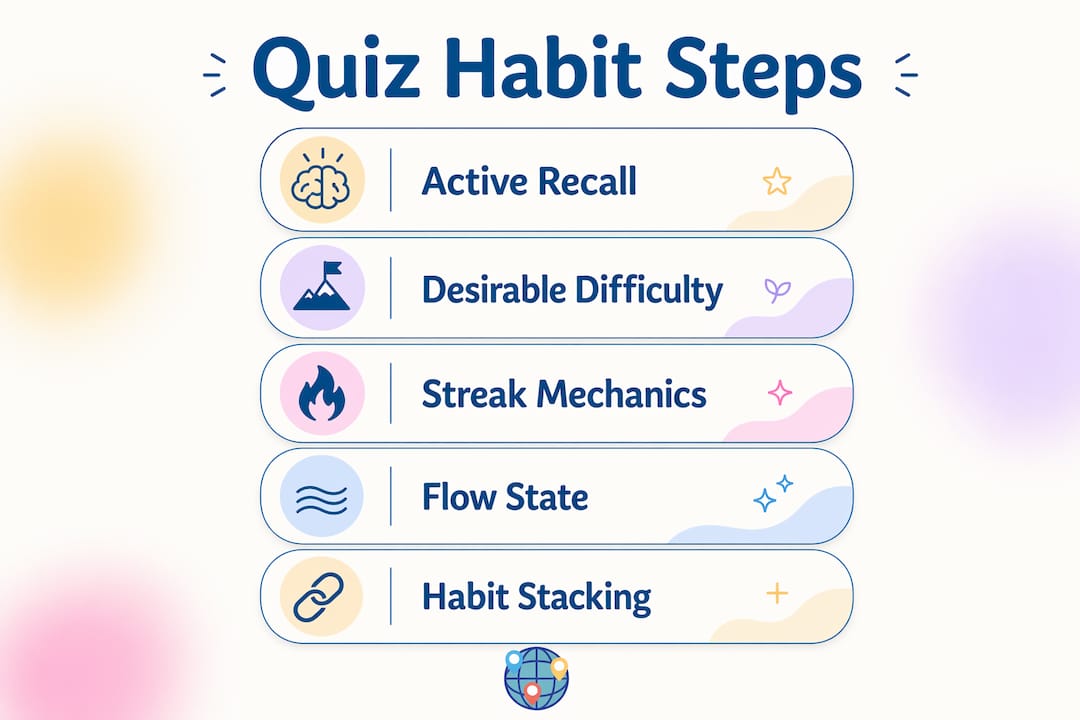
The core driver is dopamine. Your brain releases dopamine not just when you get an answer right, but in anticipation of the challenge. Dopamine during quiz anticipation makes the act of opening a quiz feel rewarding before you even answer the first question. This anticipatory reward is the same mechanism behind checking a notification or opening a mystery box. It is a cognitive itch that only the quiz itself can scratch.
Here is how the psychological loop builds over time:
- Anticipation: You expect a new challenge, and dopamine fires in response to that expectation.
- Engagement: The quiz presents a problem that sits just at the edge of your current knowledge, triggering a flow state.
- Reward: A correct answer delivers a hit of satisfaction. An incorrect answer delivers curiosity and the urge to learn.
- Streak reinforcement: A visible streak counter activates loss aversion. Missing a day feels like losing something real, even if the stakes are low.
- Social proof: Sharing results or seeing a leaderboard adds a layer of external motivation that compounds internal drive.
Streak mechanics and loss aversion are particularly powerful because they work even on days when your internal motivation is low. You might not feel like quizzing on a Tuesday morning, but the thought of breaking a 14-day streak is enough to open the app. That is loss aversion doing the heavy lifting your willpower would otherwise need to provide.
The flow state piece matters too. Daily quizzes balance challenge and skill, keeping you engaged without tipping into frustration or boredom. When difficulty is calibrated well, you enter a state of focused absorption where time passes quickly and the activity feels intrinsically rewarding. That is not an accident. It is design.
Pro Tip: If you find your motivation dipping mid-week, switch quiz topics rather than skipping entirely. Novelty restores dopamine response without breaking your streak.
How daily quizzes compare to other learning habits
Not all learning habits are created equal. Here is how daily quizzing stacks up against the most common alternatives.
| Method | Retention after one week | Time required | Habit sustainability |
|---|---|---|---|
| Daily quizzing (active recall) | ~80% | 3 to 5 minutes | High (low barrier, reward loop) |
| Passive rereading | ~36% | 20 to 60 minutes | Low (no feedback, no reward) |
| Flashcards (spaced repetition) | High, if used consistently | 10 to 20 minutes | Medium (requires setup effort) |
| Long weekly study sessions | Moderate | 60 to 120 minutes | Low (easy to skip, high friction) |
The data tells a clear story. Daily quizzing delivers the highest retention with the lowest time investment and the most sustainable habit structure. Passive rereading feels comfortable because fluency during study feels like mastery. It is not. Fluency and mastery are distinct: the ease of recognizing familiar text does not translate to the ability to retrieve it later under pressure.
Flashcards using spaced repetition apps like Anki come close to daily quizzing in retention outcomes, but they require you to build and maintain a deck, which adds friction. That friction is the enemy of habit formation. The simpler the entry point, the more likely you are to show up every day.
This is where the two-minute rule becomes relevant. Tasks under two minutes are easier to initiate and sustain as habits. A 3 to 5 minute quiz clears that psychological threshold easily, especially when the format is engaging rather than clinical. The habit forms because the cost of starting feels negligible.
One pitfall to watch: mistaking a high score for deep understanding. If a quiz is too easy, you are practicing recognition, not retrieval. Seek out formats that include unfamiliar angles on familiar topics, or that mix difficulty levels, to keep the cognitive effort honest.
What practical strategies help you maintain a daily quiz habit?
Knowing the science is one thing. Building the actual habit is another. Here is what works.
Anchor your quiz to an existing routine. Habit stacking, attaching a new behavior to an established one, dramatically reduces the willpower needed to start. Your morning coffee, your commute, or the two minutes before a meeting are all natural anchors. The quiz rides along on the momentum of something you already do automatically.
Keep the time and place consistent. Contextual cues reduce cognitive load by automating the trigger for your habit. When you always quiz at the same time in the same spot, your brain starts to associate that context with the behavior, and it becomes nearly effortless after a few weeks.
Do not let a missed day spiral. Missing occasional days does not erase accumulated learning or habit progress. The research is detailed on this. One skipped day is noise. A week of skipping is a pattern. Forgive the miss, return the next day, and move on without drama.
Pair daily quizzes with a weekly deeper challenge. A 3 to 5 minute daily quiz builds the habit and maintains retention. A longer weekly challenge, like a timed geography round or a themed trivia set, builds the depth that daily practice alone cannot. Think of daily quizzes as maintenance and weekly challenges as growth.
Track your progress visibly. Streaks work because they make your consistency visible. Whether it is a streak counter in an app or a simple paper calendar with X marks, seeing your progress creates a psychological commitment to continue. Habit formation solidifies within 21 to 28 days of consistent daily practice at 3 to 5 minutes per session.
Pro Tip: Start with a quiz topic you genuinely enjoy rather than one you think you “should” learn. Intrinsic interest accelerates habit formation and makes the first 21 days far easier to sustain.
Key takeaways
Daily quizzes build habits by combining the cognitive power of active recall with behavioral psychology mechanisms like dopamine reward loops, streak mechanics, and low-friction daily triggers that make consistent practice automatic within 21 to 28 days.
| Point | Details |
|---|---|
| Testing effect drives retention | Active recall produces 80% retention after one week versus 36% with passive review. |
| Dopamine makes quizzes addictive | Anticipation of a daily challenge fires dopamine before you even start, reinforcing the habit loop. |
| Low friction is non-negotiable | Quizzes lasting 3 to 5 minutes clear the two-minute rule threshold, making daily starts easy. |
| Missed days are not habit killers | Occasional skips do not erase progress; returning the next day preserves the habit. |
| Context consistency automates behavior | Same time, same place reduces the willpower needed to start and speeds up habit formation. |
Build your daily quiz habit with Worldlecity
If you are ready to put this into practice, Worldlecity makes it genuinely easy to start. Each day, a new photograph of a mystery city appears, and you get six attempts to identify it, with proximity and direction clues after each guess. It is the kind of low-pressure, high-reward format that makes daily habit building feel less like a chore and more like something you look forward to.
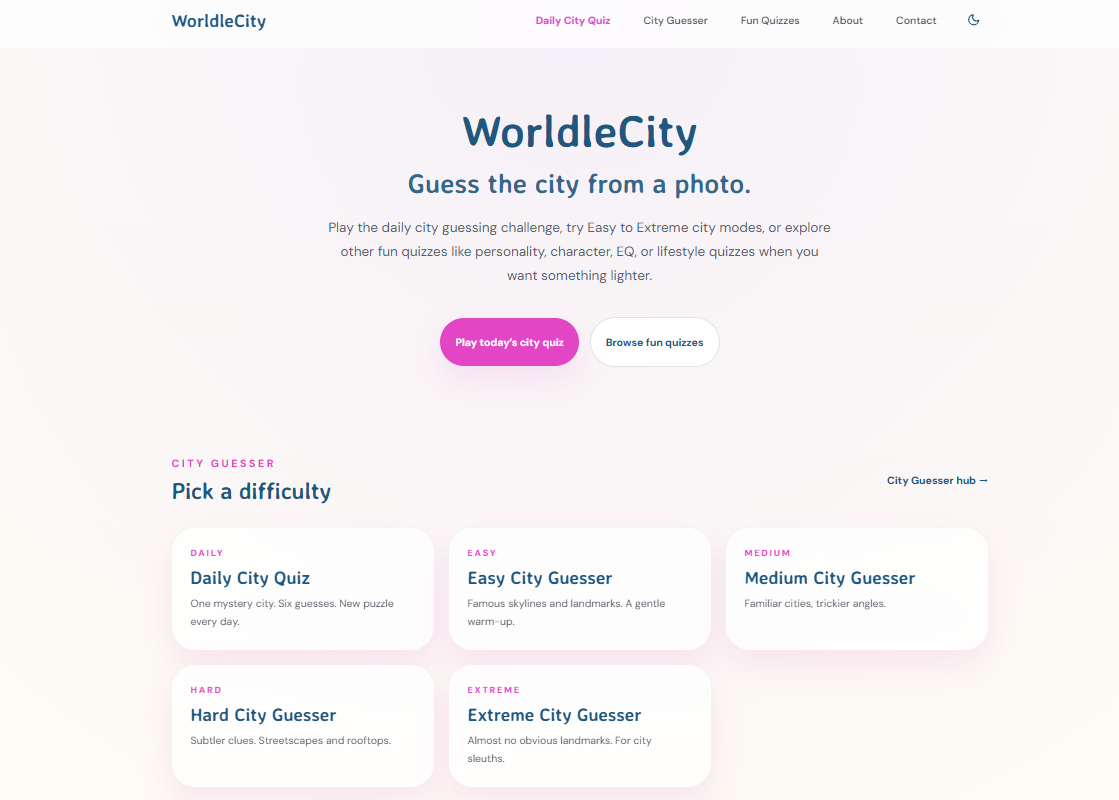
Beyond the daily city challenge, Worldlecity offers geography quizzes across four difficulty modes, plus personality and lifestyle quizzes with no account registration required. The streak system keeps your momentum visible, and the shareable results add a social layer that compounds motivation. If you want to explore quiz patterns and strategies to sharpen your performance, there is a resource for that, too. Show up daily, stay curious, and let the habit build itself.
FAQ
Why do daily quizzes build habits faster than weekly study?
Daily quizzes create a consistent behavioral loop with immediate rewards, which reinforces the habit faster than infrequent, longer sessions. The low time commitment and dopamine-driven feedback make daily repetition far easier to sustain.
How long does it take to form a daily quiz habit?
Daily quiz habits form reliably within 21 to 28 days with 3 to 5 minutes of daily practice. Consistency matters more than duration during this window.
Does getting answers wrong during a quiz hurt learning?
No. Productive failures during recall actually prime stronger memory encoding than immediate success. Struggling to retrieve an answer before seeing the correct one deepens the memory trace.
What happens if I miss a day in my quiz habit?
Missing one day does not significantly harm long-term habit formation as long as overall frequency stays high. Return the next day without guilt, and the habit remains intact.
Are daily quizzes better than flashcards for habit formation?
Daily quizzes have a lower setup barrier than flashcard systems like Anki, which makes them more sustainable as a daily habit. Both use retrieval practice, but quizzes win on friction and engagement for most people.