Why Lifestyle Quizzes Go Viral: the Psychology Behind It
Discover why lifestyle quizzes go viral and how they engage users emotionally. Uncover the psychological factors driving their popularity!
- how to create fun quizzes
- what makes quizzes popular
- best quiz formats for sharing
- why people love lifestyle quizzes
- why do quizzes spread online
- viral quiz trends
- psychology behind viral quizzes
- factors for viral quizzes
On this page

Lifestyle quizzes go viral because they deliver a personalized result that feels emotionally true and instantly worth sharing, which is something rare in digital media. Platforms like BuzzFeed and Interact, and quiz tools like Quiz and Survey Master, have repeatedly proven this. Interactive quiz content achieves up to 5 times higher engagement than static tools like calculators, with users viewing an average of 5.3 pages per session. That number tells you an important insight that people don’t just take one quiz and leave. They stay, explore, and share. The formula behind why lifestyle quizzes go viral comes down to three interlocking forces: emotional resonance, identity affirmation, and frictionless completion.
Why do lifestyle quizzes go viral in the first place?
The short answer is psychology. Lifestyle quizzes tap into three of the most reliable triggers in human behavior, which are curiosity, self-expression, and the need to belong.
Personalized quizzes activate brain reward circuits by making the taker feel uniquely seen and personally attended to. That feeling is not accidental. It is engineered through question design, result framing, and the language used to describe outcomes. When a quiz tells you that you are “the chaotic creative of your friend group,” you don’t just read it. You feel it.
Here are the core psychological drivers that make lifestyle quizzes so shareable:
- Identity signaling. Quiz results let people broadcast who they are without writing a single original word. Sharing a result is a low-effort form of self-expression.
- High-arousal emotions. Pride, amusement, and surprise are the emotions most linked to sharing behavior. A result that makes you laugh or feel flattered gets screenshotted immediately.
- Curiosity and self-knowledge. People genuinely want to understand themselves. A quiz that promises insight into your personality, habits, or preferences satisfies that desire quickly.
- Social comparison. Seeing what result your friends got pulls you in. It turns a solo activity into a group conversation.
- Low cognitive load. Short questions and clear answer choices keep completion rates high. No one abandons a quiz because it was too easy to finish.
Pro Tip: When you design personality or lifestyle quizzes, design your answer choices to feel like personality descriptors, not just options. “I’d probably overthink it” lands better than “Option B” every single time.
The combination of these factors creates a sharing loop. You take the quiz, feel something, share the result, and your friends take it too. No algorithm required.
How quiz design drives viral engagement and repeat visits
Psychology gets people to click. Design gets them to finish and share. The two work together, and the details matter more than most creators realize.

The most effective viral quizzes typically have 5 to 15 questions. That range is not arbitrary. Fewer than five questions feels too thin to trust. More than fifteen starts to feel like homework. The sweet spot gives users enough substance to feel the result is earned without making them work for it.
Here is what the design of a high-performing lifestyle quiz looks like in practice:
- Question flow is thematic, not scattered. Logical question flow enhances the perception of result accuracy and keeps users engaged. Jumping between unrelated topics breaks the immersion and makes results feel random.
- Results are visual, not just textual. Shareable result cards are the viral mechanism that turns users into unpaid promoters. A visually appealing card with a bold personality label gets posted. A wall of text does not.
- Companion content extends the session. Chaining quiz traffic with articles tied to quiz results taps peak curiosity moments and increases time on site significantly.
- Answer choices feel human. Relatable, slightly humorous options lower the barrier to engagement and make the experience feel conversational rather than clinical.
- Results use affirming language. Positive framing encourages sharing. No one posts a result that makes them feel bad about themselves.
Pro Tip: Treat your results page as the product. The questions are just the path to get there. Every word on that results card should be something the user would want their friends to read about them.
Here is a quick comparison of design choices and their impact on virality:
| Design element | High-virality approach | Low-virality approach |
|---|---|---|
| Quiz length | 5–15 questions | 20+ questions |
| Result format | Visual card with personality label | Plain text score |
| Question flow | Thematic and consistent | Random topic jumps |
| Answer choices | Relatable, personality-flavored | Generic or clinical |
| Post-quiz content | Linked companion articles | Dead end |
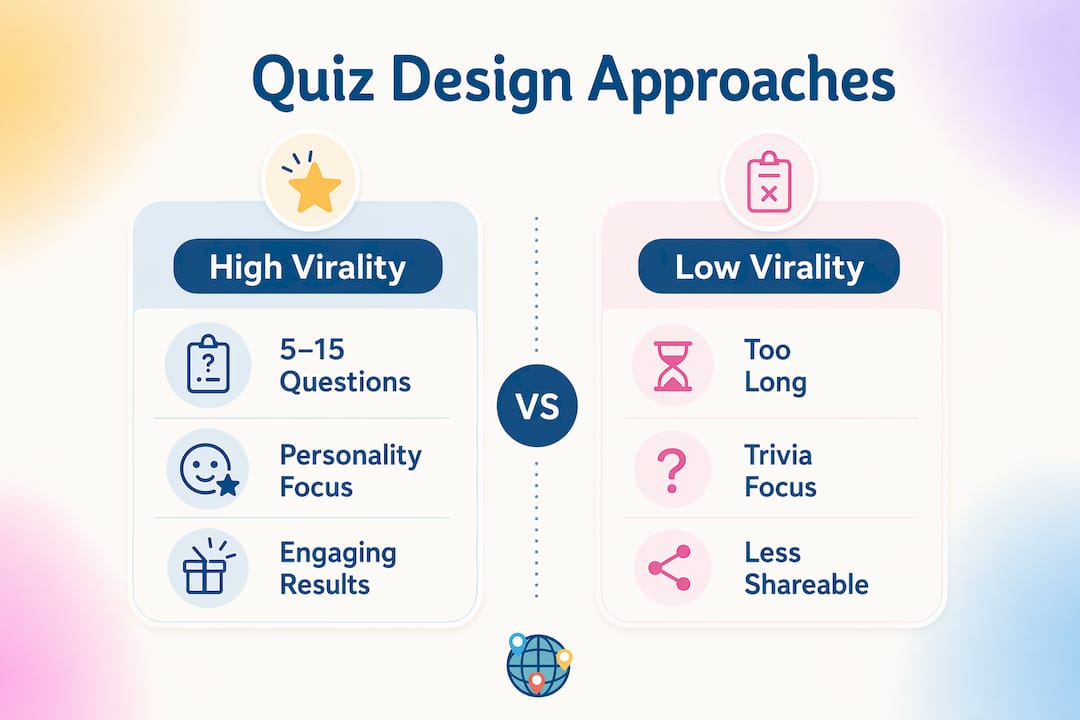
The difference between a quiz that gets shared 50 times and one that gets shared 50,000 times often comes down to these exact choices.
Why personality results outperform performance scores for sharing
This is the insight that separates viral lifestyle quizzes from trivia tests and knowledge checks. Personality-based quiz results drive significantly more sharing than performance-based scores because they align with social identity signaling. Performance scores tell you how you ranked. Personality results tell you who you are. Those are very different emotional experiences.
Consider the difference between BuzzFeed’s “Which Hogwarts House Are You?” and a geography trivia test. One result is a badge you wear proudly. The other is a grade you might hide.
Here is why personality outcomes win the sharing game:
- They feel affirming, not evaluative. A personality label like “The Visionary” or “The Loyal Protector” is flattering by design. A score of 6 out of 10 is not.
- They spark conversation. Labels attached to identities become conversation starters. “I got Slytherin, what did you get?” is a social invitation. “I got 70%” is not.
- They create the “this is so me” effect. Quiz results that resonate emotionally allow quick, low-effort self-expression that users want to broadcast. That effect is the engine of organic distribution.
- They reduce sharing anxiety. Performance scores can trigger embarrassment. Personality results rarely do, because there is no wrong answer.
| Result type | Emotional response | Sharing likelihood | Conversation potential |
|---|---|---|---|
| Personality label | Pride, amusement, recognition | High | High |
| Performance score | Anxiety, comparison, judgment | Low to moderate | Low |
| Lifestyle archetype | Curiosity, self-reflection | High | High |
| Knowledge rank | Competitive, sometimes embarrassing | Moderate | Moderate |
The psychology of personality quizzes is built on one core truth: people share things that make them look good or feel understood. Personality results do both. Performance scores rarely do either.
How lifestyle quizzes fit into broader digital media trends
Lifestyle quizzes don’t exist in a vacuum. They thrive because they fit perfectly into how people consume and share content right now.
Interactive content beats static content on engagement and loyalty across entertainment and media contexts. Audiences want to participate, not just observe. Quizzes are the most accessible form of interactive content available. No app download, no account required, no learning curve.
Several converging trends explain why quiz content keeps growing:
- Short attention spans favor bite-size formats. A 10-question quiz takes three minutes. That fits perfectly into the gaps between other content.
- Social media platforms are built for sharing results. Instagram Stories, X (formerly Twitter), and TikTok comment sections all make it trivially easy to post a quiz result. The distribution infrastructure already exists.
- Gen Z and Millennial audiences are especially drawn to relatable, identity-based formats. These groups grew up with personality quizzes as a form of social currency. The format feels native to them.
- Quizzes create engagement loops. Viral quizzes create a cycle where curiosity fuels multiple completions and sharing, generating natural growth without relying on recommendation algorithms.
- Brands use quizzes for organic reach. A quiz that spreads through social sharing costs nothing in paid distribution. That makes it one of the most efficient content formats available to creators and marketers alike.
Relatable themes lower the barrier to sharing because they reflect daily life for the user. When a quiz topic feels personally relevant, sharing it becomes a form of self-expression rather than content promotion. That shift in motivation is what separates viral quiz content from everything else. You can explore how quiz patterns and engagement tricks work in practice to see these principles applied directly.
Quizzes also function as content funnels. A user who finishes a lifestyle quiz and clicks through to a related article is already invested. That investment is what drives the session depth numbers mentioned earlier. It is not accidental traffic. It is curiosity in motion.
Try it yourself on Worldlecity
Worldlecity puts all of these principles into practice in a format that’s genuinely fun to play with. The platform offers daily city guessing games and a full range of personality and lifestyle quizzes, all without requiring an account. You get shareable results, a real sense of accomplishment, and the kind of “wait, let me try again” pull that keeps sessions going.
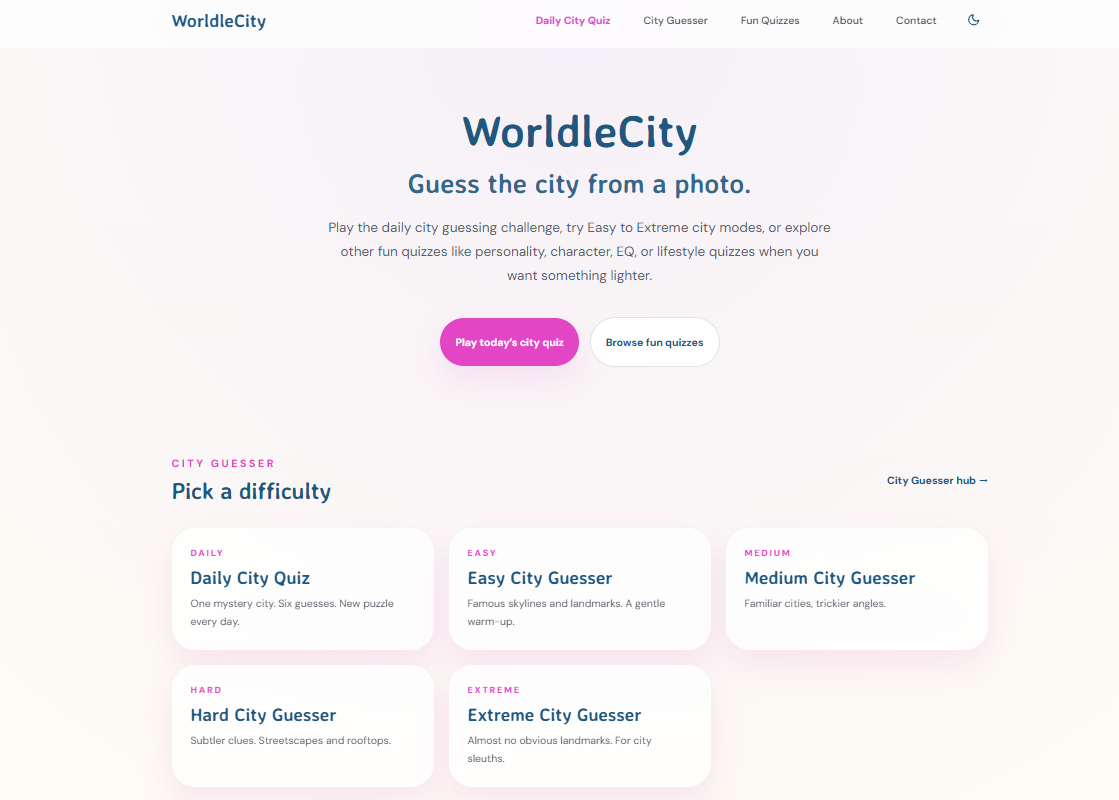
Whether you’re here to test your city guessing knowledge or find out what your digital personality is, Worldlecity delivers the interactive, social experience that makes quiz content worth coming back to. The results are built to share. The format is built to engage. Give it a go and see which result is “so you.”
Key takeaways
Lifestyle quizzes go viral because they combine identity-affirming results, low cognitive friction, and visually shareable formats that turn every user into an organic distributor.
| Point | Details |
|---|---|
| Psychology drives sharing | High-arousal emotions like pride and amusement are the primary triggers for quiz sharing behavior. |
| Design determines completion | Quizzes with 5–15 thematic questions and visual result cards consistently outperform longer or text-heavy formats. |
| Personality beats performance | Personality-based results generate more shares than scores because they affirm identity rather than evaluate it. |
| Engagement loops sustain growth | Companion content linked to quiz results extends sessions and creates repeat visit cycles without paid promotion. |
| Trends amplify reach | Social media sharing tools and Gen Z’s affinity for interactive formats give lifestyle quizzes a built-in distribution advantage. |
FAQ
Why do people love taking lifestyle quizzes so much?
Lifestyle quizzes satisfy the desire for self-knowledge while delivering an emotionally affirming result quickly. The combination of curiosity, low effort, and a flattering outcome makes them hard to resist.
What makes a quiz go viral on social media?
Visual result cards, personality-based outcomes, and relatable question themes are the three design factors most linked to viral sharing. Results that feel personally true get posted. Results that feel generic do not.
How long should a viral lifestyle quiz be?
The optimal length is 5 to 15 questions. That range balances enough substance to make results feel credible with enough brevity to keep completion rates high.
Why do personality quizzes get shared more than trivia quizzes?
Personality results let users signal identity and feel seen, which motivates sharing. Trivia scores can trigger comparison anxiety, which reduces the impulse to post publicly.
What role does quiz design play in engagement?
Thematic question flow, affirming result language, and companion content links all directly increase session depth and sharing rates. The results page is the most important design element in any viral quiz.