Discover New Destinations Through Quizzes: A Practical Guide
Discover new destinations through quizzes that personalize travel options based on your preferences. Find your perfect getaway in under 60 seconds!
- travel quizzes for fun
- fun quizzes for travel lovers
- explore destinations with quizzes
- find new travel locations through quizzes
- quiz your way to vacation spots
- test your travel knowledge
- quiz-based travel inspiration
- destination discovery games
On this page

Travel destination quizzes are interactive tools that filter 20 to 70+ destinations down to a personalized shortlist in under 60 seconds, using your answers as constraints rather than vague personality profiles. You can discover new destinations through quizzes by answering 5–12 targeted questions about budget, climate, travel pace, and practical limits like visa comfort or flight time. The result is a concrete list of places that actually fit your life, not just your mood board. Worldlecity takes this idea further by turning geography itself into a daily game, so learning about cities feels less like homework and more like a challenge worth sharing.
How do destination-discovery quizzes work?
The mechanics behind a good travel quiz are more deliberate than they look. You answer a short set of questions, and the quiz uses your responses as filters, cutting out destinations that fail on your hard limits first.
The question framework
Most destination-discovery quizzes ask between 5 and 12 questions. Each answer eliminates a chunk of the destination pool. By question eight, you might go from 200 options down to a manageable shortlist of six or seven.
The questions are not random. They follow a priority order:
- Climate preference (tropical, temperate, cold, dry) ranks as the most critical filter
- Budget tier (budget backpacker, mid-range, luxury) narrows options fast
- Travel style (adventure, culture, relaxation, food)
- Trip duration (weekend, one week, two weeks or more)
- Practical constraints like visa requirements and maximum flight time
Weighted scoring, not personality types
Modern destination matchers use weighted scoring systems, not broad personality categories. Climate gets the heaviest weight because it is the factor most likely to make or break a trip. Budget and travel style follow. This approach means two people with identical personalities, but different budgets, get completely different results.
The best quizzes treat your answers as deal-breakers. Effective quiz design focuses on what would cause a trip to fail, not just what sounds appealing. That shift from aspiration to constraint produces sharper, more realistic recommendations.
Pro Tip: Use a discovery quiz for practical trip planning and a trivia quiz for inspiration. They serve different purposes, and mixing them up leads to results that feel off.
How to use quizzes to find your next travel destination
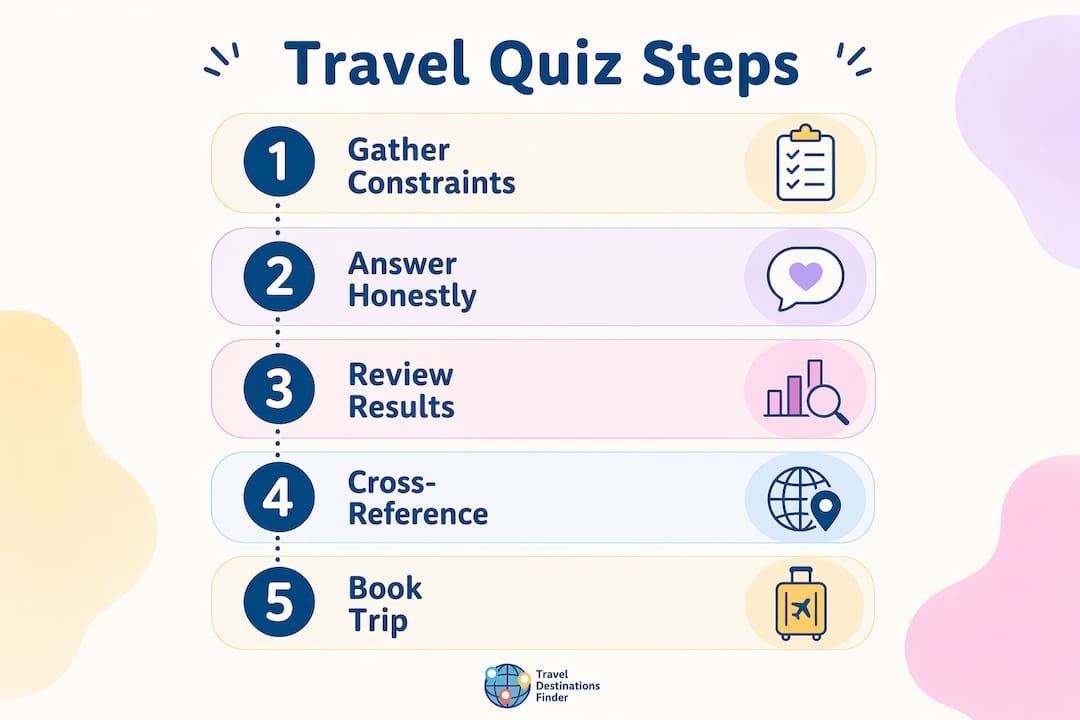
Getting useful results from a travel quiz takes about three minutes of honest thinking before you even click the first answer. Here is a step-by-step process that actually works.
Step 1: Gather your real constraints
Before you open any quiz, write down three things: your total trip budget (flights included), your available travel dates, and any hard limits like visa restrictions or medical considerations. Vague answers produce vague results.

Step 2: Answer honestly, not aspirationally
This is where most people go wrong. You might dream of a two-week luxury safari, but if your budget is $1,500 all-in, answering “luxury” just wastes your time. Answer what is true for this trip, not your ideal trip.
Step 3: Work through the questions in order
- Set your climate preference first. This single answer eliminates most destinations.
- Lock in your budget tier. Be specific if the quiz allows ranges.
- Choose your travel style. If the quiz offers multiple styles, pick your top priority only.
- Enter your trip duration. A four-day weekend and a two-week trip rarely share the same best destination.
- Add practical constraints. Visa comfort and maximum flight hours matter more than most travelers admit.
Step 4: Read the full shortlist, not just the top result
Quiz results layer data, including seasonal climate, cost of living, and flight logistics. The second or third result on your list might fit your actual dates better than the top recommendation. Check all of them.
Step 5: Cross-reference before booking
Travel industry analysts are clear that quiz results are starting points, not final decisions. Once you have your shortlist, check current visa requirements, seasonal weather data, and flight prices independently. A quiz from three months ago may not reflect a new airline route or a visa policy change.
Pro Tip: Some AI-powered quiz tools generate a ready-made prompt you can paste into an AI chat tool to build a full itinerary from your quiz results. That turns a 60-second quiz into a complete trip plan in under ten minutes.
You can also sharpen your quiz strategy skills to get more out of every format you try.
Why trivia quizzes build better travel instincts
Discovery quizzes find your next trip. Trivia quizzes build the geographic knowledge that makes every future trip richer. These two quiz categories serve distinct purposes, and understanding the difference helps you use both well.
A travel trivia quiz tests what you already know about the world: city nicknames, airline tail fins, world time zones, national flags, and famous landmarks. The format is fast, often under a minute per session, with scoring mechanics that reward repeated play. You get a number, you want a better number, you play again. That loop is genuinely effective for learning.
What trivia quizzes cover
Interactive trivia quizzes teach geographic facts through quick, engaging games with high-score mechanics for repeated play. Common topics include:
- World time zones and international date lines
- City nicknames (the Eternal City, the City of Light, the Big Apple)
- National flags and their symbolism
- Famous landmarks and the cities that house them
- Airline liveries and hub airports
Why this matters for travel planning
Knowing that Lisbon sits on seven hills or that Chiang Mai hosts a lantern festival every November changes how you think about a destination. Trivia quizzes surface those details in a way that a Wikipedia article rarely does, because the game format creates a memory hook. You remember what you got wrong.
Map-based quiz games take this further by asking you to place cities, countries, or landmarks on a blank map. That spatial practice builds genuine geographic intuition, not just a list of facts.
Common mistakes that kill your quiz results
Most travel quizzes are free to play online and require minimal personal information. That ease of access is great. It also means most people rush through them without thinking, which produces results they ignore.
The three most common mistakes
Rushing the answers. A quiz that takes 60 seconds to complete still deserves 60 seconds of honest thought. Clicking through in 15 seconds because you want to see the result fast guarantees a result that does not fit.
Ignoring practical constraints. Answering “I love adventure” but skipping the visa and flight-time questions produces a shortlist that looks exciting and is completely impractical for your actual situation.
Treating the result as a final answer. No quiz has real-time flight prices, current visa policies, or knowledge of the festival that sold out every hotel in your preferred destination for your exact travel dates.
How to pick a quiz worth your time
| Feature category | What to look for | Red flag |
|---|---|---|
| Data depth | Climate, budget, visa, and flight-time filters | Personality types only |
| Question count | 5–12 focused questions | Under 4 or over 20 |
| Result detail | Specific destinations with context | Generic region names |
| Fun factor | Engaging format, shareable results | Plain text output only |
Pro Tip: Use a quiz as a first-pass filter, not a travel agent. It narrows 200 options to six. You do the final research on those six.
Understanding what a map quiz is and how different formats work helps you pick the right tool for the right moment.
Key takeaways
Travel quizzes work best when you treat your answers as hard constraints, use discovery quizzes for planning and trivia quizzes for learning, and always cross-reference results with current travel data before booking.
| Point | Details |
|---|---|
| Answers are constraints | Treat every quiz answer as a filter, not a preference, to get realistic results. |
| Climate filters first | Weighted scoring prioritizes climate above budget and style for accurate shortlists. |
| Two quiz types, two purposes | Discovery quizzes plan trips; trivia quizzes build geographic knowledge. |
| Results are starting points | Cross-reference quiz output with current visa rules, prices, and seasonal data. |
| Speed matters less than honesty | Rushing answers produces useless results; 60 seconds of honest input changes everything. |
Worldlecity: put your geography knowledge to the test
If reading about travel quizzes has you itching to actually play one, Worldlecity is a natural next stop.
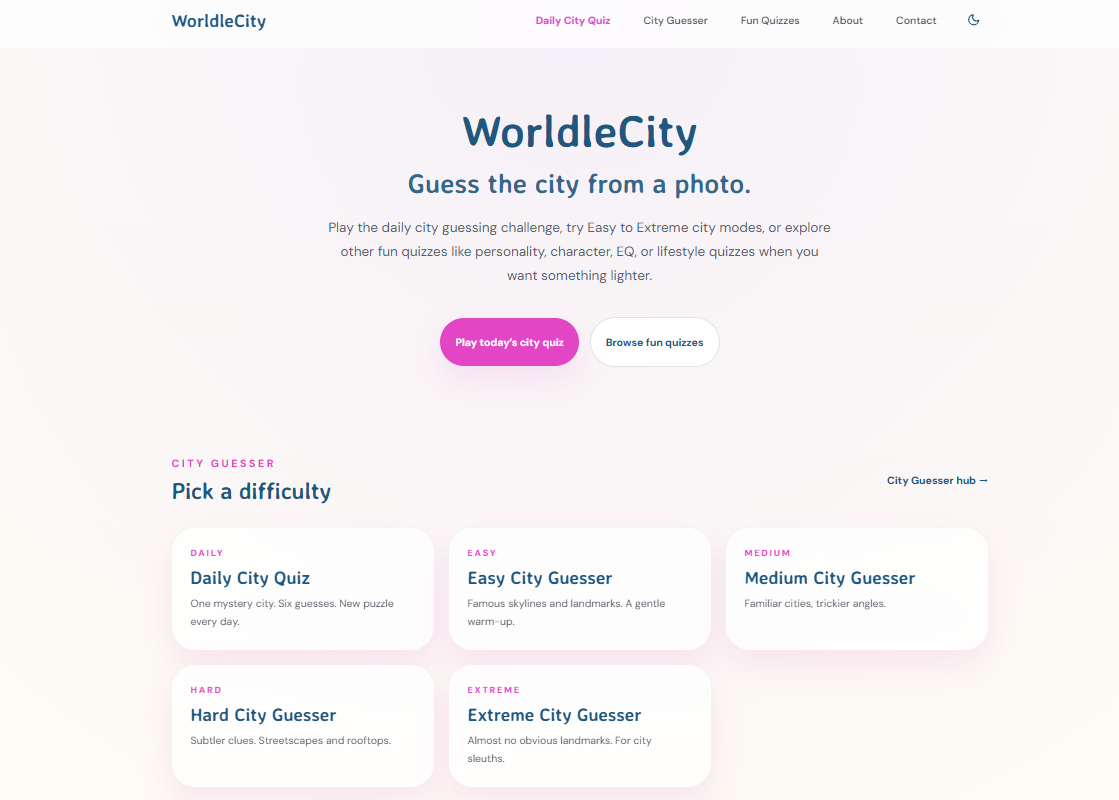
Each day, Worldlecity drops a mystery city photo and gives you six guesses to identify it. Every wrong guess reveals how close you are and which direction to look, so you learn something even when you miss. Beyond the daily challenge, Worldlecity offers city guesser quizzes across four difficulty modes, plus personality and lifestyle quizzes that require zero account registration. The stunning pictures used as the clues for the city guessing quizzes will surely awaken the travel bug sleeping in you. To satiate that curiosity, useful links about the cities are provided along with the results so that you can explore further. It is the kind of platform where five minutes turns into genuine geographic knowledge, and your score is worth sharing. Whether you are a seasoned traveler or just curious about the world, Worldlecity makes the learning feel like a game.
FAQ
How many questions does a destination quiz usually have?
Most destination-discovery quizzes ask between 5 and 12 questions and deliver a personalized shortlist in under 60 seconds.
What is the difference between a discovery quiz and a trivia quiz?
Discovery quizzes filter destinations based on your budget, climate, and practical constraints. Trivia quizzes test geographic knowledge through scored, time-limited questions.
Are travel quizzes accurate enough to use for real trip planning?
Travel quizzes are reliable first-pass filters, not final decisions. Cross-reference your shortlist with current visa rules, flight prices, and seasonal data before booking.
Do I need to create an account to use travel quizzes?
Most travel quizzes are free to play and require minimal personal information. Worldlecity, for example, requires no account registration at all.
What destination should I visit if I have a tight budget and limited time?
A destination-discovery quiz with budget tier and trip-duration filters will narrow the options fast. Enter your real numbers, not your dream numbers, for results you can actually book.