Puzzle Versus Quiz Difference Explained for Gamers
Discover the puzzle versus quiz difference explained. Learn how each format engages you and enhances your gaming experience. Click for insights!
- what is a quiz
- types of puzzles and quizzes
- puzzles vs quizzes comparison
- difference between puzzles and quizzes
- similarities between puzzles and quizzes
- quiz or puzzle which is better
- difference between quiz and game show
- puzzle versus quiz difference explained
- what is a puzzle
On this page

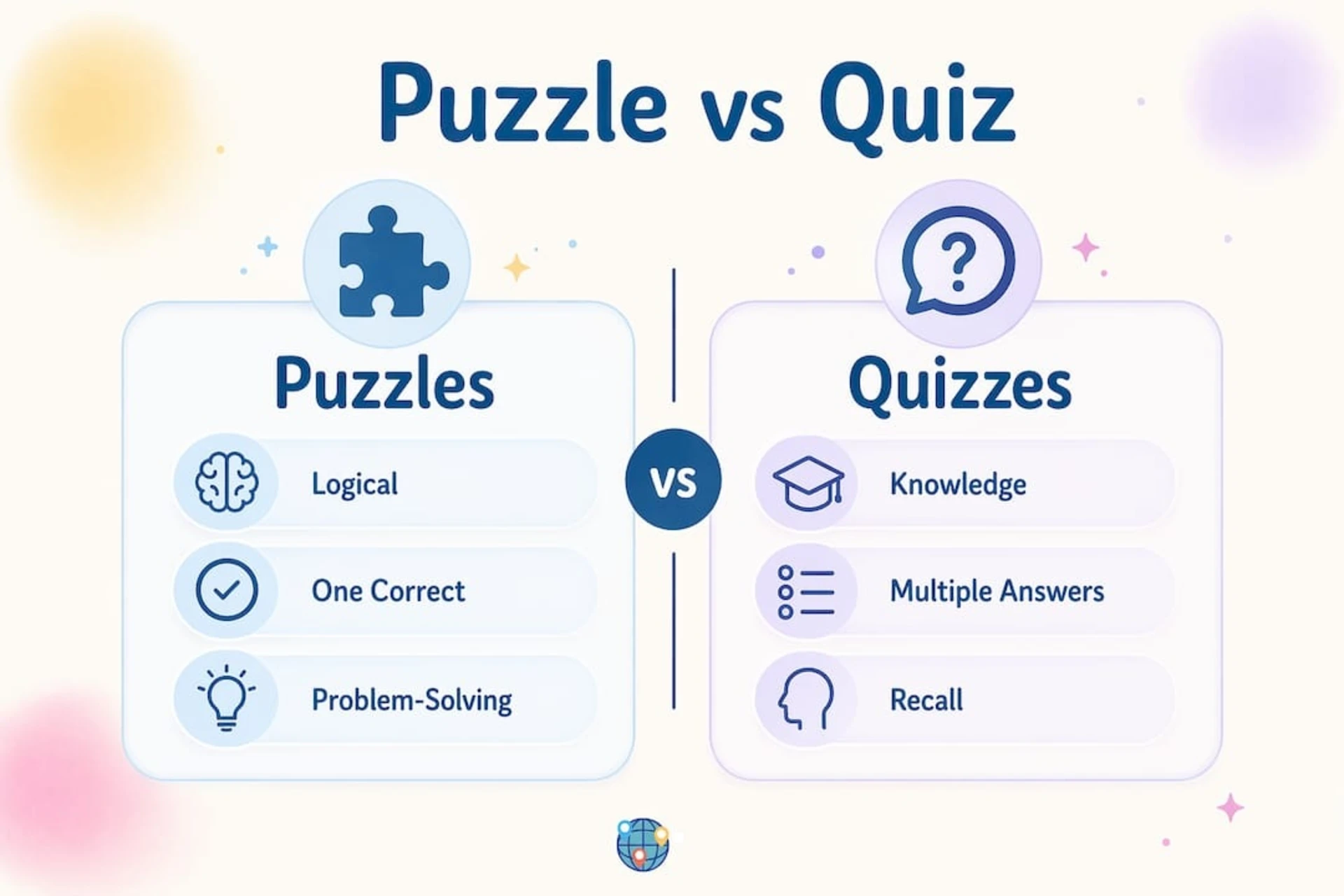
A puzzle is a problem designed to have one specific, logical solution, while a quiz is a short test of knowledge with no single required reasoning path. That core distinction shapes how you engage with each format, how long you stay, and what you walk away knowing. If you’ve ever wondered why a crossword feels different from a trivia night, the puzzle versus quiz difference explained here will make that click. Both formats power some of the best educational games and activities out there, and knowing which does what helps you pick the right one for your goals.
What is the core puzzle versus quiz difference?
Puzzles require systematic logical reasoning to reach one valid answer. There is no guessing your way through a well-designed puzzle. Every clue points toward a single correct solution, and the solver has to work through the logic step by step.
Quizzes work differently. A quiz tests your existing knowledge, asking you to recall facts, make associations, or express preferences. The answers are either right or wrong based on what you already know, not on a chain of deductions you build in the moment.

The practical difference shows up fast. Sit down with a logic puzzle, and you might spend 20 minutes on one problem. Open a trivia quiz, and you can burn through 10 questions in under two minutes. Neither is better. They just do different things to your brain.
How puzzles and quizzes engage you differently
The engagement mechanics behind each format are genuinely distinct, and understanding them helps you choose the right one.
Puzzles tap into a dopamine feedback loop tied to problem-solving. Micro-puzzles under one minute outperform longer, complex puzzles because the brain gets its reward faster, which drives repeat visits. That is why daily puzzle formats, like a city guessing game where you get six attempts to identify a mystery photo, feel so addictive. The short loop keeps you coming back.
Quizzes work through what psychologists call information-gap theory. You sense a gap between what you know and what you want to know, and the quiz promises to close it. That tension drives clicks, shares, and immediate engagement. It is a faster burn than puzzles, but it spreads wider.
Here is how the engagement patterns break down:
- Puzzles reward patience and methodical thinking. They build a habit loop over days or weeks.
- Quizzes reward speed and recall. They generate social sharing and quick satisfaction.
- Personality quizzes add a self-discovery layer, making them especially shareable because the result feels personal.
- Trivia quizzes boost session time by 10–30% and generate strong social share rates.
- Connections-style puzzles increase return visits by 20–50%, showing their strength in building long-term habits.
Pro Tip: If you want players to come back daily, a short puzzle with a clear win condition beats a long quiz every time. The faster the reward, the stronger the habit.
Common formats across puzzles and quizzes
The types of puzzles and quizzes available today cover a wide range of cognitive demands and audience needs.
Puzzle formats worth knowing
Crosswords test vocabulary and lateral word association. Logic puzzles, like grid deductions or number sequences, demand pure reasoning. Jigsaw puzzles train spatial recognition. Word searches sit at the lighter end of the puzzle spectrum, requiring pattern recognition rather than deduction. Each of these formats shares one defining trait: every puzzle has one valid, logical solution, and the design process has to guarantee that.
Quiz formats and how they differ
Trivia quizzes test factual recall across categories like history, geography, or pop culture. Personality quizzes use your answers to map you to a type or result, with no right or wrong answer. Quick knowledge quizzes, like a five-question geography check, sit between trivia and assessment. Optimal general-knowledge quizzes contain 6–10 questions, while personality quizzes perform best at 3–6 questions.
Here is a side-by-side look at how the formats compare:
| Feature | Puzzles | Quizzes |
|---|---|---|
| Goal | Find one correct logical solution | Test or express knowledge |
| Cognitive demand | Reasoning and deduction | Recall and recognition |
| Typical length | Variable, often open-ended | 3–10 questions |
| Social shareability | Moderate (result-based) | High (personality and trivia) |
| Production effort | High (single valid solution required) | Lower (multiple formats possible) |
| Best for | Habit building, deep engagement | Fast reach, social acquisition |
Short personality quizzes with visual share cards and personalized scoring perform best for social acquisition. That is why you see them everywhere on social media. They are cheap to produce and easy to share.
When should you choose a puzzle or a quiz?
The right choice depends on what you want to achieve and who you are designing for.
- Choose puzzles for long-term retention. Puzzles build habitual users who return daily. If your goal is a loyal audience that keeps coming back, a daily puzzle format with a clear win condition is the stronger play.
- Choose quizzes for fast social reach. Quizzes spread quickly because they are low-friction and highly shareable. A well-crafted trivia or personality quiz can reach new audiences in hours.
- Combine both for full-funnel results. Quizzes work for top-of-funnel growth while puzzles build the retention layer. Using both together covers acquisition and loyalty at the same time.
- Factor in production complexity. Puzzles require 5–10 times more production effort than quizzes because every puzzle needs a guaranteed single solution. Quizzes are faster to build and easier to iterate.
- Match difficulty to your audience. Beginners need lower-friction formats. Experienced players want a challenge that feels earned, not arbitrary.
Pro Tip: Start with a quiz to grow your audience, then introduce a daily puzzle to lock in the habit. The quiz gets them in the door. The puzzle keeps them coming back.
The science behind daily quiz habits confirms that consistency and short feedback loops are the two biggest drivers of long-term engagement. Both puzzles and quizzes can deliver those, but they do it through different mechanics.
Common misconceptions about puzzles and quizzes
A few misunderstandings come up constantly in the puzzles vs quizzes comparison, and they are worth clearing up.
Quizzes are not a type of puzzle. A quiz tests what you already know. A puzzle asks you to reason toward something you do not yet know. The cognitive process is fundamentally different. Calling a quiz a puzzle is like calling a spelling test a math problem.
Riddles and brain teasers are not the same as puzzles. Puzzles stimulate calm, methodical progression, while brain teasers rely on lateral thinking and sudden insight. A riddle plays with language and misdirection. A logic puzzle follows a structured path. They feel different because they are different.
Luck plays no role in a well-designed puzzle. If you can guess your way to the answer, the puzzle is broken. Quizzes, on the other hand, allow for educated guessing because knowledge exists on a spectrum.
- Puzzles: no luck, pure logic, one solution
- Brain teasers: lateral thinking, insight-based
- Riddles: language play, misdirection
- Trivia quizzes: knowledge recall, some guessing possible
- Personality quizzes: no right or wrong, preference-based
The emotional experience also differs. Finishing a puzzle delivers a specific satisfaction tied to having worked something out. Finishing a quiz delivers either validation (you knew it) or curiosity (you did not). Both feel good, but for completely different reasons. Understanding that difference is the real payoff of the quiz category breakdown that serious game designers use.
Key Takeaways
Puzzles build deep engagement through logical reasoning, while quizzes drive fast social reach through knowledge recall. Combining both formats gives you the strongest results across acquisition and retention.
| Point | Details |
|---|---|
| Core definition difference | Puzzles require one logical solution; quizzes test existing knowledge with no fixed reasoning path. |
| Engagement mechanics | Puzzles build return habits; trivia quizzes boost session time and social shares. |
| Format selection | Use puzzles for long-term loyalty and quizzes for fast audience growth. |
| Production effort | Puzzles take significantly more design effort than quizzes due to single-solution requirements. |
| Combination strategy | Pair quizzes for top-of-funnel reach with daily puzzles for retention and habit building. |
Worldlecity puts both formats in one place
If you want to feel the puzzle versus quiz difference firsthand, Worldlecity is the place to do it. Each day, a new mystery city photo drops, and you get six attempts to name it, with proximity and direction clues after each guess. That is the puzzle format at its most satisfying: one answer, real feedback, and a habit that builds over time.
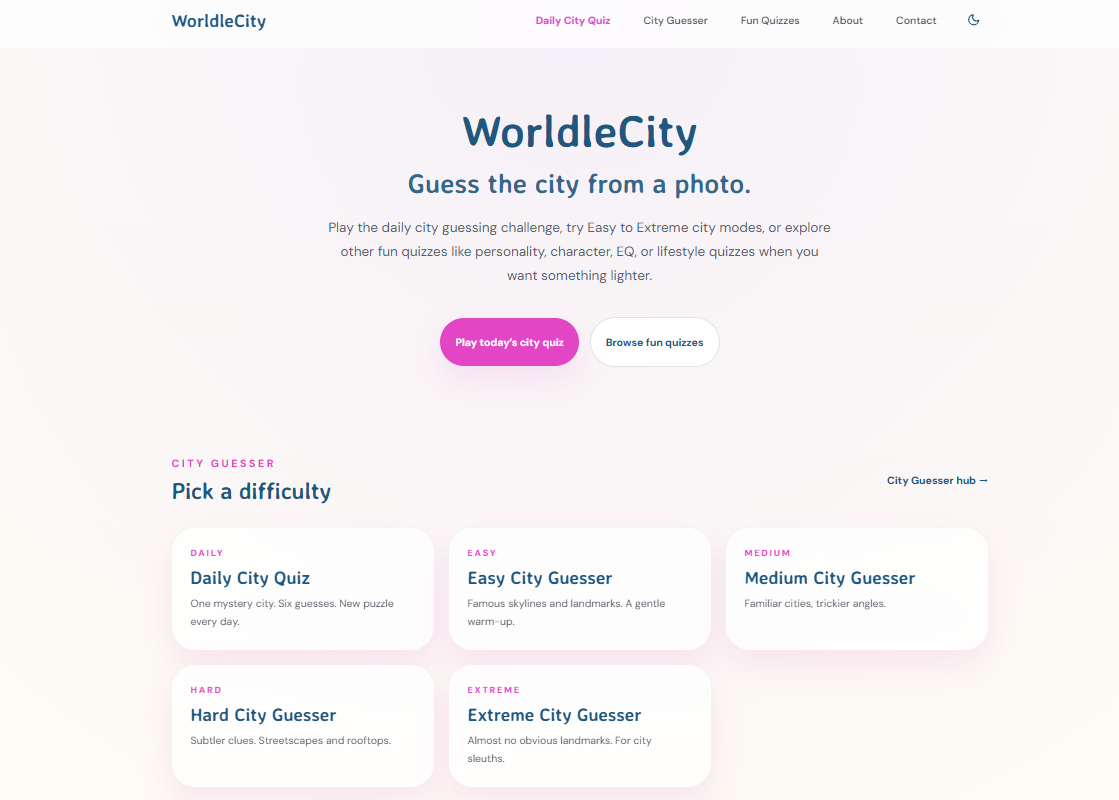
When you want something quicker, Worldlecity’s city guesser quizzes run across four difficulty modes and cover geography, personality, and lifestyle topics with no account required. You can try both formats back to back and feel exactly why they engage you differently. No pressure, no login, just a genuinely fun way to test what you know and sharpen what you do not.
FAQ
What is the main difference between a puzzle and a quiz?
A puzzle requires logical reasoning to find one correct solution, while a quiz tests existing knowledge through recall or preference. The cognitive process is different even when the topic is the same.
Are puzzles better than quizzes for learning?
Puzzles build deeper retention through active problem-solving, while quizzes are better for fast knowledge checks and social engagement. The best learning outcomes come from using both formats together.
What are the most common types of puzzles and quizzes?
Common puzzle types include crosswords, logic grids, and jigsaw puzzles. Common quiz types include trivia, personality quizzes, and quick knowledge checks. Each targets different skills and audience needs.
How many questions should a quiz have?
General-knowledge quizzes perform best with 6–10 questions, while personality quizzes work best at 3–6 questions. Shorter formats reduce drop-off and increase completion rates.
Can a quiz also be a puzzle?
Not technically. A quiz tests what you already know, while a puzzle asks you to reason toward an answer you do not yet have. Some formats blend elements of both, but the underlying cognitive demands remain distinct.