Why Quizzes Boost General Knowledge: Science Explained
Discover why quizzes boost general knowledge by enhancing memory retention and exposing knowledge gaps. Unleash your learning potential today!
- why quizzes boost general knowledge
- how quizzes improve learning
- quizzes for knowledge retention
- benefits of quizzes
- impact of quizzes on memory
On this page

Quizzes build general knowledge better than almost anything else because they force your brain to dig a fact back out instead of just letting it wash over you. Cognitive scientists call that digging retrieval practice, and it lays down stronger, longer-lasting memory than rereading or highlighting ever will. A 2026 meta-analysis in npj Science of Learning confirms that practice tests beat restudying for long-term retention. But memory is only part of it — quizzes also hand you instant feedback, expose the gaps you didn’t know you had, and spark the kind of motivation that actually brings you back tomorrow. To get why quizzes work, you have to look at the neuroscience and the psychology together.
Why quizzes boost general knowledge through retrieval practice
The engine behind quiz-based learning is retrieval practice. Answer a quiz question and your brain doesn’t just recognize the fact — it rebuilds the memory from scratch, which strengthens the pathway linking the cue to the stored information. Every successful pull makes that pathway faster and more reliable.

Learning science has a name for this: the testing effect. Retrieval practice forces you to generate the answer, and that effort builds durable memories that beat passive rereading in controlled experiments. The takeaway is blunt — if you want to remember something next week, quizzing yourself once beats reading it three times.
Feedback is the other half. Retrieval with corrective feedback pushes test scores up to 13 percentage points higher than restudy alone. That gap exists because feedback pulls double duty — it confirms what you’ve got right, which builds confidence, and it catches errors before they harden into false memories.
Scientists also talk about desirable difficulties — a bit of friction during learning, exactly what a good quiz creates, produces better long-term retention than smooth, effortless review. That small struggle to land an answer isn’t a sign learning is failing. It’s the signal that learning is actually happening.
Pro Tip: When you miss a question, don’t just clock the right answer — write one sentence on why it’s right. That extra beat deepens the encoding and makes you far less likely to trip on it again.
What retrieval practice buys you, in short:
- Strengthens specific memory pathways through active recall
- Exposes the gap between what you think you know and what you actually know
- Corrects misconceptions before they set
- Builds metacognitive awareness, so you study smarter
How do quizzes improve motivation and engagement for learning?
Memory science explains how quizzes work. Motivation science explains why you keep showing up. The ARCS model, from John Keller, names four psychological drivers of lasting learning motivation — Attention, Relevance, Confidence, and Satisfaction. A well-built quiz hits all four.
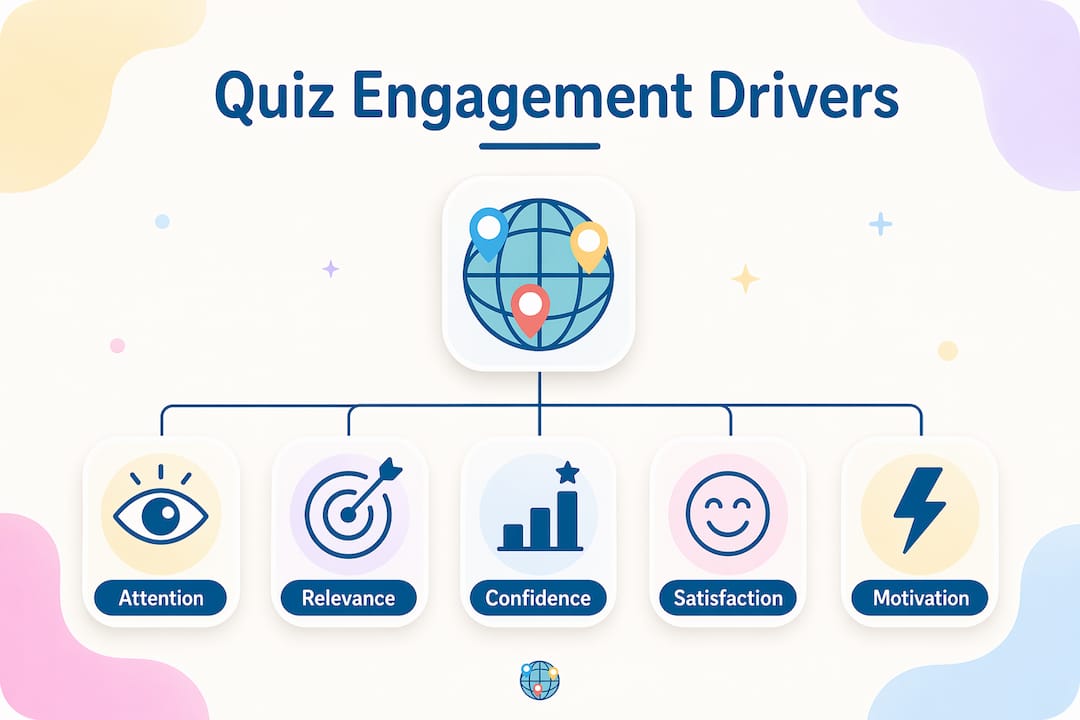
A 2026 study on gamified quizzes found that platforms like Quizizz lift learner motivation by serving immediate results, building a sense of progress, and tying content to real-world relevance. Confidence and satisfaction scores among learners using gamified formats ran measurably higher than in traditional study conditions. That matters more than it sounds — motivation is what decides whether you come back tomorrow.
Here’s how the ARCS model maps onto quiz design that actually works:
- Attention comes from varied question formats, surprising facts, and timed challenges that kill passive scrolling.
- Relevance comes from topics that hook into what you already care about — geography, history, science, or culture.
- Confidence builds when difficulty is tuned so you win often enough to feel progress, without the material going trivial.
- Satisfaction lands with immediate feedback, score summaries, and the social sharing of results that platforms like Worldlecity put front and center.
Competition adds another layer. Gamified quizzes ride the line between motivation and anxiety — competitive elements boost engagement, but crank the stakes too high and you tip into test anxiety. The fix is a low-stakes setup where a wrong answer costs nothing. When failure is just information rather than judgment, people take bigger swings, attempt harder questions, and ultimately learn more.
“The best quiz environment is one where getting something wrong feels like a clue, not a verdict.”
Low-stakes formats also kill the illusion of competence. Reread a chapter and everything feels familiar, so you overrate your mastery. A quiz shatters that in seconds — uncomfortable for about thirty of them, then genuinely useful.
What quiz designs best build and retain general knowledge over time?
Knowing quizzes work is only half the picture. How they’re designed decides how much knowledge actually sticks. Spaced practice improves retention more reliably than retrieval practice alone, per a 2026 meta-analysis spanning math and several other domains. Spacing just means spreading sessions across days and weeks instead of cramming them into one sitting.
Cumulative quizzes — the ones that loop older material back in alongside new content — are especially good for building general knowledge. They break the learn-it-for-the-test-forget-it-in-two-weeks cycle. Every time an old fact resurfaces in a new quiz, its memory trace gets refreshed and reinforced.
Pro Tip: Run a 10-minute quiz three times a week instead of one 30-minute session. Same total time, much better retention — because spacing forces repeated retrieval across longer intervals.
Question format matters more than most learners clock:
| Question format | Strength | Best use case |
|---|---|---|
| Multiple choice (recognition) | Fast, low friction, good for broad topic coverage | Introducing new knowledge areas |
| Free recall (open answer) | High retrieval effort, strongest memory encoding | Reinforcing facts already encountered |
| Ordering or matching | Tests relational understanding, not just isolated facts | Concepts with sequences or categories |
| Image-based identification | Engages visual memory pathways | Geography, art, science identification |
Low-stakes quizzes reduce overconfidence and sharpen calibration — you become a more accurate judge of what you actually know. That metacognitive payoff is one of the most underrated perks of regular quizzing. You stop pouring time into stuff you’ve already got and aim it where it counts.
Immediate feedback after each question beats delayed feedback for fixing errors on the spot. Delayed feedback — a day or two later — works better for cementing answers you got right. Use both in one program and you get the strongest result.
How do quizzes compare to other learning methods?
Passive methods — rereading, watching videos, sitting through lectures — breed a sense of familiarity that’s easy to mistake for mastery. Quizzes drag the gaps that passive review hides into the open, forcing you to face what you don’t actually know. That diagnostic alone makes them more efficient than most of the alternatives.
Side by side:
- Rereading: builds familiarity, not recall. Manufactures the illusion of competence. Needs many passes to leave any durable memory.
- Highlighting and note-taking: fine for initial encoding, but zero retrieval practice. The memory fades without follow-up testing.
- Quizzing: forces active recall, exposes gaps, delivers feedback, and builds durable memory pathways in fewer total hours.
- Spaced quizzing: retrieval practice plus optimal timing — the strongest long-term retention of any self-study method.
The motivation gap is just as stark. Rereading a chapter for the third time is a reliable path to bored and unproductive. A timed quiz on the same material creates urgency, engagement, and a result at the end. That result — a score, a streak, a comparison with yesterday — is the feedback loop that keeps the habit alive over weeks and months.
Quizzes also scale across age groups and settings in ways structured study sessions don’t. A ten-year-old playing a geography guessing game and a forty-year-old drilling world capitals before a trip are both doing retrieval practice. The format flexes; the mechanism doesn’t. Get a feel for quiz patterns and tricks and you’ll sharpen how you handle different question types, too.
Key takeaways
Quizzes build general knowledge more effectively than passive study because retrieval practice, spaced repetition, and immediate feedback team up to create memory that’s durable and accurate.
| Point | Details |
|---|---|
| Retrieval practice beats rereading | Active recall strengthens memory pathways in ways passive review cannot replicate. |
| Feedback corrects errors fast | Immediate corrective feedback prevents false memories and raises test scores by up to 13 points. |
| Spacing multiplies retention | Distributing quiz sessions across days produces stronger recall than massed study sessions. |
| Low stakes improve calibration | Low-pressure quizzes reduce overconfidence and help learners identify real knowledge gaps. |
| Motivation sustains the habit | Confidence, satisfaction, and relevance in quiz design keep learners engaged over the long term. |
Quizzes as a daily habit: what I’ve actually learned
I spent years treating quizzes as something you did right before a test, not a learning method in their own right. Wrong framing — and it cost me a lot of inefficient study time. Things shifted when I started treating a ten-minute quiz as a daily check-in instead of a performance event. The pressure vanished, and within weeks the retention noticeably improved.
What most people miss is the spacing. They quiz themselves hard for a few days, feel sharp, and stop — then the knowledge evaporates. The research on spaced retrieval is blunt about this: consistency across time beats intensity in a single session, every time.
The other thing I underrated was format variety. Mixing image-based questions with free recall and multiple choice isn’t just more entertaining — it encodes knowledge through different cognitive channels, which makes it easier to pull back later. A geography quiz that shows you a photo of a city skyline and asks you to name it is doing something fundamentally different from a text-based capitals quiz. Both help. Together, they beat either one alone.
Honest advice: start with topics you already like. The motivational lift from relevance is real, and it carries you into the harder material once the habit is set. Platforms that pair geography games with broader quiz formats are great for this — the variety keeps things fresh without making you bounce between tools.
Build your general knowledge with Worldlecity
Want to put these principles into practice? Worldlecity is built around exactly the quiz design the research supports.
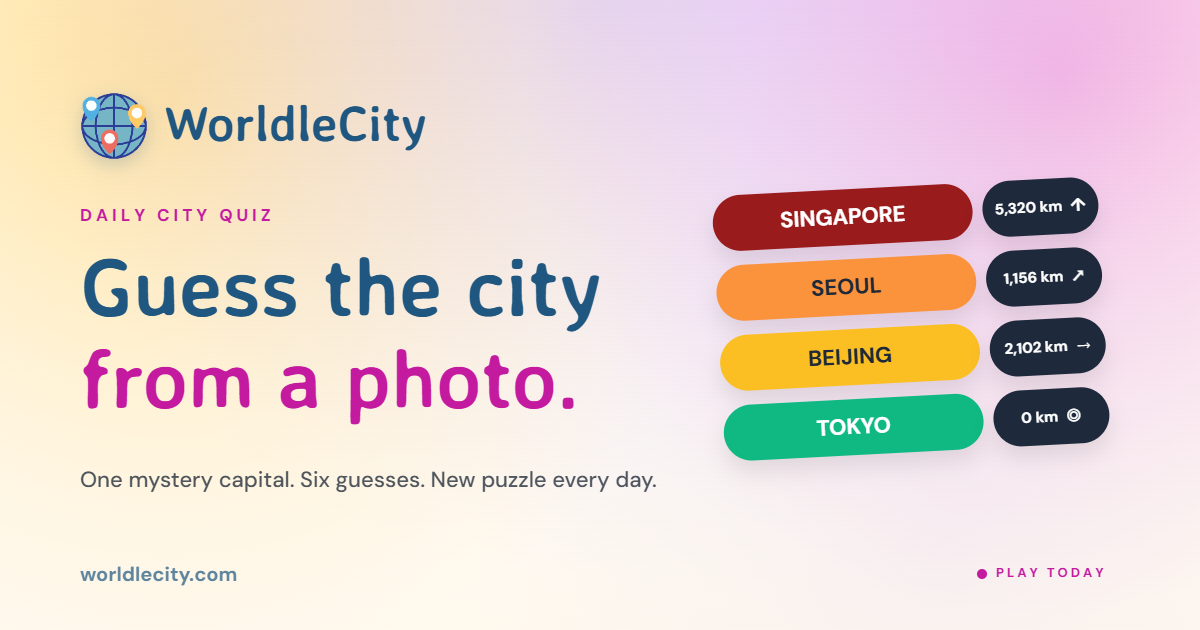
Every day, Worldlecity shows you a photo of a mystery city and gives you six shots to identify it, with directional feedback after every guess. That instant feedback loop mirrors the corrective mechanism that makes retrieval practice so effective. Past the daily challenge, there are city guesser quizzes across four difficulty modes, plus personality and lifestyle quizzes that need no account. The daily city guessing game is free, social, and built to make geography knowledge genuinely stick. Building a habit from scratch or sharpening skills you already have, Worldlecity turns the science of quizzing into something you’ll actually look forward to.
FAQ
Why do quizzes improve memory better than rereading?
Quizzes force active retrieval, which strengthens memory pathways in ways passive review cannot. The testing effect shows that recalling information produces more durable memories than re-exposing yourself to the same material.
How often should you quiz yourself to retain general knowledge?
Spaced sessions distributed across multiple days outperform single long study blocks. A 2026 meta-analysis confirms that spacing produces more consistent retention gains than massed retrieval practice alone.
Do low-stakes quizzes actually help you learn more?
Yes. Low-stakes quiz formats reduce overconfidence and improve metacognitive calibration, meaning learners become more accurate about what they know and can direct study effort more efficiently.
What makes gamified quizzes more motivating than traditional study?
Gamified quizzes activate the ARCS model drivers of attention, relevance, confidence, and satisfaction simultaneously. Research on Quizizz in learning environments shows measurably higher motivation scores compared with conventional study methods.
Can quizzes help with subjects outside of school or formal learning?
Retrieval practice works for any domain where facts, concepts, or patterns need to be remembered. Geography, history, science, and culture are all well-suited to quiz-based learning, and the cognitive mechanism functions the same regardless of the subject or the learner’s age.