How to Identify European Cities from Skyline Photos: Five Worked Examples
Five European cities, five photos I took myself, and the one detail in each frame that names the city, from Prague's rooflines to Amsterdam's bike racks.
- European skyline recognition
- Identify city skylines
- Famous European city landmarks
- Identifying architecture in photos
- Skyline photos of Europe
On this page
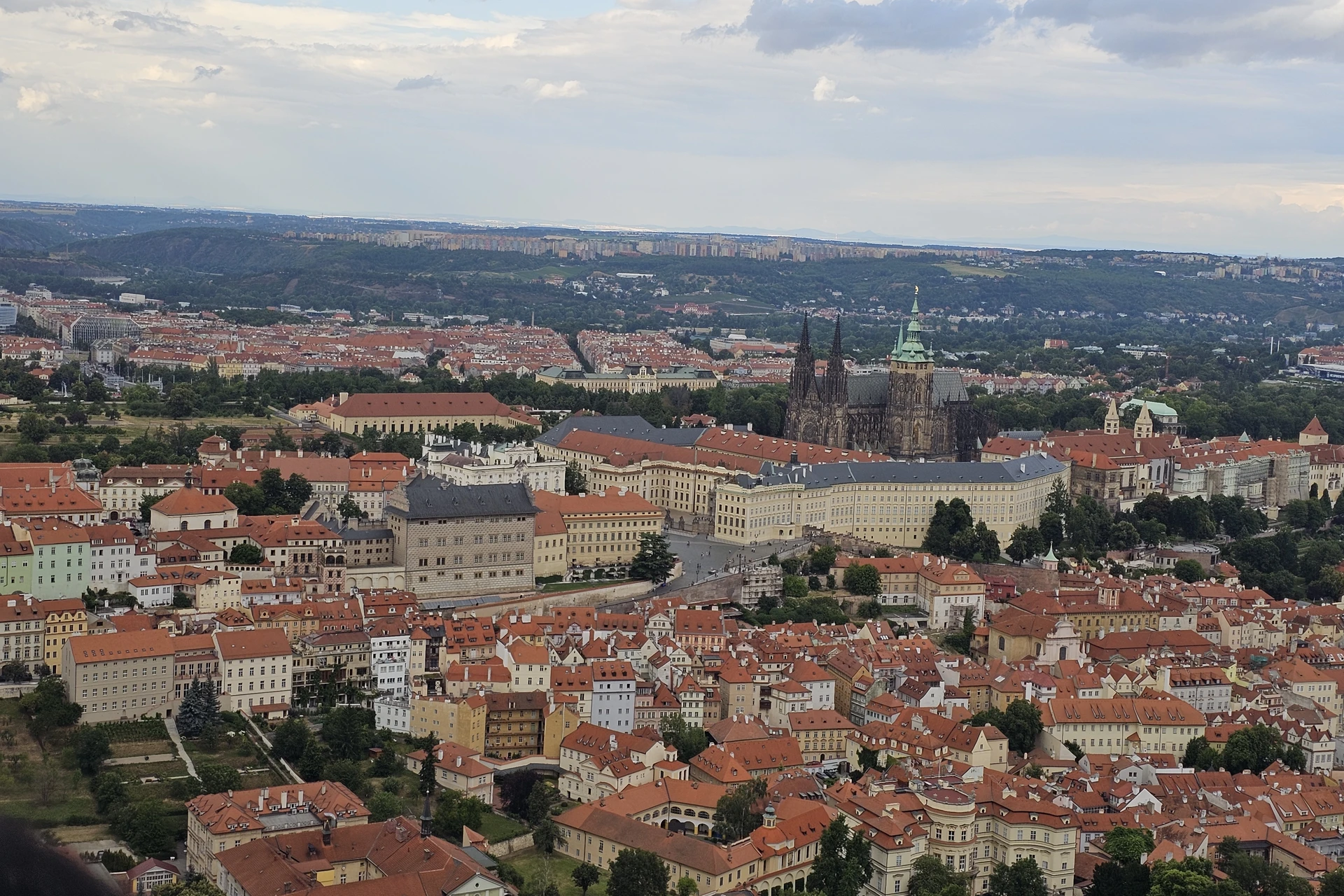
Skyline identification means naming a city from its visual profile alone: rooflines, landmark silhouettes, terrain, and street-level detail, with no map and no metadata to fall back on. This guide works through five European cities using photos I took myself in Prague, Budapest, Bratislava, Lucerne, and Amsterdam, and in each one I point at the specific detail that settles the answer. The method comes first and the software comes second, and there is a reason for that order.
What visual and architectural clues reveal a European city skyline?
European skylines have a personality that American and Asian skylines do not share. Most European centres are low and horizontal, punctuated by a single dominant dome, spire, or tower rather than a wall of glass. When one religious or civic building rises clear above everything around it, you are almost certainly looking at a European city.
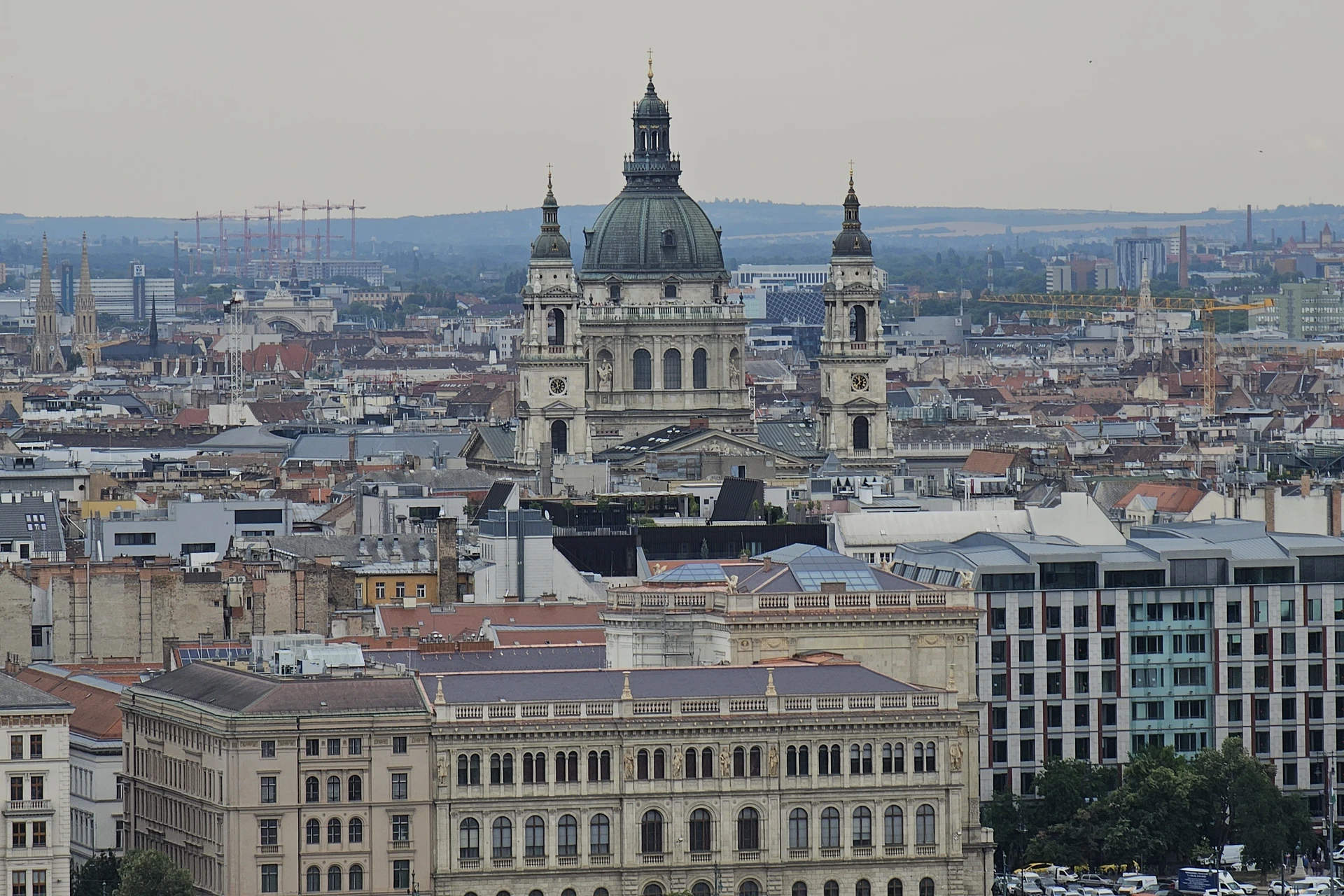
That is Budapest, photographed from the Fisherman’s Bastion on the Buda side of the Danube, looking across into Pest. The dome breaking the roofline is St. Stephen’s Basilica, and the reason it reads so cleanly is regulatory rather than architectural. At 96 metres it is exactly as tall as the Hungarian Parliament, and for a long stretch of the city’s history nothing in Budapest was permitted to exceed that height. The result is a skyline with a deliberate ceiling. Very few European capitals sit this flat around a single dome, which makes the shape itself a strong clue.
Landmark silhouettes as instant identifiers
A handful of European cities are identifiable from the skyline alone. Paris has La Défense’s cluster of towers set well apart from the historic core. London’s Canary Wharf forms a tight, American-style group. Frankfurt is the only German city with a genuine high-rise skyline, which is how it earned the nickname “Mainhattan.”
Those three are the outliers. Most European cities give you exactly one unmistakable structure, and finding that structure is faster than trying to read the skyline as a whole.
Architectural style and urban layout
Cities built before the 20th century share a recognisable urban grammar: block courtyards, narrow street grids, and consistent four-to-seven-storey heights across Vienna, Prague, and Amsterdam alike.
The photo at the top of this page is the clearest example of that I have. It is Prague from the Petřín Tower, an almost unbroken field of red-orange clay tile, with Prague Castle and the Gothic spires of St. Vitus Cathedral as the only things breaking the plane. Roof material on its own is a strong regional filter: terracotta tile through Central and Southern Europe, slate and metal as you move north.
Stone colour works the same way. Oxford’s architectural styles are held together by local Cotswold limestone, whose “warm honey-gold colour unifies buildings across nine centuries.” That palette reads as instantly un-Prague as it does un-Amsterdam.
Natural features and lighting as geographic clues
Water and terrain narrow a search faster than any building. Prague sits on the Vltava, Budapest straddles the Danube, Lisbon runs downhill to the Tagus.
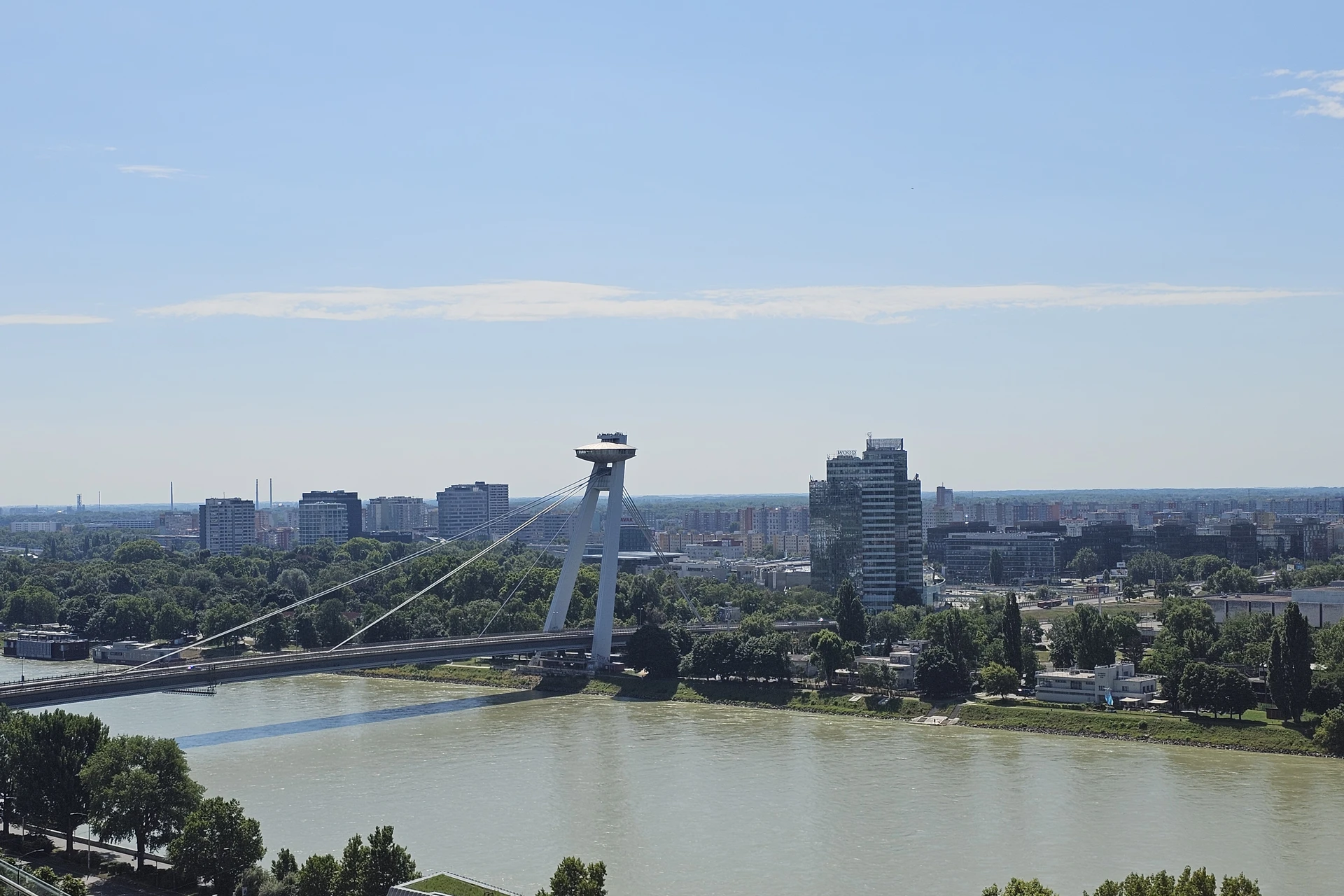
Bratislava, from the castle terrace in July 2023. The Danube gives you the region. The UFO observation deck cantilevered off the pylon of Most SNP gives you the city outright. This is the single-structure case from the section above: once you have the deck, you do not need to read the rest of the frame.
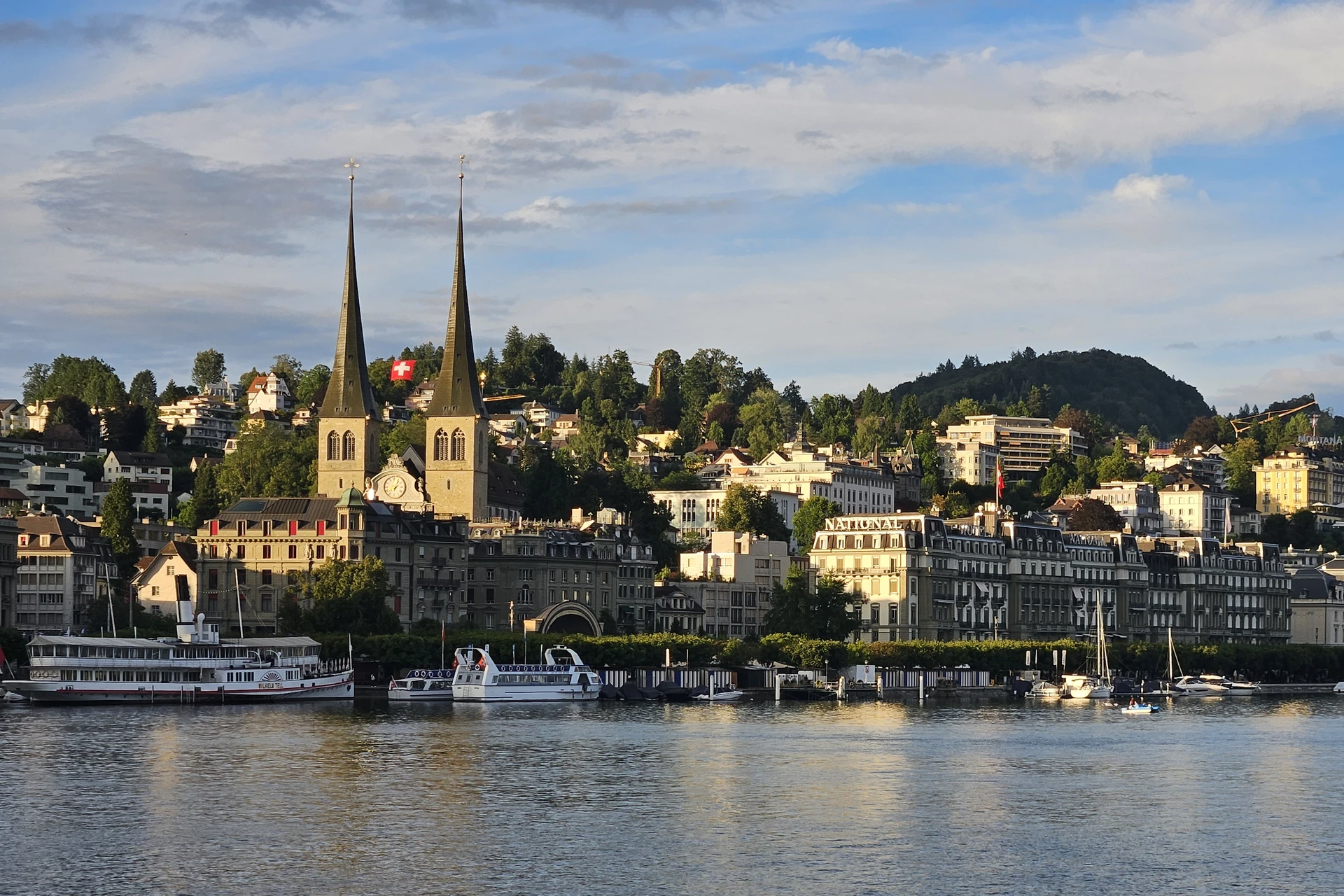
Lucerne solves it with a different combination: a lake rather than a river, the twin spires of the Church of St. Leodegar on the rise behind the waterfront, and grand 19th-century hotel frontage along the shore, the Grand Hotel National among it. A lakefront hemmed in by steep ground puts you in the Alpine belt long before you identify any single building.
Light is the other half of this. Shadow direction and length fix the time of day, and with more effort a rough latitude band. A low sun throwing long shadows in the middle of the day points north rather than Mediterranean, which is a useful sanity check on a guess you are already leaning towards.
Pro Tip: Check the vegetation. Palms suggest the Mediterranean, birch and pine suggest Scandinavia, and a dense deciduous canopy suggests Central Europe. Planting is slow to change and rarely lies.
How to manually identify European cities from skyline photos
There is no fixed clock on this. A recognisable landmark can resolve in under a minute, while an unremarkable residential street can take half an hour or beat you entirely.
The sequence below is ordered deliberately, from what your eyes can do to what a browser can do. Work down it and stop as soon as the city is obvious. Every attempt you make not to use AI tools directly is a step that would have taught you something.
-
Read the roofs and the building materials. This is the widest filter you have and it costs nothing. Terracotta tile puts you in Central or Southern Europe, slate and dark metal push you north, and render colour narrows it further. Uniform four-to-seven-storey heights mean a pre-20th-century core.
-
Read the terrain and the water. River, lake, coast, or none. Flat, hilly, or ringed by mountains. A city built up a hillside behaves differently in a photo than one on a plain, and terrain cannot be renovated away.
-
Read the street, not the horizon. Street furniture, road markings, bollards, tram rails, and lamp standards. These are set by national standards, so they repeat across a country and stop at its borders. This step usually settles the country outright.
-
Read the language and the alphabet. Any legible shop sign, street plate, or poster narrows Europe fast. Diacritics do a lot of the work: å, ø, and æ point Nordic, ř and ů point Czech, ő and ű point Hungarian, ł and ż point Polish.
-
Commit to a candidate, then find the landmark. Only now look back at the skyline and ask which dome, spire, or tower fits the city you have arrived at. Reversing this order is what sends people chasing the wrong cathedral for twenty minutes.
-
Confirm in satellite and Street View. Find the approximate spot on Google Maps, switch to satellite to match the building cluster, then drop into Street View to compare ground-level detail against your photo. This is verification of an answer you already reasoned out, not a search for one.
A worked example: arriving at Amsterdam
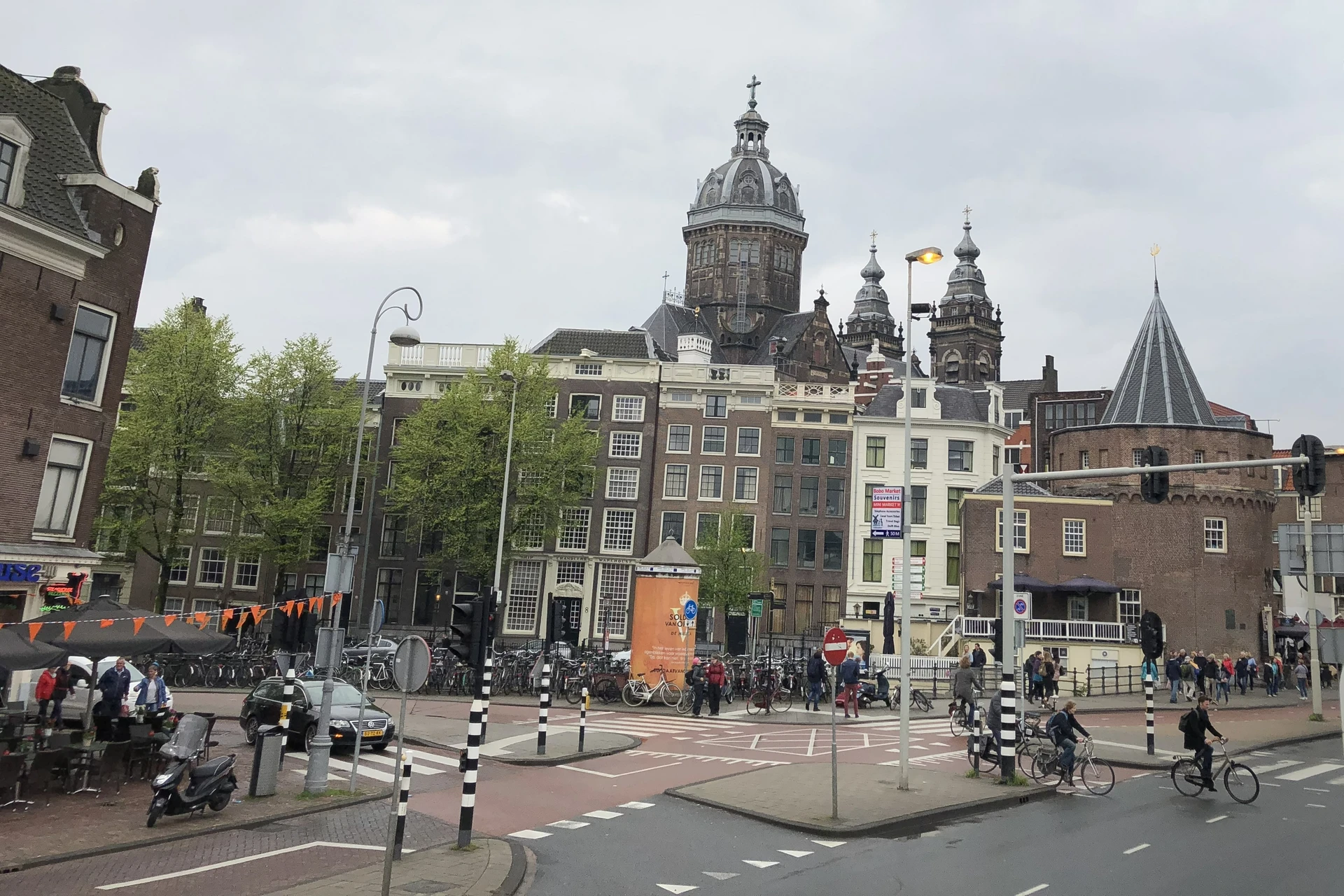
Almost none of the evidence in that frame is in the skyline. Here is the same ladder, applied in order.
-
Roofs and materials. Narrow, tall brick facades packed shoulder to shoulder, four to five storeys, with windows taking up an unusual share of the frontage. That is Northern European and specifically Low Countries. Southern Europe does not build this narrow or this vertical.
-
Terrain and water. Dead flat, with no rise anywhere in shot. That removes the Alpine candidates and most of the hillier Nordic ones immediately.
-
The street. This is where it is won. Bicycles parked in dense ranks, a dedicated bike path carrying more of them, and cyclists outnumbering cars at the intersection. That density of cycling infrastructure narrows Europe to a very short list, essentially the Netherlands and Denmark. Then look at the signal post: black, banded in white, with a round yellow sensor housing on top. Traffic signals follow national specifications, and that combination is Dutch rather than Danish.
-
Language and colour. Orange banners strung overhead. Orange is the Dutch national colour, so a street dressed in it confirms the country rather than merely suggesting it.
-
Commit, then find the landmark. The country is settled, so now the skyline earns its keep. The dome in the background belongs to the Basilica of Saint Nicholas, which puts you in central Amsterdam near Centraal Station.
-
Confirm. Drop into Street View by the station and match the facades and the signal post against the photo.
The skyline came fifth out of six. That is the whole point of the order. The bikes, the signal post, and the banners are all nationally specified and change on a timescale of decades, while a roofline can change in a single construction season.
Which digital tools and AI technologies help with skyline identification?
Modern AI can attempt all of this, provided you treat every result as a candidate rather than an answer.
- Google Lens is the fastest option. Drop a cropped image into it and you get visually similar results, often with city names attached. It works far better on one isolated distinctive building than on a full panorama, which is why cropping matters. Locus does the same thing internally, cutting each building it detects out as its own 224×224 image before matching.
- GeoSpy AI is purpose-built for photo geolocation, working from environmental and architectural features rather than metadata. It publishes no benchmark, so treat its confidence as a suggestion.
- Locus is an open-source pipeline that detects individual buildings in a photo, encodes each one as a 2048-dimensional vector with ResNet50, and queries a FAISS index for the five most similar buildings it has seen. It returns candidates for review, not a location.
- TerraSky3D is a dataset of 50,000 images across 150 ground, aerial, and mixed scenes of European landmarks, published with calibration data, camera poses, and depth maps. It targets 3D reconstruction rather than classification, but it is exactly the kind of multi-view data that closes the gap between a photo shot from the pavement and imagery captured from the air.
How accurate are these tools?
| Tool | What it actually does | Published accuracy |
|---|---|---|
| Google Lens | Visual similarity search | Reliable on famous landmarks, weak on generic streets |
| GeoSpy AI | Environmental and architectural feature analysis | No published benchmark |
| Locus | ResNet50 embeddings plus FAISS retrieval | Returns its top five building matches |
| Hybrid research models | Multi-modal data fusion | Over 68% within 200m on a large-Europe dataset |
The strongest published figure belongs to that last row. The authors report that their approach “can localize within 200m more than 68% of queries of a dataset covering a large part of Europe.” That is genuinely impressive, and it also means close to a third of queries land somewhere else entirely.
When not to use any of this
If you are playing a quiz, a puzzle, or a daily guessing game, none of the above belongs anywhere near it. Pasting the photo into Google Lens does not win the round so much as cancel it. The whole pleasure of the format lives in the few seconds between noticing the roof tiles and working out what they mean, and a reverse image search deletes exactly that interval. You are left with a correct answer and no better chance at the next one, which is the opposite of why you sat down.
AI earns its place when the answer matters more than the practice:
- Verifying a conclusion you already reached. You reasoned your way to Ljubljana and want a second opinion before publishing it.
- Archive and provenance work. Dating and placing an inherited photograph, or any image that arrived with no caption and no surviving context.
- Journalism and open-source research, where a location has to be established under deadline and being right matters more than the exercise.
- Volume. Sorting several hundred unlabelled holiday photos into cities is a filing problem, not a puzzle.
- Regions you have no reference for at all. If you have never seen a Baltic street scene, a tool gives you somewhere to start reasoning from instead of a blank page.
In all five the workflow is the same: let the tool produce a shortlist, then confirm it yourself in Street View. The one thing it should never be is a shortcut past the part you were trying to learn.
Common mistakes when identifying European cities
Europe has its own failure modes, and most of them come from shared history rather than shared geography.
- Reading a shared imperial style as a single city. Habsburg-era public buildings repeat a very specific ochre-yellow render with white trim across Vienna, Budapest, Bratislava, Ljubljana, and Zagreb, because one administration commissioned them. That colour tells you the former Austro-Hungarian sphere, not which city inside it. The same trap runs through the former Eastern Bloc, where prefabricated panel housing repeats almost identically from Leipzig to Sofia.
- Assuming an old-looking core is old. Large parts of central Europe are careful post-war reconstructions. Warsaw’s Old Town was rebuilt after 1945, Rotterdam’s centre was destroyed in 1940 and replaced with modernist blocks, and Dresden’s Frauenkirche was only completed again in 2005. A medieval silhouette does not guarantee an untouched city, and a modern one does not rule out an ancient one.
- Confusing similar civic landmarks. Large red-brick civic buildings with a single dominant tower photograph almost identically. Stockholm’s City Hall and Hamburg’s Rathaus are the classic mix-up, both dark-toned, both beside water. Never commit to a city on building type alone.
- Trusting the skyline alone. Skylines change: towers go up, cranes move, and a profile from 2010 may be unrecognisable by 2026. PlaceSpotter’s beginner checklist makes the point from the other direction, recommending you anchor on what stays constant, namely building shapes and arrangements, road intersections and layouts, terrain, and unusual architectural details.
Several of the remaining pitfalls are not European at all. They apply to a photo of any city anywhere, and they are covered separately in how to identify cities from photos, which works through facades, interiors, signage, and street-level images rather than skylines.
Key takeaways
| Point | Details |
|---|---|
| Work eyes-first, browser-last | Roofs, terrain, street furniture, language, then the landmark, then Street View. |
| Look for the ceiling | Many European skylines are capped by regulation, like Budapest’s 96-metre limit, leaving one dome or spire dominant. |
| Roof and stone colour are regional | Terracotta tile across Central and Southern Europe, slate further north, honey limestone in Oxford. |
| One structure usually settles it | Bratislava’s UFO deck names the city on its own, so you rarely need the whole skyline. |
| Shared history creates lookalikes | Habsburg yellow and Eastern Bloc panel housing identify a region, not a city. |
| The foreground is the stable part | Bike racks, signal posts, and paving outlast any roofline and follow national standards. |
Practice your skyline skills with WorldleCity
Reading about skyline identification is one thing. Doing it daily, under a little friendly pressure, is where the skill actually sticks.
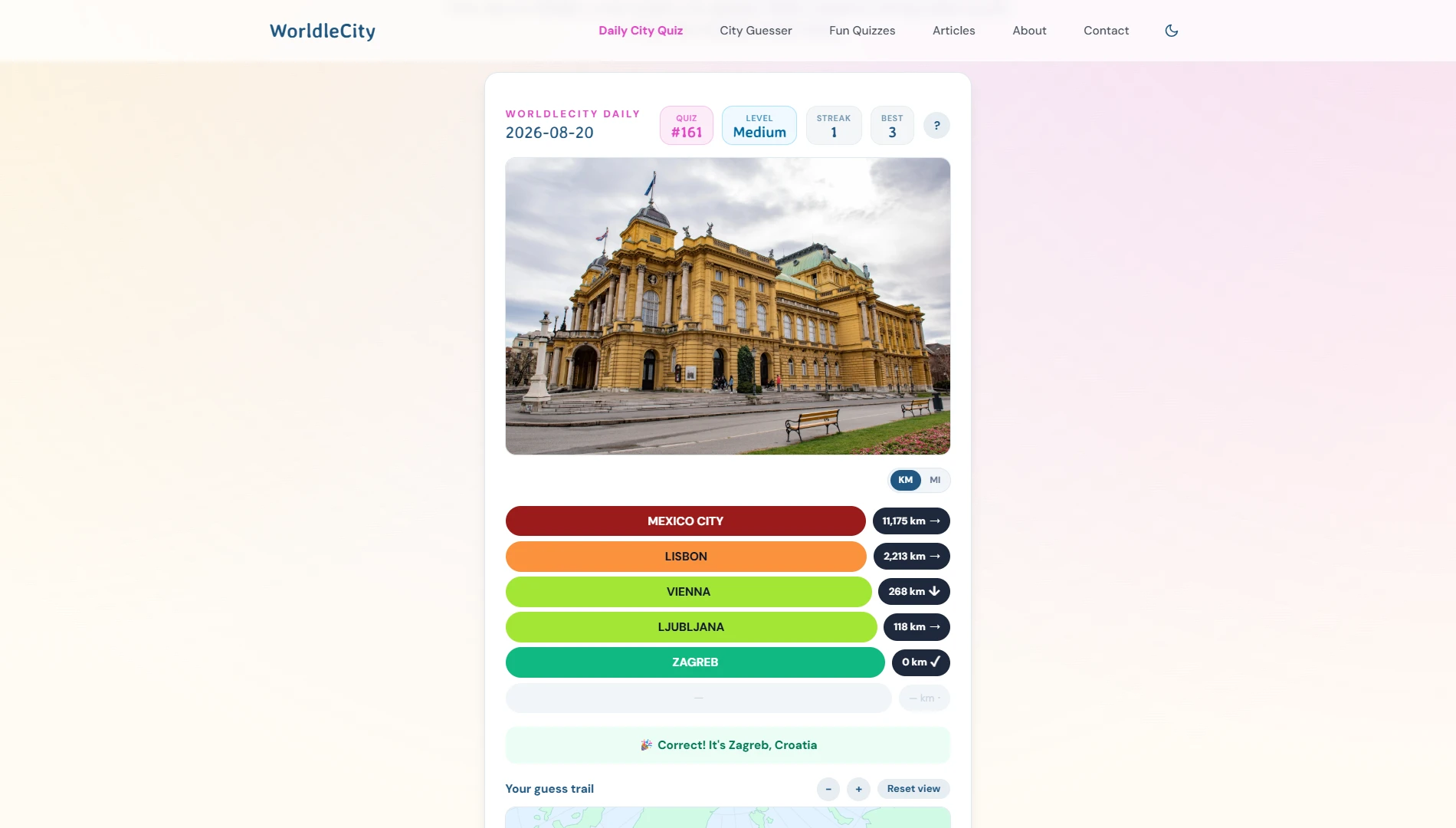
That is a real round, daily quiz #161, which came up at medium level that day. The first guess, Mexico City, came back 11,175 km out. Lisbon pulled it to 2,213 km. Vienna landed 268 km away with an arrow pointing south, Ljubljana narrowed it to 118 km, and Zagreb closed it on the fifth attempt.
Now run that photo through the ladder above and watch the round get shorter. Step one, roofs and materials: a grand ochre-yellow civic theatre with white stone dressing, statuary along the roofline, and a formal landscaped plaza in front of it. Stone and render like that are European, so Mexico City is gone before a guess is spent. Step one also reads the colour, and that yellow-with-white is Habsburg municipal architecture, which places the answer in the former Austro-Hungarian sphere and spends Lisbon pointlessly too. Step three, the street, agrees: the kerbs, benches, and lamp standards are Central European rather than Iberian.
That is two wasted guesses avoided before touching a map, and it leaves a shortlist of Vienna, Budapest, Bratislava, Ljubljana, and Zagreb. Open with Vienna instead of Mexico City and the 268 km arrow pointing south hands you Zagreb on the second or third attempt rather than the fifth. The photo is the visual-clue half and the distance and direction after each guess are the elimination half, which is the same pairing this whole article is built on.
WorldleCity posts a new mystery city photo every day and gives you six attempts. There are also city guesser quizzes with four difficulty modes to choose from, running from obvious capitals to mid-size cities that will trouble seasoned travellers. No account needed.
FAQ
What are the easiest European city skylines to recognize?
Paris, London, and Frankfurt, because each one breaks the European pattern with a genuine high-rise cluster: La Défense, Canary Wharf, and Frankfurt’s “Mainhattan” banking towers. Most European cities are the opposite case, being low, flat, and identified by a single dominant dome, spire, or tower rather than by a skyline as a whole.
Can AI identify a city from a skyline photo without GPS data?
Yes. Tools like GeoSpy AI and Locus work from visual features rather than metadata. The strongest published research figure reports localizing more than 68% of queries within 200 metres on a dataset covering a large part of Europe, which still leaves close to a third of queries landing somewhere else. Treat any AI output as a shortlist to verify rather than an answer, and keep it out of quizzes and games entirely, where handing the photo to a tool just ends the round.
How long does manual skyline identification take?
There is no fixed time. A recognisable landmark can resolve in well under a minute, while an unremarkable residential street can take half an hour or defeat you entirely. What reliably saves time is the order of work: read the roofs and materials first, then the terrain and water, then the street-level detail, then any legible signage, commit to a candidate, and only then open Street View to confirm it.
Why do micro-clues work better than skylines for city identification?
Street furniture, road markings, paving, and signage are specified to national standards, so they repeat across a country, stop at its borders, and stay put for decades. A skyline can change in a single construction season, which means a photo taken ten years ago may no longer match what you see on a map today.
How do I improve my ability to recognize city skylines over time?
Repeated exposure to real photos with immediate feedback. The daily game on WorldleCity shows you a photo of one city each day and tells you after every guess how far off you were and in which direction, which builds a mental map of European cities faster than reading about them does.