What Does Quiz Category Mean? A Clear Guide
Discover what does quiz category mean and how it enhances your quiz experience. Play smarter and design better quizzes with our clear guide.
- quiz categories
- types of quiz categories
- how are quizzes grouped
- thematic quiz
- logic based quiz
On this page

A quiz category is a defined grouping that organizes quiz questions by theme or segments quiz results by logic. You see this concept at work everywhere, from pub trivia nights to daily geography challenges on platforms like Worldlecity, to personality assessments on Interact. Whether you’re sorting capitals from landmarks or figuring out which Stranger Things character you are, quiz categories are the invisible architecture making it all work. Understanding what does quiz category mean helps you play smarter, design better, and get more out of every quiz you take.
What does quiz category mean, exactly?
A quiz category is a thematic bucket used to group questions in trivia and interactive games. Think of it as a folder. Every question inside that folder shares a common subject, skill level, or logical purpose.
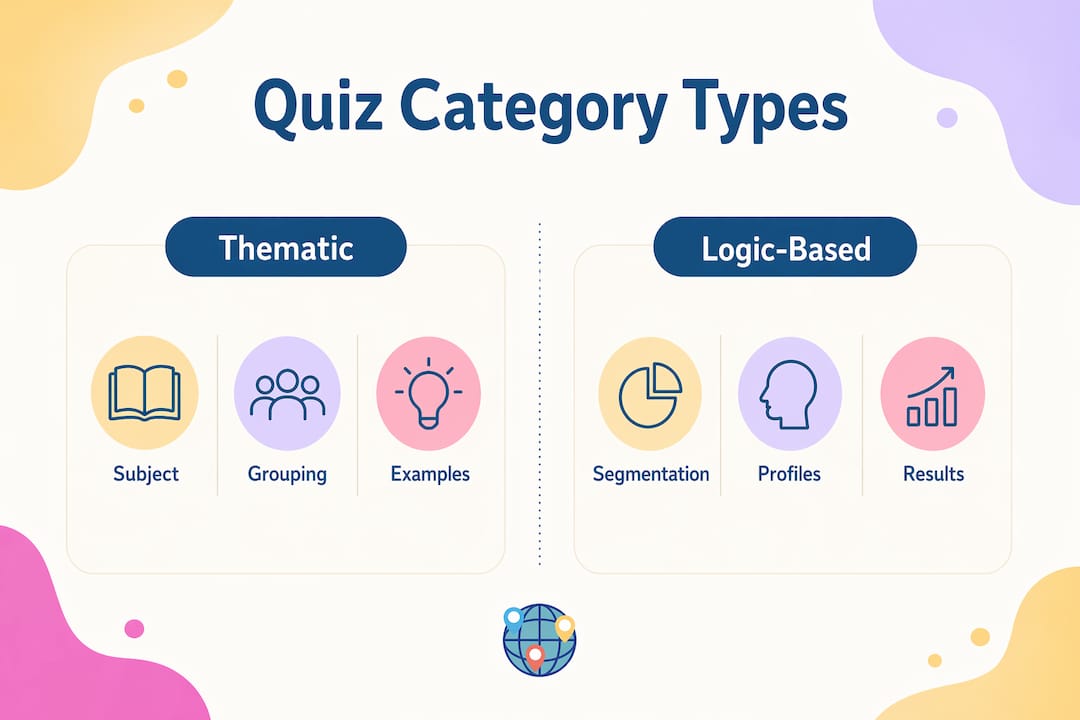
There are two distinct types. The first is a thematic category, which organizes questions by subject matter. Geography, history, science, and pop culture are all thematic categories. The second is a logic-based category, which segments players into outcome groups based on how they answer. Personality quizzes use this type constantly.
These two types serve completely different goals. A thematic category tells you what the question is about. A logic-based category tells you what your answers reveal about you. Mixing them up is one of the most common design mistakes quiz creators make.
What are the main types of quiz categories?
Quiz categories split cleanly into two families, and each family has its own rules.
Thematic categories cover subject areas. Here are the most common ones you’ll encounter:
- Geography: Capitals, flags, landmarks, continents, rivers
- History: Ancient civilizations, wars, timelines, famous figures
- Science: Biology, physics, chemistry, space
- Pop culture: Movies, music, TV shows, sports
- General knowledge: Mixed facts that don’t fit a single subject

Logic-based categories work differently. Instead of grouping questions, they segment users into profiles rather than providing a single score. A quiz about travel habits might route you into “The Adventurer,” “The Planner,” or “The Homebody” based on your answer patterns.
The structure of these categories matters a lot. Interact, a popular quiz platform, recommends using 4–6 categories with at least 2 questions mapped to each one. That range gives you enough variety to feel meaningful without overwhelming the player.
Pro Tip: If you’re building a personality quiz, sketch your categories before writing a single question. Knowing your 4–6 outcome groups first makes it much easier to write questions that actually sort people correctly.
Category structure also shapes the difficulty curve. A well-designed thematic quiz mixes easy, medium, and hard questions across categories so no single section feels like a wall. A well-designed logic quiz balances how many questions point toward each outcome so no single result dominates unfairly.
How are quiz categories used in geography quizzes and interactive games?
Geography quizzes rely on categories more than almost any other quiz type. The subject matter is so broad that without categories, a geography quiz becomes a random pile of facts. Categories give it shape.
Here are the most common geography quiz categories you’ll run into:
- Capitals: Name the capital city of a given country, or identify which country a capital belongs to.
- Flags: Recognize national or regional flags from images, colors, or symbols.
- Landmarks: Identify famous buildings, monuments, or natural wonders from photos or descriptions.
- Continents and regions: Place countries within the correct continent or geographic region.
- Rivers and mountains: Name major waterways or mountain ranges based on clues or maps.
Each of these categories tests a different geographic skill. Capitals test memory. Flags test visual recognition. Landmarks test cultural awareness. That variety is the point. Map-based quiz games use these categories to keep rounds feeling fresh and to give players a fair shot regardless of their specific strengths.
Interactive games like Worldlecity’s daily city guessing challenge take this further. Instead of a static category list, the game uses a photograph of a mystery city as the prompt. Players use visual clues like architecture, street layout, and vegetation to narrow down their guess. That’s a landmark and urban geography category rolled into one dynamic challenge.
Categories also control difficulty balance. A quiz that stacks five consecutive capital questions feels monotonous. Rotating through flags, landmarks, and rivers keeps energy up and tests a wider range of knowledge. Quiz patterns and category rotation are actually learnable strategies that help players perform better over time.
What are the best practices for designing quiz categories?
Good quiz category design is less about creativity and more about proportion. Industry standards recommend a trivia mix of 60% universal, 30% niche, and 10% skill-based categories to maintain player engagement. That ratio exists for a reason.
| Category type | Recommended share | Purpose |
|---|---|---|
| Universal (geography, history, science) | 60% | Keeps broad audiences engaged |
| Niche (specific fandoms, local knowledge) | 30% | Rewards specialists without alienating others |
| Skill-based (logic puzzles, math) | 10% | Adds challenge without causing drop-off |
Too much niche content is the biggest lever in quiz planning that hosts get wrong. When a quiz leans too heavily on niche categories, participation drops because most players feel locked out. Universal categories keep everyone at the table.
Tie-breaks are another area where quiz designers often stumble. When a player scores equally across two categories, the quiz has to make a call. Defaulting to the first listed category can misrepresent true outcomes. The fix is simple: predefine a result order in your quiz logic so ties resolve consistently and meaningfully.
Category overload is also real. Too many categories cause drop-off because the quiz starts to feel like homework. Keeping categories to 4–6 with at least 2 questions each gives you statistically reliable results without fatiguing your players.
Pro Tip: Test your quiz by answering every question the same way and checking which category wins. If one category dominates no matter what, your question mapping is off and needs rebalancing.
How does quiz technology use categories behind the scenes?
The category system you see as a player is just the surface. Underneath, scoring and categories serve as the logic layer that maps answers to labeled results. Every answer you select adds points to one or more category buckets. When you finish, the quiz tallies those buckets and assigns you the category with the highest score.
Here’s how that process works step by step:
- Answer selection: You pick an answer. Behind the scenes, that answer is linked to one or more categories with a point value assigned.
- Running totals: As you move through the quiz, each category accumulates points based on your choices.
- Final tally: At the end, the quiz compares all category totals and identifies the highest scorer.
- Result assignment: The winning category triggers a specific result message, profile, or label tailored to that outcome.
- Tie resolution: If two categories tie, the predefined result order determines which one wins.
Points assigned to answers translate into category scores and overall results. That translation is what makes a quiz feel personalized rather than generic.
Quizzes measuring multiple categories provide richer feedback, making the experience more engaging and insightful. A single score tells you how well you did. Multiple category scores tell you where you’re strong and where you have room to grow. That’s the difference between a quiz that feels like a test and one that feels like a conversation.
The technical side also handles categorization question types that require sorting or grouping items, which assess higher-level cognitive skills. These question types use “distractors,” which are plausible but incorrect groupings, to challenge precision. Geography quizzes use this format when asking players to sort countries into the correct continent or match flags to nations.
Try quiz categories in action with Worldlecity
Quiz categories make a lot more sense once you’ve felt them working in real time.
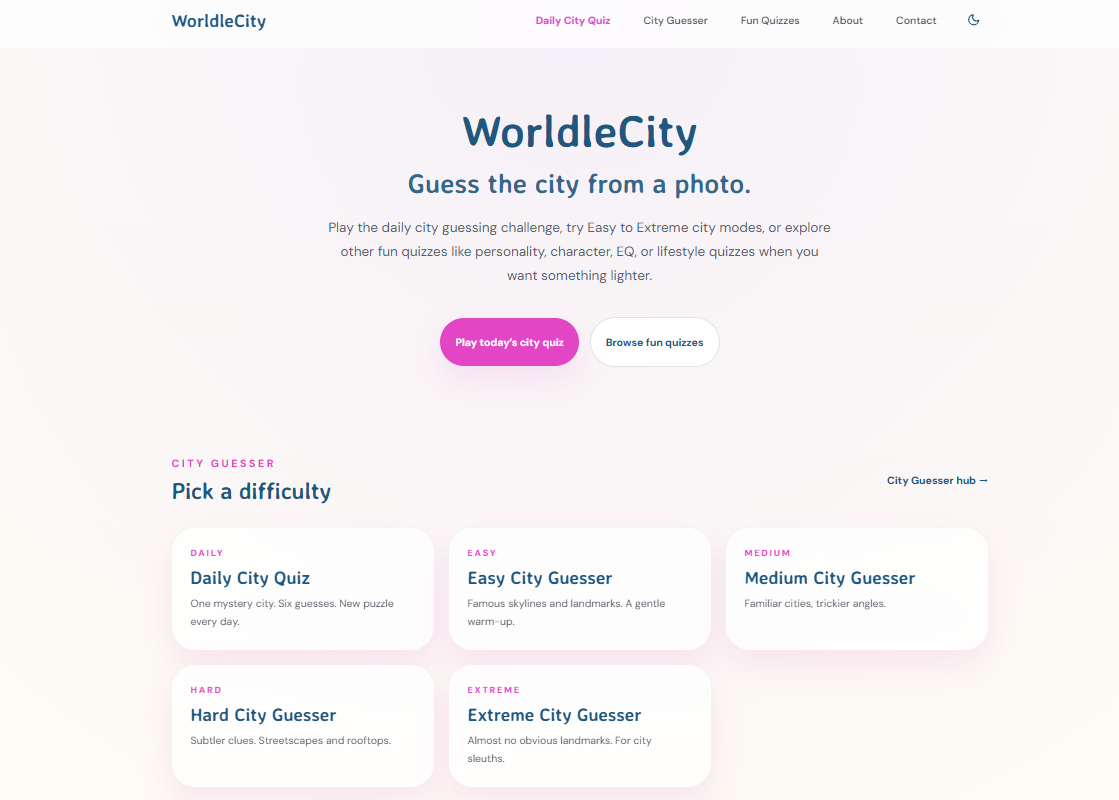
Worldlecity puts well-structured geography categories at the center of every experience. The daily city guessing game gives you a mystery photo and six attempts to name the city, with each guess revealing how close you are by distance and direction. That’s visual geography, spatial reasoning, and landmark recognition all rolled into one tight challenge. Beyond the daily game, Worldlecity also offers personality and lifestyle quizzes across varied categories, all without requiring an account. Jump in, pick a category that interests you, and see how your geography knowledge actually stacks up.
Key takeaways
Quiz categories are the structural backbone of every well-designed quiz, whether you’re playing trivia at a bar or guessing cities from photos on Worldlecity.
| Point | Details |
|---|---|
| Two category types exist | Thematic categories group questions by subject; logic-based categories segment players into outcome profiles. |
| Optimal category count is 4–6 | Using 4–6 categories with at least 2 questions each keeps results reliable and players engaged. |
| Category mix ratio matters | A 60% universal, 30% niche, 10% skill-based split maintains broad audience participation. |
| Tie-break rules must be predefined | Without a result order, tied scores default arbitrarily and can misrepresent a player’s true outcome. |
| Multiple categories give richer feedback | Quizzes measuring several categories reveal where players are strong, not just whether they passed. |
FAQ
What does quiz category mean in trivia games?
A quiz category in trivia is a thematic grouping that organizes questions by subject, such as geography, history, or science. It helps hosts structure rounds and gives players a fair mix of topics to answer.
How many quiz categories should a quiz have?
Most well-designed quizzes use 4–6 categories. That range provides enough variety for meaningful results without causing player fatigue or drop-off.
What are examples of geography quiz categories?
Common geography quiz categories include capitals, flags, landmarks, continents, rivers, and mountains. Each one tests a different geographic skill, from memory to visual recognition.
How do quiz categories affect your result in a personality quiz?
Each answer you select adds points to one or more categories. At the end, the category with the highest point total determines your result, which is why category weighting and question mapping matter so much in quiz design.
What is the difference between thematic and logic-based quiz categories?
Thematic categories organize questions by subject matter. Logic-based categories sort players into outcome profiles based on their answer patterns. Confusing the two leads to quizzes that feel unfocused or produce meaningless results.