How Visual Clues in Quizzes Sharpen Your City Guesses
Discover the role of visual clues in quizzes and how they enhance your city guesses. Activate memory and boost your engagement now!
- how visuals improve quiz results
- visual learning in assessments
- role of images in educational quizzes
- importance of visual aids in quizzes
- impact of imagery on quiz performance
- role of visual clues in quizzes
On this page

A single photograph of a skyline can tell you more than a paragraph of text ever could. That’s the core of what makes visual clues so powerful in geography quizzes: they give your brain something concrete to grab onto, turning a cold guess into an educated one.
Here’s what good visual clues actually do for you:
- Trigger recognition — a distinctive roofline or a canal instantly narrows your options
- Reduce guesswork — images activate memory faster than words alone
- Scaffold complex info — a map or symbol organizes spatial relationships your brain can’t easily build from text
- Boost motivation — something to look at keeps you engaged longer
- Signal context — architectural style, vegetation, and signage all whisper the region before you consciously process them
The types you’ll encounter most: city photographs, illustrative maps, national symbols, and landmark close-ups. Each one works differently, and knowing how to read them is half the game.
Why visuals improve quiz performance: what research says
The evidence here is pretty clear. Image-based quizzes produce statistically significant improvements in correct answers compared to text-only formats — even among younger learners who haven’t developed strong reading stamina yet.
It goes deeper than simple recall, too. A 2018 pharmacy education study found that visual aids raised scores across both lower and higher cognitive categories under Bloom’s taxonomy, meaning students weren’t just memorizing — they were analyzing. That’s the multimedia effect in action: your brain processes text and images through separate channels, and when both fire together, comprehension sticks harder.
Questions with image support also get skipped less often in online quiz formats. Players commit more when there’s something visual to engage with.
When visuals backfire: avoiding noisy or irrelevant images
Not every image helps. The coherence principle is blunt about this: irrelevant or decorative images actively hurt performance by splitting your attention and increasing cognitive load. Near-significant negative effects on response accuracy show up when images don’t connect to the question.
There are three functional categories worth knowing:
- Decorative — purely aesthetic, no informational value, and no measurable performance benefit
- Representational — mirrors the text, reinforces what’s already stated
- Informative — carries solution-relevant content the text alone doesn’t provide
Only informative images consistently improve quiz-solving. Representational ones help somewhat. Decorative ones? Skip them.
Poorly placed visuals create another problem. When an image sits far from its question, eye jumps increase and scores drop — the contiguity principle at work. Players waste mental energy on navigation instead of reasoning.
Pro Tip: When you hit a confusing image in a quiz, ask yourself: “Does this picture tell me something the question text doesn’t?” If yes, it’s informative — study it carefully. If not, don’t let it distract you.
Getting better at “reading” quiz images: developing visual literacy
Visual literacy is a learnable skill, not a talent you either have or don’t. Educators confirm that struggling players often treat images as decoration rather than as puzzles to decode — and that shift in mindset changes everything.
What to train your eye to notice:
- Landmark shapes — the silhouette of a famous bridge or tower is often enough
- Map features — coastline curves, river bends, and island clusters all narrow geography fast
- Architectural style — Ottoman domes vs. Baroque facades vs. Soviet-era blocks each point to a region
- Symbols and signage — even partial text in a foreign script tells you a continent
Practice breaking images into zones: foreground, background, and sky. Each zone holds different clues. Worldlecity’s guide to identifying cities from photos walks through this kind of systematic photo reading with real examples.
How spatial reasoning supercharges your city guesses
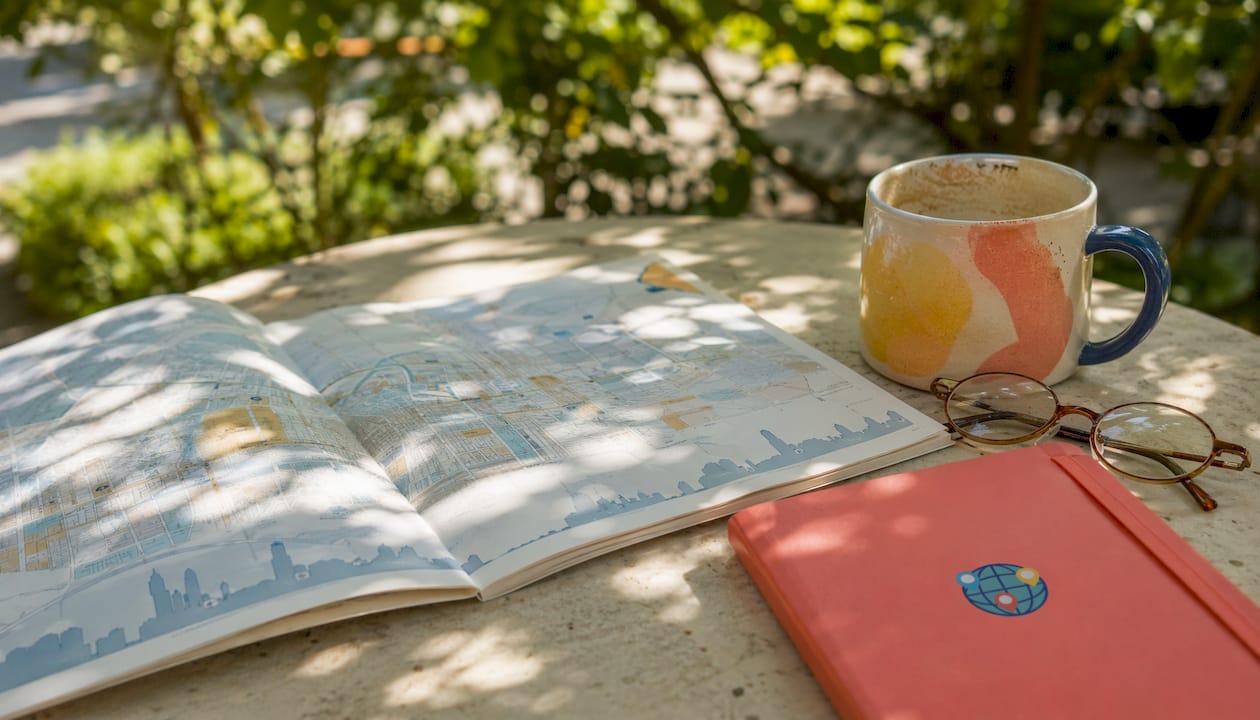
Spatial reasoning is what happens after you recognize a clue — it’s the mental step that connects “I see a harbor” to “this is probably a coastal city in the Mediterranean.” It bridges raw visual input and geographic logic.
Benefits that build up as you play more:
- Stronger mental maps of regional geography
- Faster pattern recognition across similar city types
- More confident guessing even with partial visual information
- Better use of directional feedback between rounds
Each guess in a geography quiz sharpens this skill. When you learn that your guess was 800 miles east of the answer, your brain recalibrates its internal map. Over repeated rounds, that recalibration compounds — you get more accurate not just at the game, but at map-based spatial thinking generally.
Worldlecity: putting visual clues to work for you
Worldlecity is built around the idea that a single photograph should be enough to spark genuine geographic reasoning. Every daily challenge drops you into a mystery city photo and gives you six attempts to name it, with proximity and direction feedback after each guess. The quiz mechanics behind it are designed to make that visual analysis feel rewarding, not stressful.
What makes the visual design work:
- Photos are chosen for informational density — skylines, street-level shots, landmarks, famous monuments, and waterfront views that carry real geographic signal
- Four difficulty modes in the city guesser quizzes let you calibrate how much visual context you get
- No account required — you’re playing within seconds
The most effective quiz images are the ones that reward careful looking. A photo of a tram on a cobblestone street tells you more than you think: the tram gauge, the stone pattern, the building heights, the signage font. Geography is hiding in plain sight.
Pro Tip: Before guessing, spend ten seconds scanning the full image. Players who pause to analyze the background — not just the obvious landmark — consistently narrow their options faster.
Cognitive benefits of integrating images in quizzes
Images don’t just help you answer correctly in the moment — they change how your brain stores the information afterward. Eye-tracking research shows that text-picture combinations increase focused attention and reduce unnecessary visual search, which means your brain spends more time processing and less time hunting.
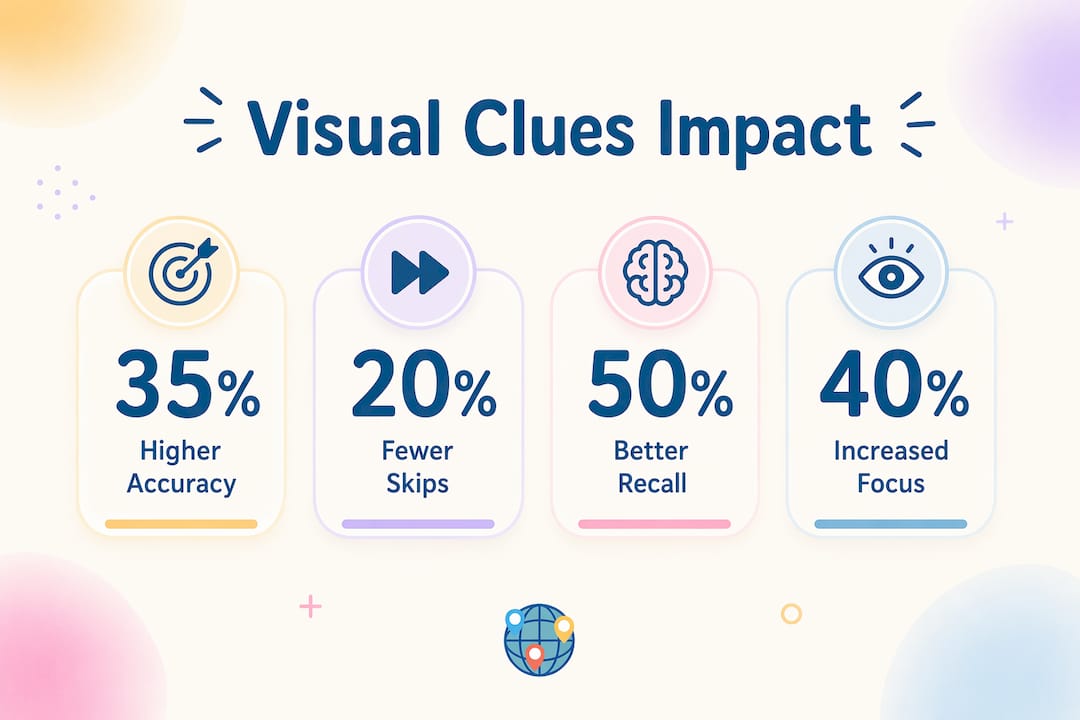
The result is deeper encoding. You’re more likely to remember that Lisbon has those distinctive yellow trams after seeing a photo than after reading a description. That kind of memory sticks across sessions, building a genuine geographic knowledge base rather than trivia that evaporates after the quiz ends.
Importance of visual literacy skills for decoding clues
The multimedia effect only kicks in when you can actually read the image. Players who treat every photo as a single object — “it’s a city” — miss the layered information that separates a confident guess from a random one.
Visual literacy means reading an image the way you’d read a paragraph: systematically, with attention to detail and context. The skill transfers directly to quiz performance. Players who practice it consistently make better use of partial clues, recover faster from wrong guesses, and find the experience more satisfying overall.
How visual clues influence user motivation and retention in gamified quizzes
Pictures reduce rapid-guessing behavior in quiz situations — players slow down, look more carefully, and invest more effort when a meaningful image is present. That’s not just good for accuracy; it’s good for enjoyment.
Motivation in gamified quizzes is closely tied to perceived competence. When a visual clue helps you arrive at the right answer through reasoning rather than luck, the win feels earned. That feeling drives return visits. It’s also why sharing your result — “got it in three!” — lands differently when you can point to the photo that gave it away.
Worldlecity is where visual clue strategy meets daily fun
If you’ve made it this far, you already think about geography quizzes differently than most players. Worldlecity is built for exactly that mindset.
Every day, a new mystery city photo. Six guesses. Real feedback on distance and direction. No account, no friction — just a photograph and your best geographic reasoning. The city guesser quiz modes stack four difficulty levels, so whether you’re just starting to build your visual literacy or you’re the person who spots a city from a single rooftop shot, there’s a challenge that fits.
Play today’s city at worldlecity.com.
Key Takeaways
Visual clues work best when they carry solution-relevant information, are placed close to the question, and are decoded by players with practiced visual literacy skills.
| Point | Details |
|---|---|
| Informative images win | Only informative pictures consistently improve quiz accuracy; decorative images show no measurable performance benefit. |
| Coherence matters | Irrelevant or poorly placed images increase cognitive load and can actively lower your score. |
| Visual literacy is learnable | Treating images as puzzles to decode — not just pictures to glance at — is the skill that separates fast guessers from accurate ones. |
| Spatial reasoning compounds | Each quiz round recalibrates your mental map, making future guesses more confident and more accurate. |
| Worldlecity applies these principles | Daily city photos are chosen for informational density, with six-guess feedback loops that build spatial reasoning over time. |
FAQ
How do visual clues improve quiz accuracy?
Relevant images give your brain a second processing channel alongside text, which research confirms produces statistically significant improvements in correct answers compared to text-only formats.
What types of visual clues work best in geography quizzes?
Informative images — ones that carry geographic detail the question text doesn’t — outperform decorative or purely representational visuals every time.
Can looking at images actually hurt your quiz performance?
Yes. Irrelevant or poorly placed images increase cognitive load and can lower accuracy, per the coherence and contiguity principles in multimedia learning research.
How does Worldlecity use visual clues in its daily quiz?
Worldlecity presents a single mystery city photograph per day, chosen for geographic signal density, and gives players six attempts with proximity and direction feedback to sharpen spatial reasoning.
Is visual literacy something you can actually get better at?
Absolutely. Practicing zone-by-zone image analysis — foreground, background, sky — and focusing on architectural style, signage, and map features builds the skill steadily across quiz sessions.