Famous Buildings and Landmarks of US Cities: Which City Is This?
The landmark that gives away each major US city in a photo, shown on real WorldleCity quiz photos, plus the replicas that point to the wrong city.
- US city landmarks
- Famous buildings in America
- Identify cities from photos
- American skylines
- City guessing tips
On this page
Many major US cities are known by one structure: New York by the Empire State Building, San Francisco by the Golden Gate Bridge, Seattle by the Space Needle, St. Louis by the Gateway Arch. That answers which US landmarks are famous. The harder question, and the one that matters when you are looking at a photo, is which city a building is in. For that, the landmark is only half the job. The setting around it, such as mountains, a lake or a desert, usually confirms the answer, and a few famous buildings have copies in other cities that will send you the wrong way.
Instead of a laundry list of famous landmarks in the US, I have picked a few of them here and explained how to recognise them in a photograph. I don’t have my own photos of US landmarks, so every photo below is a picture from WorldleCity’s city-guess library, a growing collection of city photos that I sort into four difficulty levels. You will come across them when you play some of the city guessing games here. They are licensed from popular image sites, and the source is credited under each one.
Which landmark identifies each major US city?
The table below provides a quick reference. The last column tells you what to look for when the landmark is small, partly hidden or not in the frame at all.
| City | Signature landmarks | What to look for in a photo |
|---|---|---|
| New York | Empire State Building, Statue of Liberty, One World Trade Center | The Empire State’s stepped Art Deco spire in Midtown; One World Trade Center’s tapering glass tower and spire downtown |
| Washington, D.C. | US Capitol, Washington Monument, Lincoln Memorial, White House | A low skyline of white stone, domes and columns, with no skyscrapers |
| San Francisco | Golden Gate Bridge | Red-orange suspension towers over open water, with hills on both shores |
| Chicago | Willis Tower, Cloud Gate (“The Bean”) | A black tower with two antennas; Lake Michigan on the east side of downtown |
| Seattle | Space Needle | A disc-topped tower on thin legs, often with Mount Rainier behind it |
| Los Angeles | Downtown skyline | A compact cluster of towers with the San Gabriel Mountains behind, snow-capped in winter |
| Las Vegas | The Strip | Casino replicas of other cities’ landmarks, lit up at night, in a flat desert basin |
| St. Louis | Gateway Arch | A stainless steel arch on the Mississippi riverfront |
| Philadelphia | Independence Hall, City Hall | A Georgian brick hall with a white steeple; a statue of William Penn on top of City Hall’s tower |
| Dallas | Reunion Tower | A tower topped with a lit geodesic ball |
How do you read a US landmark photo?
Seattle: the landmark, then the terrain that confirms it
Source: Photo by Timothy Chi on Pexels
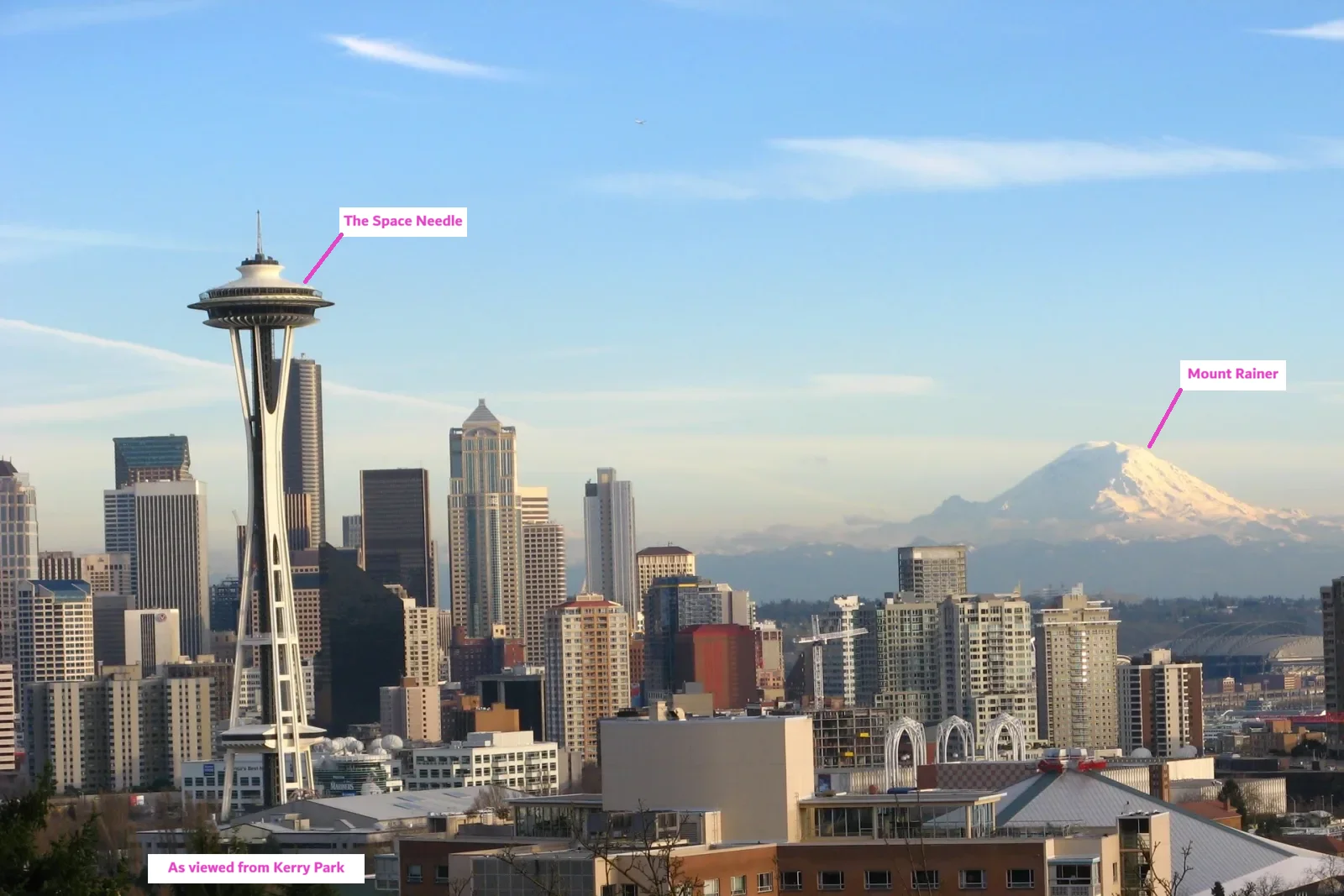
This is the easiest kind of photo: one landmark you know, and a setting that agrees with it. The Space Needle, 605 feet tall to its aircraft beacon, opened for the 1962 Seattle World’s Fair, and its disc top on thin, waisted legs is hard to mistake, though a few towers elsewhere come close (more on those below). The snow-covered volcano on the right is Mount Rainier, 14,410 feet high by the National Park Service’s figure, southeast of the city. The view is from Kerry Park, which Seattle’s parks department describes as a view of Elliott Bay and downtown “with an occasional backdrop of Mount Rainier” that draws photographers. Even with the Needle cropped out, a large, isolated snow cone behind a downtown skyline points to the Pacific Northwest.
Los Angeles works the same way without a single famous building. The library’s Easy photo shows downtown’s towers, including the sail-shaped crown of the Wilshire Grand Center, 1,100 feet tall, completed in 2017 and now the city’s tallest building, against a wall of snow-capped mountains. That ridge is the San Gabriel range, topped by Mount San Antonio, better known as Mount Baldy and, at 10,064 feet, the highest point in Los Angeles County. Chicago is the opposite case. Its Easy photo is a flat sea of lights at night, and the clues are the twin antennas of Willis Tower, the world’s tallest building for nearly 25 years after it opened in 1973, and a black edge of water on the left. Downtown Chicago has Lake Michigan on its east side, so a lake shore in the frame also tells you which way the camera is facing.
Washington, D.C.: read what is missing
Source: Photo by David Everett Strickler on Unsplash
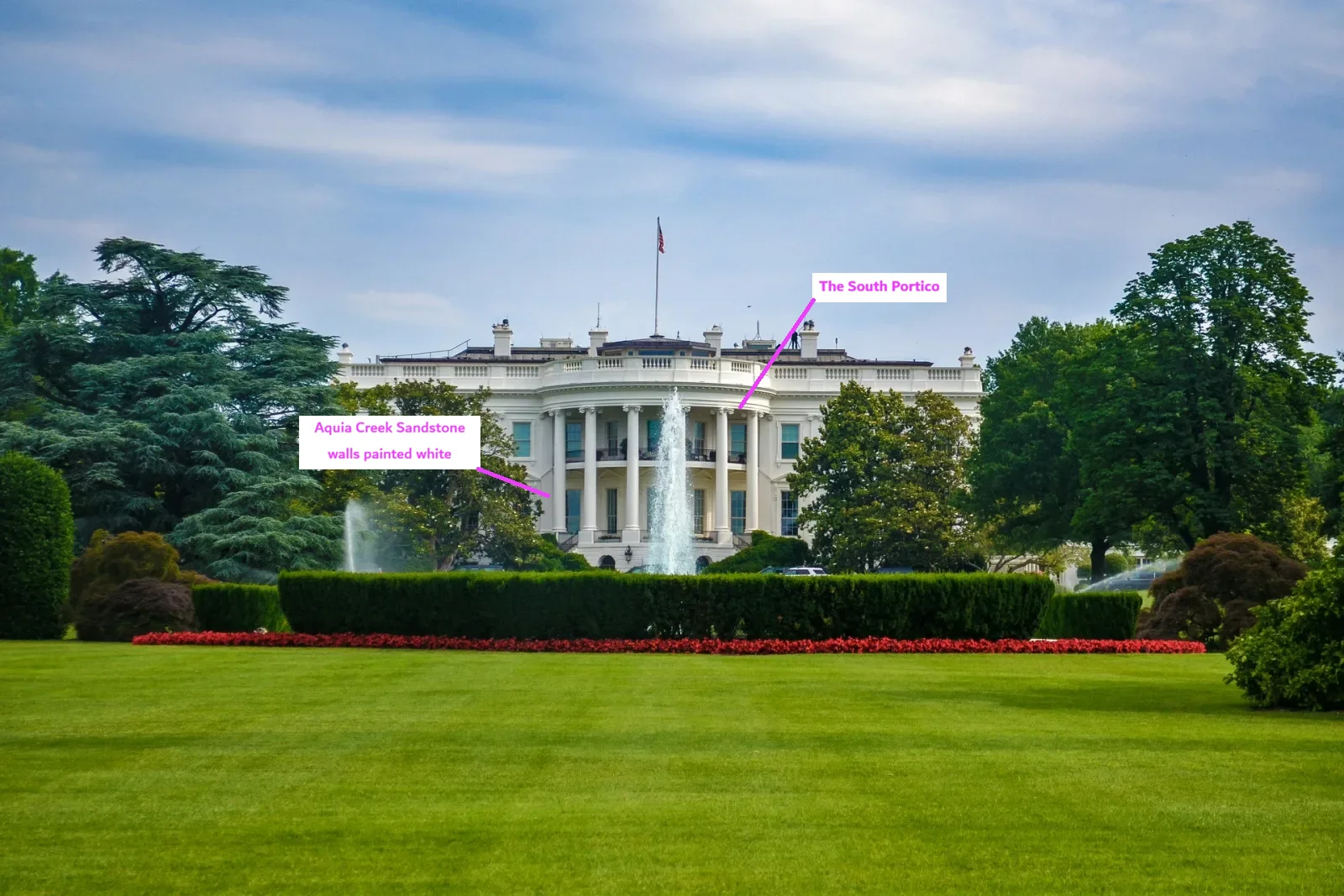
Most people know the White House, but this photo shows the side that is easier to miss. The curved, columned porch is the South Portico, completed in 1824. The walls are Aquia Creek sandstone, first whitewashed in 1798 to protect the porous stone from frost, and the name “White House” probably came from that.
The wider lesson for Washington is what you don’t see. There are no skyscrapers. The tallest thing in most views of the city is the Washington Monument, 555 feet of marble, and you can often see a change in its colour about a third of the way up. Construction stopped in 1854 and did not resume for more than two decades, and the later stone came from different quarries. At the west end of the National Mall, the Lincoln Memorial has 36 Doric columns, one for each state in the Union when Lincoln died. White marble, domes and columns, with no glass towers anywhere in the frame, are what make Washington recognisable.
San Francisco and New York: one structure is enough
Some landmarks need no setting at all. The San Francisco photo is hazy and shows no city at all, but the red tower in the foreground can only be the Golden Gate Bridge, painted “international orange” and opened in 1937. Its 4,200-foot main span was the longest of any suspension bridge until New York’s Verrazzano–Narrows Bridge passed it in 1964.
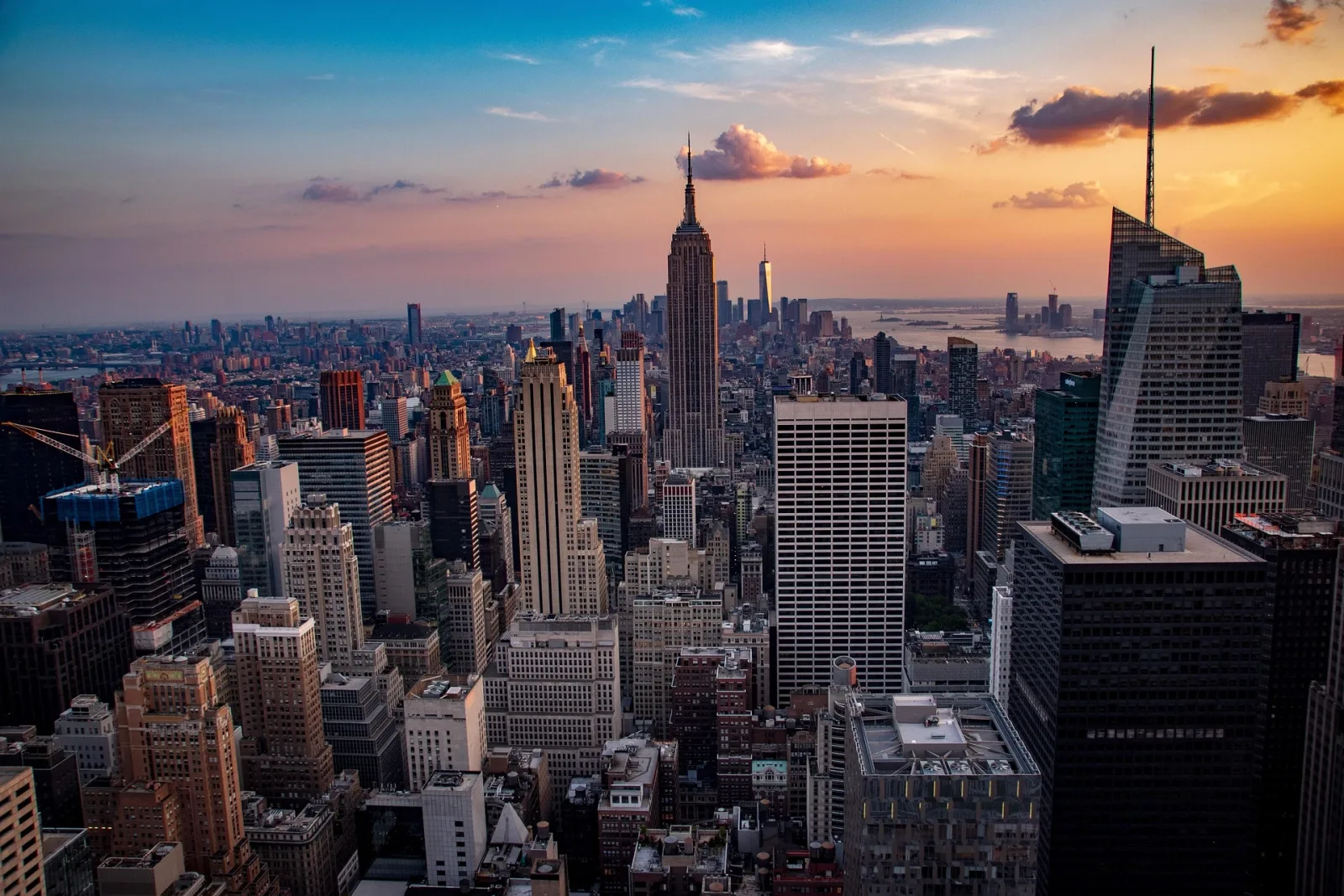
The photo at the top of this page is New York’s Easy photo. The Empire State Building, completed in 1931, rises in the middle of Midtown with its stepped Art Deco top and spire, 1,454 feet to the tip. It was the world’s tallest building until the World Trade Center’s North Tower overtook it in 1970. The thin tower on the horizon behind it is One World Trade Center, at 1,776 feet the tallest building in the Western Hemisphere today.
What makes a city photo hard to guess?
Usually it isn’t the city. It is what the photo lets you read. A photo is easy when it puts a landmark you know in the middle of the frame, and it gets harder as the clues get smaller, further away or more generic: a building style shared by many cities, a street that could be in several places, a skyline at night. I saw the same pattern with Nordic cities, where Malmö has photos in two different tiers, and when I ranked the world’s most recognizable skylines. New York shows it well, because its second photo in the library sits in the Medium tier, not Easy.
Source: Image by wiggijo on Pixabay
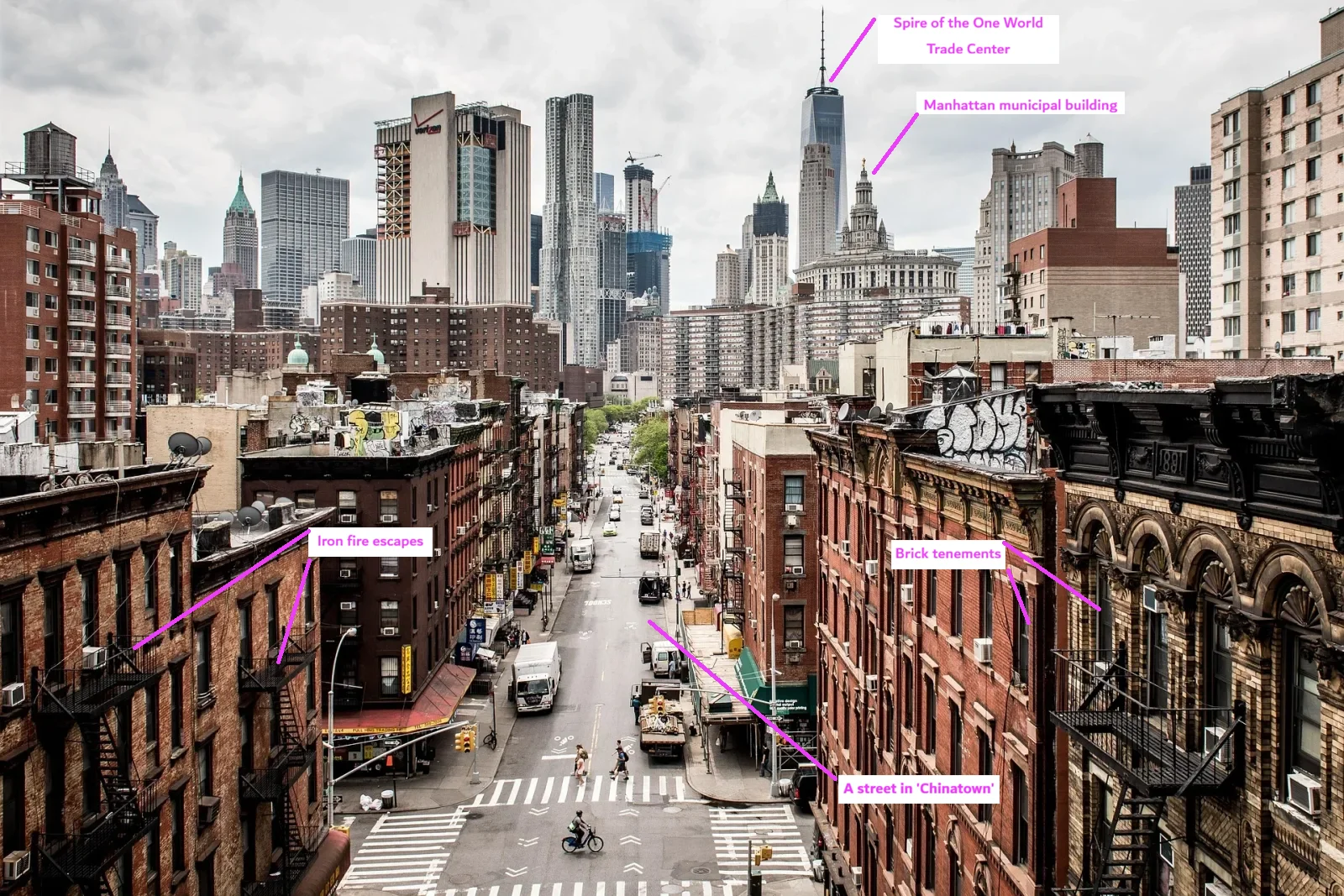
The photo is taken from the Manhattan Bridge, looking down a street in Chinatown. Most of the frame is the street itself: brick tenements with iron fire escapes on both sides, a graffiti-covered rooftop, delivery trucks and a cyclist at a crossing. Above the rooftops, in the distance, are the towers of Lower Manhattan. One World Trade Center’s spire is on the skyline, and to its right is the Manhattan Municipal Building, finished in 1914, with Civic Fame, a 20-foot gilded copper statue, on its tiered top.
So why is this photo Medium when the Empire State photo at the top of this page is Easy? The clues are all there, but none of them is in the foreground. The landmarks are small shapes on the horizon that you have to spot first and then recognise without their usual surroundings. The clues that fill the frame, tenements and fire escapes, point to an older American city on the East Coast, but they fit more than one. If you spot One World Trade Center, it is New York. If you don’t, the street still makes New York a good guess, just not a certain one. That gap between a likely guess and a sure one is what the Medium tier is for.
Which US landmarks point to the wrong city?
Las Vegas: Paris’s tower, New York’s statue, and not quite Las Vegas
Source: Photo by Julian Paefgen on Unsplash
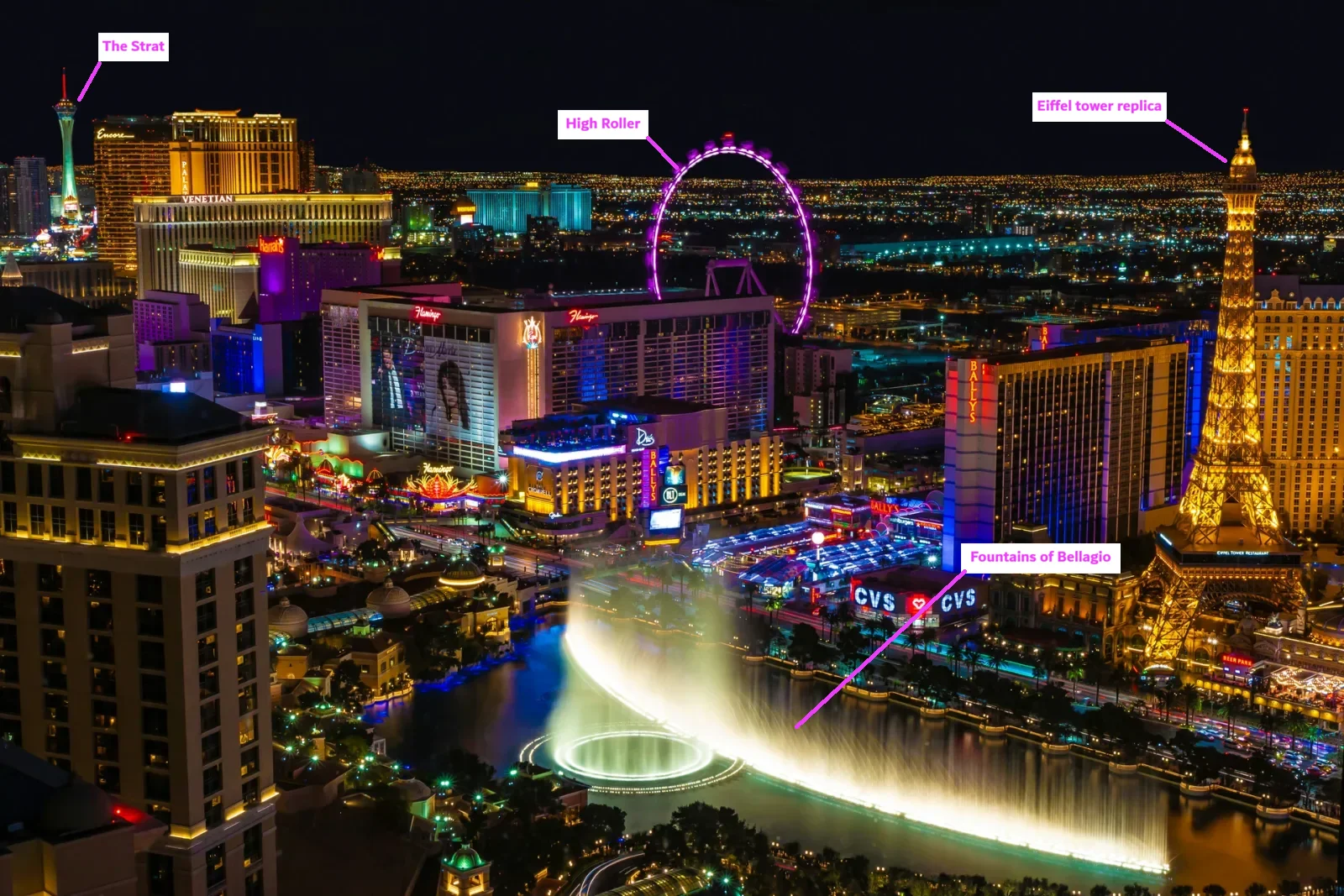
The most recognisable landmark in this photo belongs to another country. The tower on the right is the half-scale Eiffel Tower replica at Paris Las Vegas, 541 feet tall and lit for the first time in 1999. Elsewhere on the Strip, New York-New York has a 150-foot Statue of Liberty and a 529-foot Empire State Building, both copies. If you name a city from the landmark alone, Las Vegas sends you to Paris or New York.
What gives it away is everything around the landmark: every building is lit, the signs are huge and there is a fountain show in the middle of a desert. The purple wheel is the High Roller, 550 feet tall, opened in 2014. The fountains in front of the Bellagio fill an 8.5-acre lake.
There is one more twist. Almost none of this is in the city of Las Vegas. The Strip lies just south of the city limits, in the unincorporated towns of Paradise and Winchester. WorldleCity accepts Las Vegas as the answer, because that is what everyone calls it.
A Capitol dome doesn’t always mean Washington
A white dome over a columned building looks like the US Capitol, whose cast-iron dome was completed in 1866. But some state capitols borrow that look. The California State Capitol in Sacramento was partly modelled on it, with one deliberate difference: a gold ball on top of the dome instead of a statue, for the Gold Rush. The Texas State Capitol in Austin is built of red granite and is taller than the Capitol in Washington. Check the top of the dome and the colour of the stone before you settle on D.C.
Towers that look like the Space Needle
A disc on top of a tall, thin tower is not only in Seattle. Several cities built observation towers in the same years and the same spirit, and from a distance they are easy to mix up. Two details settle most cases. The first is the base. The Space Needle stands on three legs in a “wasp-waisted” shape, pinched at the middle and open between them. Most of its look-alikes stand on a solid concrete shaft. The second is the setting around the tower.
- The Strat, Las Vegas. At 1,149 feet, opened in 1996, it is the tallest freestanding observation tower in the United States, and it is the thin tower at the far left of the Las Vegas photo above. Three concrete legs merge into a single shaft, with a 12-storey pod and a needle on top that carries thrill rides. Unlike most of the Strip, it is inside the Las Vegas city limits.
- Tower of the Americas, San Antonio. Like the Space Needle, it was built for a world’s fair, HemisFair ‘68. It is 750 feet tall, and its top sits on one plain concrete shaft rather than open legs. A flat Texas skyline around it rules out Seattle quickly.
- Skylon Tower, Niagara Falls, Ontario. 520 feet above the street, opened in 1965, just across the border in Canada. Its giveaways are the “Yellow Bug” elevators running up the outside of the shaft, and the falls themselves if they are in the frame.
- Calgary Tower, Calgary. 626 feet tall and opened in 1968 as the Husky Tower, another single concrete column with a disc on top, also in Canada.
If the tower stands on open white legs and there is a snow-capped volcano or a bay behind it, it is Seattle. If it stands on a solid concrete shaft, look at the setting: a desert and casinos, a flat Texas city or a waterfall gorge each point somewhere else.
Other famous US landmarks
A few of the landmarks in the table above are not covered in detail elsewhere in this guide. They are worth knowing because each one identifies its city on its own.
- Gateway Arch, St. Louis. 630 feet tall and just as wide, clad in stainless steel, designed by Eero Saarinen and completed in 1965. It is the tallest man-made monument in the US.
- Independence Hall, Philadelphia. Built between 1732 and 1753 in American Georgian style. The Declaration of Independence and the Constitution were both debated and adopted here, and it became a UNESCO World Heritage Site in 1979.
- Philadelphia City Hall. A 37-foot bronze William Penn stands on top of the tower. A gentlemen’s agreement among developers kept him the tallest point in the skyline until 1987, when One Liberty Place rose above him.
- Reunion Tower, Dallas. 561 feet tall, opened in 1978, topped with a geodesic sphere, nicknamed The Ball, that is lit with LEDs at night.
- Statue of Liberty, New York. Dedicated in 1886, designed by Frédéric Auguste Bartholdi, with a metal framework built by Gustave Eiffel.
Practise on real US city photos with WorldleCity
Knowing that the Space Needle is in Seattle is easy. Spotting it as a small shape on the edge of a photo, or knowing that a lit Eiffel Tower can mean Nevada, is what takes practice.
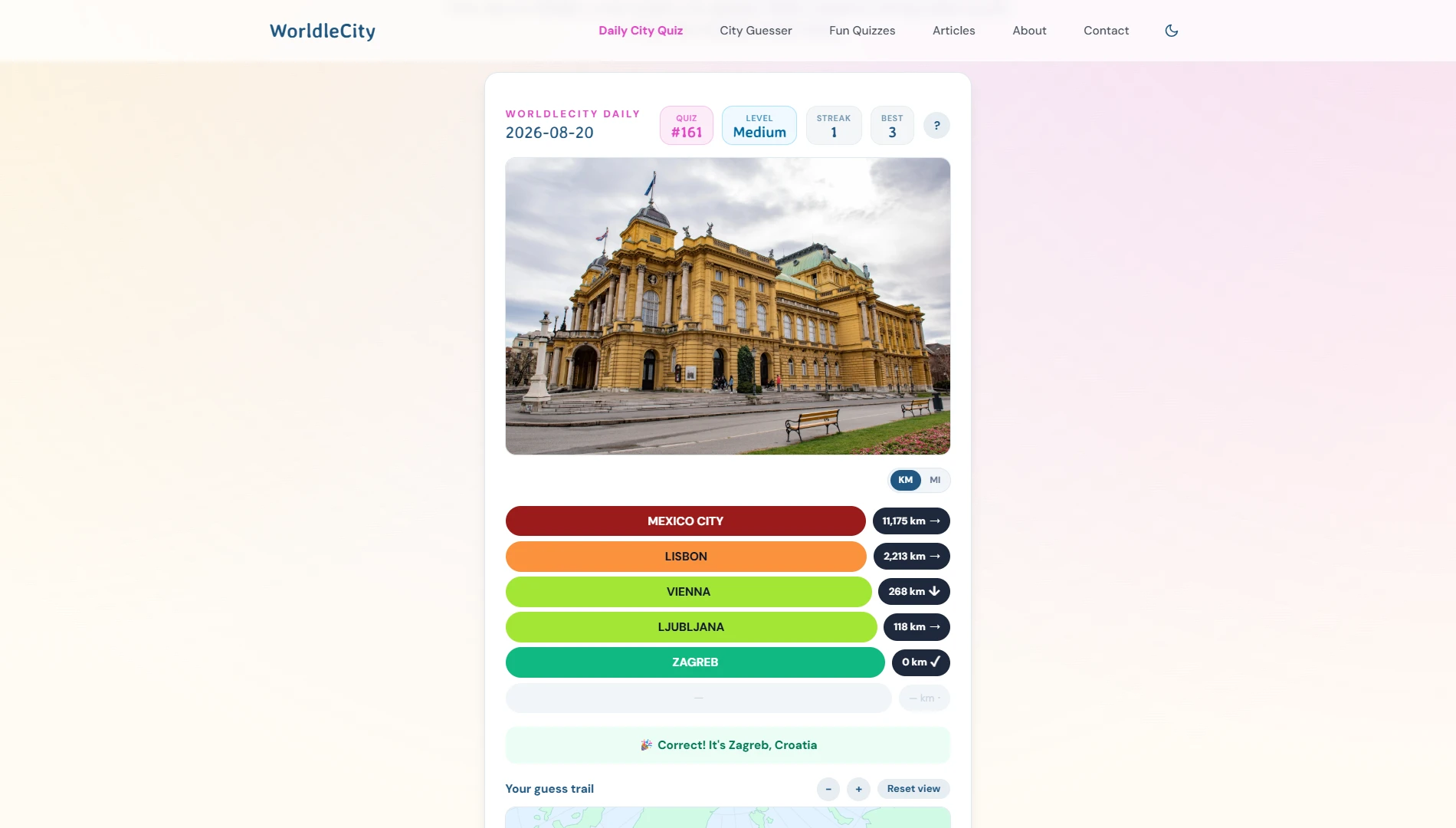
WorldleCity posts a new mystery city photo every day and gives you six attempts, with the distance and direction to the answer after each wrong guess. The city guesser quizzes come in four difficulty modes, and every photo in this guide comes from them. Most of the US photos are in Easy, so start there, then see whether the Medium photos still give the city away once the landmark is gone. If you want the general method for photos without a famous building, the guide on how to identify cities from photos covers it. No account needed.
FAQ
Which landmark is each major US city known for?
New York for the Empire State Building and the Statue of Liberty, Washington, D.C. for the Capitol, the Washington Monument and the White House, San Francisco for the Golden Gate Bridge, Chicago for Willis Tower and Cloud Gate, Seattle for the Space Needle, St. Louis for the Gateway Arch and Philadelphia for Independence Hall. Las Vegas is known for the Strip as a whole rather than one building.
Is the Statue of Liberty in New York or New Jersey?
New York. Liberty Island is part of the State of New York, as an exclave of Manhattan, even though it sits in the waters of Jersey City, New Jersey. An 1834 compact between the two states set the boundary down the middle of the harbour but kept the island as New York territory.
How tall is the Gateway Arch?
630 feet (192 metres), and it is exactly as wide as it is tall. Designed by Eero Saarinen, clad in stainless steel and completed in 1965, it is the tallest man-made monument in the US. It stands on the Mississippi riverfront in St. Louis, inside Gateway Arch National Park.