Quiz Types for Different Learning Styles: 2026 Guide
Discover effective quiz types for different learning styles that enhance engagement and retention. Tailor assessments to boost learner success.
- auditory learning quiz types
- best quizzes for learners
- interactive quiz formats
- kinesthetic learning activities
- learning style assessment quizzes
- quizzes for visual learners
- quiz types for different learning styles
On this page

Quiz types for different learning styles are tailored assessment formats designed to boost engagement and knowledge retention by matching how learners best absorb information. The VARK model (Visual, Auditory, Read/Write, Kinesthetic) gives educators a practical framework for choosing the right quiz format. Research confirms that multimodal learning combining two to three integrated sensory channels optimizes retention across all learners. The key is not locking every student into one style, but using learning preferences as a starting point for smarter quiz design.
1. Quiz types for different learning styles: why format matters
The format of a quiz is not just a delivery choice. It directly shapes how well a learner processes and recalls information. Learning styles increase motivation by allowing learners to use study methods that feel natural, which improves persistence with evidence-based techniques like retrieval practice and spaced repetition. That motivation effect is real and worth building on.
Matching quiz format to learner preference does not mean ignoring other formats entirely. Think of it as a starting point. A visual learner who gets an image-based quiz will engage faster, but they still benefit from a well-placed multiple-choice question. The goal is a quiz that feels natural enough to reduce friction and challenging enough to build real knowledge.

2. Best quizzes for visual learners
Visual learners process information most effectively through images, diagrams, and spatial relationships. The best quiz formats for this group put pictures and graphics at the center of the question, not just as decoration.
Top quiz formats for visual learners:
- Image hotspot questions: Learners click on a specific part of an image to answer. Great for anatomy, geography, and labeled diagrams.
- Drag-and-drop sequencing: Learners arrange visual elements in the correct order. Works well for timelines, processes, and ranked lists.
- Diagram labeling: Learners type or select labels for parts of a diagram. Effective for science and technical subjects.
- Photo-based identification: A photograph is shown and learners identify the subject. This is the core mechanic behind map-based quiz games used by educators worldwide.
Image-based questions are processed 60,000 times faster by the brain than text. That speed advantage sustains cognitive momentum and keeps visual learners engaged through longer assessments.
Pro Tip: Use consistent color coding across your visual quiz questions. When learners associate a color with a concept, recognition becomes faster and memory retention improves.
3. Auditory learning quiz types that actually work
Auditory learners absorb information best through sound, spoken language, and verbal explanation. Standard text-only quizzes underserve this group significantly.
Effective quiz formats for auditory learners:
- Audio-narrated questions: The question is read aloud through a recording. Learners hear the prompt before reading it, which reinforces comprehension.
- Spoken recall prompts: Learners listen to a short audio clip and answer questions about what they heard. Excellent for language learning and listening comprehension.
- Recorded self-explanation quizzes: Learners record a brief verbal answer and play it back for self-assessment. This format builds metacognitive awareness.
- Verbal instruction quizzes: Instructions are delivered as audio rather than text, reducing reading load and keeping auditory learners focused.
Auditory learners benefit from recorded self-explanations, which link their natural preference to a proven retrieval method. Retrieval practice is one of the most evidence-backed techniques in learning science, and audio formats make it feel less like studying and more like conversation.
Pro Tip: Pair audio quiz questions with a short written summary at the end. Auditory learners consolidate what they heard, and the written recap reinforces the material through a second channel.
4. Kinesthetic learning activities in quiz form
Kinesthetic learners need to do something, not just read or listen. They learn through action, trial, and immediate feedback. The best quiz formats for this group involve movement, decision-making, and active problem-solving.
Quiz formats that engage kinesthetic learners:
- Drag-and-drop interactions: Learners physically move elements on screen to build answers. The act of dragging reinforces the concept.
- Branching scenario quizzes: Each answer leads to a different follow-up question, simulating real decisions. Branching scenarios create tailored learner experiences by dynamically adjusting question flow based on responses.
- Interactive loop quizzes: Learners cycle through a question set, with incorrect answers returning them to review content before retrying.
- Sequencing events: Learners arrange steps in a process in the correct order by dragging cards. Works well for history, science procedures, and workflows.
Interactive quiz formats like drag-and-drop and branching scenarios significantly outperform standard text-based quizzes for kinesthetic and visual learners. More than 5,000 global instructors adopted these formats in early 2026, reducing manual grading time while providing nuanced partial credit.
Pro Tip: Balance interactive question types with some familiar multiple-choice questions. Too many complex interactions in a row can cause cognitive overload, which kills momentum fast.
5. Effective quiz formats for reading/writing learners
Reading/writing learners thrive with text. They process information through written language and retain it best when they write something down or read carefully structured content.
Top quiz formats for reading/writing learners:
- Short answer questions: Learners write a brief response in their own words. This forces synthesis rather than recognition.
- Fill-in-the-blank: A sentence with a missing word or phrase. Effective for vocabulary, grammar, and factual recall.
- Matching questions: Learners connect terms to definitions or concepts to examples. Good for building conceptual relationships.
- Essay questions: Learners write a structured argument or explanation. Essay questions are necessary for higher-order evaluation, while multiple choice fits recognition and application tasks.
Text-based quizzes support cognitive synthesis and evaluation, the upper levels of Bloom’s Taxonomy. A well-written short answer question can test more depth than five multiple-choice questions combined. For reading/writing learners, the act of writing the answer is part of the learning process itself.
Pro Tip: Keep question language clear and direct. Ambiguous wording frustrates reading/writing learners more than other groups because they pay close attention to every word. One clear question beats three clever ones.
6. How to build a balanced quiz that works for everyone
No learner fits perfectly into one style. Multimodal learning is about integration of multiple sensory inputs rather than adherence to fixed styles. Research supports diverse input formats improving retention universally, regardless of preferred style.
The practical takeaway: design quizzes that mix formats intentionally. A balanced 7-question quiz might look like this: two image-based questions, two multiple-choice questions, one drag-and-drop interaction, one short answer, and one audio prompt. That structure gives every learner at least two questions in their preferred format while exposing everyone to other modes.
Maintaining 60–70% familiar question formats like multiple-choice and true/false while using interactive types strategically is the recommended approach. Consistency supports momentum and reduces learner fatigue. Throwing in a branching scenario every other question sounds exciting but often backfires.
Adaptive quizzes enhance engagement regardless of fixed learning styles by adjusting difficulty in real time based on learner responses. This approach transcends style categories entirely and personalizes the challenge level for each individual.
Here is a comparison of quiz types by engagement level and best fit:
| Quiz type | Best fit | Engagement level | Cognitive level |
|---|---|---|---|
| Image hotspot | Visual learners | High | Application |
| Drag-and-drop | Kinesthetic, visual | High | Analysis |
| Audio narrated | Auditory learners | Medium-high | Recall |
| Short answer | Reading/writing | Medium | Synthesis |
| Multiple choice | All learners | Medium | Recognition |
| Branching scenario | Kinesthetic | Very high | Evaluation |
| Fill-in-the-blank | Reading/writing | Medium | Recall |
You can also explore quiz patterns and tricks that help learners recognize question structures faster, which reduces anxiety and improves performance across all formats.
Key takeaways
Matching quiz format to learner preference increases engagement and retention, but the most effective quizzes blend visual, auditory, kinesthetic, and text-based formats rather than locking learners into a single style.
| Point | Details |
|---|---|
| Format drives retention | Quiz format shapes how learners process and recall information, not just how they feel about the quiz. |
| Visual learners need images | Image hotspots and diagram labeling engage visual learners faster than any text-based format. |
| Kinesthetic learners need action | Drag-and-drop and branching scenarios outperform passive formats for hands-on learners. |
| Balance prevents overload | Keep 60–70% familiar question types and use complex interactive formats selectively. |
| Multimodal beats single-style | Combining two to three sensory channels in one quiz improves retention for all learner types. |
WorldleCity makes learning feel like a game
If you want to see quiz design done right, WorldleCity is worth a look. Every day, the daily city guessing game drops a mystery city photograph and gives you six attempts to identify it, with directional feedback after each guess. It is a live example of image-based, kinesthetic quiz design that works for visual and hands-on learners simultaneously.
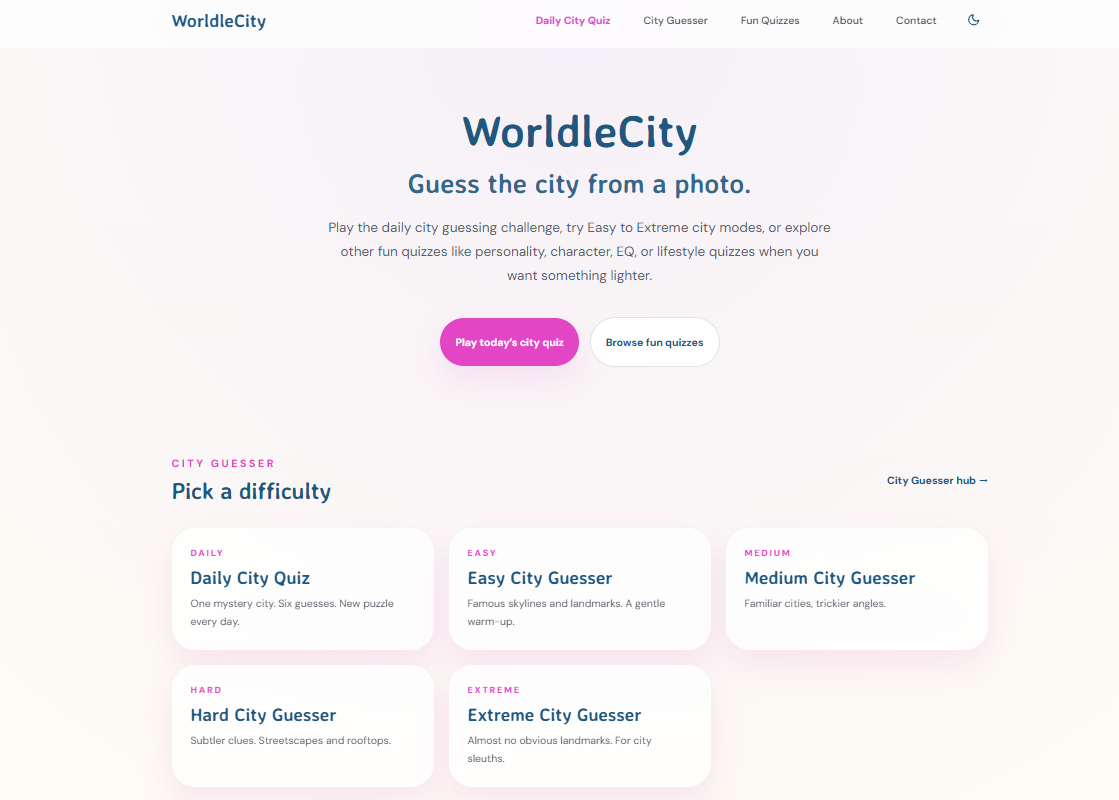
Beyond the daily challenge, Worldlecity offers personality and lifestyle quizzes with no account registration required. The platform covers visual, interactive, and reflective formats, making it a natural fit for educators who want to show learners what engaging quiz design actually feels like. Whether you are a teacher looking for inspiration or a parent wanting a low-pressure way to keep kids curious, Worldlecity delivers the kind of immediate feedback and social sharing that makes learning stick.
FAQ
What are the best quiz types for visual learners?
Image hotspot questions, diagram labeling, and drag-and-drop sequencing are the most effective quiz formats for visual learners. These formats use the brain’s faster processing of images to sustain engagement and improve recall.
How do auditory learning quiz types differ from standard quizzes?
Auditory learning quiz types use audio-narrated questions, spoken recall prompts, and recorded self-explanation instead of text-only formats. These formats connect verbal processing to retrieval practice, which strengthens memory for auditory learners.
What is the VARK model and how does it apply to quiz design?
VARK stands for Visual, Auditory, Read/Write, and Kinesthetic. It gives educators a framework for selecting quiz formats that match how different learners absorb and retain information.
Can one quiz work for multiple learning styles?
Yes. A balanced quiz mixing image-based, multiple-choice, interactive, and short-answer questions serves all four learning style groups. Research shows that combining two to three sensory channels in one quiz improves retention universally.
How many question types should a balanced quiz include?
A well-designed quiz keeps 60–70% of questions in familiar formats like multiple-choice and true/false, then adds one or two interactive types like drag-and-drop or branching scenarios for synthesis goals.