Regional vs Global Quiz: Key Differences Explained
Discover the key difference between regional and global quiz formats. Learn which challenge suits your skills best and elevate your knowledge!
- what is a regional quiz
- regional quiz vs global quiz
- difference between regional and global quiz
- key distinctions regional global quizzes
- regional vs global quiz comparison
On this page

A regional quiz tests knowledge within a defined geographic area sharing common traits across multiple cities, counties, or states, while a global quiz covers phenomena spanning multiple countries or the entire world. That single distinction in scale of analysis shapes everything: the content, the difficulty, and what you actually learn. Understanding the difference between regional and global quiz formats helps you pick the right challenge for your skill level and get more out of every round you play.
What is a regional quiz, and what features define it?
A regional quiz focuses on a connected geographic area where multiple localities share something in common. That shared trait could be physical (like the Rocky Mountains stretching across several states), cultural (like the American South’s food and music traditions), or economic (like the Rust Belt’s industrial history). The scale of analysis sits between local and national, capturing patterns that cross jurisdictions without going worldwide.
Regional quizzes come in two main flavors that geographers recognize:
- Formal regions use objective criteria like climate zones, political boundaries, or language distribution. A quiz on U.S. Census regions or European Union member states falls here.
- Perceptual regions rely on cultural identity and shared reputation. “The Bible Belt” or “Silicon Valley” are perceptual. Formal and perceptual regions both show up in quiz content, and knowing which type you’re dealing with changes how you approach the questions.
The content scope of a regional quiz typically includes:
- Multi-city landmarks and local geography (think Great Lakes cities or Appalachian Trail waypoints)
- State or province capitals within a defined zone
- Regional cultural facts: cuisine, dialects, historical events tied to a specific area
- Economic activity zones like the Sun Belt or the Corn Belt
Regional quizzes build geographic frameworks without overwhelming you. When you learn the states of the American Midwest before tackling all 195 UN-recognized countries, you’re building a mental map piece by piece. That structure makes the bigger picture easier to absorb later.
Pro Tip: If a regional quiz feels too easy, try switching from formal regions (clear political lines) to perceptual ones (fuzzy cultural zones). The ambiguity adds real challenge and teaches you how geography is actually lived, not just drawn.

How does a global quiz differ in scope and challenge?
A global quiz covers phenomena that span multiple countries or the entire world. The questions zoom out past any single region and ask you to think in terms of continents, international systems, or worldwide patterns. Geographers select scale based on the question they want to answer, and global scale is chosen when the pattern only becomes visible at that level.
Global quiz content typically includes:
- All world capitals and country locations across all continents
- Worldwide landmarks: the Eiffel Tower, Machu Picchu, the Great Wall of China
- International cultural facts: languages by number of speakers, global religions, major migration routes
- Global forces: climate zones that cross borders, international trade routes, worldwide political bodies like the United Nations
The challenge in a global quiz is breadth. You’re not going deep on one area. You’re holding a mental model of the whole planet and retrieving facts quickly. Interactive global quiz tools use auto-zoom, panning, and scoring to make recalling all 195 UN-recognized countries manageable and engaging. That tech matters because the raw volume of information in a global quiz can feel punishing without good design.
Global quizzes also test a different kind of thinking. Regional quizzes reward local depth. Global quizzes reward pattern recognition across large systems. A question about which countries share the Amazon River basin, or which nations belong to ASEAN, requires you to think in networks, not neighborhoods.
One underappreciated fact: global and regional powers project influence differently across geography, and advanced global quizzes on politics and international relations test exactly this. Knowing that a regional power like Brazil dominates South America while a global power like the United States operates across multiple regions adds real depth to political geography questions.
Regional vs global quiz: a side-by-side comparison
The clearest way to see the regional quiz vs global quiz distinction is to put the key dimensions next to each other.
| Dimension | Regional quiz | Global quiz |
|---|---|---|
| Geographic scale | Multi-city, multi-state, or sub-continental area | Multiple countries or worldwide |
| Typical content | State capitals, cultural regions, local landmarks | World capitals, international landmarks, global systems |
| Knowledge depth | Deep and specific within a defined zone | Broad and pattern-based across the whole world |
| Difficulty source | Local detail and regional nuance | Volume of countries, languages, and global facts |
| Best for | Building structured map knowledge | Expanding context and seeing big-picture patterns |
| Example topic | U.S. Sun Belt geography | All 195 UN-recognized countries |
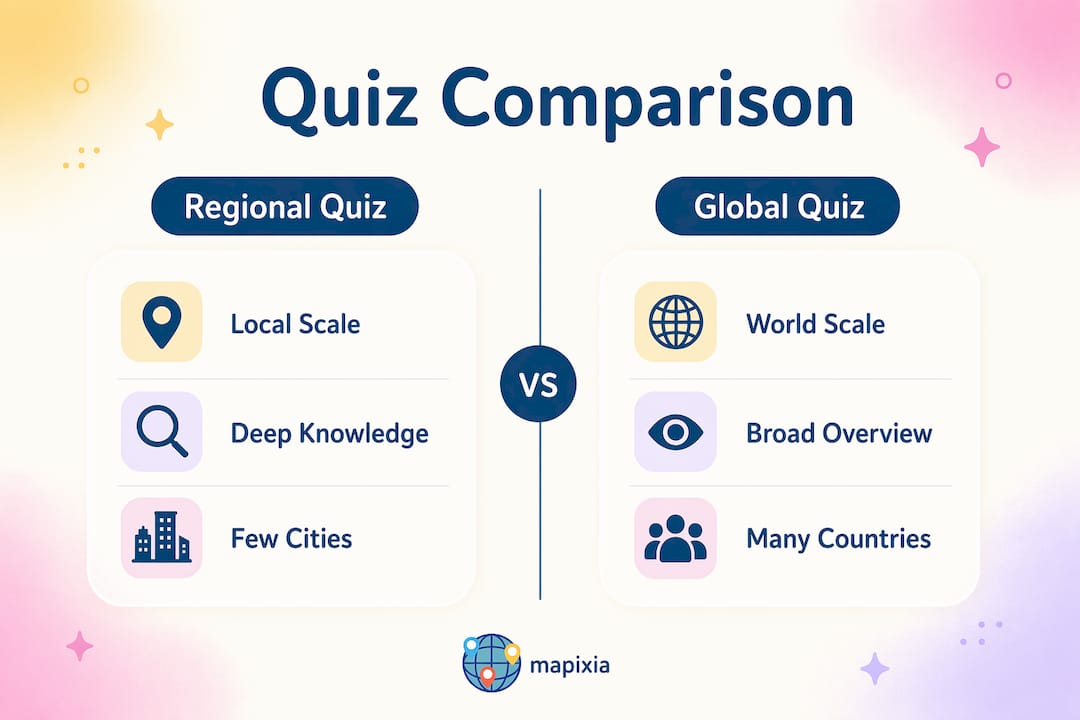
The same dataset tells different stories depending on the scale you choose. A quiz about river systems in the American Southeast is a regional quiz. A quiz about the world’s longest rivers is a global one. The underlying geography is related, but the questions, the difficulty, and the learning outcome are completely different.
Pro Tip: Before you start any quiz, check whether the questions are bounded by a region or open to the whole world. That single check tells you whether to focus on local detail or broad pattern recall, and it changes your strategy immediately.
How to use regional and global quizzes together for better learning
The most effective approach combines both formats in sequence. Educational games sequence regional quizzes first to build a structural map frame, helping you avoid cognitive overload before tackling global trivia. That sequencing improves both retention and engagement.
Here is a practical learning sequence you can follow:
- Start with formal regional quizzes. Pick a continent or a large country and learn its internal divisions: states, provinces, major cities. This builds your mental scaffolding. The country you live in becomes a natural choice here.
- Add perceptual regional quizzes. Test yourself on cultural regions like the Middle East, Sub-Saharan Africa, or Southeast Asia. These regions cross political lines and teach you how geography is actually grouped in real-world conversation.
- Move to country-level global quizzes. Once you have regional structure in place, tackle all world countries by location. The regional knowledge you built makes this much less overwhelming.
- Layer in capital cities. A 3-step quiz sequence that moves from country boundaries to capitals to landmark trivia is widely used in educational quiz tools and builds knowledge stepwise.
- Finish with thematic global quizzes. Questions about climate, trade, migration, and political systems require the broadest view. Save these for when your map foundation is solid.
This sequence works because quizzes are genuinely effective educational tools when they match your current knowledge level. Jumping straight to a global quiz without regional grounding is like trying to read a novel in a language you just started learning. The structure matters.
You can also mix formats for fun rather than strict study. A quiz night that starts with a regional round (say, European capitals only) and finishes with a global round (worldwide landmarks) gives players a warm-up before the harder challenge. That format keeps energy high and lets everyone contribute early. For ideas on how to structure that kind of evening, quiz night topic guides offer solid starting points.
The key insight is that regional and global quizzes are not competitors. They are different tools for different stages of geographic learning, and they work best when you use them together.
Key Takeaways
The core difference between regional and global quizzes is scale: regional quizzes build deep local knowledge within a connected area, while global quizzes train broad pattern recognition across the entire world.
| Point | Details |
|---|---|
| Scale defines everything | Regional quizzes cover multi-city or multi-state areas; global quizzes span multiple countries or the whole world. |
| Two types of regional quizzes | Formal regions use objective criteria; perceptual regions use cultural identity. Both appear in quiz content. |
| Global quizzes test breadth | Volume and pattern recognition across 195 UN-recognized countries make global quizzes harder in a different way than regional ones. |
| Sequence for best results | Start regional to build map structure, then progress to global quizzes to expand context and see larger patterns. |
| Same data, different stories | Choosing regional or global scale on the same topic changes what the quiz reveals and what you learn from it. |
Worldlecity puts both formats in one place
If you want to feel the difference between regional and global quiz formats firsthand, Worldlecity is built for exactly that.
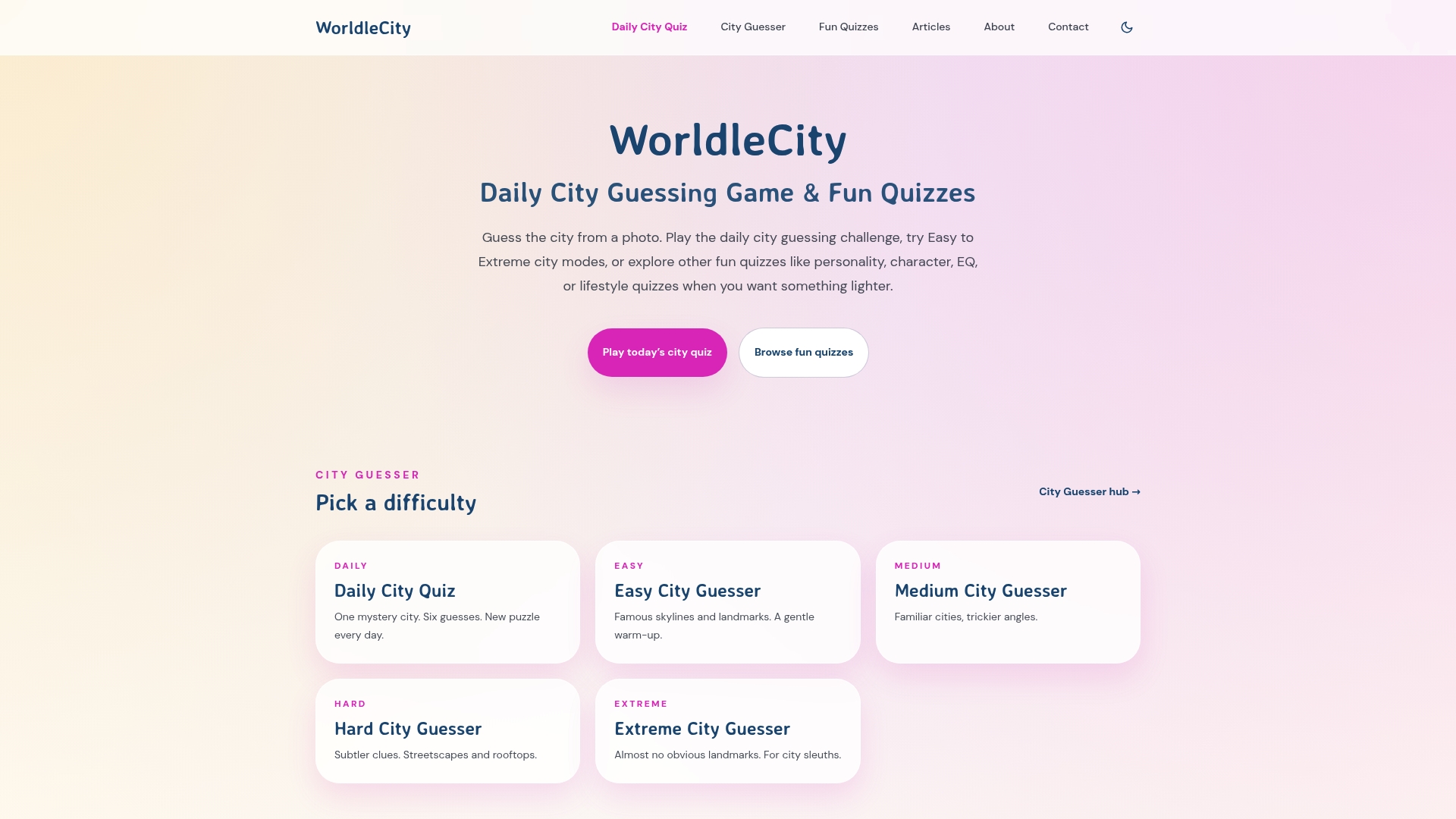
Each day, Worldlecity drops a mystery city photo and gives you six guesses to identify it. Every guess tells you how close you are and which direction to look. It’s a global-scale challenge by design, one city, drawn from anywhere in the world, no regional narrowing to lean on. Beyond the daily game, Worldlecity’s city guesser quizzes stack four difficulty modes, so you can build up global recognition at your own pace before tackling the toughest tier. No account needed. Just pick a quiz and go.
FAQ
What is the main difference between a regional and global quiz?
A regional quiz covers a connected geographic area defined by shared traits across multiple cities or states, while a global quiz covers phenomena spanning multiple countries or the entire world. The scale of analysis is the defining factor.
What topics appear in a regional quiz?
Regional quiz topics include state or province capitals within a zone, multi-city landmarks, cultural regions like the American South, and economic areas like the Sun Belt. Both formal and perceptual regions appear as content.
Why are global quizzes harder than regional ones?
Global quizzes require broad knowledge across all 195 UN-recognized countries, international landmarks, and worldwide systems. The challenge comes from volume and pattern recognition rather than local depth.
Can you use regional and global quizzes together?
Yes. Starting with regional quizzes builds a structural map framework, which makes global quizzes significantly easier to tackle. Educational quiz tools widely use this sequenced approach to improve retention.
How do I know which quiz type is right for me?
If you are new to geography quizzes, start regional to build confidence and structure. If you already have solid map knowledge, global quizzes offer the breadth and complexity to keep you challenged.