Why Nostalgia Quizzes Attract Players: The Psychology Behind It
Discover why nostalgia quizzes attract players. Learn how they evoke emotions and boost engagement, providing a unique, fun experience.
- psychology of nostalgia in games
- benefits of nostalgia in gaming
- nostalgia quiz popularity
- nostalgia and player attraction
- why nostalgia engages players
- role of nostalgia in quizzes
On this page

Nostalgia quizzes attract players by triggering emotional and cognitive responses that no standard content format can replicate. When you answer a question about a cartoon you watched at age eight or a song that defined your middle school years, your brain does not just recall a fact. It reconstructs a feeling. Research shows that interactive quizzes generate over three times more engagement than standard web pages, with average session durations of 2 minutes 48 seconds versus 1 minute 46 seconds for general content. That gap exists because nostalgia quizzes do something uniquely powerful: they combine the cognitive reward of trivia with the emotional warmth of personal memory, creating a pull that keeps you coming back.
Why nostalgia quizzes attract players on a psychological level
Nostalgia is not just a warm fuzzy feeling. Psychologists define it as a psychological tool that restores self-esteem, social connections, and existential meaning. That makes nostalgia quizzes fulfilling on multiple levels at once, which is rare for any single type of content.
When you play a nostalgia quiz, you get an instant micro-dose of positive affect. You remember something good, you feel competent for knowing it, and your mood lifts. That sequence lengthens the time you spend on a quiz without you even noticing. Psychologists call this “mental transportation,” where your mind briefly inhabits a past version of yourself. It feels good in a way that is hard to articulate but very easy to feel.

The social dimension matters just as much. Nostalgic social media engagement boosts positive affect and mental transportation, enhancing well-being by connecting past and present selves. Nostalgia quizzes work the same way. When you share your score or debate an answer with a friend, the experience becomes social bonding, not just solo entertainment.
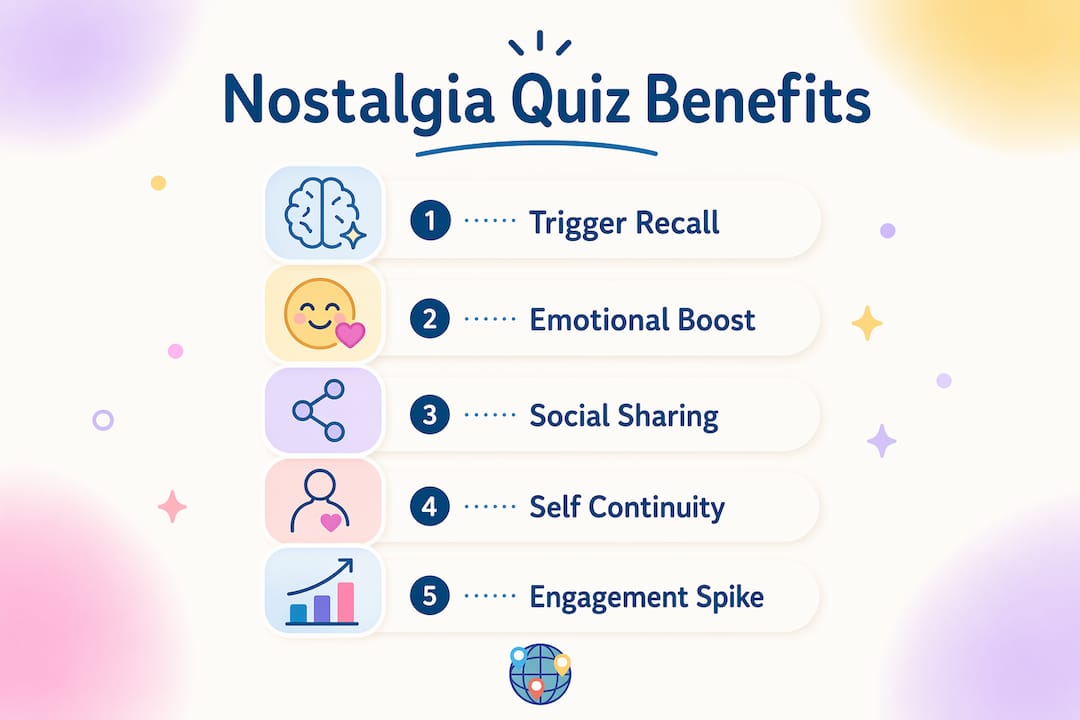
Here is what the psychology actually delivers for players:
- Self-continuity. Quizzes connect who you are now to who you were then, reinforcing a stable sense of identity.
- Social belonging. Shared cultural references create an “us” feeling, even between strangers online.
- Mood repair. Nostalgia reliably lifts mood, making quizzes a low-effort way to feel better fast.
- Competence. Getting answers right triggers a small but real sense of mastery.
- Curiosity. Questions about the past make you want to know what you remember and what you have forgotten.
Pro Tip: If you want to get the most psychological benefit from a nostalgia quiz, play it with someone who shares your cultural era. The conversation it sparks is often more rewarding than the score itself.
One nuance worth knowing: reflective nostalgia, which prioritizes the feeling of a memory over its factual accuracy, engages players better than quizzes that demand perfect historical recall. The goal is emotional resonance, not a history exam.
How quiz structure amplifies the nostalgia effect
The psychology of nostalgia only works if the quiz itself is built to deliver it. Structure matters enormously. A poorly designed quiz can kill the emotional payoff before it starts.
The most effective nostalgia quizzes calibrate their difficulty carefully. Questions that are too easy feel patronizing. Questions that are too hard feel alienating. The sweet spot is a question you almost remember, one that sits right at the edge of your recall. That moment of retrieval, when the answer finally surfaces, triggers a dopamine release. Research confirms that quizzes create dopamine and oxytocin responses through “aha!” moments and social bonding, making them neurologically rewarding.
Here is how the best nostalgia quiz structures work:
- Graduated difficulty. Start with easy, confidence-building questions and increase the challenge gradually. This keeps players in the “flow” state where engagement peaks.
- Personalized feedback. Telling players what their score means about them, not just how many they got right, deepens the sense of identity connection.
- Pop culture anchors. References to shared cultural touchstones act as social equalizers. Everyone has an opinion on the best Saturday morning cartoon, regardless of background.
- Shareable results. A score or personality result that players can post creates a social loop, pulling in new players while rewarding existing ones.
- Repeat visit hooks. Daily or weekly formats build habit. The science behind daily quizzes shows that consistent formats train players to return automatically.
Pro Tip: Quiz creators get the best engagement when they treat the result screen as a second quiz. Add a fun fact, a related memory prompt, or a shareable image. Players who linger on results pages share more.
The algorithmic benefits are real too. Nostalgia content fuels virality by triggering high dwell time, frequent comments, and shares. Those signals tell platforms to distribute the content more widely, creating a compounding reach effect that purely informational content rarely achieves.
| Engagement signal | Why nostalgia quizzes generate it |
|---|---|
| High dwell time | Emotional recall slows reading and increases time on page |
| Comments | Shared memories spark debate and personal stories |
| Shares | Results feel personal and worth showing to friends |
| Return visits | Habit-forming formats and new content keep players coming back |
What 2026 consumer trends reveal about nostalgia quiz popularity
The appeal of nostalgia quizzes is not static. Consumer behavior in 2026 shows a sharp acceleration in nostalgia-driven engagement across categories. Search interest in nostalgia-linked products surged, with “nostalgia toys” up 225% and 2000s-era toys up 140%. That is not a coincidence. It reflects a broader cultural shift toward the past as emotional shelter during uncertain times.
Quizzes sit right at the center of this trend. They are free, fast, and emotionally satisfying. When the world feels unpredictable, a quiz about the best 90s TV shows offers something rare: a moment of certainty, comfort, and shared experience.
| Generation | Primary nostalgia era | Quiz content that resonates |
|---|---|---|
| Millennials | 1990s–2000s | Y2K pop culture, early internet, childhood cartoons |
| Gen Z | 2000s–2010s | Vine era, early YouTube, mid-2000s gaming |
| Gen Alpha | 2010s–2020s | Early streaming, mobile gaming, meme culture |
Generational shifts affect nostalgia triggers significantly. Millennials and Gen Alpha respond to entirely different cultural references, which means quiz creators who rely on static audience profiles miss the mark fast. The most successful nostalgia quizzes update their content continuously, tracking which eras are trending rather than assuming the same references always land.
The shift from simple “reboot nostalgia” to what researchers call “reclamation nostalgia” is also worth noting. Players are not just revisiting the past for fun. They are actively reclaiming a version of themselves that felt more grounded. That emotional depth explains why nostalgia quiz popularity keeps growing even as other content formats plateau.
How to get the most out of nostalgia quizzes as a player or creator
Whether you are playing or building, a few principles make the experience significantly better.
For players:
- Play with people who share your era. The conversation beats the score every time.
- Do not stress about wrong answers. The point is the memory, not the grade.
- Share your results. The psychology behind quiz virality shows that sharing amplifies your own enjoyment, not just the platform’s reach.
- Try quizzes slightly outside your era. Discovering what you do not know is its own kind of fun.
For creators:
- Prioritize emotional resonance over factual precision. Reflective nostalgia outperforms accuracy-obsessed formats every time.
- Avoid overly rigid representation of a specific year or subculture. Exclusivity kills shareability.
- Use interactive quiz formats that deliver immediate personal feedback. Players who get a result that feels true to them share it.
- Refresh your content regularly. Nostalgia trends shift fast, especially across generations.
- Build in social features. Comments, leaderboards, and shareable results turn a solo activity into a community event.
The biggest mistake creators make is treating nostalgia as a fixed asset. It is not. What feels nostalgic to a 35-year-old today is completely different from what will feel nostalgic to a 20-year-old in five years. Staying current with generational shifts is not optional. It is the whole game.
Key Takeaways
Nostalgia quizzes attract players because they deliver emotional, social, and cognitive rewards that other content formats cannot match at the same speed or depth.
| Point | Details |
|---|---|
| Emotional payoff is instant | Nostalgia quizzes trigger positive affect and mood repair faster than most content types. |
| Brain chemistry drives retention | Dopamine from “aha!” moments and oxytocin from social bonding make quizzes neurologically rewarding. |
| Structure determines engagement | Graduated difficulty, personalized feedback, and shareable results maximize player involvement. |
| Consumer trends back the appeal | Search interest in nostalgia content surged in 2026, reflecting a cultural shift toward emotional shelter. |
| Generational targeting matters | Millennials and Gen Alpha respond to different eras, so quiz content must evolve continuously. |
Worldlecity: where nostalgia meets geography and fun quizzes
Worldlecity quiz platform runs on a related psychology. Each day, you get a photograph of a mystery city and six attempts to identify it, with proximity and direction clues after each guess. For a lot of players, that photo is not neutral. It is the city from a college trip, a family vacation, or a place a sibling once lived, and the guessing turns into its own kind of memory retrieval.
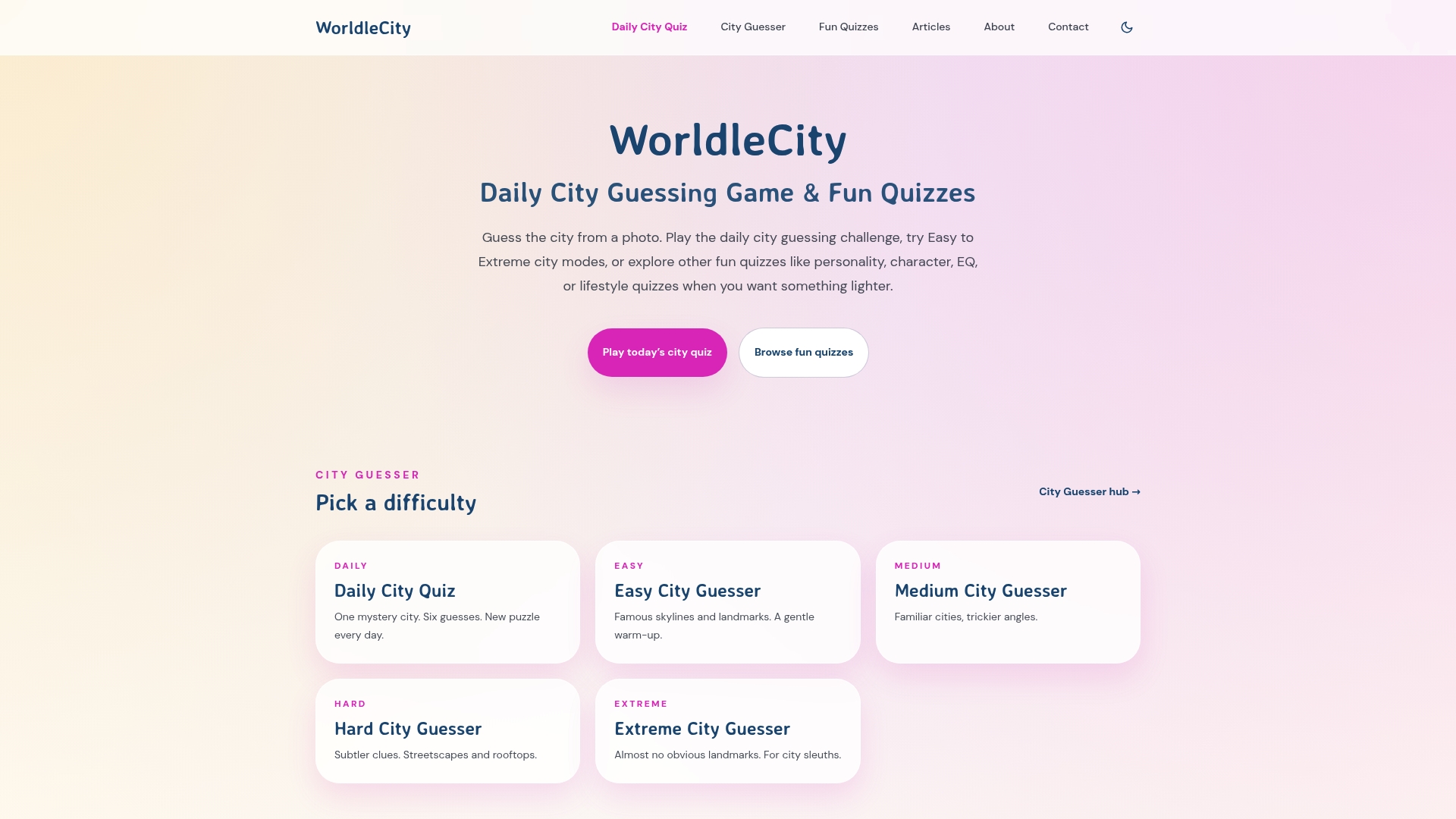
That is where the same competence and curiosity loop from this article shows up. You almost remember a place, the answer surfaces, and it feels good. Streaks and shareable scores add the social layer, since a result posted from a city you actually visited hits differently than a generic score. Beyond the daily game, Worldlecity’s personality and lifestyle quizzes run on the same shareable-identity mechanics, no account required.
FAQ
Why do nostalgia quizzes keep players engaged longer?
Nostalgia quizzes combine emotional recall with cognitive challenge, which extends session duration well beyond standard content. The emotional warmth of memory slows players down in the best possible way.
What psychological needs do nostalgia quizzes satisfy?
They restore self-esteem, reinforce social belonging, and strengthen self-continuity by connecting your present self to your past. That combination makes them fulfilling on multiple levels simultaneously.
Why do nostalgia quizzes get shared so often?
Results feel personal and identity-linked, which makes players want to show them to people who share their cultural background. Nostalgia content consistently generates high comment and share rates because it sparks real conversation.
Does nostalgia quiz content need to be historically accurate?
No. Reflective nostalgia, which captures the feeling of an era rather than its exact facts, engages players more effectively than quizzes that demand precise historical recall.
Are nostalgia quizzes more popular now than before?
Yes. Consumer search data from 2026 shows nostalgia-related interest rising sharply across categories, with quiz formats benefiting directly from the broader cultural shift toward past experiences as emotional comfort.