Answer Geography Quiz Questions Faster: Proven Tips
Learn how to answer geography quiz questions faster with proven techniques like active recall and spaced repetition. Boost your quiz skills now!
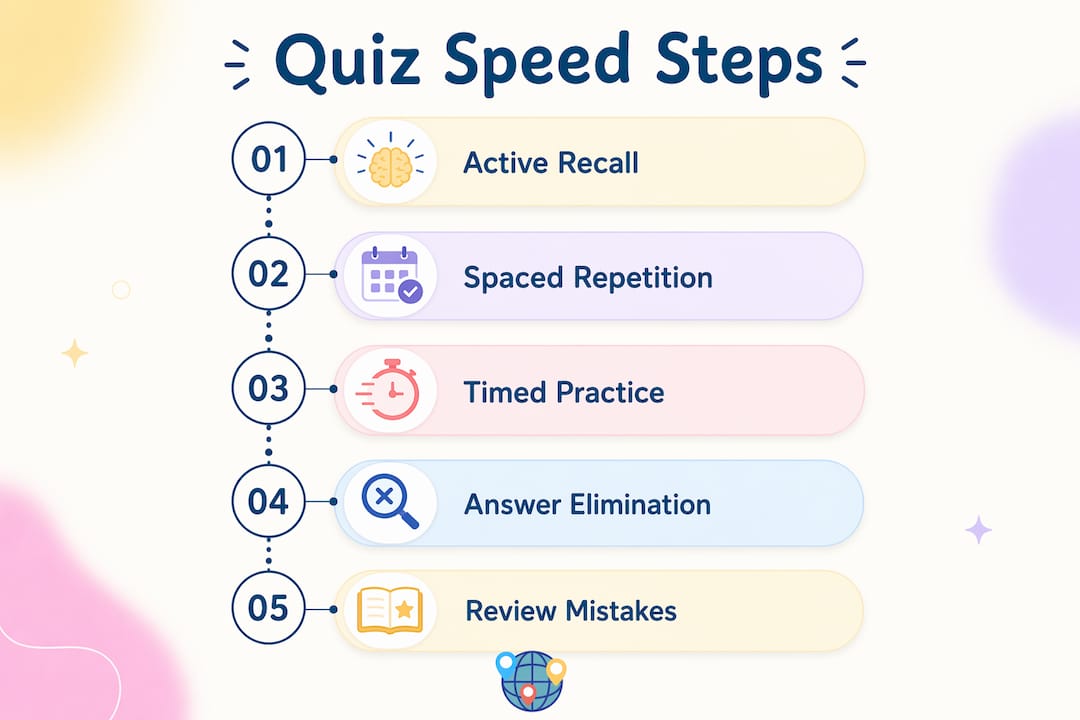
- how to answer geography questions quickly
- best practices for geography quizzes
- boost geography quiz performance
- efficient geography quiz strategies
- geography quiz preparation tips
- geography question answering skills
On this page

Answering geography quiz questions faster is defined by your ability to retrieve facts automatically, without consciously searching your memory. The fastest quiz players have trained their brains to shortcut from conscious recall to automatic retrieval through active recall and timed practice. This guide covers the exact techniques that build that speed: spaced repetition, desirable difficulty, and structured daily sessions. Whether you are prepping for a pub quiz, a school exam, or a daily challenge on WorldleCity, these strategies will sharpen your response time and cut your hesitation.
How to answer geography quiz questions faster
The single most effective method is active recall. That means testing yourself instead of reading or staring at a map. Every time you force your brain to retrieve an answer, you strengthen that memory pathway. Passive review, like tracing borders or re-reading capitals, does almost nothing for quiz speed.
Spaced repetition works alongside active recall. You review material at increasing intervals, revisiting weak spots more often than strong ones. Apps built on this principle, like Anki, schedule your reviews automatically so you spend time where it counts most.
Timed practice is the third pillar. Setting a clock creates pressure, and that pressure forces your brain to retrieve answers faster. Over time, what felt like a scramble becomes a reflex. The desirable difficulty principle explains why: mild struggle during learning produces stronger, faster memory than easy review.
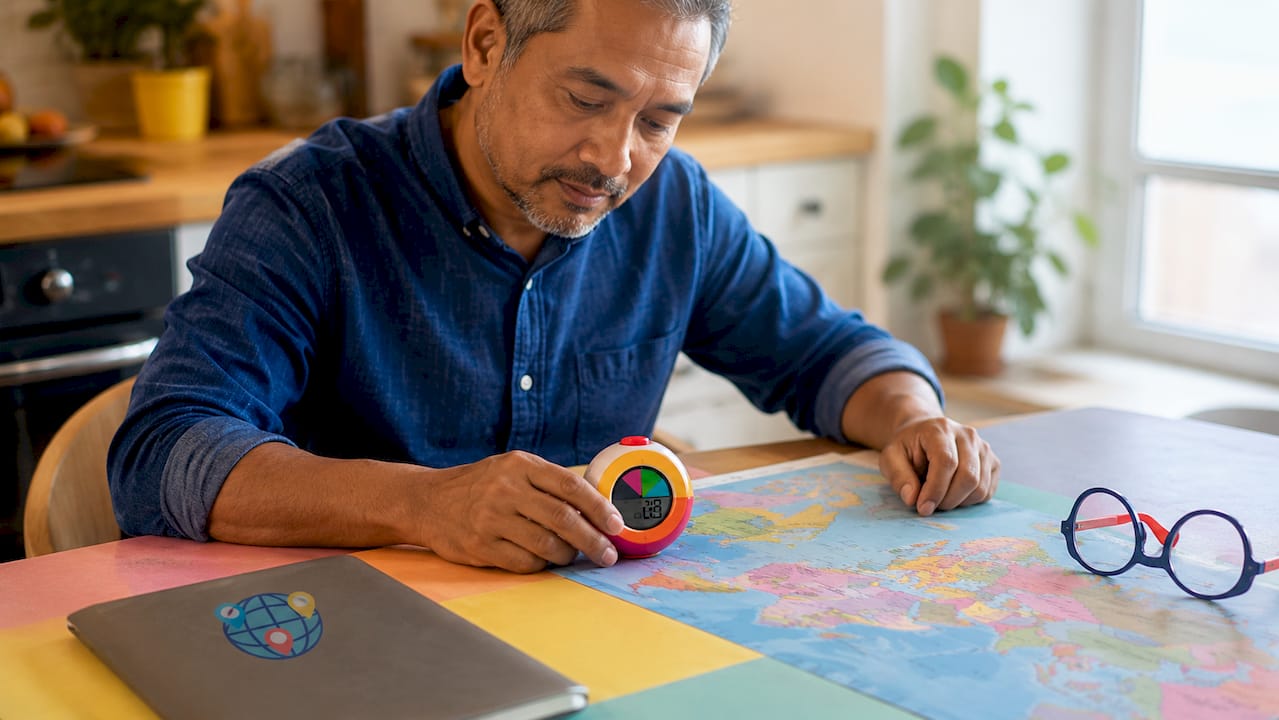
What tools help you improve geography quiz speed?
The right platform makes a real difference. Here is how different tool types compare on the features that matter most for speed training.
| Feature | Timed game formats | Exam-style quiz platforms | Flashcard apps |
|---|---|---|---|
| Question count per session | 7–25 | 25 | Custom |
| Timer pressure | High | Moderate | Low |
| Immediate feedback | Yes | Yes (with rationale) | Yes |
| Score multipliers | Yes | No | No |
| Spaced repetition | No | No | Yes |
Geo Duel Cup packs 7 questions into 90 seconds, with combo multipliers that reward consecutive correct answers and double points on the final question. That format trains you to commit to answers quickly rather than second-guess yourself.
GeoQuizzy takes a different angle. Its 25-question, 25-minute timed exams mimic real test conditions, and each session ends with a PDF showing your score breakdown and the rationale behind every answer. That feedback loop is what turns a quiz into a study session.
Flashcard apps built on spaced repetition, like Anki, let you build custom decks for flags, capitals, and borders. They are less exciting than game formats, but they fill the gaps that timed games miss.
Pro Tip: Mix at least two tool types each week. Use a fast game format for speed training and a flashcard app for retention. They target different parts of the recall process.
You can find a broader breakdown of map-based quiz games worth trying across different skill levels and formats.
How does timed practice build faster recall?
Timed quizzes create what learning scientists call “desirable difficulty.” The discomfort of a ticking clock forces your brain to retrieve answers under pressure, which builds faster, more automatic recall over time.
“The initial panic you feel during a timed quiz is not a sign you don’t know the material. It is the feeling of your brain being trained to retrieve faster. Lean into it.”
Here is a simple timed practice routine you can run in under 15 minutes:
- Set a 60-second timer. Name as many countries in South America as you can before it runs out.
- Check your list. Note every country you missed. Those are your priority targets.
- Run a second round. Same timer, same region. Did you add any? Did you get faster?
- Switch regions. Move to Southeast Asia or West Africa. Repeat the cycle.
- End with a full quiz. Use a platform like GeoQuizzy or a timed game to test everything you just reviewed.
The key is not to avoid the panic. Accepting initial discomfort during timed practice is what trains your brain to shortcut from slow, conscious recall to fast, automatic retrieval. That shortcut is called automaticity, and it is the real goal.
Pro Tip: Start your timer before you feel ready. Waiting until you feel confident defeats the purpose. The pressure is the point.
Memory techniques that speed up quick geography question answers
Strong quiz speed comes from how you study, not just how much. The right habits build fast retrieval. The wrong ones waste your time.
Spaced repetition and active recall consistently outperform passive study methods. Staring at a map for 30 minutes builds familiarity, not speed. Forcing yourself to recall a capital without looking it up builds the reflex you need under quiz pressure.
Short daily sessions beat long weekend cramming. Your brain consolidates memory during rest, so spreading practice across the day works better than one long block. A 5-minute quiz in the morning, a 10-minute review at lunch, and a quick recap before bed will outperform a single 45-minute session every time.
Failure is a feature, not a bug. When you get an answer wrong, that error creates a stronger memory trace than a correct answer does. Debug your mistakes deliberately. Look up why Nur-Sultan is Kazakhstan’s capital, or why Suriname borders Brazil. Context sticks faster than bare facts.
Here are the study habits that directly improve quiz response speed:
- Quiz yourself daily, even for 5 minutes. Frequency beats duration.
- Use flags and maps together. Recognizing a flag and placing it on a map uses two memory pathways, which reinforces both.
- Review wrong answers immediately. Do not skip past errors. Pause, read the correct answer, and say it out loud.
- Practice capitals in batches by region. Grouping by geography creates mental clusters that speed up retrieval.
- Track your streaks. Gamification elements like streaks and XP keep motivation high and make daily practice feel rewarding.
Pro Tip: After any quiz, spend 2 minutes on only the questions you got wrong. That 2-minute review does more for your speed than 10 minutes of reviewing what you already know.
Common mistakes that slow you down during geography quizzes
Overthinking is the biggest speed killer. When you pause to debate between two answers, you break your rhythm and often end up choosing the wrong one anyway. Your first instinct is usually correct, especially after consistent practice.
Hesitation also costs you points in game formats. In Geo Duel Cup, breaking a combo streak by hesitating costs you multiplier points. Speed and accuracy work together, not against each other.
| Mental state | Effect on recall speed | Effect on accuracy |
|---|---|---|
| Calm confidence | Fast | High |
| Mild pressure | Faster | Moderate to high |
| Overthinking | Slow | Low |
| Panic (untrained) | Very slow | Low |
| Panic (trained) | Fast | Moderate to high |
Answer elimination is your best tool under time pressure. If you do not know the answer immediately, cross out the options that are clearly wrong. Narrowing four choices to two cuts your decision time significantly.
Quiz fatigue is real. After 30 or more questions, your recall slows and your error rate rises. Build in short breaks during long study sessions. Even 60 seconds of looking away from the screen resets your focus.
Pro Tip: If you are stuck on a question for more than 5 seconds, commit to your best guess and move on. Lingering costs you time on every question that follows.
What does a daily practice routine look like?
Consistency is what separates players who plateau from those who keep getting faster. Short, regular sessions build speed more reliably than sporadic long ones.
Here is a sample weekly routine:
| Day | Morning (5 min) | Lunch (10 min) | Evening (5 min) |
|---|---|---|---|
| Monday | Capitals: Europe | Timed game round | Flag review: Asia |
| Tuesday | Borders: Africa | GeoQuizzy exam | Wrong answers review |
| Wednesday | Capitals: Asia | Timed game round | Map placement: Americas |
| Thursday | Flags: Europe | Spaced rep flashcards | Capitals: Africa |
| Friday | Borders: Asia | Timed game round | Full region recap |
| Saturday | Mixed capitals | Long quiz session | Streak check |
| Sunday | Light review | Rest or free play | Worldlecity City guesser game |
Short daily quiz sessions spaced throughout the day enhance memory retention and speed when combined with active recall. That is not a suggestion. It is the most efficient structure the research supports.
Session ideas to rotate through:
- Name all capitals in a region from memory, then check
- Identify flags without labels, then review misses
- Place countries on a blank map by memory
- Run a 60-second country-naming sprint by continent
- Complete a timed geography quiz and log your score
Tracking your scores over time matters. When you see your time per question dropping week over week, that is real evidence the practice is working. It also keeps you motivated to keep the streak alive.
Worldlecity makes daily geography practice feel like a game
Worldlecity is built for exactly this kind of daily practice. Each day, you get a photograph of a mystery city and six attempts to guess it. Every guess tells you how close you are and which direction to look. That feedback loop trains your spatial geography instincts fast. You also get to read a lot about yesterday’s mystery city through useful links which further enhances your geography knowledge.
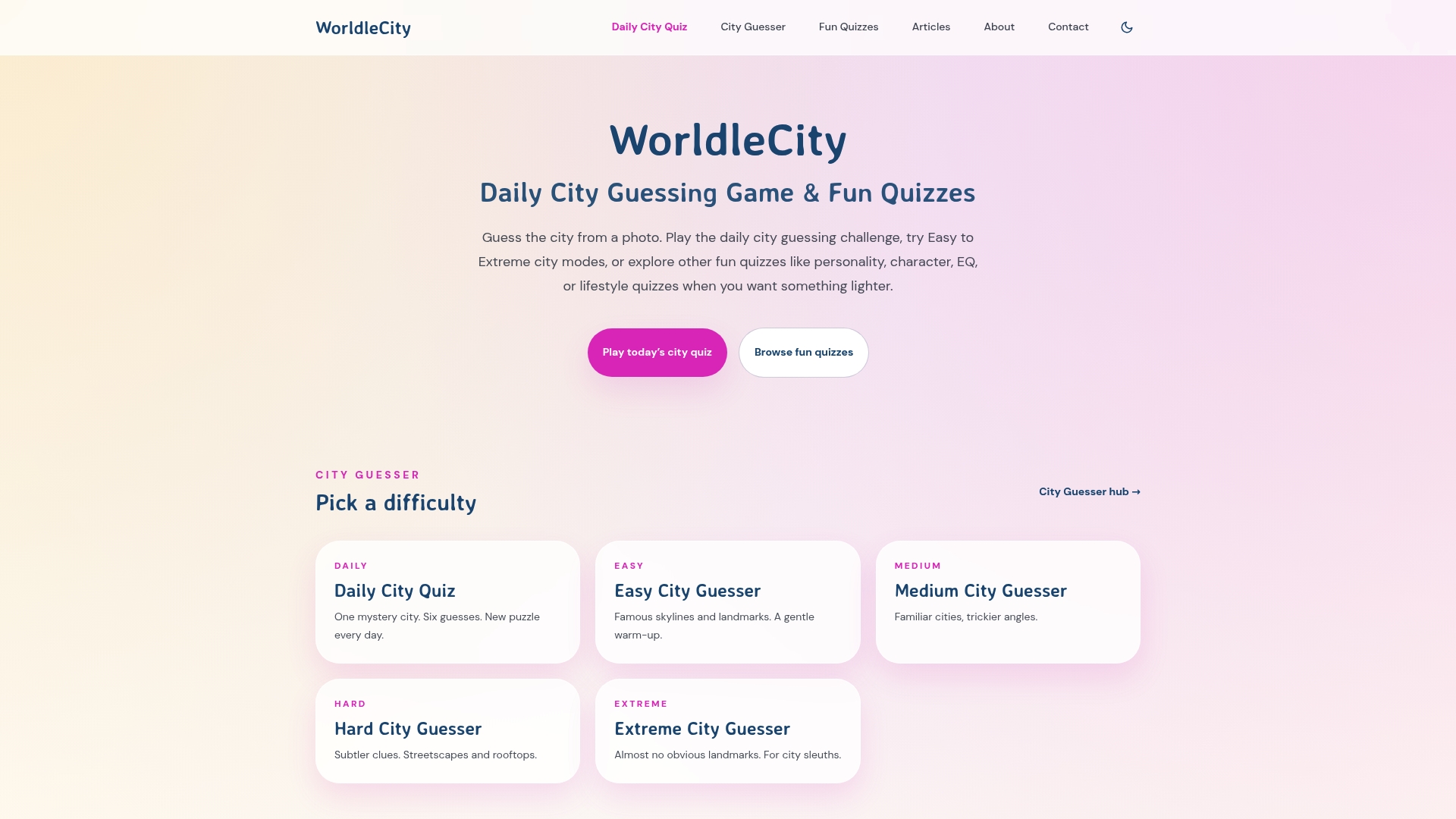
Beyond the daily city game, Worldlecity offers city guesser quizzes across four difficulty modes, so you can match the challenge to where you are in your training. No account needed. Just show up, play, and share your results. The daily city guessing game is free, quick, and genuinely good practice for building the kind of fast, confident recall that wins quizzes.
Key takeaways
Active recall and timed practice are the fastest path to quick geography quiz answers because they build automatic retrieval, not just familiarity.
| Point | Details |
|---|---|
| Active recall beats passive study | Testing yourself, not reading maps, is what builds quiz speed. |
| Timed pressure trains automaticity | Timers force faster retrieval and build reflexes over repeated sessions. |
| Short daily sessions outperform cramming | Five to ten minutes spread across the day beats one long weekly block. |
| Failure accelerates learning | Wrong answers create stronger memory traces than correct ones do. |
| Gamified tools reinforce speed habits | Combo multipliers and streaks reward fast, accurate answers and sustain motivation. |
FAQ
What is the fastest way to improve geography quiz speed?
Active recall combined with timed practice is the fastest method. Testing yourself under a timer forces your brain to retrieve answers automatically rather than consciously searching.
How long should I practice geography each day?
Three short sessions totaling 20 minutes per day, spread across morning, lunch, and evening, outperform a single long session. Frequency and spacing matter more than total time.
Does playing geography games actually help quiz performance?
Yes. Game formats with combo multipliers and timed rounds, like Geo Duel Cup, train you to commit to answers quickly and balance speed with accuracy under real pressure.
What should I do when I get a geography question wrong?
Review the correct answer immediately and add context, like why a capital is located where it is. That context creates a stronger memory trace than simply noting the right answer.
How do I stop overthinking during timed quizzes?
Commit to your first instinct within 5 seconds. If you are unsure, eliminate clearly wrong options and pick from what remains. Hesitation costs more time than a confident wrong guess does.