What Is a Population Quiz? Your Guide to Scoring Big
Discover what is a population quiz and test your knowledge of demographics and geography. Score big while learning about global population trends!
- how to score on population quiz
- population quiz definition
- types of population quizzes
- importance of population quizzes
- what do population quizzes test
- what is a population quiz
On this page

A population quiz is an assessment tool designed to test your knowledge of human demographics, population statistics, and geographic trends through engaging questions and challenges. These quizzes typically cover 10–25 questions on topics like world population milestones, density, birth rates, and life expectancy, with the world population now exceeding 8.1 billion people as a common reference point. Whether you are a geography enthusiast or just curious about how many people actually live in Indonesia, a population quiz gives you a fast, free way to find out exactly where your knowledge stands.
What is a population quiz, and what does it actually test?
A population quiz is a structured set of questions that measures how well you understand human demographics, not just raw headcounts. Standard quizzes cover population density, the world’s most populous nations, demographic transition model stages, and natural increase rates. That range means you are being tested on real conceptual understanding, not just whether you memorized that China has a lot of people.
The core concepts you will encounter include:
- Population density: How many people live per square kilometer in a given country or region.
- Growth rates and natural increase: The difference between birth rates and death rates, expressed as a percentage.
- Demographic Transition Model (DTM): A four or five stage framework describing how countries shift from high birth and death rates to low ones as they develop.
- Population pyramids: Visual charts showing the age and gender breakdown of a population.
- Urbanization: The percentage of a population living in cities, which has risen sharply across Asia and Africa.
- Life expectancy and fertility rates: Two of the most telling indicators of a country’s development stage.
Demographers emphasize that population study involves dynamic variables like migration and fertility rates, not just headcounts. The best quizzes reflect that complexity, asking you to apply concepts rather than just recall a number.
Pro Tip: Focus on understanding the Demographic Transition Model before you take any population quiz. Knowing which stage a country is in tells you its likely birth rate, death rate, and growth trajectory, which covers a huge chunk of typical quiz questions.
Most quizzes run 3–10 minutes and are completely free. Most platforms do not charge fees for basic demographic quizzes, with optional account creation available for saving progress or earning certificates. You do not need to sign up for anything to get started.
What types of population quizzes are out there?
Population quizzes come in several formats, and the format matters more than you might think. Each one engages a different part of your brain and builds a different kind of geographic intuition.
Multiple-choice quizzes are the most common format. You get a question like “Which country has the highest population density?” and pick from four options. They are fast, low pressure, and great for covering a lot of ground quickly.
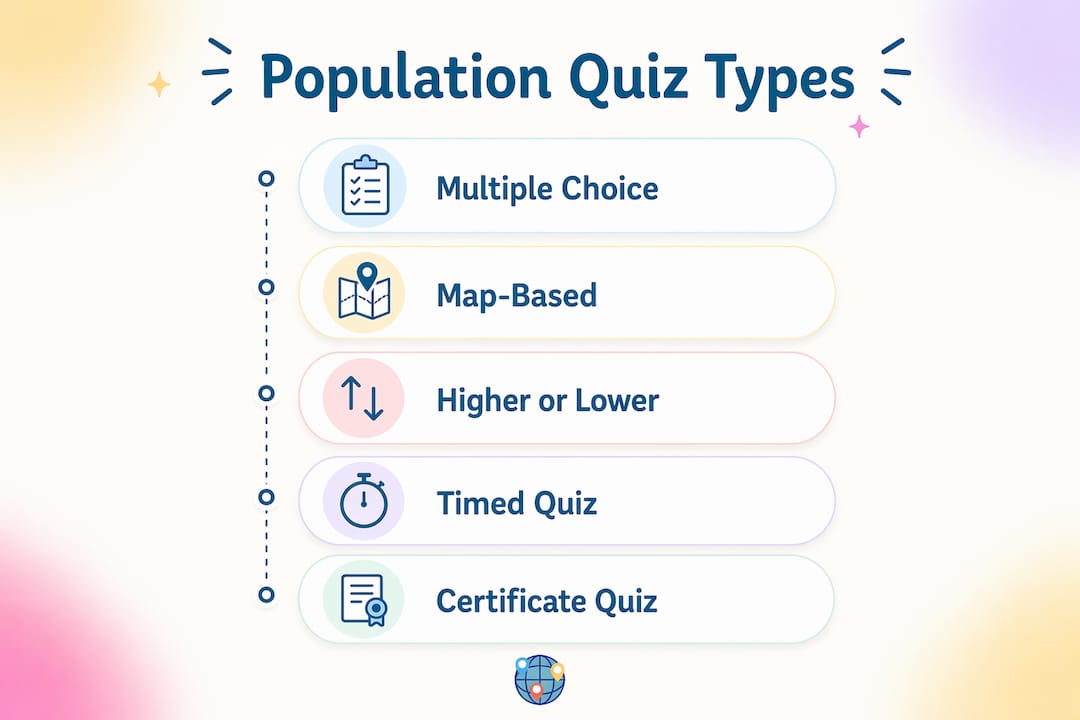
Interactive map-based quizzes ask you to click directly on a country or region. Interactive formats reinforce spatial awareness better than text-only quizzes. When you physically locate Bangladesh on a map and then learn it holds over 170 million people in a space smaller than Iowa, that fact sticks.

Higher or lower guessing games show you two countries and ask which has the bigger population. This format is surprisingly addictive and builds a strong intuitive sense of comparative population sizes across continents.
Timed quizzes add a layer of pressure that sharpens recall. You get a set number of seconds per question, which forces you to rely on genuine understanding rather than working through each option slowly.
Certificate and scorecard quizzes reward full completion with a printable result or detailed breakdown. Advanced users seek these features for motivation and progress tracking, making them a solid choice if you are studying for an exam or just love a good leaderboard.
Visual quiz formats help users understand demographic trends beyond memorization. That is the real advantage of choosing an interactive format over a plain text quiz.
Pro Tip: If you want to build genuine spatial awareness of where populations cluster, start with map-based quizzes. Clicking on the Ganges Plain or the Nile Delta while answering population questions creates a mental map that sticks far longer than a list of facts.
You can find map-based quiz games designed for both casual players and serious geography learners, covering everything from city populations to continental distribution.
Why population quizzes are worth your time
Population quizzes serve a dual purpose. They are genuinely fun, and they are also serious study tools for anyone trying to understand how the world works.
“Population quizzes transform complex demographic data into manageable learning challenges. They help users see how birth rates, migration, and urbanization connect to real-world issues like housing shortages, aging workforces, and resource distribution.”
That connection to real-world issues is what separates a good population quiz from a trivia game. Demographic data directly shapes urban planning, resource management, and policy decisions. When you understand why Japan’s population pyramid looks the way it does, you understand why its government is worried about pension costs.
Abstract numbers become intuitive through repeated quiz practice. Knowing that sub-Saharan Africa has the world’s fastest-growing population is one thing. Seeing it framed as a quiz question, getting it wrong, and then checking the answer creates a memory that lasts. That is the learning mechanism quizzes exploit so effectively, and quizzes work as educational tools precisely because they create that moment of productive struggle.
Regular practice also builds pattern recognition. After a dozen quizzes, you start to notice that high-income countries cluster around low birth rates and aging populations, while lower-income countries often show the opposite. That pattern becomes a mental shortcut that helps you answer new questions faster and more accurately.
How to score well on a population quiz
Scoring well on a demographic quiz is less about memorizing numbers and more about understanding frameworks. Here is a practical approach that actually works.
-
Learn the Demographic Transition Model first. The DTM and population pyramids are foundational concepts that outweigh memorizing yearly statistics. If you know the four stages, you can infer a country’s likely birth rate, death rate, and growth pattern without memorizing each one individually.
-
Know the top 10 most populous countries. China, India, the United States, Indonesia, Pakistan, Brazil, Nigeria, Bangladesh, Russia, and Ethiopia cover a huge percentage of quiz questions about country rankings. India surpassed China as the world’s most populous country, which is a frequent quiz topic.
-
Understand continent-level distribution. Asia holds roughly 60% of the world’s population. Africa is the fastest-growing continent. Europe is aging. These broad patterns answer a surprising number of questions.
-
Use quiz feedback actively. When you get a question wrong, do not just move on. Read the explanation, look up the country on a map, and connect the fact to a broader pattern. That extra 30 seconds per wrong answer is where real learning happens.
-
Practice with interactive formats. Map-based and higher-or-lower quizzes build spatial intuition that text-only quizzes cannot replicate. Mixing formats keeps practice sessions from feeling repetitive and covers more cognitive ground.
-
Manage your time on timed quizzes. Skip questions you are genuinely unsure about and return to them. Spending 40 seconds on one hard question while easier ones sit unanswered is the most common way people lose points.
The quiz night topics guide from Worldlecity is also worth a look if you want to see how population questions fit into broader geography quiz formats.
Pro Tip: Before any timed quiz, spend two minutes reviewing the top 10 most populous countries and the five stages of the DTM. Those two frameworks cover the majority of questions in most standard population quizzes.
FAQ
What is the population quiz definition?
A population quiz is an online assessment that tests your knowledge of demographics, including population density, growth rates, birth and death rates, and country-specific statistics. Most quizzes run 10–25 questions and take 3–10 minutes to complete.
What do population quizzes test?
Population quizzes test conceptual understanding of topics like the Demographic Transition Model, population pyramids, urbanization rates, and country population rankings. The best quizzes go beyond raw numbers to assess how well you understand demographic patterns and trends.
Are population quizzes free?
Most population quizzes are free to play with no account required. Some platforms offer optional account creation for saving scores or earning completion certificates, but basic access costs nothing.
How do I score well on a population quiz?
Focus on understanding frameworks like the Demographic Transition Model and population pyramids rather than memorizing individual statistics. Knowing the top 10 most populous countries and broad continental distribution patterns covers the majority of standard quiz questions.
What types of population quizzes are available?
Population quizzes come in multiple-choice, interactive map-based, higher-or-lower guessing game, timed, and certificate formats. Interactive and visual formats build stronger spatial awareness and longer-lasting retention than text-only quizzes.
Key Takeaways
A population quiz is most useful when it tests conceptual frameworks like the Demographic Transition Model, not just raw statistics, because frameworks let you answer questions about countries you have never specifically studied.
| Point | Details |
|---|---|
| Population quiz definition | An online tool testing knowledge of demographics, density, growth rates, and country statistics across 10–25 questions. |
| Core concepts to know | The Demographic Transition Model, population pyramids, urbanization rates, and top country rankings cover most quiz content. |
| Best quiz formats | Interactive map-based and higher-or-lower quizzes build spatial intuition that text-only formats cannot replicate. |
| Scoring strategy | Learn frameworks first, use wrong-answer feedback actively, and practice across multiple quiz formats for best results. |
| Free and accessible | Most platforms offer full quiz access at no cost, with optional accounts for certificates and progress tracking. |