How to Choose the Right Quiz Difficulty Level
Learn how to choose the right quiz difficulty level for rewarding learning. Understand the numbers behind success rates and enhance your quizzes!
- how to choose quiz level
- select quiz difficulty
- quiz difficulty guide
- choose right test difficulty
- quiz level selection guide
- quiz difficulty options
- determining quiz difficulty
- adjusting quiz challenge
On this page

Choosing the right quiz difficulty level is the single biggest factor in whether a geography quiz feels rewarding or just frustrating. Get it wrong in either direction and you either breeze through without learning anything, or you crash out on question three and never come back. The good news: difficulty is measurable. Easy questions carry success rates above 80%, medium questions land around 50–60%, and hard questions drop to 20–35%. Those numbers give you a real target to aim for, not just a vibe. Understanding where you sit on that spectrum, and how cognitive science backs it up, makes picking your level a lot less guesswork and a lot more satisfying.
How to choose the right quiz difficulty level: what the numbers actually mean
Difficulty is not just a label someone slaps on a question. It maps directly to how often people answer correctly. Educational assessment standards define “Easy” as questions where 85–95% of players succeed, “Standard” at 75–85%, and “Challenging” at 60–75%. Those benchmarks exist to balance confidence with genuine learning, and they hold up whether you’re sitting a school exam or playing a geography quiz on a Saturday afternoon.
For geography quizzes specifically, the difference between levels shows up fast. An easy question might ask you to name the capital of France. A medium question asks you to identify which African country borders both the Atlantic Ocean and the Mediterranean Sea. A hard question asks you to place a mid-sized city in Central Asia from a single street-level photo.
The cognitive load jumps with each step. Easy questions test recognition. Medium questions require you to connect two or more facts. Hard questions demand that you synthesize knowledge you probably didn’t consciously memorize.

Pro Tip: If you’re consistently scoring above 85% on a given level, move up. Staying comfortable feels good but stops the learning cold.
Here’s a quick breakdown of what each tier looks like in practice:
- Easy: Capital cities, major continents, well-known landmarks. Success rate above 80%. Good for warm-ups or total beginners.
- Medium: Regional geography, country borders, major rivers and mountain ranges. Success rate around 50–60%. The sweet spot for most casual players.
- Hard: Obscure cities, disputed territories, precise geographic coordinates. Success rate as low as 20–35%. Built for geography enthusiasts who want a real challenge.
How does Bloom’s Taxonomy connect to quiz difficulty?
Bloom’s Taxonomy is a six-level framework that describes how we think, from basic recall all the way up to creating new ideas. It was designed for education, but it maps onto quiz difficulty almost perfectly. Difficulty aligns with Bloom’s levels like this: Easy questions sit at Remember and Understand, Medium questions live at Apply and Analyze, and Hard questions reach into Evaluate and Create.
In geography terms, a “Remember” question asks you to recall that the Nile is in Africa. An “Analyze” question asks you to compare two river systems and explain which drains a larger watershed. An “Evaluate” question asks you to judge which of two proposed capital city locations would better serve a landlocked country’s economy.
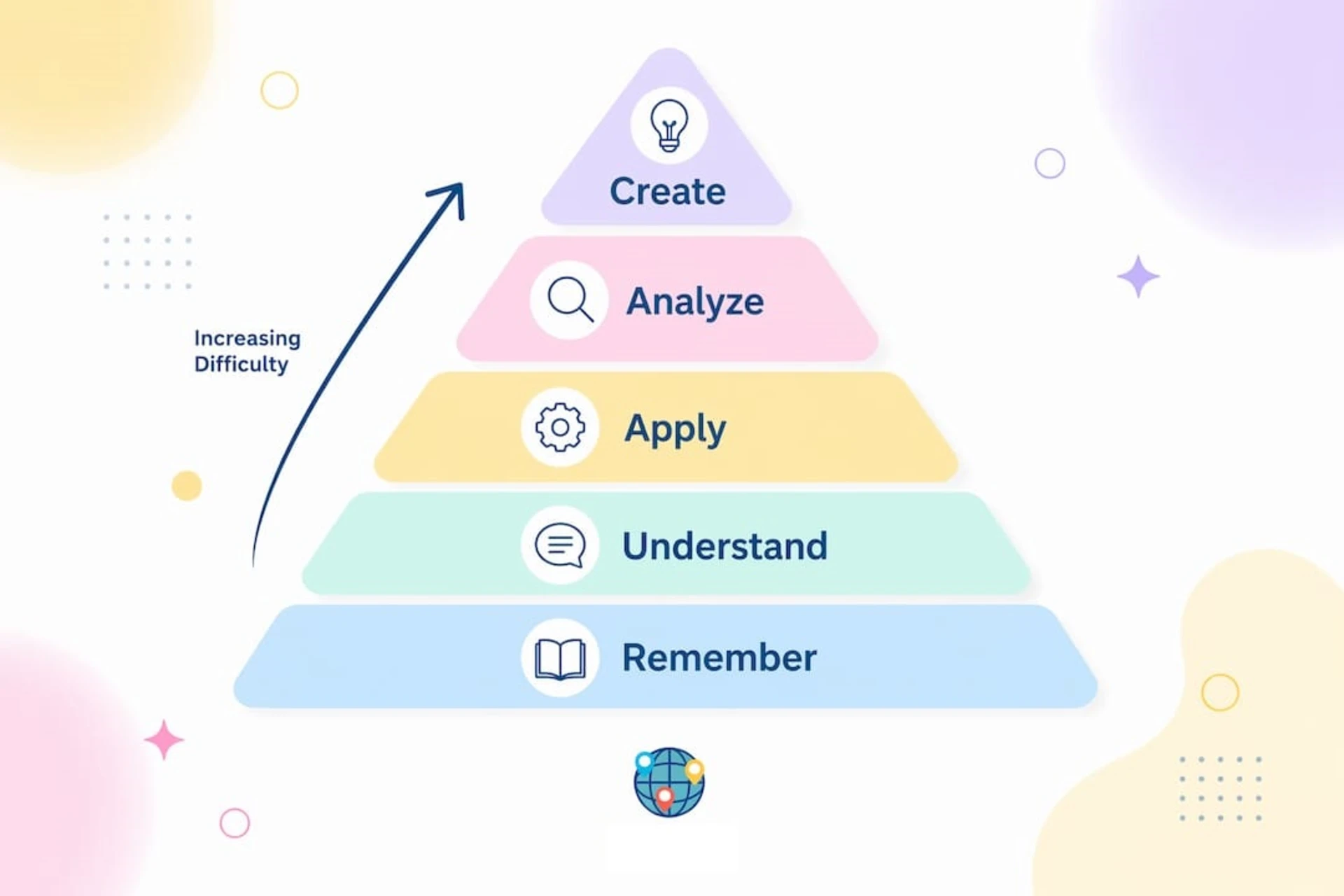
That cognitive ladder matters because it tells you what kind of mental work you’re actually doing. Moving up a difficulty level is not just about knowing more facts. It’s about thinking differently.
There is one important catch, though. Difficulty is subjective, shaped by content obscurity and cognitive load beyond simple recall. An extremely obscure fact, like the name of a minor river in a rarely discussed country, sits at the lowest Bloom’s level (Remember) but feels brutally hard if you’ve never encountered it. Bloom’s level tells you the type of thinking required, not how familiar the content is.
Pro Tip: When you’re selecting a quiz level, ask yourself two questions: “Do I know this topic area?” and “Can I reason through it?” Both matter. A high Bloom’s level question in a familiar topic might be easier for you than a low-level question in an unfamiliar one.
| Bloom’s Level | Cognitive Task | Geography Example | Difficulty Tier |
|---|---|---|---|
| Remember | Recall a fact | Name the capital of Japan | Easy |
| Understand | Explain a concept | Describe why the Sahara is a desert | Easy/Medium |
| Apply | Use knowledge in context | Identify which country a river flows through | Medium |
| Analyze | Break down relationships | Compare two climate zones | Medium/Hard |
| Evaluate | Make a judgment | Assess which city is best positioned for trade | Hard |
| Create | Build something new | Design a route across three continents | Hard |
How do you assess your skill and pick the best starting difficulty?
Starting at the wrong level costs you. Too easy and you disengage within minutes. Too hard and you feel defeated before you’ve learned anything. Starting at a moderate difficulty maximizes retention by keeping you in the zone between boredom and frustration. That’s not just intuition. It’s backed by adaptive quiz design research.
Here’s a practical way to find your starting point:
- Take a short self-assessment. Answer five questions at medium difficulty. If you get four or five right, start at hard. If you get two or three right, stay at medium. If you get fewer than two right, start at easy.
- Track your score across three rounds. One round is not enough data. If you’re consistently above 85% correct, move up. If you’re below 40%, move down.
- Let the quiz choose for you. Offering users choice in difficulty improves engagement and performance, especially among younger players. But if you’re unsure, starting at medium and adjusting is the most reliable method.
- Mix difficulty levels intentionally. A quiz that blends easy, medium, and hard questions mirrors the structure of quality standardized exams. It keeps you engaged without burning you out.
- Revisit your level every few sessions. Geography knowledge builds fast when you’re actively playing. What felt hard two weeks ago might be medium today.
The goal is not to find the level where you always win. The goal is to find the level where you’re learning. That usually means getting some questions wrong. Quizzes are genuinely effective educational tools precisely because the struggle of retrieval is where the learning happens.
For beginners, easy mode is not a consolation prize. It builds the geographic vocabulary you need to tackle harder questions later. For intermediate players, medium is where the real growth lives. For advanced players, hard mode is where you find out what you actually know versus what you thought you knew.
What are the most common mistakes when selecting quiz difficulty?
The biggest mistake is treating difficulty as a fixed label rather than a dynamic setting. Most players pick a level once and never adjust it. That’s a problem because your knowledge grows, and a static difficulty level stops reflecting your actual skill.
A few specific pitfalls show up repeatedly:
- Too few questions per level. A quiz needs at least 10–15 unique questions per difficulty tier to prevent memorization and give you an accurate read on your skill. A five-question hard quiz tells you almost nothing reliable.
- Starting too hard too fast. Jumping straight to hard mode feels ambitious, but it often just produces frustration without learning. The failure rate at hard level (20–35% success) means you’ll get most questions wrong before you’ve built any context.
- Answer length bias in multiple-choice questions. Balanced answer length distribution in multiple-choice questions reduces guess bias. When one answer is noticeably longer than the others, players often pick it because test-writers tend to make correct answers more detailed. A well-designed quiz keeps answer lengths roughly similar so your score reflects actual knowledge.
- Ignoring question format. A map-based question and a text-based question about the same city can feel completely different in difficulty. Format affects perceived challenge, not just content.
The fix for most of these is simple: use a quiz platform with a large, varied question bank, and commit to adjusting your level based on real score data rather than gut feeling. Checking out quiz night topic guides can also help you understand which subject areas tend to skew harder or easier, so you can calibrate your expectations before you start.
Key takeaways
Picking the right difficulty level means matching question complexity to your current skill, then adjusting as you grow.
| Point | Details |
|---|---|
| Use success rate benchmarks | Easy tops 80% correct, medium lands at 50–60%, hard drops to 20–35%. |
| Apply Bloom’s Taxonomy | Match question type to cognitive level: recall for easy, analysis for medium, evaluation for hard. |
| Start at moderate difficulty | Beginning at medium and adjusting based on score data beats guessing your level upfront. |
| Watch for question bank size | Fewer than 10–15 questions per tier produces unreliable skill measurement. |
| Adjust dynamically | Revisit your difficulty setting every few sessions as your geography knowledge builds. |
WorldleCity makes difficulty selection part of the fun
Geography quizzes hit different when the difficulty actually matches where you are. Worldlecity offers four stacked difficulty modes across its city guesser quizzes, so you can start where it makes sense and move up when you’re ready.
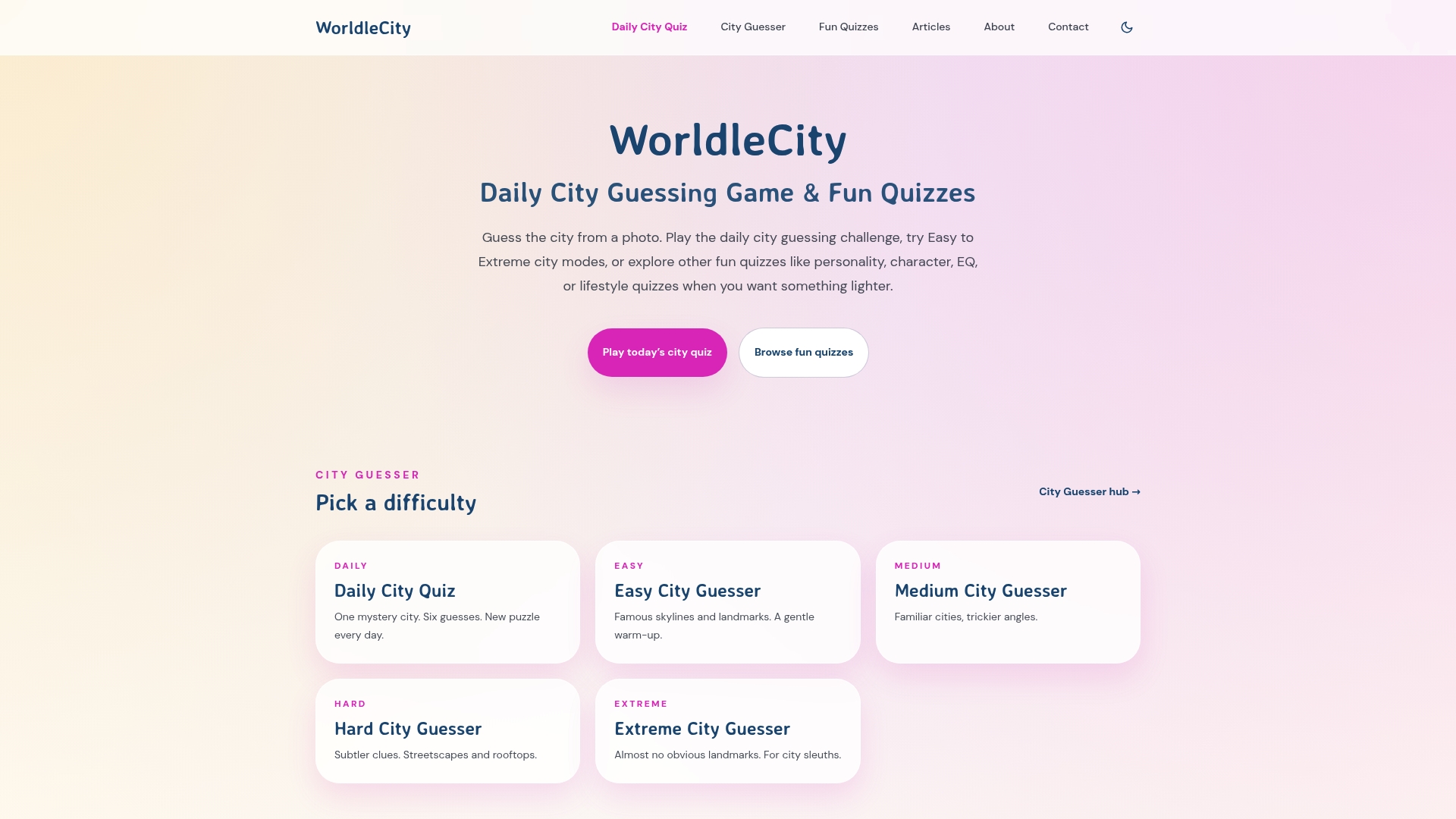
Each day, Worldlecity drops a fresh mystery city photo and gives you six attempts to name it, with proximity and direction feedback after every guess. That feedback loop is exactly what good difficulty design looks like in practice: you’re never just wrong, you’re getting closer. Whether you want a breezy warm-up or a geography challenge that genuinely tests you, Worldlecity’s quiz modes let you pick your level and play without signing up for anything. No account, no friction, just the map and your brain.
FAQ
What success rate defines an easy quiz question?
Easy quiz questions have a success rate above 80%. Educational assessment standards place “Easy” at 85–95% correct, meaning most players should get them right.
How does Bloom’s Taxonomy help me select quiz difficulty?
Bloom’s Taxonomy maps cognitive demand to difficulty: Remember and Understand align with easy, Apply and Analyze with medium, and Evaluate and Create with hard. Matching your skill to the right cognitive level makes the quiz more effective.
Should I start at easy or medium if I’m new to geography quizzes?
Start at medium and track your score across three rounds. If you score below 40% consistently, drop to easy. Starting moderate gives you the most accurate read on your actual level.
Why do some hard questions feel impossible even if they’re just recall?
Difficulty is subjective. An obscure fact sits at the lowest Bloom’s level but feels brutally hard if the content is unfamiliar. Content novelty and cognitive load both shape perceived difficulty, not just question type.
How many questions does a quiz need per difficulty level?
A quiz needs at least 10–15 unique questions per difficulty tier. Fewer than that and you risk memorizing answers rather than measuring real skill.