Why Quiz Competitions Attract Players: the Real Reasons
Discover why quiz competitions attract players with insights into the brain science, social bonding, and thrill of unpredictable rewards.
- what attracts quiz enthusiasts
- why quiz competitions attract players
- popular reasons for quiz participation
- charm of trivia competitions
- quiz competitions and player engagement
- why people join quiz contests
- appeal of quiz competitions
- benefits of quiz participation
- motivations for quiz players
- factors influencing quiz game appeal
On this page

Quiz competitions attract players because they deliver a rare combination of mental challenge, social bonding, and unpredictable rewards that satisfy your brain on multiple levels at once. Whether you’re huddled around a table at a Thursday trivia night or racing through a daily online challenge, the pull is the same. Your brain wants the rush, and quiz formats are wired to deliver it. This article breaks down the neuroscience, social dynamics, and design principles that explain why people join quiz contests and keep coming back, drawing on behavioral psychology and real participation data from 2026.
Why quiz competitions attract players: the brain science
The appeal of quiz competitions starts in your brain’s dopamine system, not in the prize pool. When you anticipate a correct answer or wait for the reveal, your brain releases dopamine before you even know if you’re right. That anticipation is the hook. Research confirms that dopamine fires at quiz notifications, and the unpredictability of whether you’ll get the answer right makes that release even stronger. This is the same neurological loop that makes social media and video games so sticky.
Beyond dopamine, quiz competitions engage a cognitive process called active recall. Humans forget roughly 50% of new information within an hour and up to 90% within a week. Active quiz participation short-circuits that forgetting curve by forcing your brain to retrieve information under mild pressure, which locks it in far more effectively than passive reading.

Quiz formats also push you into what psychologists call a flow state: that sweet spot where the challenge is just hard enough to demand focus but not so brutal that you shut down. When a quiz hits that balance, time disappears and engagement spikes.
Here’s what the cognitive pull actually looks like in practice:
- Anticipation loops: Each question creates a micro-tension that your brain wants to resolve. Getting it right feels like a small win. Getting it wrong creates motivation to do better next time.
- Quick thinking under pressure: Competitive formats reveal skills like rapid recall and pattern recognition that you don’t use in everyday conversation. That novelty is genuinely stimulating.
- Knowledge breadth rewards: Unlike a specialist exam, trivia competitions reward wide-ranging curiosity. Knowing an obscure geography fact or a pop culture reference suddenly has real value.
- Skill-building without stress: Quiz competitions reveal cognitive skills like leadership under pressure without the anxiety of formal testing, which makes participation feel voluntary and energizing.
Pro Tip: If you want to sharpen your quiz performance, study the patterns behind winning answers rather than cramming random facts. Recognizing question structures gives you a consistent edge.
How team play creates the social magnetism of trivia
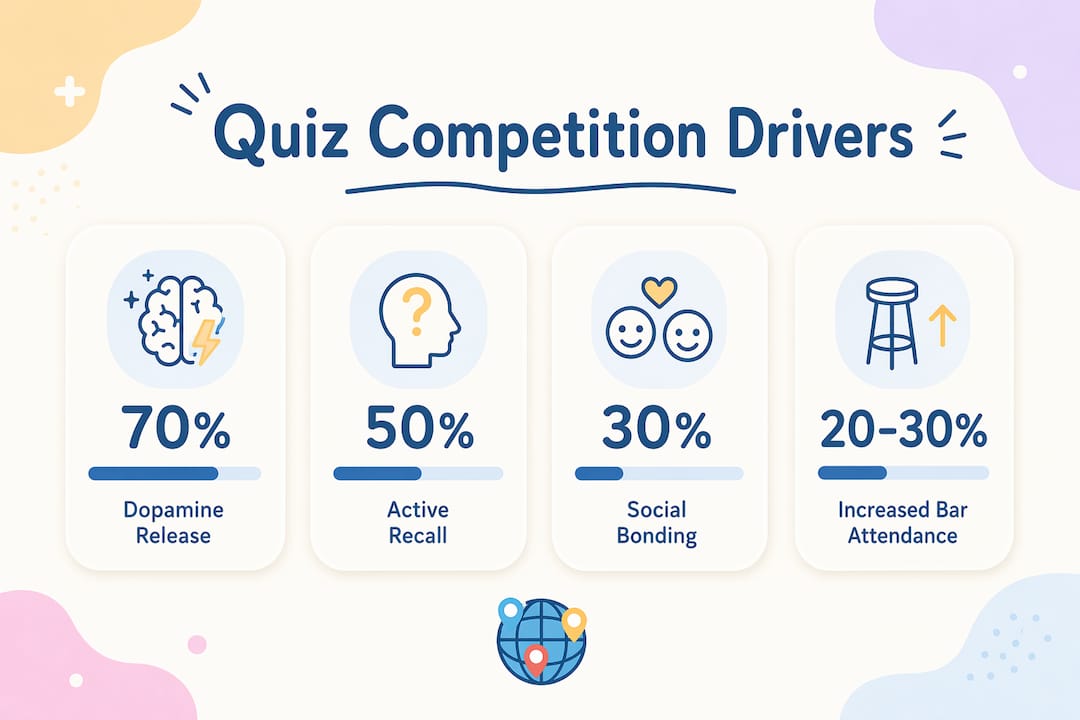
Solo quizzes are fun. Team quizzes are electric. The difference comes down to oxytocin, the hormone your brain releases during social bonding. Social quiz participation triggers oxytocin, transforming what could be a lonely test into a shared emotional experience. That chemical shift is why a correct team answer feels more satisfying than getting the same question right alone.
Team formats create camaraderie through shared wins and shared losses. When your team collectively blanks on a question, and then one person pulls the answer from nowhere, that moment becomes a story. Inside jokes form. Rivalries develop. The quiz becomes the context for a social experience that extends well beyond the event itself.
“The best trivia nights aren’t really about who knows the most. They’re about the moment someone on your team remembers something nobody else did, and everyone loses their minds.”
Online multiplayer quizzes extend this dynamic beyond physical spaces. Platforms that let you compete against friends or strangers in real time replicate the social energy of a bar trivia night without requiring everyone to be in the same room. This is a big part of why the charm of trivia competitions has grown so sharply in digital formats over the past few years.
Friendly rivalry also plays a specific motivational role. Competing against a known opponent, whether a friend, a coworker, or a recurring online rival, raises the personal stakes in a way that competing against an anonymous leaderboard doesn’t. You care more when the person you’re beating (or losing to) is someone you know.
The numbers back this up. Well-promoted quiz nights can increase weekday bar attendance by 20 to 30%, and team-based formats specifically lead to 25% higher repeat visits. That repeat behavior is the clearest signal that social quiz formats aren’t just fun once. They build habits.
What makes quiz outcomes so hard to predict (and so addictive)
Variable rewards are more powerful than fixed ones. This is one of the most replicated findings in behavioral psychology, and quiz competitions are built on it. You never know exactly which questions will appear, whether your team will click, or whether that one obscure topic you happen to know will show up. That uncertainty is not a design flaw. It’s the entire point.
The primary appeal of quizzes lies in anticipation, not in the actual reward. This mirrors the psychology behind slot machines and social media notifications: intermittent reinforcement creates stronger behavioral loops than consistent rewards. When you sometimes win big and sometimes fall short, you stay engaged longer than if the outcome were predictable every time.
Here’s a quick comparison of how predictable versus unpredictable reward structures affect quiz engagement:
| Reward type | Player behavior |
|---|---|
| Fixed reward (same prize every time) | Engagement plateaus quickly; players stop once they’ve “solved” the format |
| Variable reward (outcome uncertain) | Engagement stays high; players return repeatedly to chase the next win |
| Streak mechanics (daily challenges) | Creates habit loops; missing a day feels like a loss even without a tangible prize |
| FOMO-driven formats (expiring daily quizzes) | Drives consistent return visits; scarcity increases perceived value |
Streak mechanics deserve special attention. When a platform shows you a 14-day streak, skipping feels like losing something real, even though nothing tangible is at stake. Daily city guessing games and timed quiz challenges use exactly this mechanic to turn casual players into regulars.
Pro Tip: If you’re designing or choosing a quiz format for engagement, prioritize daily challenges with visible streaks over one-off competitions. The habit loop is what keeps players coming back, not the prize.
How difficulty balance and inclusivity shape quiz fun
The best quiz competitions operate in what researchers call the Goldilocks Zone: questions that are balanced in difficulty to keep novices engaged without boring experts. Too easy and the competition feels pointless. Too hard and players drop out. The sweet spot is where everyone on a mixed team can contribute something.
Here’s how well-designed quiz formats achieve that balance:
- Mix difficulty tiers within a single round. A round that opens with accessible questions and builds toward harder ones lets every player feel competent early, which keeps them invested through the tougher stretch.
- Use team diversity as a feature, not a bug. Teams combining different knowledge domains consistently outperform groups of individual specialists. A team with a sports fan, a film buff, and a geography nerd will beat a team of three generalists almost every time.
- Design for near misses. When a player almost gets an answer right, or their team debates two options and picks the wrong one, that near miss creates strong motivation to replay. Near misses in knowledge quizzes trigger a desire to return, while questions that are simply too hard increase dropout risk.
- Keep scoring transparent and pacing brisk. Players disengage when they don’t understand how points are calculated or when rounds drag. Clear scoring and a consistent rhythm maintain momentum and trust.
- Use themes to attract niche audiences. Themed trivia nights boost retention by 85% over six months compared to generic formats. A 90s pop culture night or a geography-themed round gives players a reason to show up specifically, not just generally.
The inclusivity angle matters more than most quiz organizers realize. When someone who “doesn’t know much” contributes the answer that wins a round, they become a quiz convert. That moment of unexpected competence is one of the most powerful recruitment tools a quiz format has.
It’s also worth noting the difference between personality quizzes and knowledge quizzes when thinking about inclusivity. Personality quizzes get two to three times higher social sharing rates than knowledge quizzes precisely because there’s no risk of failure. Knowledge quizzes drive stronger challenge-based engagement, but personality formats lower the barrier to entry for players who feel intimidated by competitive formats.
Ready to feel the quiz pull for yourself?
If this breakdown of quiz psychology has you itching to test your own knowledge, Worldlecity is built exactly for that feeling.
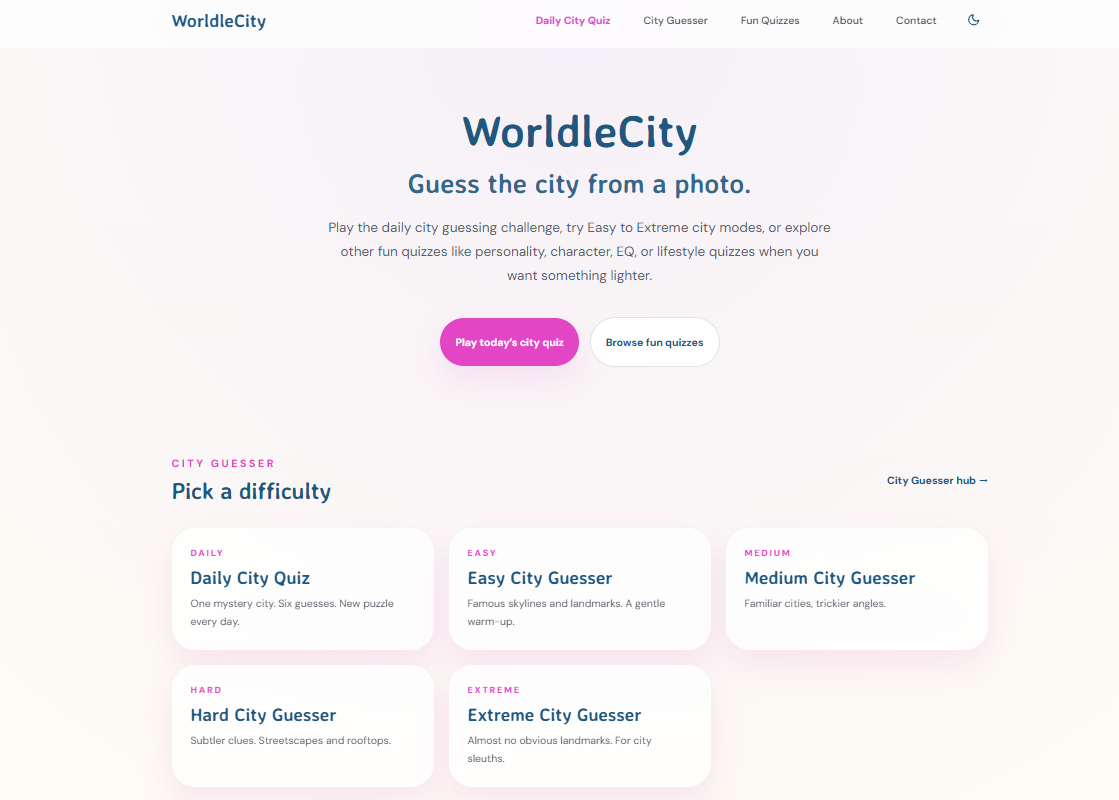
Every day, Worldlecity drops a fresh city photo challenge where you get six attempts to identify a mystery city, with directional clues after each guess to keep the tension alive. It’s the variable reward loop and the streak mechanic rolled into one clean daily habit. Beyond the daily city guessing game, Worldlecity also offers personality and lifestyle quizzes with zero account registration required. You can play solo, share your results socially, or just enjoy the quiet satisfaction of getting a hard geography question right. No pressure, no paywall, just the good brain chemistry this article has been describing.
FAQ
Why do quiz competitions feel so addictive?
Quiz competitions trigger dopamine release through anticipation and variable rewards, the same neurological loop behind social media and gaming. The uncertainty of each outcome keeps your brain engaged and returning for more.
What makes team quizzes more engaging than solo play?
Team formats stimulate oxytocin release, which promotes trust and bonding among players. Shared wins and losses create emotional memories that solo play simply cannot replicate.
How does question difficulty affect quiz participation?
Balanced difficulty keeps both beginners and experienced players engaged, while near misses motivate replay rather than dropout. Questions that are consistently too hard increase abandonment rates significantly.
Why do daily quiz challenges build such strong habits?
Streak mechanics and expiring daily formats create a sense of loss when skipped, even without tangible prizes. This intermittent reinforcement loop is one of the most effective behavioral hooks in quiz design.
Are themed trivia nights more effective than general ones?
Themed trivia nights boost player retention by 85% over six months compared to generic formats, because themes attract niche audiences who feel a personal connection to the subject matter.
Key takeaways
Quiz competitions attract and retain players because they satisfy cognitive, social, and psychological needs simultaneously through challenge, bonding, and unpredictable rewards.
| Point | Details |
|---|---|
| Dopamine drives the hook | Anticipation of a correct answer triggers dopamine before the result is known, making quizzes neurologically compelling. |
| Social formats multiply engagement | Team play releases oxytocin and creates shared memories, producing 25% higher repeat participation than solo formats. |
| Variable rewards beat fixed ones | Unpredictable outcomes keep players returning longer than consistent prizes, mirroring behavioral loops in gaming. |
| Difficulty balance is non-negotiable | The Goldilocks Zone of question difficulty keeps novices and experts both engaged without alienating either group. |
| Themed formats lock in loyalty | Themed trivia nights retain players at dramatically higher rates by giving audiences a personal reason to return. |