How to Approach Difficult Quiz Questions Strategically
Learn how to approach difficult quiz questions strategically with proven techniques. Boost your confidence and accuracy for better scores!
- tips for difficult quiz sections
- overcoming challenging quiz problems
- how to handle difficult quizzes
- quiz question strategies
- tackle tough quiz questions
- strategies for tough quiz questions
- effective quiz answering strategies
- best ways to approach quizzes
On this page

Approaching difficult quiz questions strategically means using tested methods like elimination, active recall, and time pacing to answer more accurately and confidently. Most quiz takers lose points not because they lack knowledge, but because they misread questions, panic under time pressure, or fall into traps set by clever distractors. The good news: these are all fixable problems. This guide covers the research-backed techniques that separate consistent high scorers from everyone else, whether you’re prepping for a big exam or just trying to win your next trivia night.
How to approach difficult quiz questions strategically: start with your mindset
The biggest performance gap in quizzes is not knowledge. It is preparation habits and mental framing before you even read question one.
Active recall beats passive review every time. Retrieval practice delivers 40–50% better retention compared to re-reading notes. That means testing yourself with flashcards or practice questions, not just highlighting your notes the night before.

Before a quiz, train yourself to recognize specific question patterns. Two of the most dangerous are “EXCEPT” and “NOT” questions, which flip the logic entirely. Spotting them early prevents the most common and most preventable errors.
Here are the core mental habits to build before you sit down:
- Do the cover-up test. Read the question stem, then mentally generate your answer before looking at the options. This prevents distractor bias, where a plausible-sounding wrong answer pulls you away from what you actually know.
- Expect time pressure. Decide in advance that you will not linger on any single question. Accepting this removes the panic spiral when you hit something hard.
- Audit your weak categories. Review common quiz night topics before competitive events so you know where your blind spots are.
- Ditch the ego. Skipping a question you cannot answer is a skill, not a failure. More on this below.
Pro Tip: Run a five-minute self-quiz the morning of any test. Even a handful of retrieval attempts primes your brain to recall information faster under pressure.
What are the best step-by-step tactics for tough quiz questions?
Once you are inside the quiz, a repeatable process beats raw guessing every time. Here is how to work through a hard question without losing your head.
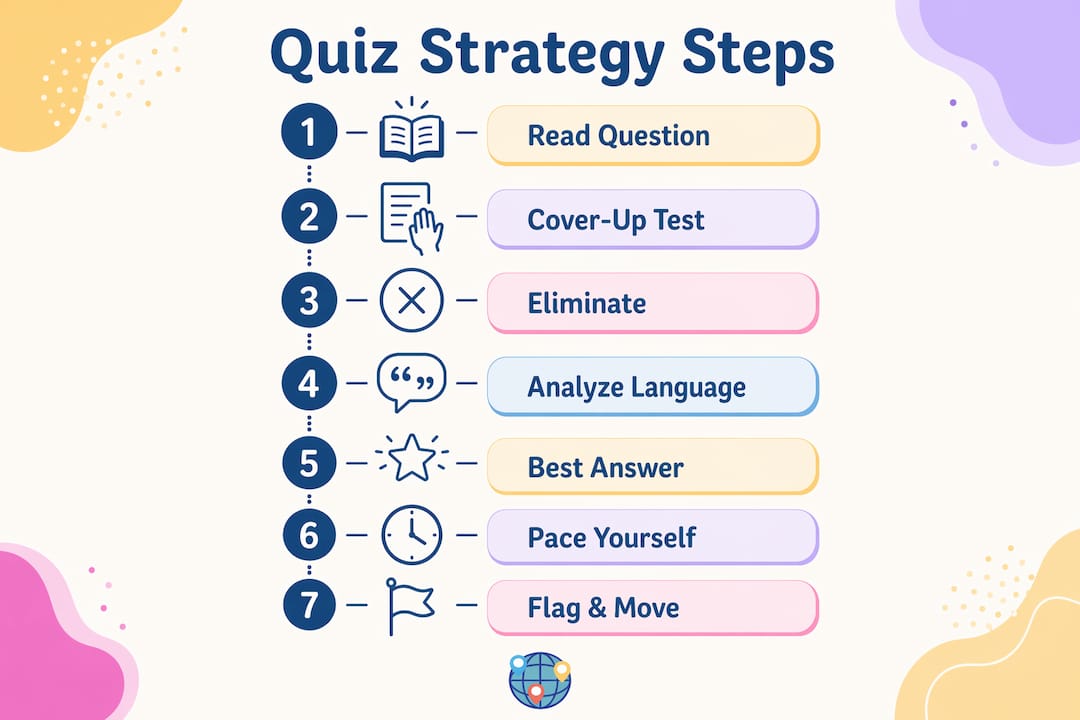
1. Read the full question stem first
Read every word before you glance at the options. Question writers hide critical qualifiers like “most likely,” “least accurate,” or “except” inside the stem. Missing one word can flip the correct answer entirely.
2. Use the cover-up test
Cover the options mentally and form your own answer. Then look for the option that matches your answer. This technique reduces option-induced bias and keeps your reasoning clean.
3. Eliminate obviously wrong answers
Eliminating one or two wrong options immediately doubles your guessing probability from 25% to 50%. That is a massive statistical edge. Cross out anything clearly incorrect before comparing the remaining choices.
4. Watch for absolute vs. hedged language
Options using words like “always” or “never” are almost always incorrect. Real-world scenarios almost never allow for zero exceptions. Hedged language like “usually,” “often,” or “in most cases” tends to signal the correct answer.
5. Handle “best answer” questions carefully
Hard quiz questions test analysis and evaluation, not just recall. When two options both look correct, ask yourself which one is more complete, more specific, or more directly answers the question stem. Rank the remaining options rather than picking the first one that sounds right.
6. Apply the one-third rule for pacing
The one-third rule is simple: you should have answered one-third of the questions by the time one-third of your total time has passed. If you are behind that pace, switch to triage mode. Answer every question you are confident about first, then return to the hard ones with whatever time remains.
7. Flag and move on
Most quiz formats let you flag a question and return to it. Use this. Spending four minutes on one question while five easier ones go unanswered is a losing trade.
Here is a quick reference for the two-pass approach:
| Pass | Goal | Action |
|---|---|---|
| First pass | Answer confident questions | Flag anything uncertain and move on |
| Second pass | Revisit flagged questions | Apply elimination and best-answer ranking |
| Final check | Catch careless errors | Re-read stems on questions you changed |
Pro Tip: On timed quizzes, set a personal time cap of 60–90 seconds per question before you flag and move. Sticking to this cap consistently is more valuable than solving any single hard question.
What common traps make difficult quiz questions harder?
Knowing the traps is half the battle. Quiz writers use predictable patterns to mislead, and once you recognize them, they lose their power.
- The “EXCEPT/NOT” flip. These questions ask for the one wrong answer in a list of correct ones. Deliberate re-reading reduces these errors significantly. Underline or circle “EXCEPT” or “NOT” when you see it so your brain stays in the right logic mode.
- Absolute language traps. As covered above, “always” and “never” are red flags. If you see them in an option, treat that option with suspicion unless you have a very strong reason to pick it.
- Partially correct distractors. These are the sneakiest traps. An option can be true in general but wrong in the specific context of the question. Always verify that your chosen answer fits the exact scenario described in the stem, not just the topic in general.
- Option fixation. This happens when you read option A, decide it sounds right, and stop reading. Always read all options before committing. Option D might be more precise.
- The Ego Trap. Over-investing time on obscure questions is one of the most common cognitive traps in high-stakes quizzes. If you have eliminated what you can and still have no strong answer, make your best guess and move on. Sunk time does not improve your odds.
“Skipping a question you cannot answer after elimination is not giving up. It is protecting the points you can still earn. The Ego Trap costs more points than any single hard question ever will.”
On answer changing: research shows that changing an answer thoughtfully improves your score slightly more often than it hurts. The key word is “thoughtfully.” Change an answer when you have a clear reason, not because you second-guessed yourself into a spiral.
How do you train strategic quiz answering skills?
Reading about tactics is useful. Practicing them under real conditions is what actually builds the skill.
The single most effective training method is retrieval practice. Actively recalling information, rather than passively reviewing it, is what builds durable memory. Use practice quizzes, not just notes.
Two-pass strategies and flagging difficult questions during practice exams train your brain to stay calm when you hit a hard question. Do this consistently and the behavior becomes automatic.
Track which question types trip you up. If “EXCEPT” questions cost you points every time, spend a week drilling only those. Targeted practice beats general review.
Here is a comparison of common practice methods:
| Method | Effort level | Retention benefit | Best for |
|---|---|---|---|
| Re-reading notes | Low | Low | Initial familiarity only |
| Flashcard retrieval | Medium | High | Fact-based recall |
| Timed practice exams | High | Very high | Pacing and pressure simulation |
| Reviewing wrong answers | Medium | High | Fixing specific weak spots |
Reviewing explanations for wrong answers is especially powerful. Understanding why a distractor was wrong teaches you the exact logic quiz writers use. That knowledge transfers directly to future questions.
Pro Tip: After every practice quiz, spend as much time reviewing your wrong answers as you spent taking the quiz. The review session is where the real learning happens.
You can also learn quiz patterns and tricks by playing regularly across different quiz formats and categories. Variety builds pattern recognition faster than drilling one topic repeatedly.
Put your skills to the test with Worldlecity
The strategies in this article work best when you practice them regularly, and Worldlecity gives you two different ways to do that.
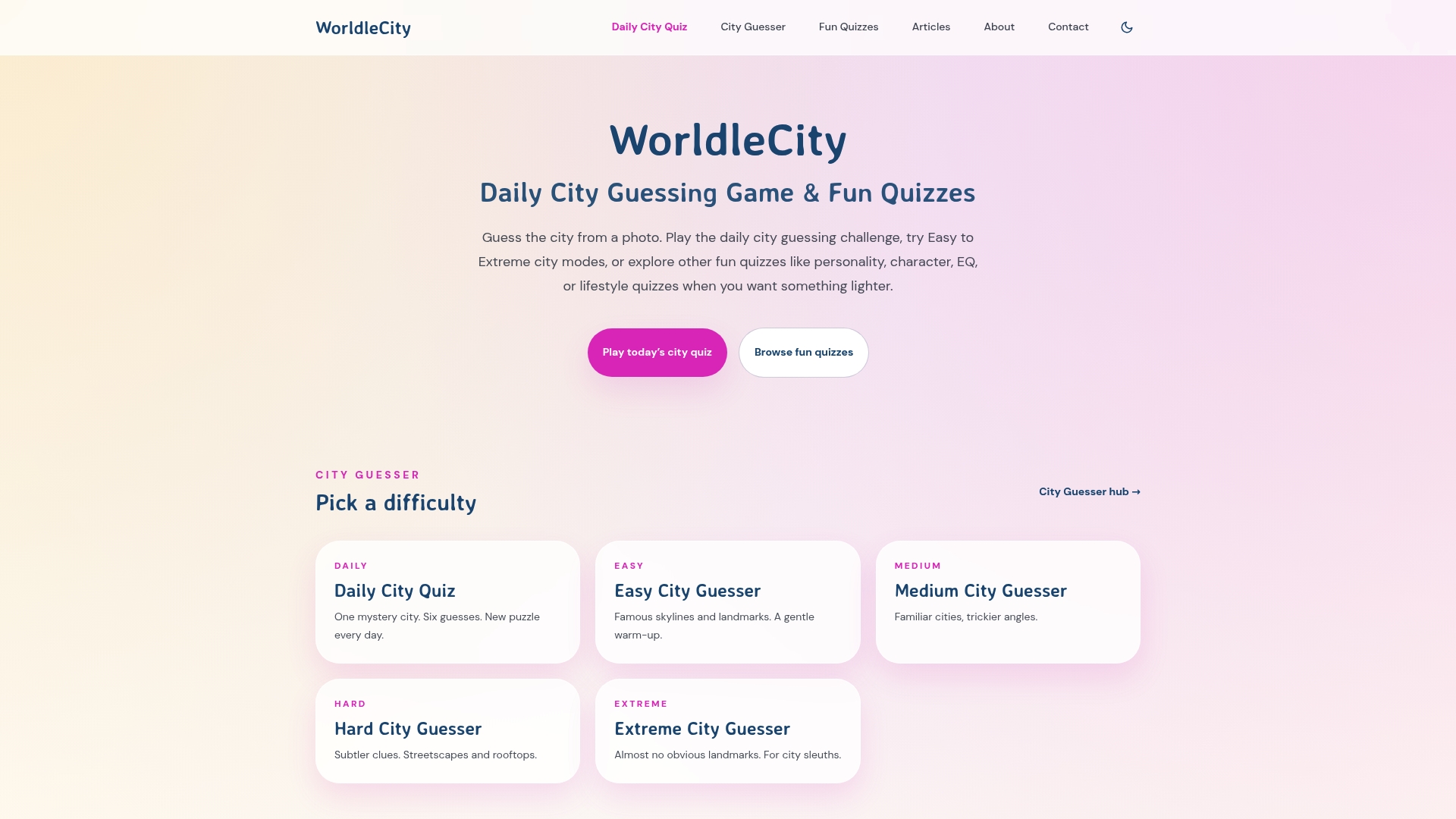
Worldlecity’s daily city guessing game gives you six attempts to identify a mystery city from a photograph, with directional feedback after each guess. There is no option list to eliminate here, so the skill you are actually training is retrieval and pacing discipline: six guesses is a hard cap, which forces you to commit, adjust based on feedback, and know when to walk away from a guess that is not working. It is the Ego Trap in miniature, every single day.
For the elimination habits, cover-up test, and absolute-language spotting from this article, Worldlecity’s quiz library is the better fit. Multiple-choice quizzes across geography, personality, and lifestyle, no account needed, four difficulty modes to push your pacing under real time pressure.
FAQ
What does it mean to approach quiz questions strategically?
Approaching quiz questions strategically means using deliberate techniques like elimination, the cover-up test, and time pacing rather than relying on instinct alone. These methods improve accuracy and reduce errors caused by traps in question wording.
Why do absolute words like “always” and “never” signal wrong answers?
Options with absolute language are almost always incorrect because real-world scenarios rarely allow for zero exceptions. Hedged language like “usually” or “in most cases” accounts for context and is more often correct.
What is the cover-up test in quiz strategy?
The cover-up test means reading the question stem and forming your own answer before looking at the options. This prevents distractor bias, where a plausible-sounding wrong answer pulls you away from what you actually know.
When should you skip a difficult quiz question?
Skip a question when you have eliminated what you can and still have no strong answer. Spending too long on one question is the Ego Trap, and it costs more points than the question itself is worth.
How does retrieval practice improve quiz performance?
Retrieval practice delivers 40–50% better retention than re-reading notes. Actively recalling information through practice quizzes trains your brain to access knowledge faster and more accurately under pressure.
Key takeaways
The most effective way to tackle tough quiz questions is to combine elimination, the cover-up test, and the one-third pacing rule into a single repeatable process.
| Point | Details |
|---|---|
| Use the cover-up test | Form your own answer before reading options to avoid distractor bias. |
| Eliminate first, then choose | Removing one or two wrong options doubles your guessing odds from 25% to 50%. |
| Watch for absolute language | Options with “always” or “never” are almost always wrong; hedged language is usually correct. |
| Apply the one-third rule | If behind pace at one-third of time elapsed, switch to triage mode immediately. |
| Practice with retrieval, not re-reading | Active recall builds 40–50% better retention than passive note review. |