City Nicknames List: A Searchable U.S. + World Guide
Explore our searchable city nicknames list to discover the fascinating origins behind iconic names like The Big Apple and The Windy City.
- city nicknames list
- famous city nicknames
- city nickname origins
- US city nicknames
- world city nicknames
- city aliases
On this page
This is a comprehensive, searchable city nicknames list covering the U.S. state-by-state and the world’s most talked-about aliases, with short origin notes so you’re not left guessing why Chicago got stuck with “The Windy City.” Before the deep dive, here are the eight nicknames everyone already knows, whether they’ve thought about the backstory or not.
- The Big Apple — New York City. Widely considered the most recognized city nickname in the country.
- The Windy City — Chicago. Officially adopted by the city in spirit, if not by statute.
- Sin City — Las Vegas. Unofficial, but the branding stuck harder than almost any nickname on this list.
- The Big Easy — New Orleans. Beloved locally, used constantly in tourism materials.
- Motor City — Detroit. Rooted in a century of car manufacturing history.
- Music City — Nashville. Now semi-official, thanks to the city’s own tourism branding.
- City of Angels — Los Angeles. Comes straight from the city’s original Spanish name.
- Mile High City — Denver. A literal, measurable fact, not a marketing flourish.
Some of these are stamped on official city letterhead. Others are just what everybody calls the place anyway, which honestly carries more weight. Keep reading for the full state-by-state breakdown, the world list, and the receipts behind each origin story.
Key takeaways
The most durable city nicknames combine a concrete historical, geographic, or industrial root with decades of genuine local adoption, not a marketing campaign alone.
| Point | Details |
|---|---|
| Check the label first | Official nicknames appear in city branding; unofficial ones are just widely used by locals and media. |
| Five categories cover most cases | Historical, descriptive, aspirational, industrial, and pejorative nicknames explain almost every entry on this list. |
| Multi-nickname cities need context | Los Angeles alone carries City of Angels and Tinseltown, each with a different origin story. |
| Verify with primary sources | Newspaper archives and municipal records beat modern compilation pages for disputed origins. |
| Test your knowledge | A geography quiz is a quick way to check how well you actually know the cities behind these nicknames. |
What this city nicknames list covers and how to use it
This isn’t every nickname ever slapped on a water tower. It’s a curated reference: a state-by-state A to Z list for the U.S., plus a regional list of the world’s most notable city aliases, each with a one-line origin note.
You’ll see labels next to entries: (official) means the city itself has adopted the nickname in branding, signage, or municipal use. (unofficial) means it’s widely used but never formally claimed. (tourism slogan) flags nicknames that started as marketing copy rather than something locals came up with on their own. Where the origin is genuinely disputed, we say so instead of pretending there’s a clean answer.
Navigation is simple. Entries are grouped by state header, then listed as city, nickname, and a compact origin line. Use your browser’s find function (Ctrl+F or Cmd+F) if you’re hunting a specific city rather than scrolling the whole thing. If you want to check a claim yourself, jump to the verification section near the end. That’s where the source trail lives.
Related terms worth knowing as you go: you’ll sometimes see these called city aliases, city monikers, or simply civic nicknames in other references. They all mean the same thing here.
How city nicknames actually form
Most city nicknames fall into a handful of reliable buckets, and once you know them, you can basically reverse-engineer why any given nickname exists.
- Historical — tied to a specific event, era, or founding story. Philadelphia’s “City of Brotherly Love” comes straight from William Penn’s Quaker-influenced naming of the city, built from Greek roots meaning “brotherly love.”
- Descriptive — based on geography, climate, or a visible physical trait. Denver’s “Mile High City” is a literal elevation marker, not a metaphor.
- Aspirational or branding-driven — created deliberately to shape outside perception. Nashville’s “Music City” grew out of decades of tourism promotion around its recording industry.
- Agricultural or industrial — rooted in what the local economy actually produces. Detroit’s “Motor City” comes directly from a century of automobile manufacturing.
- Pejorative or insider — nicknames locals use that outsiders rarely hear, often a little sharp-edged. These tend to say more about daily life than any tourism board ever would.
Nicknames survive when they cross the gap between local pride and outsider recognition. A city can coin a slick slogan, but if residents never actually say it out loud, it dies with the press release. The nicknames that last decades are usually rooted in something concrete: a specific industry, a documented event, a geographic feature. Chambers of commerce love inventing new slogans, but the ones tied to genuine economic development branding tend to fade fast unless locals actually adopt them into daily speech.
Pro Tip: When you’re trying to figure out if a nickname is “real” or just marketing, check whether locals use it casually in conversation or only in tourism brochures. If it only shows up on welcome signs, it’s probably a slogan wearing a nickname’s clothes.
The comprehensive U.S. city nicknames list, state by state
This is the core reference. Cities are grouped by state, with the most recognized nickname listed first where a city has more than one. Contested or notable origins carry a citation.
Alabama to Georgia
| City | Nickname | Origin note |
|---|---|---|
| Birmingham, AL | The Magic City | Grew explosively after its founding, seemingly overnight, thanks to iron and steel (unofficial) |
| Anchorage, AK | The City of Lights and Flowers | Refers to civic beautification efforts (unofficial) |
| Phoenix, AZ | Valley of the Sun | Descriptive, referencing the desert basin and near-constant sunshine (official/tourism) |
| Little Rock, AR | The Rock | Shortened form used constantly by locals (unofficial) |
| Los Angeles, CA | City of Angels | From the city’s original Spanish name, “El Pueblo de Nuestra Señora la Reina de los Ángeles” (official) |
| Los Angeles, CA | Tinseltown | References the glitz and artifice of the film industry (unofficial) |
| San Francisco, CA | The City by the Bay | Descriptive, geography-driven (unofficial) |
| Denver, CO | Mile High City | Elevation is roughly one mile above sea level, a literal, measurable fact (official) |
| Hartford, CT | Insurance Capital of the World | Home to a dense concentration of major insurance companies (unofficial) |
| Wilmington, DE | Chemical Capital of the World | Rooted in DuPont’s long industrial presence (unofficial) |
| Miami, FL | Magic City | Rapid early growth mirrored Birmingham’s nickname origin (unofficial) |
| Atlanta, GA | The Big Peach | Georgia’s peach-growing reputation, descriptive and agricultural (unofficial) |
Hawaii to Massachusetts
| City | Nickname | Origin note |
|---|---|---|
| Honolulu, HI | The Gathering Place | Reflects Oahu’s role as a cultural and travel hub (unofficial) |
| Boise, ID | The City of Trees | Named for the unusually dense urban tree canopy in a high-desert region (official) |
| Chicago, IL | The Windy City | Disputed origin. Popular legend ties it to New York press mockery during the 1893 World’s Fair bid; earlier print uses point to actual lakefront wind (unofficial) |
| Indianapolis, IN | Circle City | Named for the circular Monument Circle at the city’s center (unofficial) |
| Des Moines, IA | The Hartford of the West | References the city’s insurance industry, echoing Hartford, Connecticut (unofficial) |
| Wichita, KS | Air Capital of the World | Home to major aircraft manufacturers since the 1920s (unofficial) |
| Louisville, KY | Derby City | Named for the Kentucky Derby, held there annually (official/tourism) |
| New Orleans, LA | The Big Easy | Believed to reference the relaxed pace of life and easy access to music gigs for working musicians (unofficial) |
| Portland, ME | The Forest City | Descriptive, tied to extensive tree cover (unofficial) |
| Baltimore, MD | Charm City | Coined deliberately in a 1970s marketing campaign to soften the city’s image (tourism slogan) |
| Boston, MA | Beantown | References colonial-era molasses and baked bean traditions (unofficial) |
Michigan to New York
| City | Nickname | Origin note |
|---|---|---|
| Detroit, MI | Motor City | Rooted in a century of automobile manufacturing dominance, starting with Ford and GM (official) |
| Minneapolis, MN | City of Lakes | Descriptive, referencing the numerous lakes within city limits (unofficial) |
| Jackson, MS | The City with Soul | Tourism-driven, tied to music and cultural heritage (tourism slogan) |
| St. Louis, MO | Gateway City | References its historical role as the launch point for westward expansion (official) |
| Billings, MT | Magic City | Rapid railroad-era growth, similar to Birmingham’s origin (unofficial) |
| Omaha, NE | Gateway to the West | Historical, tied to westward migration routes (unofficial) |
| Las Vegas, NV | Sin City | Grew from the legalization of gambling in 1931 and the city’s association with vice-friendly entertainment (unofficial) |
| Manchester, NH | Queen City | Historical industrial-era title, common across multiple U.S. cities (unofficial) |
| Atlantic City, NJ | America’s Playground | Tourism-driven, referencing boardwalk entertainment culture (tourism slogan) |
| Albuquerque, NM | The Duke City | Named after the Duke of Alburquerque, the Spanish city’s namesake (unofficial) |
| New York City, NY | The Big Apple | Popularized by 1920s horse-racing journalist John J. FitzGerald, who heard the phrase from stable workers; later cemented by a 1970s tourism campaign (official) |
North Carolina to South Dakota
| City | Nickname | Origin note |
|---|---|---|
| Charlotte, NC | The Queen City | Named for Queen Charlotte of Mecklenburg-Strelitz (official) |
| Fargo, ND | Gateway to the West | Historical railroad-era branding (unofficial) |
| Cleveland, OH | The Forest City | Descriptive, referencing early tree-planting efforts (unofficial) |
| Oklahoma City, OK | OKC | Simple abbreviation used constantly in casual speech (unofficial) |
| Portland, OR | The City of Roses | Descriptive, tied to the climate’s suitability for rose cultivation (official) |
| Philadelphia, PA | City of Brotherly Love | From Greek roots meaning “brotherly love,” reflecting William Penn’s Quaker founding vision (official) |
| Providence, RI | The Creative Capital | Tourism-driven, promoting the city’s arts scene (tourism slogan) |
| Charleston, SC | The Holy City | References the historically high number and prominence of church steeples (unofficial) |
| Sioux Falls, SD | The Best Little City in America | Self-proclaimed civic pride branding (tourism slogan) |
Tennessee to Wyoming
| City | Nickname | Origin note |
|---|---|---|
| Nashville, TN | Music City | Grew from the city’s country music recording industry, now embraced in official tourism branding (official) |
| Houston, TX | Space City | Named for the nearby NASA Johnson Space Center (official) |
| Salt Lake City, UT | The Crossroads of the West | Historical, tied to its role as a transportation hub (unofficial) |
| Burlington, VT | Queen City | Historical civic title, shared with several other U.S. cities (unofficial) |
| Richmond, VA | River City | Descriptive, referencing the James River running through downtown (unofficial) |
| Seattle, WA | The Emerald City | Descriptive, tied to the region’s dense evergreen forests (official) |
| Charleston, WV | Chemical Capital of the World | Rooted in the region’s chemical manufacturing industry, echoing Wilmington’s nickname (unofficial) |
| Milwaukee, WI | Brew City | Rooted in the city’s historical brewing boom, led by names like Pabst and Schlitz (unofficial) |
| Cheyenne, WY | Magic City of the Plains | Rapid railroad-era growth, another entry in the “Magic City” family (unofficial) |
A few cities carry more than one active nickname, which can trip up trivia players. Los Angeles alone answers to “City of Angels” and “Tinseltown,” and they mean different things: one points to the city’s Spanish-language founding name, the other mocks the entertainment industry’s manufactured glamor. When a city has two nicknames, check whether one leans historical and the other leans cultural commentary. That split is usually the tell.
You’ll also notice small towns with self-proclaimed “capital of” titles, like a town calling itself the “Chair City” for furniture manufacturing. Those are real, but they’re locally famous at best, and you should treat them as trivia curiosities rather than nicknames with wide recognition.
Notable world city nicknames by region
Global coverage means picking the nicknames that actually travel outside their home country. Here’s a regional rundown of the ones worth knowing.
Europe
- Paris, France — The City of Light. Often credited to the city’s early adoption of street lighting and its role as a center of Enlightenment-era thought.
- Rome, Italy — The Eternal City. A title used since antiquity to reflect the city’s uninterrupted historical significance.
- Venice, Italy — The Floating City. Descriptive, referencing the network of canals that define the city’s layout.
- Edinburgh, Scotland — Auld Reekie. An affectionate, slightly self-deprecating nickname referencing historical coal-smoke haze over the old town.
Asia
- Singapore — The Lion City. Comes from the Malay name “Singapura,” meaning “lion city,” tied to a legendary sighting by a Sumatran prince.
- Mumbai, India — The City of Dreams. References the city’s role as India’s entertainment and finance capital.
- Bangkok, Thailand — The Venice of the East. One of many “Venice of the…” nicknames worldwide, referencing its historic network of canals.
Americas
- Buenos Aires, Argentina — The Paris of South America. Reflects the city’s European-style architecture and boulevards.
- Rio de Janeiro, Brazil — The Marvelous City. A descriptive, widely used tourism-friendly title referencing the city’s landscape.
Africa
- Cape Town, South Africa — The Mother City. Refers to its status as South Africa’s oldest city and its founding role in the country’s colonial history.
Oceania
- Sydney, Australia — The Harbour City. Descriptive, tied to its famous natural harbor.
You’ll spot a pattern with “Venice of the…” nicknames. Cities from Bangkok to Amsterdam borrow Venice’s canal-city reputation because it’s instantly understood shorthand, even if the comparison is a stretch. That’s branding doing the heavy lifting, not geography. Some of these regional nicknames are organic and centuries old, like Rome’s “Eternal City.” Others, like the various “Paris of” titles, are closer to tourism-driven place branding designed to borrow prestige from a more famous city.
The gritty origin stories behind the most iconic nicknames
The most iconic nicknames usually share a recipe: a media moment, a commercial push, and years of local repetition until the name outlives its original context. Here’s the receipts on the big eight.
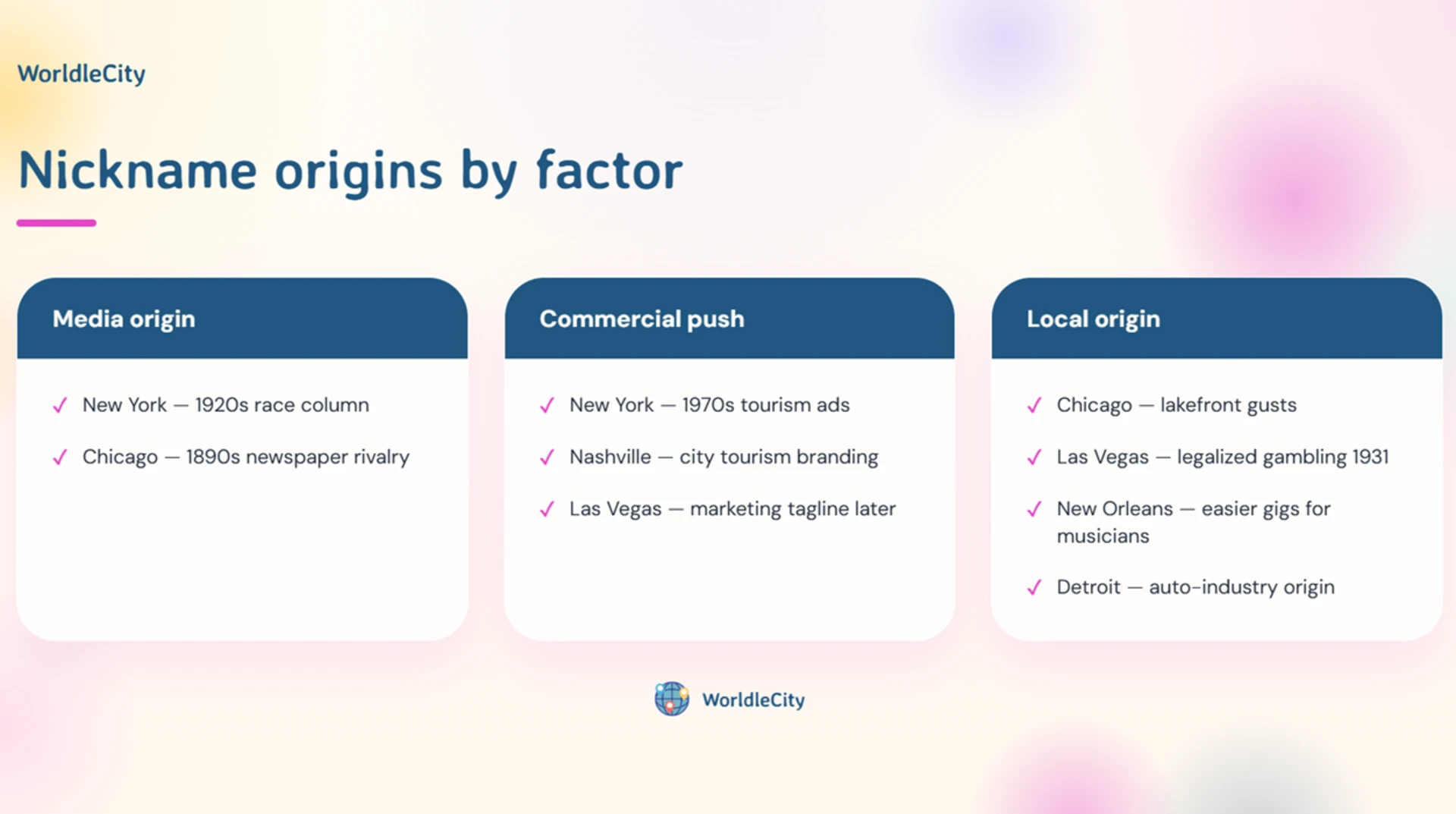
The Big Apple. New York City’s nickname traces back to 1920s horse-racing journalist John J. FitzGerald, who picked up the phrase from Black stable hands in New Orleans who called New York’s racetracks “the big apple,” meaning the top prize. FitzGerald used it in his column headlines for years. It sat mostly dormant until the city’s tourism board revived it in a 1970s ad campaign, and it never let go.
The Windy City. This one’s genuinely contested. The popular story credits an 1890s newspaper rivalry, where New York Sun editor Charles Dana supposedly mocked Chicago as “windy” during its bid to host the 1893 World’s Fair, implying the city was full of hot air rather than actual wind. Researchers have never located that column, so treat the attribution as folklore rather than record. Other accounts simply point to Chicago’s real lakefront gusts off Lake Michigan.
Earliest documented uses of “Windy City” in print actually predate the World’s Fair legend by several years, which is the kind of detail that only shows up if you dig into original newspaper archives instead of trusting the repeated folklore.
Sin City. Las Vegas earned this one honestly. Nevada legalized gambling in 1931, and the city built its entire identity around vice-friendly entertainment, casinos, and later, its famous marketing tagline about what happens there staying there.
The Big Easy. New Orleans’ nickname likely refers to the relative ease working musicians had finding steady gigs compared to tighter, more competitive scenes elsewhere, alongside the city’s generally relaxed pace of life.
Motor City. Detroit’s identity is inseparable from the automobile industry that built it, starting with Henry Ford’s assembly line innovations in the early 1900s and cementing over a century of manufacturing dominance.
Music City. Nashville’s nickname grew organically from its country music recording scene, then got formal backing decades later through the city’s own tourism branding, making it one of the rarer cases where organic use and official adoption fully aligned.
City of Angels. Los Angeles didn’t earn this one through branding at all. It’s a direct translation from the city’s original Spanish name, making it one of the most historically literal nicknames on this entire list.
Mile High City. Denver’s nickname is arguably the most fact-based entry here. The city sits at almost exactly one mile above sea level, and there’s even a marked step on the state capitol steps confirming the exact elevation.
Want to test how well you actually know these cities beyond their nicknames? Try matching photos to places in a city guessing challenge and see how fast the visual clues click with what you just read.
How to verify a nickname’s origin (and find hidden ones)
The fastest verification path runs in a specific order: historical newspaper archives first, then city or tourism government sites, then local history blogs, and finally compiled reference pages like Wikipedia’s city nickname category as a starting point, never an ending point.
Here’s a practical checklist to run when you’re trying to confirm whether a nickname is real, disputed, or just marketing:
- Search the exact nickname phrase in quotes alongside the city name and the word “history” or “origin.”
- Check whether the city’s own government or tourism website uses the nickname officially, or only third-party sites do.
- Look for the earliest documented print use. Multiple independent early mentions are a stronger signal than one repeated claim across modern blogs.
- Check local library or historical society archives, which often have digitized newspaper collections free to search.
Reliability cues worth trusting: if a nickname shows up in official municipal materials before it shows up in tourism campaigns, it’s probably organic. If the reverse is true, it’s likely branding that got lucky. Primary sources like original newspaper archives and municipal records beat modern compilation pages every time a nickname’s origin is disputed. For background on how civic slogans get manufactured in the first place, this UW-Extension paper on community slogans is a useful primer.
A useful copy-paste search template looks like this: "[nickname]" "[city name]" origin history newspaper. Swap in quotation marks exactly as shown, and you’ll cut through a lot of recycled blog content straight to primary sourcing.
Sources
If you want to keep digging past this list, a few source types are worth bookmarking. Wikipedia’s compiled U.S. city nicknames page is the broadest starting reference and includes the Tagline Guru survey data referenced earlier in this piece. For city-specific deep dives, local encyclopedias like the Philadelphia Encyclopedia offer sourced, historically grounded entries rather than recycled summaries.
For quick origin snapshots across many cities at once, LoveExploring’s roundup is a solid secondary reference. And if you’re curious about the branding side of things, academic material on place branding and civic slogans explains why so many nicknames exist to sell a city as much as describe it.
Once you’ve got the names memorized, put them to use. Our guide to how landmark identification quizzes work breaks down the formats, and WorldleCity’s daily city guessing game gives you six photo-based guesses to see if you can connect a nickname to the skyline that earned it.
- List of city nicknames in the United States
- Community Slogans and Economic Development (UW-Extension, archived)
FAQ
What is the most famous city nickname in the U.S.?
New York City’s “The Big Apple” is the most widely recognized U.S. city nickname. A 2005 Tagline Guru survey of branding and marketing professionals also ranked it the best U.S. city nickname, ahead of Las Vegas’s “Sin City” and New Orleans’s “The Big Easy.”
Are city nicknames official or just nicknames people use?
It depends on the city. Some, like Denver’s “Mile High City,” are embraced in official branding, while others, like Chicago’s “Windy City,” remain unofficial despite near-universal use.
Why do some cities have more than one nickname?
Cities often earn nicknames from different sources over time, like history, industry, or pop culture, so Los Angeles carries both “City of Angels” (from its Spanish founding name) and “Tinseltown” (mocking the entertainment industry).
How can I verify where a city nickname actually came from?
Start with historical newspaper archives and city or tourism government sites before trusting modern compilation pages, since original print sources are far more reliable for contested origins.
Is “The Windy City” really about the weather?
It’s disputed. The popular legend ties it to an 1890s newspaper rivalry mocking Chicago during its World’s Fair bid, though some earlier print uses suggest it may simply reference real lakefront wind.