The Hardest General Knowledge Quiz Topics, Ranked
Uncover the hardest general knowledge quiz topics ranked. Discover why geography, history, and science present serious challenges for quiz enthusiasts.
- challenging trivia categories
- toughest quiz subjects
- advanced general knowledge tests
- extreme knowledge quiz
- hard general knowledge questions
- most challenging quiz themes
- hardest general knowledge quiz topics
On this page
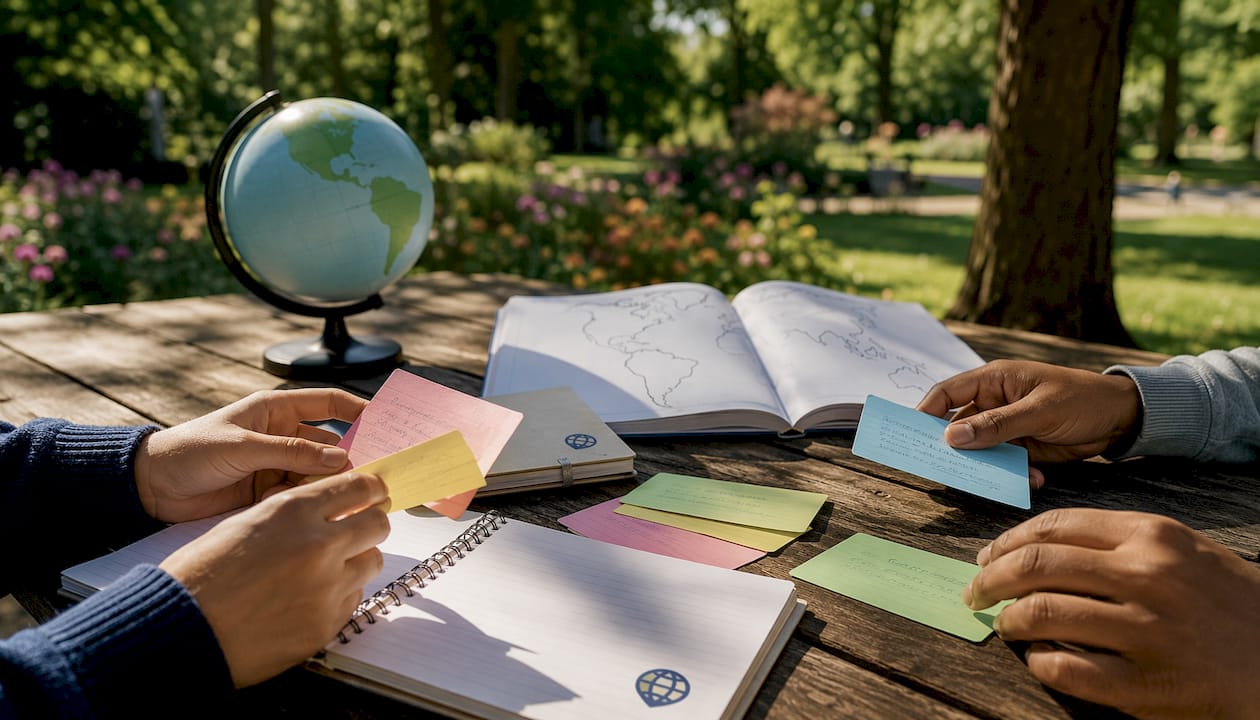
Geography, history, science, literature, and etymology consistently top the list of the hardest general knowledge quiz topics, and the gap between casual knowledge and genuine mastery is wider than most players expect. Only about 1% of people can pass all five elite expert-level quizzes across geography, history, science, literature, and etymology, scoring above the high standards set for each. That number alone tells you what you’re up against.
What makes these subjects brutal isn’t volume. It’s depth. You can’t memorize your way through a question about gene regulation or the Eastern Front. You need to actually understand the mechanics, the context, and the counterintuitive truth hiding behind the obvious answer.
Here’s a quick-reference list of the toughest quiz subjects:
- Geography (borders, capitals, physical features, city identification)
- History (timelines, battles, political context, lesser-known figures)
- Science (quantum physics, genetics, nuclear energy, astronomy)
- Literature and arts (authorship, symbolism, historical context)
- Etymology and language (Latin/Greek roots, word migration, linguistic history)
- Pop culture (deep-cut references, misquotes, obscure firsts)
- Advanced mathematics (abstract reasoning, problem-solving beyond formulas)
Why geography and history top the hard quiz categories
Mental maps lie. Your brain stores geography as a rough sketch, not a precise atlas, which is exactly why geography and history quizzes cause so many knowledge plateaus. You improve fast at first, then hit a wall when questions shift from “name the continent” to “name the river forming this border.”
History has a different problem: Hollywood. Most players absorb a dramatized version of events and mistake it for fact. The real story of Operation Market Garden or the Eastern Front is far more complex than any film captures.
Specific challenges that trip players up:
- Identifying all 54 African countries by location, capital, and physical feature
- Distinguishing WWII’s Pacific and Eastern theaters beyond the famous battles
- Placing landlocked countries in Central Asia or the Caucasus region
- Recalling which African nations share Lake Victoria or the Congo River basin
Examples of hard geography quizzes and city-guessing challenges
The African Geography quiz is one of the most ruthless formats online. It doesn’t ask you to name the Nile. It asks you to name the second-longest river, identify which countries share Lake Victoria, and recall population rankings across 54 nations.
| Quiz type | Difficulty focus | What makes it hard |
|---|---|---|
| African geography | Countries, capitals, borders, rivers | 54 countries, most under-studied globally |
| World War II deep dive | Political, military, and human complexity | Eastern Front and resistance movements rarely taught |
| City photo guessing | Visual identification, no text clues | Requires reading architecture, climate, and street layout |
| Etymology challenge | Latin/Greek roots, word history | Sounds niche, draws on linguistics and cultural history |
Worldlecity’s daily city guessing game sits squarely in the hardest column. You get a photograph of a mystery city and six attempts, with each guess returning proximity and direction feedback. No country name. No continent hint. Just the image.
Pro Tip: When city-guessing, read the architecture style, vegetation, road width, and signage script before placing your first guess. These visual clues narrow the continent before you even think about the country.
Strategies for acing the toughest general knowledge quizzes
Hard quizzes are designed to exploit your intuition. The wrong answer is usually the one that feels right. Knowing that going in changes how you read every question.
Techniques that actually work:
- Active recall over re-reading. Close the map and name every African capital you can. Then check.
- Spaced repetition for geography and dates. Revisit weak spots after 24 hours, then 72, then a week.
- Study misconceptions directly. Learn what the wrong answer is and why people choose it.
- Use answer elimination strategies when formats limit your options. Narrow to two, then reason from what you know.
Pro Tip: Trivia experts balance difficulty with fun. If a topic is crushing your confidence, drop one level and rebuild from there. Worldlecity’s four difficulty modes in its city guesser quizzes make this easy to do without quitting entirely.
Why historical events and dates are so hard to get right
Dates are deceptively specific. You might know the general era of an event but miss the year by a decade, and in a quiz, a decade is wrong. The WWII quiz format exposes this perfectly: players know D-Day happened but can’t place the Stalingrad turning point or the timeline of the Pacific campaign.
The deeper issue is that history education varies wildly by country and curriculum. What’s common knowledge in one classroom is completely absent in another.
Science questions that genuinely stump experts
Quantum physics and advanced mathematics rank among the hardest subjects in the world because they demand abstract reasoning, not just memorization. A science quiz that asks about electron configurations or the Chandrasekhar limit isn’t testing recall. It’s testing whether you understand why something behaves the way it does.

Psychology quizzes add another layer. Cognitive neuroscience questions require understanding experimental methodology and statistical concepts, not just famous studies.
Literature and arts quiz themes that catch players off guard
Most players know Shakespeare wrote Hamlet. Far fewer can identify the source of a specific soliloquy, name the historical figure behind a character, or explain the symbolism in a Renaissance painting. Literature quizzes punish surface familiarity hard.
Art history questions often hinge on period, patron, and technique simultaneously. Knowing Van Gogh painted sunflowers doesn’t help when the question asks which series came first.
Advanced pop culture questions go deeper than you think
Pop culture looks easy until the questions get specific. Iconic movie quotes are almost always misquoted. Legendary songs nearly didn’t happen. The “obvious” answer in entertainment trivia is frequently wrong, which is exactly what makes it a challenging trivia category at competitive levels.
Entertainment trends shift fast too. Keeping up with media and entertainment in 2026 means pop culture questions now span streaming, gaming, and global formats, not just Hollywood.
Resources and tools for mastering tough quiz subjects
Practice beats passive study every time. Worldlecity’s city guesser offers four difficulty modes, so you can choose the right difficulty level and build up systematically. For science and history, deep-dive quiz formats that go beyond surface facts are the fastest way to find your actual knowledge gaps.
Learning quiz patterns and tricks also helps. Recognizing how hard questions are structured, where the traps usually hide, and how to use elimination under pressure are skills you can develop with deliberate practice.
Worldlecity turns geography’s hardest topics into daily play
Geography is the toughest quiz category for most players, and Worldlecity is built around exactly that challenge. No account needed. No pressure. Just a photo of a mystery city and six guesses to place it on the map.
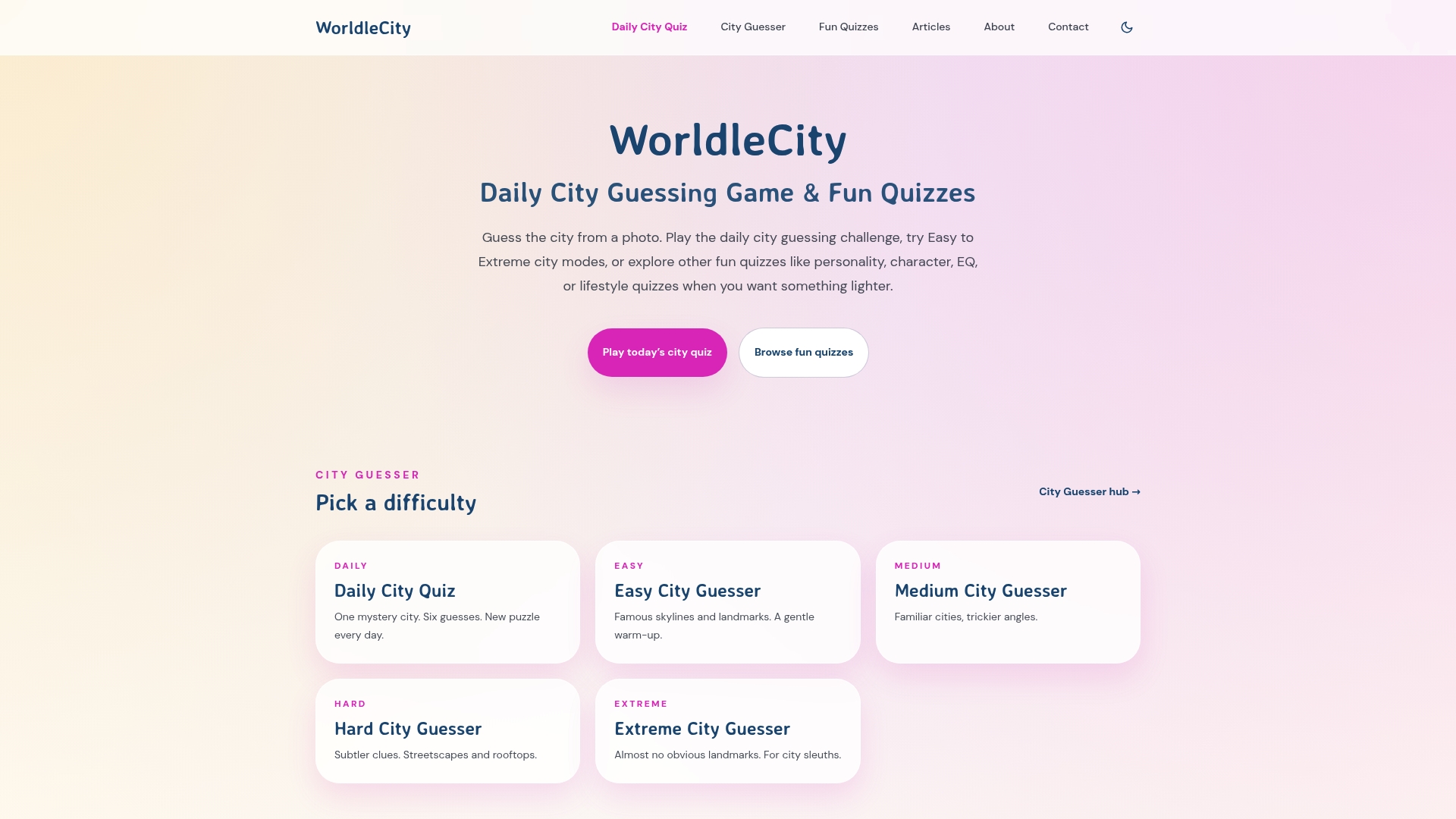
The four difficulty modes in the city guesser mean you can start where you are and push further when you’re ready. Every guess comes with proximity and direction feedback, so you learn something even when you’re wrong. Results are shareable, which makes the whole thing social without being competitive in a stressful way.
Try the daily city guessing game today and find out which corners of the world map you actually know.
Key Takeaways
Geography, history, science, and etymology are the hardest general knowledge quiz topics because they demand mechanistic understanding, not surface recall, and only about 1% of players pass all five elite-level quizzes.
| Point | Details |
|---|---|
| Top hard categories | Geography, history, science, etymology, and pop culture consistently produce the lowest quiz scores. |
| Why they’re hard | Questions require deep understanding and counterintuitive knowledge, not just memorized facts. |
| Elite difficulty benchmark | Only about 1% of players pass all five elite-level quizzes. |
| Best study strategies | Active recall, spaced repetition, and studying misconceptions directly outperform passive review. |
| Worldlecity for practice | The daily city guessing game and four-mode city guesser build geography knowledge through interactive play, no account required. |
FAQ
What are the hardest general knowledge quiz topics?
Geography, history, science, etymology, and advanced pop culture consistently produce the lowest scores. These subjects require deep understanding and counterintuitive knowledge rather than simple recall.
Why do geography quizzes cause knowledge plateaus?
Mental maps are inaccurate, and geography quizzes quickly move past continent-level knowledge into borders, rivers, and demographic details that most players have never studied systematically.
How can you get better at difficult quiz topics?
Active recall, spaced repetition, and studying common misconceptions directly are the most effective techniques. Practicing with interactive formats like Worldlecity’s city guesser builds real geography knowledge through repeated, feedback-driven play.
What makes city-guessing quizzes so hard?
You identify a city from a photograph alone, reading visual clues like architecture, vegetation, and signage with no text hints. Worldlecity’s daily challenge gives you six attempts with proximity and direction feedback after each guess.
Are science or history questions harder in general knowledge quizzes?
Both are extremely challenging, but for different reasons. Science questions test mechanistic understanding of concepts like gene regulation or reactor physics, while history questions expose gaps created by dramatized or incomplete education.