Most Popular Quiz Game Mechanics for Gamers in 2026
Discover the most popular quiz game mechanics in 2026. Learn how these engaging formats enhance player interaction and keep games exciting!
- popular game quiz styles
- engaging quiz mechanics
- what makes a quiz fun
- most popular quiz game mechanics
- most effective quiz types
- quiz game design principles
On this page

Quiz game mechanics are the structural rules that determine how players interact, answer, and compete in any quiz format. The most popular quiz game mechanics in 2026 combine multiple-choice questions, social guessing formats, and real-time multiplayer pressure to keep players engaged across every session. Multiple-choice questions alone appear in 60–70% of daily quizzes, making them the undisputed backbone of quiz design. Understanding which mechanics work, and why, helps you pick games that actually hold your attention rather than ones you abandon after round two.
1. Multiple-choice questions: the foundation of quiz design
Multiple-choice is the most dominant question format in quiz games, and for good reason. It balances accessibility with depth, letting players of any knowledge level participate without feeling lost. Branching logic built into multiple-choice questions creates personalized question paths, so two players can take the same quiz and get a different experience based on their answers.

The recommended structure for an 8–12 question quiz is 60–70% multiple choice combined with one or two short-answer questions. That mix keeps things moving while still testing deeper thinking. Multiple-choice also grades instantly, which matters a lot in competitive or timed formats.
Pro Tip: If you want to make a multiple-choice quiz feel harder without adding complexity, reduce the number of answer options from four to three. Removing one obvious wrong answer forces players to think more carefully.
2. True/false questions: speed rounds done right
True/false questions are the espresso shot of quiz design. Short, fast, and surprisingly effective when used correctly. They work best as warm-up rounds or palate cleansers between harder question types, giving players a quick win before the difficulty ramps up.
The catch is that true/false questions only test recognition, not reasoning. Use them to check basic facts, not to measure whether someone truly understands a concept. Overloading a quiz with true/false questions makes the whole thing feel shallow.
3. Fill-in-the-blank and matching: testing precise recall
Fill-in-the-blank and matching questions test a different cognitive skill than multiple-choice. Instead of recognizing the right answer from a list, players have to retrieve it from memory. That distinction matters because it separates players who genuinely know the material from those who are good at educated guessing.
Matching questions add another layer by asking players to identify relationships between two sets of items. Think pairing capital cities with their countries, or historical events with their dates. Both formats work well in geography and trivia quizzes where precision counts.
4. Short-answer and open-ended questions: where real knowledge shows
Short-answer questions are the hardest to fake. You either know the answer or you don’t. They test synthesis and recall at the same time, which is why quiz designers recommend including one or two per quiz rather than relying on them exclusively.
Open-ended questions take that further by inviting explanation rather than a single correct answer. They work better in personality and lifestyle quizzes than in competitive trivia, where objective scoring is the point. Mixing in one open-ended question per quiz adds texture without slowing the pace too much.
| Question type | Cognitive skill tested | Grading speed | Engagement level |
|---|---|---|---|
| Multiple choice | Recognition, reasoning | Instant | High |
| True/false | Basic recall | Instant | Medium |
| Fill-in-the-blank | Precise recall | Fast | Medium |
| Matching | Relationship mapping | Fast | Medium |
| Short answer | Recall, synthesis | Slow | High |
| Open-ended | Analysis, creativity | Manual | Variable |
5. Social guessing mechanics: predicting the crowd
Social guessing flips the traditional quiz format on its head. Instead of asking what the correct answer is, it asks what most people think the answer is. That shift from factual recall to crowd prediction changes everything about how the game feels.
Inspired by the Family Feud format, social guessing mechanics reward players for matching popular opinion rather than objective truth. You feel clever when you nail the crowd’s thinking, even if the “correct” answer is technically something else. That emotional payoff drives retention in a way that pure trivia rarely does.
Rounds in social guessing games typically run under one minute, which keeps the pace sharp and competitive. The short round length also makes the format highly shareable. Players want to compare results with friends immediately after each round.
Key reasons social guessing mechanics work so well:
- Accessibility. No specialized knowledge required. Anyone can guess what the crowd thinks.
- Social virality. Results beg to be shared, which drives organic growth.
- Humor. Surprising or absurd majority answers create memorable moments.
- Scalability. The format works equally well with two players or two thousand.
Pro Tip: Social guessing quizzes are great for group settings because they level the playing field. The trivia expert and the casual player have an equal shot when the goal is predicting popular opinion.
6. Real-time multiplayer and battle royale quiz formats
Real-time multiplayer is the biggest structural shift in quiz game design over the past few years. Instead of playing asynchronously and comparing scores later, players compete simultaneously in live sessions. The pressure of knowing others are answering at the same moment changes the experience entirely.
Battle royale quiz formats take that further by eliminating players progressively until one winner remains. Some platforms now support up to 1,000 concurrent players in a single live session. That scale creates a genuine spectator element, where watching others get eliminated is part of the entertainment.
Live operations cadence matters here. Platforms that run frequent live events, daily challenges, and seasonal tournaments keep players returning on a schedule. The fast response windows in synchronous gameplay also raise the stakes in a way that turn-based formats simply cannot replicate.
Benefits of real-time multiplayer quiz mechanics:
- Competitive pressure increases focus and engagement per question.
- Live leaderboards create immediate social comparison.
- Elimination formats reward consistency, not just one lucky round.
- Scheduled events build habitual play patterns.
7. Reward unlocking mechanics: beyond the scoreboard
Scores alone do not keep players coming back. Reward unlocking mechanics give players something tangible for their effort, whether that is a new character, a story element, or access to a harder difficulty mode. The reward does not have to be large. The act of unlocking something creates a sense of progress that a number on a screen rarely delivers.
This mechanic works especially well in quiz games aimed at younger players, who respond strongly to visible progress systems. For adult players, the reward can be more subtle, like unlocking a new quiz category or a harder challenge tier. The principle is the same: give players a reason to finish the quiz beyond curiosity.
8. Quiz pacing and question rhythm
Effective quiz pacing alternates question formats to sustain attention and reduce cognitive fatigue. A quiz that fires ten multiple-choice questions in a row feels monotonous by question six. Alternating between image-based, binary, and open-ended questions creates a rhythm that keeps players alert.
The optimal quiz length for engagement sits at 5–8 questions. Completion rates drop sharply once a quiz exceeds 10 questions. That finding has real implications for quiz game design: shorter, well-paced quizzes outperform longer ones even when the longer version covers more interesting content.
9. Choosing the right quiz mechanics for your style
Picking the right quiz format depends on who you are playing with and what you want from the session. A few key factors determine which mechanics fit best.
Player age and experience. Younger players and high school audiences tend to prefer strategy and currency-based mechanics, while adult players generally prefer cleaner interfaces and focused question types without heavy gamification layers. Matching the mechanic to the audience prevents the experience from feeling either too childish or too dry.
Group size and platform. Solo play favors personality quizzes and fill-in-the-blank formats. Larger groups benefit from social guessing and real-time multiplayer. Platform also matters: mobile sessions skew shorter, so 5–8 question formats with fast rounds suit them better than long-form desktop quizzes.
Session length and goal. If you have five minutes, a fast social guessing round or a true/false speed quiz fits perfectly. If you want a deeper challenge, a mixed-format quiz with short-answer questions and image-based rounds delivers more satisfaction. Pairing your goal with the right format is the difference between a session you finish and one you abandon.
| Scenario | Best mechanic | Why it works |
|---|---|---|
| Solo casual play | Personality or lifestyle quiz | Low pressure, self-paced |
| Competitive group | Real-time multiplayer | Live stakes, social comparison |
| Mixed-age group | Social guessing | No expertise required |
| Learning a topic | Mixed format with short answers | Tests recall and reasoning |
| Mobile, short session | True/false or 5-question multiple choice | Fast, completable in under 3 minutes |
You can also explore quiz types for different learning styles to match formats to how you naturally absorb information. And if you are planning a quiz night, pairing the right mechanics with the most common quiz night topics makes a real difference in how engaged your group stays.
Pro Tip: Adding format variety just for its own sake can backfire. Every format you include should serve a specific purpose, whether that is testing recall, sparking discussion, or keeping the pace sharp.
Key takeaways
The most effective quiz game mechanics combine multiple-choice versatility, social guessing engagement, and real-time multiplayer pressure to maximize player retention and enjoyment.
| Point | Details |
|---|---|
| Multiple-choice dominates | It appears in 60–70% of quizzes and supports branching logic for personalized play. |
| Social guessing drives retention | Predicting crowd opinion creates emotional payoff that pure trivia cannot match. |
| Real-time multiplayer raises stakes | Live sessions with up to 1,000 players create competitive pressure and habitual play. |
| Quiz length matters | Keep quizzes at 5–8 questions; completion rates fall sharply beyond 10 questions. |
| Match mechanics to your audience | Player age, group size, and session length should determine which format you choose. |
Worldlecity puts these mechanics to work every day
If reading about quiz mechanics has you itching to actually play, Worldlecity is worth a look. It blends picture-based guessing with structured quiz formats across four difficulty modes, giving you both the casual fun of a daily challenge and the sharper edge of a tougher difficulty mode.
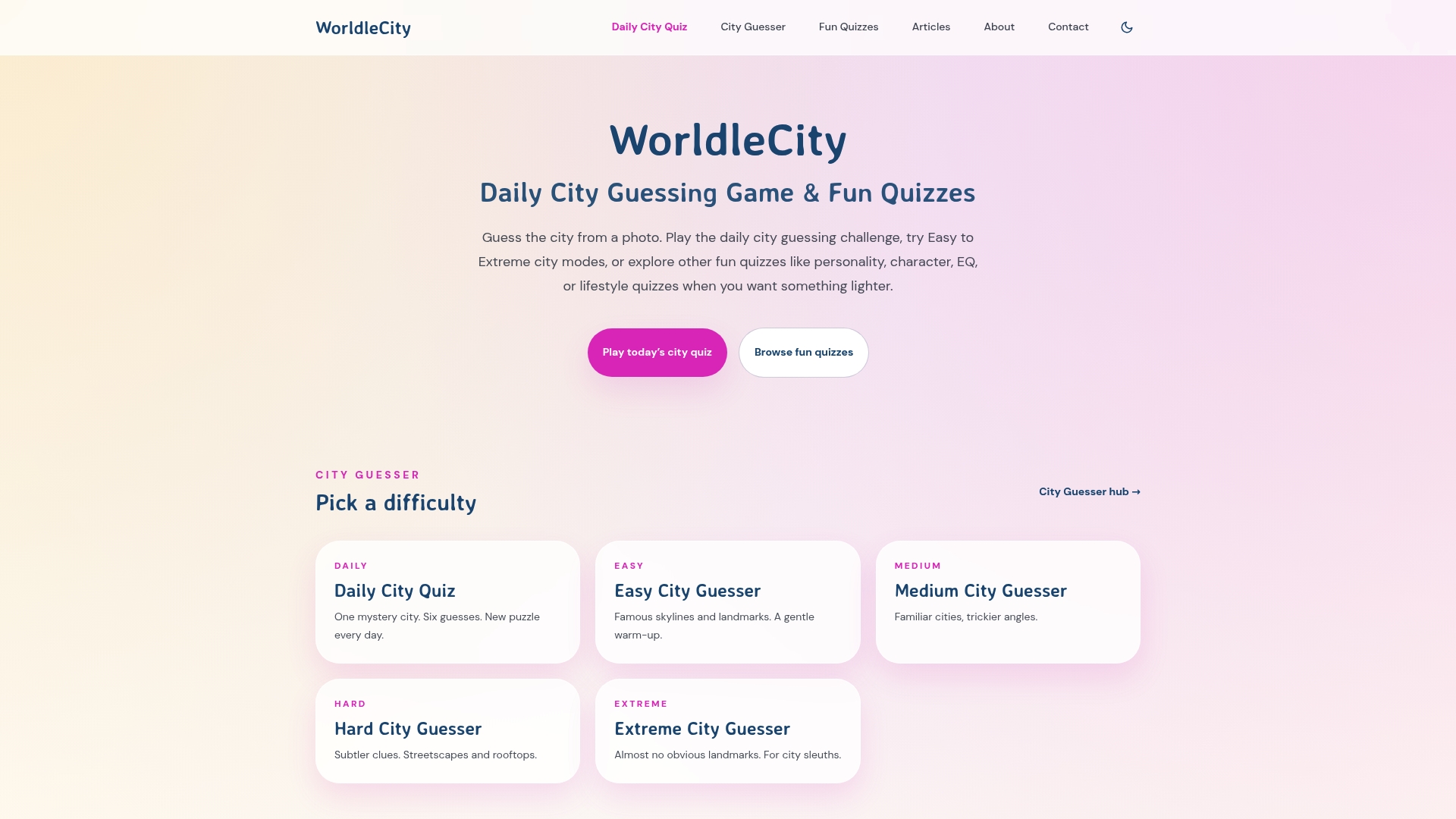
Each day, Worldlecity drops a mystery city photo and gives you six attempts to identify it, with proximity and direction feedback after every guess. It is the kind of instant-feedback loop the best mechanics rely on: every wrong guess narrows the field, so you learn from the misses, not just the hits. No account needed, no friction. Just play the daily quiz and see how your geography knowledge holds up. Share your results, compare with friends, and come back tomorrow for a new challenge.
FAQ
What are the most popular quiz game mechanics?
The most popular quiz game mechanics are multiple-choice questions, social guessing formats, and real-time multiplayer modes. Multiple-choice alone appears in 60–70% of daily quizzes, making it the most widely used format.
How long should a quiz game be for best engagement?
The optimal quiz length is 5–8 questions. Completion rates drop sharply once a quiz exceeds 10 questions, regardless of how interesting the content is.
What makes social guessing mechanics so engaging?
Social guessing mechanics reward players for predicting popular opinion rather than recalling facts. That shift creates an emotional payoff and drives retention through humor and social comparison rather than pure knowledge competition.
How do real-time multiplayer quiz formats work?
Real-time multiplayer quiz formats have all players answering simultaneously in live sessions, sometimes with up to 1,000 concurrent players. The competitive pressure of synchronous play and live leaderboards creates a higher-stakes experience than turn-based formats.
How do I choose the right quiz format for my group?
Match the format to your group size, player age, and available time. Social guessing works for mixed-age groups with no shared expertise, while real-time multiplayer suits competitive players who want live stakes and immediate results.