The Role of Anonymity in Online Quizzes: Play Honestly
Discover the role of anonymity in online quizzes. Learn how it encourages honest answers and increases participation for more accurate results.
- role of anonymity in online quizzes
- how anonymity affects quiz results
- benefits of anonymity in quizzes
- privacy in online quizzes
- anonymous feedback in online quizzes
- anonymity and user engagement in quizzes
On this page

Anonymity makes quiz answers more honest and participation more likely. If you want candid results on a personality or geography quiz, pick a no-registration option and skip any site that asks you to log in first. That single choice changes what you’re willing to say and, by extension, what the results actually mean. Platforms like Worldlecity, the ICOTS 2018 gender study, and the SIDE model (Social Identity and Deindividuation Effects) all point to the same conclusion: when your name isn’t attached, you answer more freely.
Why does anonymity change how you answer quizzes?
The anxiety you feel when you think someone is judging your answer is called evaluation apprehension. Remove the identity link, and that pressure drops fast. You stop tailoring responses to look smart, agreeable, or impressive, and you start answering what you actually think.
Social desirability bias works the same way. When your name is visible, you unconsciously nudge answers toward what seems socially acceptable. Anonymous conditions break that nudge. Research on anonymous pop-quizzes in instruction sessions found they test students’ learning “without accompanying test ‘anxiety’”. The same psychological relief applies when you’re picking a city on a geography quiz or finding out which personality type you are.
A 2025 Springer Nature study on computer-supported collaborative learning found that anonymous-to-peers modes (APM) produced statistically significant increases in both communication volume and productive, content-focused messages compared to identified modes. More messages, better messages.
How anonymity measurably shifts quiz behavior
The behavioral changes aren’t subtle. Honest responses go up, engagement climbs, and collaborative contributions increase when players know their identities are shielded from other participants.
| Outcome | Anonymous condition | Identified condition |
|---|---|---|
| Participation rate | 97.9% with clickers | 9.1% hand-raising |
| Message productivity | Higher cognitive and socio-emotional output | Lower content-focused output |
| Honest responding | Reduced social desirability bias | Answers skewed toward approval |
| Gender preference | Female students favored anonymous modes | Male students leaned competitive/identified |
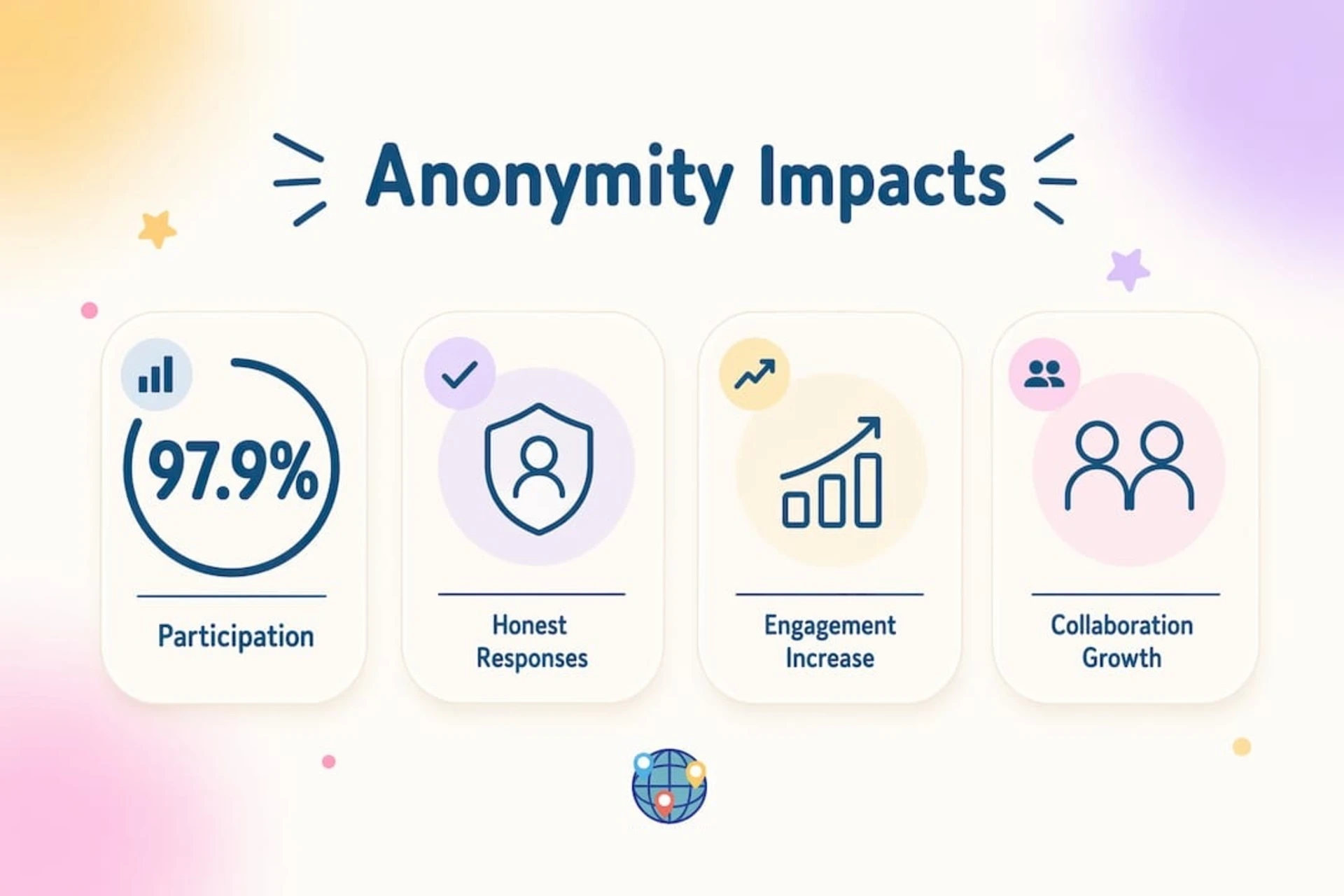
That participation gap is striking: 97.9% vs. 9.1% with the same students in the same course, differing only in how anonymous the response method was.
Gender differences matter here too, especially for multiplayer or competitive quiz formats. The ICOTS 2018 conference paper reported statistically significant differences in anonymity preferences:
- Female students preferred anonymous modes at higher rates than male students.
- Male students were more comfortable with competitive, identified formats.
- Neither group was monolithic. Separate research on electronic response systems found extraversion predicts a lower preference for anonymity.
If you’re designing or choosing a quiz format, this matters. A leaderboard-style geography challenge suits one crowd; a private, no-name personality quiz suits another. Knowing which you prefer helps you pick the right mode from the start.
What does anonymous play actually look like on quiz sites?
Most sites implement privacy across a spectrum rather than as a binary on/off switch. Learners shift between real-identity, pseudonym, and anonymous modes depending on the task, according to BERA/Wiley research on identity-revelation preferences. Here’s what each implementation looks like from your side of the screen:
- No-registration play: You land on the quiz, play, and leave. No account, no email, no stored profile. Your answers exist only in that session.
- Guest nickname/pseudonym: You pick a display name that isn’t your real identity. Others see a handle; the site may or may not link it to your device.
- Anonymous-to-peers (APM) mode: Your identity is hidden from other players but may be trackable by the platform for moderation. You get the social freedom without full invisibility.
- No-tracking/cookie-free options: The site explicitly disables behavioral trackers. Quiz platforms that avoid cookies report higher perceived safety and better data quality on sensitive topics.
Check the privacy statement before you start. “Anonymous” on one site can mean something very different from “anonymous” on another.
Benefits and trade-offs of playing anonymously
The upside is real. Anonymity improves honesty, lowers the barrier to participation, and yields higher-quality data on personality and sensitive-topic quizzes. It also makes quizzes more inclusive — players who would never raise their hand in a crowd will click an answer when no one’s watching.
The trade-offs are real too. For platforms, anonymous play increases moderation burden. Without identity accountability, abuse, trolling, and cheating become harder to catch. That’s why the APM model (anonymous to peers, trackable to admin) often captures the best of both worlds.
Pros for players:
- Honest results on personality quizzes, since you’re not performing for an audience.
- Lower anxiety, especially on knowledge-based quizzes where you fear looking wrong.
- No data trail linking your quiz history to your identity.
- Faster play — no sign-up friction.
Platform trade-offs:
- Harder to moderate bad-faith responses.
- Cheating or ballot-stuffing is easier without identity verification.
- Reduced ability to personalize follow-up content.
Pro Tip: For personality quizzes specifically, anonymous modes improve data quality because you stop answering to project a desired image. If you want results that actually reflect you, go anonymous every time.
How to play anonymously and protect your privacy
A few quick steps let you play anonymously without losing result quality. You don’t need special tools — just a little awareness before you click “start.”
- Choose no-registration or guest modes. If a site requires an account to play, that’s a signal your session will be tied to an identity. Look for “play as guest” or “no sign-up needed.”
- Use your browser’s private/incognito mode. This prevents cookies from persisting between sessions and limits cross-site tracking.
- Don’t link social accounts. “Sign in with Google” or “share to Facebook” buttons connect your quiz activity to your social identity. Skip them.
- Read the privacy statement quickly. Look for explicit language about no data collection, no cookies, or anonymous sessions. Vague statements like “we respect your privacy” aren’t the same as “we don’t track you.”
- Understand what ‘anonymous’ means on that specific site. Anonymous-to-peers is not the same as anonymous-to-the-platform. Know which one you’re getting.
Pro Tip: For quizzes on sensitive topics (mental health, values, relationship style), prefer sites that explicitly state no behavioral tracking. Journalism runs on the same logic, as this guide to anonymous sourcing lays out: people tell the truth when they know it won’t be traced back to them.
Worldlecity is a solid example of no-registration quiz play
Worldlecity offers daily city guessing games and personality quizzes without requiring any account creation. You show up, play, and get results. That’s the whole friction model — or rather, the absence of one.
What the platform actually gives you:
- No registration required for any quiz or daily game mode.
- Immediate feedback on every guess in the city game, so you learn as you play.
- Four difficulty levels on geography image quizzes, letting you choose your own pressure level.
- Personality and lifestyle quizzes alongside geography content, like the personality style quiz, all playable as a guest.
- Shareable results without forcing you to create an account first.
The no-login model maps directly to what the research says about anonymous play: lower friction, higher participation, more honest answers. There is no leaderboard and no public score, so nobody sees how you did unless you choose to share the result yourself. For more on how quiz formats shape engagement, see our guide to quiz game mechanics.
Try a quiz on Worldlecity, no account needed
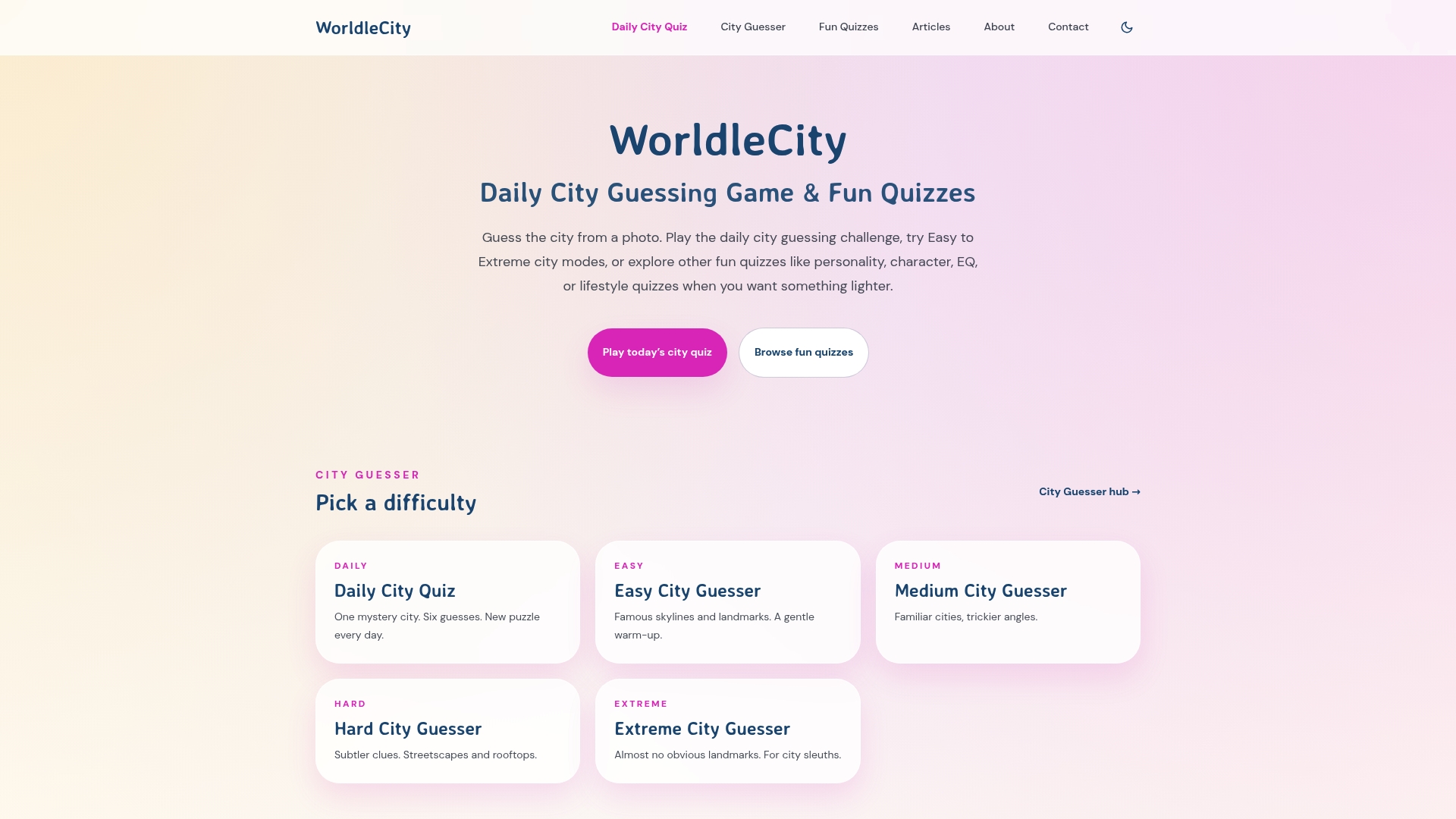
Worldlecity is built for exactly the kind of play this article describes: fast, low-pressure, and completely registration-free. Whether you want to test your geography knowledge with a daily city photo challenge or find out what your answers say about you in the personality style quiz, you can do it without handing over an email address. Honest results, zero sign-up friction. Head to Worldlecity and start playing as a guest right now.
Key Takeaways
Anonymity in online quizzes consistently increases honest answers and participation, and no-registration platforms like Worldlecity deliver that benefit without any sign-up friction.
| Point | Details |
|---|---|
| Anonymity raises participation | Clicker studies show 97.9% response rates vs. 9.1% in identified conditions. |
| Honesty improves without identity pressure | Removing your name reduces social desirability bias and produces more candid quiz answers. |
| Gender preferences differ | Female students favored anonymous modes; male students leaned toward competitive, identified formats per ICOTS 2018. |
| Privacy steps are simple | Use guest mode, private browsing, and skip social login to stay anonymous on any quiz site. |
| Worldlecity supports anonymous play | All quizzes and daily games are playable without registration, with immediate feedback and shareable results. |
FAQ
Does anonymity actually improve quiz answer quality?
Yes. Removing identity pressure reduces social desirability bias, so players answer what they actually think rather than what looks good. This effect is especially strong on personality and sensitive-topic quizzes.
What’s the difference between anonymous-to-peers and fully anonymous?
Anonymous-to-peers (APM) hides your identity from other players but may still allow the platform to track your session for moderation. Fully anonymous means no identity data is stored at all — check the site’s privacy statement to know which you’re getting.
Why do female and male players prefer different quiz modes?
The ICOTS 2018 study found female students rated anonymity significantly higher than male students, while male students rated competition higher. Separate research on electronic response systems found that personality also predicts preference, with extraversion linked to a lower preference for anonymity.
Can I play Worldlecity quizzes without creating an account?
Yes. Worldlecity’s geography games and personality quizzes are all playable as a guest, with no registration required at any point.
Does private browsing make me fully anonymous on quiz sites?
Private browsing prevents cookies from persisting after your session, but it doesn’t hide your IP address from the site’s server. For stronger privacy, combine private mode with a site that explicitly states it doesn’t collect behavioral data.
Useful sources
Key peer-reviewed and conference sources used in this article, for readers who want to go deeper:
“Anonymous pop-quizzes are an effective and easy method of adding an interactive component to any library instruction session.” — Mê-Linh Lê, Journal of the Medical Library Association
| Source | What it contributes |
|---|---|
| ICOTS 2018 — UCL Discovery | Gender-differentiated anonymity preferences in quiz/assessment contexts |
| Springer Nature 2025 | APM vs. IDM outcomes: message volume, productivity, and collaboration gains |
| BERA / Wiley — Yu 2009 | Identity-revelation spectrum: real identity, pseudonym, and anonymous modes |
| Barr 2017 — J. Computer Assisted Learning | The 97.9% vs. 9.1% participation statistic for anonymous vs. identified response methods |
| PMC — Medical Library Association | Anonymous pop-quiz effectiveness in educational settings |
| SagePub — ERS preference study | Personality traits (extraversion, performance-avoid orientation) predicting anonymous-mode preference |