The Role of Difficulty Levels in Quizzes: A Full Guide
Discover the role of difficulty levels in quizzes to enhance engagement and learning. Master quiz design for better results and retention.
- benefits of varying difficulty
- effects of quiz difficulty levels
- how difficulty affects quizzes
- adjusting quiz difficulty
- quiz difficulty strategies
- importance of quiz difficulty
- role of difficulty levels in quizzes
On this page

Difficulty levels in quizzes are the structured tiers of cognitive demand that determine how hard each question is for a given learner. The role of difficulty levels in quizzes goes far beyond sorting questions into “easy,” “medium,” and “hard” buckets. Done right, difficulty calibration shapes whether learners stay engaged, retain knowledge, and walk away having actually learned something. Research shows that optimized task difficulty correlates with learning performance at 78%, which is a strong signal that getting difficulty right is one of the highest-leverage decisions in quiz design. Whether you’re building a classroom assessment or a geography challenge, the principles are the same.
How difficulty levels affect quiz performance and engagement
The most direct effect of quiz difficulty is on motivation. Start too easy, and learners get bored. Start too hard, and they quit. The sweet spot is what researchers call optimal cognitive load: enough challenge to keep you thinking, not so much that you shut down.

Educators face what cognitive scientists call the “performance-learning paradox.” Learners consistently prefer easier quizzes because they feel better in the moment. But struggling through harder questions produces significantly better retention. The feeling of difficulty is not a sign that learning is broken. It is often a sign that learning is actually happening.
Question order matters more than most quiz designers realize. Starting at moderate difficulty reduces early frustration and keeps learners in the zone long enough to build momentum. Dropping a brutally hard question at question two is a fast way to lose someone before they hit their stride.
Here is what the research says about how difficulty shapes the quiz experience:
- Engagement stays higher when difficulty scales with learner ability rather than staying flat throughout.
- Confidence calibration improves when quizzes include genuinely hard questions, because learners stop mistaking easy recall for real mastery.
- Completion rates rise when early questions are approachable and difficulty increases gradually.
- Feedback lands better when it follows a question that actually challenged the learner, because the struggle primes the brain to absorb the answer.
Pro Tip: If you’re designing a quiz for a mixed-ability group, sequence questions from easy to hard within each topic cluster rather than mixing difficulty randomly. This keeps everyone engaged longer and gives lower-confidence learners a foothold.
Understanding why quizzes work as learning tools starts with understanding that difficulty is not the enemy of engagement. It is the engine of it.
What are the best strategies for designing quiz difficulty?
Good quiz difficulty design is not about making questions feel hard. It is about making sure each difficulty tier actually measures what you think it measures.
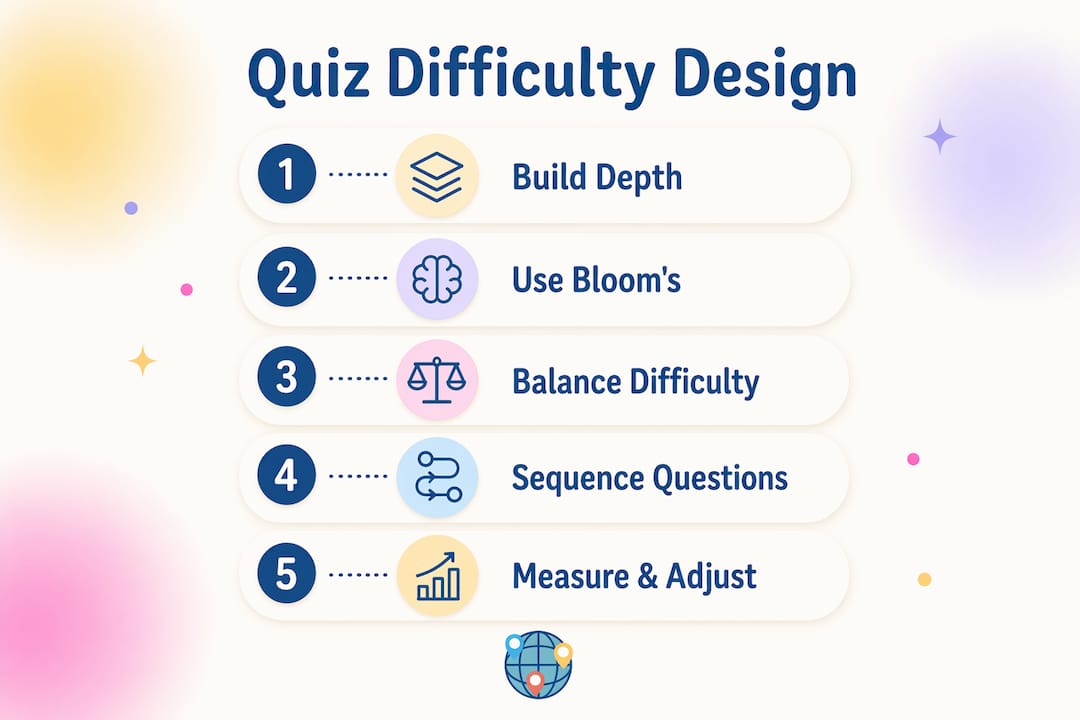
Build a question bank with real depth
A single question per difficulty level is not a question bank. It is a guessing game. The standard recommendation is 10–15 unique questions per difficulty tier to prevent answer memorization and support valid assessment over repeated attempts. For adaptive quizzes, minimum banks of 50–100 items are recommended. That scale lets the system pull fresh questions without cycling through the same set.
Use Bloom’s Taxonomy as a starting point, not a finish line
Most quiz creators misuse Bloom’s Taxonomy by treating cognitive levels as a direct map to difficulty. “Remember” does not always mean easy. A recall question about an obscure historical date can be harder than an analysis question about a familiar concept. True difficulty blends cognitive level, content density, and whether the question applies knowledge to a novel scenario. Bloom’s gives you a useful scaffold. It does not give you a complete difficulty rating.
Adaptive vs. static quiz structures
Here is a quick comparison of the two main approaches:
| Feature | Static quiz | Adaptive quiz |
|---|---|---|
| Question order | Fixed for all learners | Adjusts based on responses |
| Efficiency | Requires more questions for same precision | 20 questions can match a 60-question static quiz |
| Bank size needed | Smaller | 50–100+ items recommended |
| Best for | Standardized testing, simple assessments | Personalized learning, skill diagnostics |
| Difficulty control | Manual, set at design time | Dynamic, adjusts in real time |
Adaptive quizzes are more powerful, but they require significantly more upfront investment in question writing. Static quizzes are easier to build and still highly effective when difficulty tiers are thoughtfully designed.
Four steps to structure difficulty tiers well
- Define your difficulty criteria before writing questions. Decide whether difficulty means cognitive level, content familiarity, or question complexity. Pick one primary criterion and stay consistent.
- Write questions at each tier independently. Do not write all your easy questions first and then try to “make them harder.” Questions written for a specific tier tend to be more coherent.
- Pilot each tier separately. Run easy, medium, and hard questions with a sample group before combining them. This reveals whether your difficulty labels match actual learner performance.
- Pair difficulty with item discrimination. A question that everyone gets right (or wrong) regardless of their knowledge level is not measuring anything useful. Difficulty alone is insufficient without checking that the question actually separates high-knowledge from low-knowledge learners.
How do you measure quiz difficulty accurately?
The standard metric for question difficulty is the p-value, which in quiz design means the proportion of learners who answered a question correctly. A higher p-value means an easier question. A p-value of 1.0 means everyone got it right. A p-value of 0.0 means no one did.
The target p-value for classroom tests is around 0.75, meaning roughly three out of four learners should answer correctly. Professional certification exams use a stricter and more varied distribution, with more questions in the 0.50–0.70 range to better differentiate candidates.
| Context | Target p-value range | Why |
|---|---|---|
| Classroom formative quiz | 0.70–0.80 | Builds confidence, checks core understanding |
| Summative classroom test | 0.55–0.75 | Differentiates learners more effectively |
| Professional certification | 0.40–0.70 | High stakes, needs stronger discrimination |
| Trivia or engagement quiz | 0.30–0.60 | Keeps it challenging and fun |
P-values alone do not tell the full story. Item difficulty indices must be paired with item discrimination metrics to confirm that a question actually separates learners who know the material from those who do not. Two questions with identical p-values can have wildly different discrimination values. The one with higher discrimination is the better question.
Pro Tip: Do not make major changes to your question bank after just one or two quiz runs. A question bank needs 5–10 administrations before its difficulty statistics become reliable enough to act on. Early data is noisy.
Tracking these metrics over time also reveals drift. A question that was medium difficulty in year one may become easy by year three if the content becomes common knowledge. Regular audits keep your difficulty tiers honest.
Why does difficulty level matter for long-term retention?
Easy quizzes feel productive. They rarely are. Desirable difficulties such as spaced repetition and retrieval practice produce 2–4 times the long-term retention compared to easier study methods like re-reading. That gap is enormous, and it has direct implications for how you design quizzes if your goal is actual learning rather than a good score in the moment.
The mechanism is straightforward. When you struggle to retrieve an answer, your brain works harder to reconstruct the memory. That reconstruction process strengthens the neural pathway. When you re-read something familiar, no reconstruction happens. The information stays shallow.
Learners often mistake confidence on easy quizzes for mastery. This is the metacognitive illusion: you feel like you know it because recalling it was effortless. Introduce a harder question on the same topic, framed differently, and that confidence collapses. Well-designed difficulty tiers expose this gap before it becomes a problem on a high-stakes test or a real-world application.
Here is how to apply this in practice:
- Use retrieval practice questions that ask learners to recall information without hints or context clues, not just recognize the right answer from a list.
- Space harder questions across sessions rather than front-loading them. Returning to difficult material after a gap forces deeper retrieval.
- Give feedback after struggle, not before. Letting learners attempt a hard question before revealing the answer produces better retention than showing the answer first.
- Mix difficulty within topics. Alternating easy and hard questions on the same subject prevents learners from coasting on familiarity.
You can read more about building quiz habits that stick and why the science behind regular, challenging practice is more powerful than most people expect.
Worldlecity: quizzes built with real difficulty in mind
If you want to experience what calibrated difficulty actually feels like in practice, Worldlecity is a good place to start.
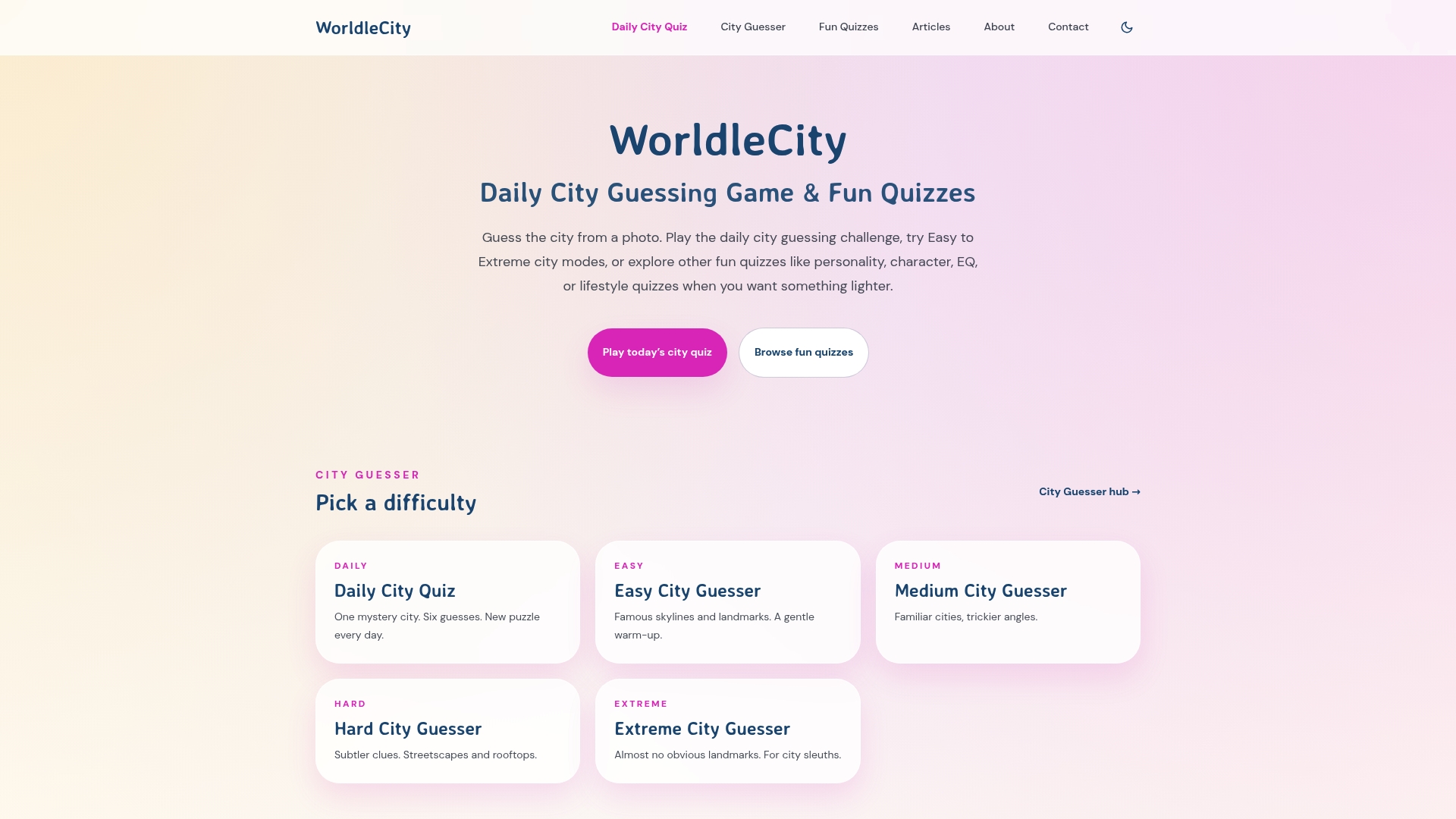
Worldlecity’s daily city guessing game gives you six attempts to identify a mystery city from a photograph, with each guess returning proximity and direction feedback. The challenge scales naturally because geography knowledge is genuinely uneven. You might nail European capitals and blank on Southeast Asian cities. That gap is where the learning happens. Beyond the daily game, Worldlecity’s city guesser quizzes stack four difficulty modes, so you can work your way up rather than hitting a wall. No account needed. Just pick a level and go.
Key takeaways
Difficulty levels in quizzes are the single most important design variable for balancing engagement and genuine learning outcomes.
| Point | Details |
|---|---|
| Difficulty drives retention | Harder questions produce 2–4x better long-term retention than easy recall tasks. |
| P-value targets vary by context | Aim for p-values of 0.70–0.80 in classroom quizzes; professional exams use 0.40–0.70. |
| Discrimination matters as much as difficulty | A question’s p-value must be paired with item discrimination to confirm it actually measures knowledge. |
| Adaptive quizzes are more efficient | A 20-question adaptive quiz can match the precision of a 60-question static quiz. |
| Burn-in period is real | Wait for 5–10 quiz administrations before treating difficulty statistics as reliable. |
FAQ
What does item difficulty mean in a quiz?
Item difficulty is the proportion of learners who answer a question correctly, expressed as a p-value. A p-value of 0.75 means 75% of learners got it right, which is the standard target for classroom tests.
Why do harder quizzes produce better learning?
Struggling to retrieve an answer strengthens the memory pathway more than easy recall does. Desirable difficulties like retrieval practice produce 2–4 times the long-term retention compared to passive study methods.
How many questions do you need per difficulty tier?
Quiz designers recommend 10–15 unique questions per difficulty tier to prevent answer memorization. Adaptive quizzes require larger banks of 50–100 items to function reliably.
What is the performance-learning paradox?
The performance-learning paradox describes the gap between how learners feel during easy quizzes (confident, successful) and how much they actually retain. Harder quizzes feel worse but produce better learning outcomes.
How do you know when to adjust quiz difficulty?
Adjust difficulty after at least 5–10 quiz administrations, once p-values and item discrimination metrics have stabilized. Acting on early data produces unreliable changes that can make your quiz worse, not better.