Solo vs Team Quizzes: Key Differences Explained
Discover the key difference between solo and team quizzes. Learn how each style enhances learning and engagement for different needs.
- group quiz effectiveness
- solo quiz advantages
- team quiz benefits
- difference between solo and team quizzes
- solo vs team testing
- team quiz dynamics
On this page

The core difference between solo and team quizzes comes down to one thing: who’s doing the thinking. Solo quizzes put you alone with the questions, your knowledge, and your pace. Team quizzes pull other people into the process, making discussion, disagreement, and collective reasoning part of the answer itself.
Here’s a quick breakdown before we go deeper:
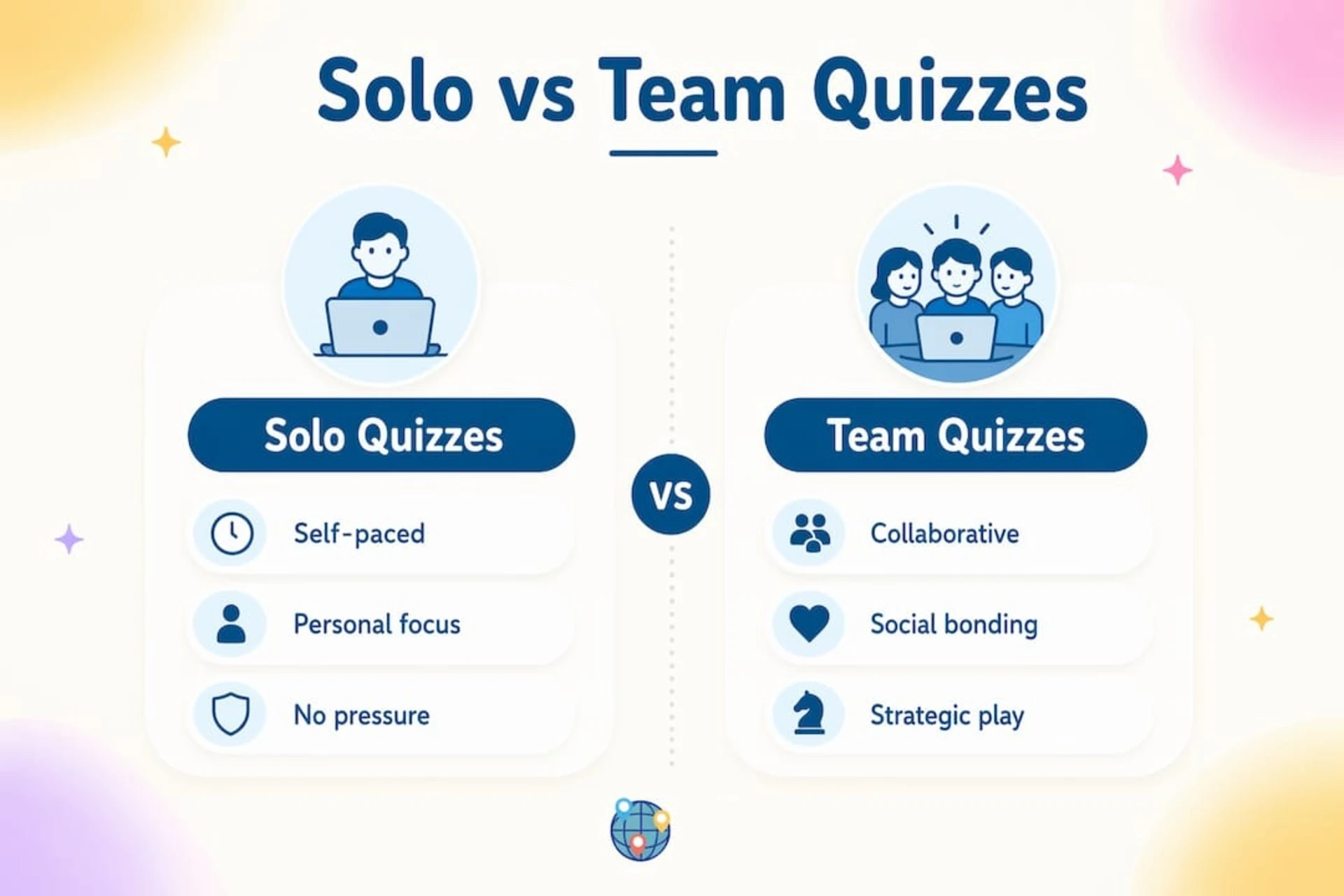
- Solo quizzes are self-paced, private, and built around individual performance tracking.
- Team quizzes require real-time coordination, shared decision-making, and group consensus.
- Scoring in solo mode reflects personal accuracy; in team mode, it reflects collective output.
- The experience shifts from quiet reflection to active social negotiation.
- Purpose differs too: solo suits personal learning diagnostics, while team formats build relationships and shared knowledge.
Neither is better. They’re just built for different moments.
What’s the difference between solo and team quizzes, really?
Solo quizzes are exactly what they sound like: one person, one screen, one set of questions. The format is typically self-paced, meaning you move through questions on your own timeline without waiting for anyone else. You get immediate feedback after each answer or at the end, and your score reflects only your own knowledge.
The mechanics are simple:
- Select a quiz topic or category.
- Read each question and choose or type your answer independently.
- Receive a score, often with explanations for wrong answers.
- Revisit or retry at your own discretion.
Solo quiz modes create a pressure-free setting where you can revisit difficult concepts at your own pace. There’s no clock ticking because someone else finished, and no social pressure to perform. That’s a feature, not a limitation.
Scoring in solo mode usually tracks points per correct answer, time taken, or a streak. Some platforms add adaptive difficulty, adjusting question complexity based on how you’re performing. The whole design centers on you as the unit of measurement.
Why solo quizzes work so well for personal learning
Solo quizzes reduce anxiety by removing the social stakes. You’re not being judged by teammates or competing in real time. That lower-pressure environment makes it easier to focus on knowledge gaps rather than on how you look while answering.
The advantages stack up quickly:
- Flexible pacing: You stop, reread, and think without holding anyone up.
- Targeted practice: You can replay a quiz on a specific weak topic as many times as you want.
- Honest self-assessment: Your score is yours alone, with no teammate carrying you or dragging you down.
- Reduced cognitive load: No need to manage group dynamics while also trying to remember facts.
- Confidence building: Getting answers right in private builds a foundation before you test yourself publicly.
Solo play is often misunderstood as lonely, but research shows it actually supports self-reliance and deep focus that social formats can’t replicate. Think of it as the difference between practicing scales alone versus performing in a band. Both matter. One comes first.
Common solo quiz use cases include exam prep, language learning drills, geography practice, and personality or lifestyle quizzes you just want to take for fun without an audience.
Pro Tip: If you’re using solo quizzes for study, don’t just check your score. Read every wrong-answer explanation before moving on. That’s where the actual learning happens.
How team quizzes work and what makes them different
Team quizzes flip the whole dynamic. Instead of one person answering independently, a group works together to produce a single answer. That requires communication, negotiation, and sometimes a little friendly arguing.
The typical flow looks like this:
- Participants divide into teams, either randomly or by choice.
- A question is presented to all teams simultaneously.
- Team members discuss, debate, and agree on an answer.
- One person submits the group’s response.
- Scores accumulate per team, not per individual.
Some platforms take team quiz collaboration even further by splitting answer choices across different team members’ devices, making it literally impossible for one person to answer alone. That design forces communication by default, not by suggestion.
The social and strategic elements are built into the format. Someone naturally takes the lead on topics they know well. Someone else catches an error before it’s submitted. A third person remembers a detail nobody else thought of. That’s collective intelligence in action, and it’s genuinely different from anything a solo format can produce.

The real benefits of team quizzes
Team quizzes do things solo formats simply can’t. The biggest one is retention through discussion. When you argue about an answer with a teammate and then find out you were right (or wrong), that moment sticks. Passive reading doesn’t create the same memory trace.
Other benefits worth knowing:
- Communication practice: Teams have to articulate their reasoning, not just pick an answer.
- Breaking down hierarchies: Team quizzes highlight diverse strengths beyond job titles, letting quieter colleagues shine.
- Engagement boost: Friendly competition between teams creates energy that solo play rarely matches.
- Collective intelligence: Groups catch errors individuals miss, especially on tricky or ambiguous questions.
- Social bonding: Shared wins and losses build rapport faster than most workplace activities.
Research comparing team and individual quiz methods found that students working collaboratively showed stronger problem-solving gains than those working alone, particularly on complex tasks. The peer feedback loop is a big part of why.
Team quizzes work especially well for workplace team building, classroom group review, virtual social events, and quiz nights where the social experience is the whole point.
How to choose between solo and team quizzes
The right format depends entirely on what you’re trying to get out of the experience. Experts put it plainly: choose based on your goal, not on what sounds more fun in the moment.
Go solo when:
- You want an honest read on your personal knowledge level.
- You’re studying a topic and need to move at your own speed.
- You feel anxious performing in front of others.
- You want to repeat a quiz multiple times without coordination hassle.
Go team when:
- Building relationships or team cohesion is part of the goal.
- The topic benefits from multiple perspectives and debate.
- You want higher engagement and shared energy.
- You’re running a group event and want everyone involved.
Pro Tip: Mixing both formats across a learning program gives you the best of each. Use solo quizzes to diagnose gaps, then team quizzes to reinforce and discuss. The quiz types you choose shape the whole experience.
Also consider the platform. Some tools support both modes with different mechanics. Others, like certain vocabulary-focused platforms, require a minimum number of players and can’t be played solo at all. Check what your platform actually supports before committing to a format.
Geography quizzes as a perfect example of both formats
Geography quizzes are a great lens for seeing solo vs team dynamics in action, because the same content plays completely differently depending on who’s in the room.
Solo geography quizzes let you test your own mental map quietly. You get a photo, a map, or a clue, and you work through it alone. The feedback is immediate and personal. You find out exactly where your knowledge is sharp and where it’s fuzzy, whether that’s Southeast Asian capitals or South American river systems.
Team geography quizzes turn that same content into a group puzzle. Someone on the team might recognize the architecture. Someone else spots the language on a sign. A third person narrows it down by climate. Together, you get further than any one person would alone. The group game voting tools available on some platforms also make it easy to decide which quiz format your group wants before you even start, which removes the coordination friction that kills team quiz momentum.
Worldlecity is built around this kind of playful geographic challenge. The daily city guessing game gives you six attempts to identify a mystery city from a photograph, with proximity and direction clues after each guess. It is a solo challenge at heart, a focused daily habit, but since everyone gets the same city that day, you can share your result and compare how friends did on the exact same puzzle. Four difficulty modes in the city guesser quizzes let you calibrate the challenge to your level, whether you are testing yourself quietly or trading scores with friends.
Key Takeaways
Solo quizzes build personal knowledge and self-reliance; team quizzes build communication, retention, and social bonds through shared reasoning.
| Point | Details |
|---|---|
| Format defines the experience | Solo quizzes are self-paced and private; team quizzes require real-time coordination and group consensus. |
| Learning impact differs | Team quiz participants showed stronger problem-solving gains than solo learners, especially on complex tasks. |
| Solo suits diagnostics | Use solo quizzes when you need an honest, pressure-free read on your personal knowledge gaps. |
| Team suits bonding and retention | Discussion and debate during team quizzes create stronger memory traces and break down workplace hierarchies. |
| Choose by goal, not preference | Experts recommend matching quiz format to your objective: diagnostics for solo, rapport and collaboration for team. |
FAQ
What is a collaborative quiz?
A collaborative quiz is a group activity where participants work together to answer questions, discuss options, and agree on a shared response. The goal is collective problem-solving, not individual scoring.
How do you run a team quiz effectively?
Divide participants into small groups, present questions to all teams simultaneously, and give each team time to discuss before submitting one answer. Keeping teams to three to five people tends to maximize participation.
Can you go to a pub quiz alone?
Yes. Solo pub quiz players benefit from flexible arrival and no coordination, but they miss out on the sanity checks and collaborative corrections that teammates provide.
When should you use a solo quiz instead of a team quiz?
Solo quizzes work best for self-assessment, exam prep, and any situation where you want pressure-free, personalized practice. Team quizzes are better when engagement, discussion, and social bonding are the priority.
Do team quizzes actually improve learning more than solo quizzes?
Research on paired vs individual participation in gamified lessons suggests team formats tend to help more with complex, discussion-based topics.