Build Your Quiz Winning Streak Routine Fast
Want to boost your quiz skills? Learn how to build your quiz winning streak routine quickly with easy anchoring and daily practice.
- build quiz winning streak routine
- how to win quizzes consistently
- quiz study plan
- quiz preparation tips
- strategies for quiz success
- maximize quiz performance
On this page

Anchor your daily quiz to an existing habit, play for a few minutes, and review one missed answer. That’s the whole routine. Habit anchoring reliably automates new behaviors by piggybacking on cues you already follow, and short daily sessions beat longer, irregular ones for long-term retention. Build your quiz winning streak routine around those two facts and you’re most of the way there.
TL;DR — do this today:
- Anchor (30 sec): pick a trigger (morning coffee, commute start, lunch break, or evening tea) and commit to it
- Micro-quiz (3–5 min): play the daily round on Worldlecity, or a quiz-library round at your chosen difficulty
- Quick review (1 min): read the correct answer for any miss, then close the tab
Pro Tip: Set a 5-minute phone timer before you open the game. When it rings, you’re done. No rabbit holes, no guilt.
Why streaks feel impossible to quit
Streaks aren’t just a fun counter. They’re a behavioral trap — in the best possible way. Daily quiz mechanics like expiring challenges and streak counters are deliberately designed to trigger dopamine and create FOMO. Once the cue-routine-reward loop clicks, it starts to feel identity-linked: you’re “the person who plays every day.”
Loss aversion does the heavy lifting. Players who maintain a streak for several days are significantly more likely to keep engaging for weeks or months because the fear of losing progress outweighs the mild effort of playing. That’s a feature, not a bug.
The risk is shame and burnout. A few tactics keep it healthy:
- Keep sessions short enough that skipping feels sillier than playing
- Never tie self-worth to a daily score — only to showing up
- If the streak breaks, treat it as data, not failure
Pro Tip: Follow the daily quiz habit science to understand exactly why the loop forms — and how to stay in control of it.
Three science-backed principles your routine needs
You can streak without learning anything. These three principles make sure you don’t.
1. Active recall beats rereading. Retrieval practice consolidates memory far more effectively than passively reviewing answers. Every time you force your brain to produce an answer before seeing it, you strengthen that neural pathway.
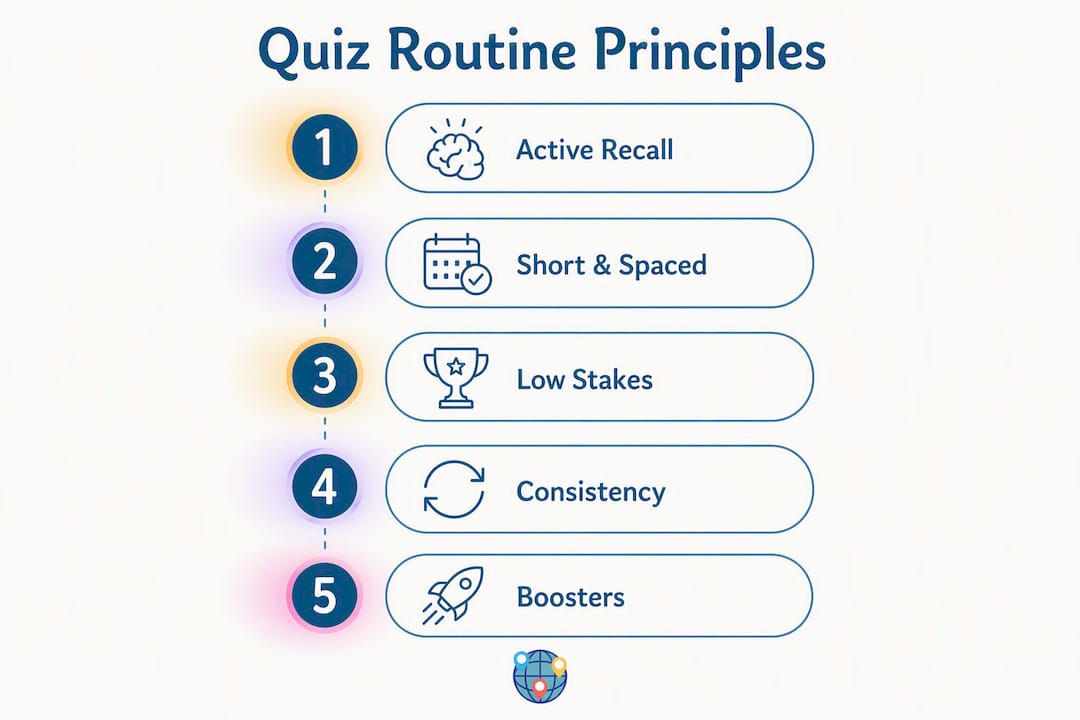
2. Short and spaced beats long and crammed. Micro-quiz schedules with same-day checks and boosters after 2–4 days improve durability more than a single long session. Three minutes today plus three minutes Thursday is worth more than twenty minutes on Sunday.
3. Low-stakes consistency is the actual goal. Low-stakes consistency beats aiming for perfect daily scores — make every session survivable so you return tomorrow. A streak of 30 mediocre days produces more learning than five perfect sessions with gaps.
These principles map directly onto the checklist below.
Your 5-step daily checklist
Memorize this. It takes under 5 minutes total.
- Pre-quiz: Attach the session to your anchor habit. Set a timer. Pick a difficulty that feels slightly challenging but not punishing.
- Warm-up: Start with 2–3 easier questions to prime recall before tackling harder items.
- During: Focus on retrieval. Guess before you look. Resist the urge to second-guess your first instinct.
- Post-quiz: Read the correct answer for every miss. Note one fact to revisit in 2–4 days.
- Close: Log the date and any weak topic. Done.
| Action | Time |
|---|---|
| Anchor + open game | 30 sec |
| Warm-up questions | 1 min |
| Main round | 2–3 min |
| Review misses | 1 min |
| Log one fact | 30 sec |
| Total | 3–5 min |
Pro Tip: Keep a sticky note or phone note titled “revisit” and drop one city or region name in after each session. That list becomes your spaced-review queue.

Quick drills that sharpen accuracy in 5–10 minutes
When you have a few spare minutes beyond the daily round, these micro-drills pay off fast.
- 2-minute city ID blitz: Open a photo-based round and name the continent before you guess the city. Forces broad-to-narrow thinking.
- Landmark tagging: For each photo, identify one visible clue (architecture style, vegetation, signage language) before submitting. Builds pattern recognition.
- Capital recall sprint: Pick a region and mentally list capitals for 60 seconds before playing. Primes the relevant memory cluster.
- Targeted weakness set: Check your recent miss log, pick the region you keep getting wrong, and play a focused set there.
- Interleaved mix: Alternate between two regions you find difficult. Interleaving topics maximizes retention while minimizing total time.
For the fastest improvement on tricky questions, the guide on answering geography quiz questions faster covers proven identification techniques worth bookmarking.
Pro Tip: Two or three of these drills per week is plenty. Daily is the streak; drills are the upgrade.
How to turn wrong answers into lasting memory
A wrong answer is the most valuable moment in your session. Here’s the workflow:
- Label the error. Was it a region mix-up, a visual clue you missed, or a total blank? One word is enough.
- Read the correct answer slowly. Don’t skim. Let it land.
- Wait 60–120 seconds, then retry from memory. This short delay forces retrieval and encodes the correction more deeply than immediate re-reading.
- Add it to your revisit list for a follow-up 2–4 days later, then again at roughly one week.
Getting a quiz answer wrong before seeing the correct answer is more effective than passively reading the correct answer from the start. When you attempt to produce an answer — even incorrectly — and then see the correct information, your brain encodes it more deeply than if you had simply read it without attempting to recall it first.
That pretesting effect is why mistakes, handled well, accelerate learning faster than always answering correctly. For tough items that keep coming back, the walkthrough on approaching difficult quiz questions has specific tactics.
Pro Tip: Never skip the retry step. The 60-second wait feels awkward. Do it anyway.
What to do when you miss a day
Missing a day feels worse than it is. Here’s the recovery sequence:
- Accept the skip. One missed day does not erase a streak’s behavioral momentum.
- Do a 3-minute catch-up. Low-stakes, no pressure. Just re-establish the loop.
- Reset your anchor. If the original trigger failed, attach the quiz to a different daily habit for the next week.
- Shorten the next session. A 2-minute round is better than skipping again because a full session feels like too much.
The psychological reframe that actually works: measure your learning trajectory, not your streak length. A 20-day streak with one gap and consistent review beats a 30-day streak played on autopilot.
Pro Tip: Keep an “emergency round” bookmarked — a quick, easy mode you can finish in 90 seconds on the worst days. Having it ready removes the activation barrier entirely.
Track progress without obsessing over your score
Some metrics help. Some just create anxiety.
| What to track | Why it helps |
|---|---|
| Date played | Confirms consistency at a glance |
| Minutes per session | Keeps sessions from creeping longer |
| Missed topics | Feeds your spaced-review queue |
| Confidence rating (1–3) | Flags areas needing a targeted drill |
Skip daily score fixation and leaderboard comparisons. Raw score on a single round is noisy data. What matters is whether your miss rate on a given region drops over two or three weeks.
When to ignore metrics entirely: if tracking starts to feel like homework, drop everything except the date. Showing up is the metric that compounds.
Three ready-to-copy routines
5-minute morning routine
- Coffee pours. Open Worldlecity’s daily puzzle.
- Work through your six guesses, reading the proximity and direction feedback after each one.
- If you name the city, drop one fact about it into your revisit note.
- If you run out of guesses, note the clues that stumped you and check back tomorrow to find the correct answer.
- Close the tab before the coffee gets cold.
Commute micro-session
- Headphones in, game open.
- Three-minute blitz round, any difficulty.
- Screenshot or mentally note the one answer you got wrong.
- After work, spend 60 seconds retrying that item from memory.
Weekly deep-dive (15–20 minutes)
- Pull up your revisit list from the week.
- Play two interleaved rounds mixing your two weakest regions.
- Run a mini cumulative quiz: mentally recall five cities from the past week before opening the game.
- Log which topics improved and which need another week.
| Routine | Time | Best for |
|---|---|---|
| Morning | 3–5 min | Daily streak protection |
| Commute | 3 min + 1 min retry | Busy days, low activation |
| Weekly deep-dive | 15–20 min | Consolidation and gap-closing |
For social settings where you want to bring a quick geography game into a group, picking the right game for the occasion makes the whole thing easier.
Why Worldlecity fits this routine perfectly
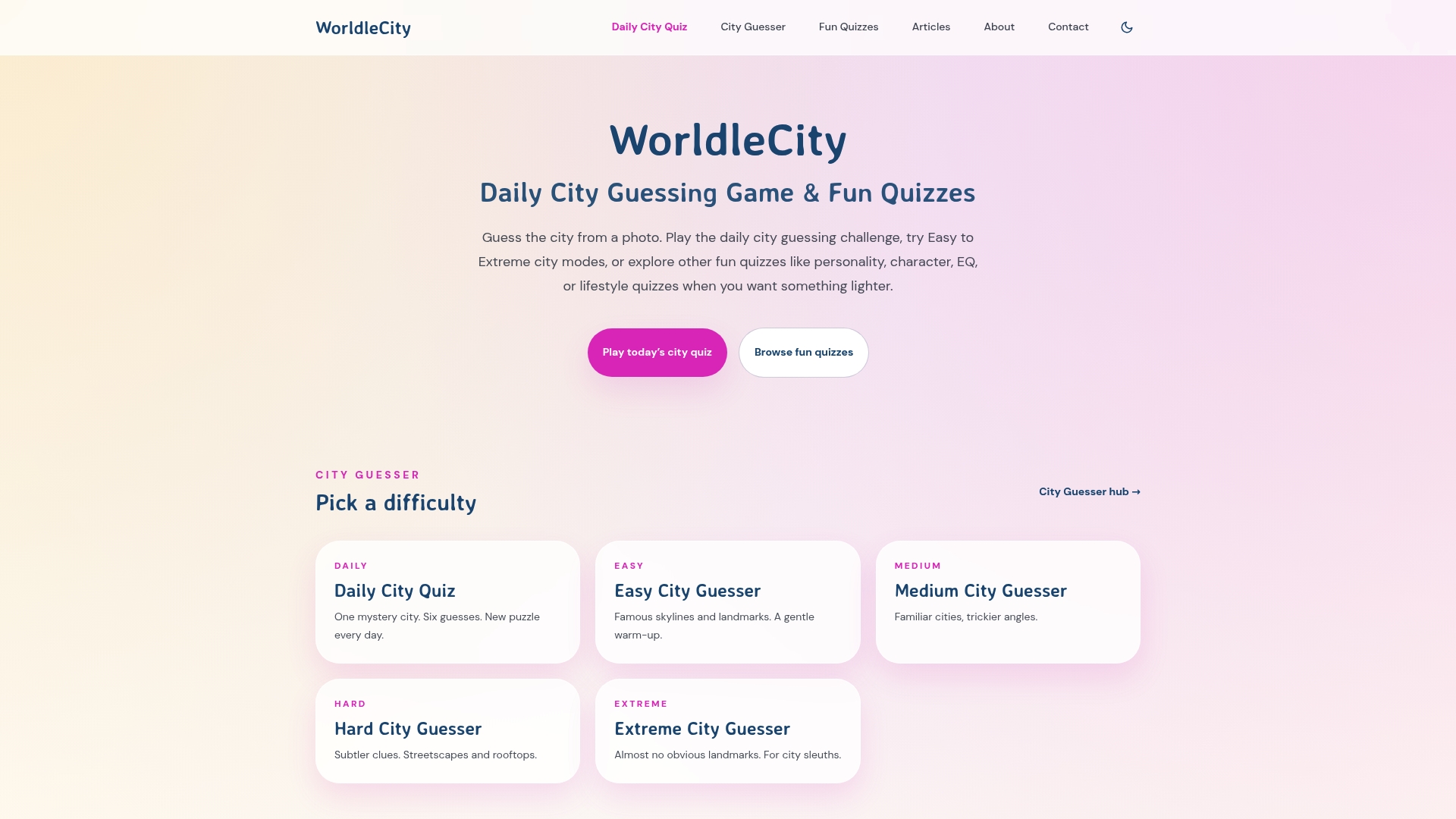
Worldlecity’s format was practically built for the checklist above. Each daily city-guessing round uses a real photograph, gives you six attempts, and shows proximity and direction feedback after each guess — that’s built-in corrective feedback with no extra setup.
The daily city round is your main session and the streak-maker. Around it, the city-guess quiz library adds four selectable difficulty modes (Easy, Medium, Hard, Extreme) that map onto the rest of the routine:
- Easy mode: testing waters and recovery days
- Medium: warm-up rounds
- Hard: focused practice sets
- Extreme: weekly deep-dive and interleaved drills
No registration means zero friction. You open the game, play, and close it. The daily quiz competition guide covers how to use the streak mechanics strategically once you’re comfortable with the format.
Pro Tip: Use Worldlecity’s city guesser quizzes for targeted regional drills — pick the difficulty that matches your weakest area and work through it as your focused practice set.
| Routine step | Worldlecity feature |
|---|---|
| Warm-up | Quiz library Easy/Medium mode, 2–3 quick rounds |
| Main session | Daily city round (protects your streak) |
| Weekly deep-dive | Quiz library Hard/Extreme mode |
| Daily routine | The daily city quiz at your anchor time |
Key Takeaways
A 3–5 minute daily routine anchored to an existing habit, built on active recall and spaced review, is the most reliable way to protect a quiz streak and build real geography knowledge.
| Point | Details |
|---|---|
| Anchor the habit | Tie your daily quiz to coffee, a commute, or another fixed trigger for automatic consistency. |
| Keep sessions short | Three to five minutes daily outperforms longer, irregular sessions for retention. |
| Use mistakes actively | Retry any wrong answer after 60–120 seconds to encode the correction through the testing effect. |
| Track frequency, not score | Log dates and missed topics; ignore daily score fluctuations and leaderboard position. |
| Worldlecity as your engine | Free, photo-based daily rounds plus a quiz library with four difficulty modes, all with no registration, make it the lowest-friction daily practice tool. |
Worldlecity makes the routine effortless
Geography knowledge compounds when the daily habit is frictionless. Worldlecity gives you a photo-based daily city round with real directional feedback and a running streak, plus a quiz library with four selectable difficulty modes for warm-ups through deep dives, all with zero registration requirements, so the only thing between you and your streak is opening the game.
Play one round right now, log one missed city, and you’ve already started. The streak takes care of itself from there. Start your daily round at Worldlecity and see how quickly the routine clicks.
Useful sources
The routine in this article draws on research in habit formation, retrieval practice, and quiz game psychology. Here are the key sources:
- Habit formation and anchoring (PMC)
- How a 4-minute daily quiz builds a lasting habit
- Quiz game daily streaks and loss aversion
- Retrieval practice and spacing for memory
- The psychology of hot-streak game design
- The testing effect and micro-quiz schedules
- Quiz assessment strategies: interleaving and spacing
- Test-taking strategies and warm-up practices
- Spaced retrieval scheduling for durable learning
- Why daily quiz challenges are addictive
FAQ
How long should a daily quiz streak session be?
A 3–5 minute daily quiz session is enough for streak protection and retention. Short daily sessions beat longer, irregular ones for long-term habit formation.
What’s the best way to recover after missing a day?
Do a low-stakes 3-minute catch-up round, reset your anchor habit, and shorten the following session. One missed day doesn’t erase behavioral momentum.
Does getting answers wrong actually help you learn?
Yes. The pretesting effect shows that attempting an answer before seeing the correct one encodes it more deeply than passive review, so retrieval practice makes mistakes genuinely useful.
How do I use Worldlecity to build a streak routine?
Play the daily city round as your main streak session, then use the city guesser quiz library’s difficulty modes around it: Easy for warm-ups and recovery days, Medium or Hard for targeted regional drills. No registration required.
What should I track to improve without burning out?
Track date played, minutes per session, and missed topics. Skip daily score fixation; frequency and correction rate are the metrics that actually predict improvement.