How to Compete in Daily Online Quiz Challenges
Learn how to compete in daily online quiz challenges effectively. Master formats, avoid common mistakes, and boost your quiz scores!
- trivia games to play online
- daily trivia competitions
- compete in daily online quiz challenges
- online quiz tournaments
- how to win online quizzes
- challenge yourself with quizzes
On this page

Daily online quiz challenges are timed, multiple-choice games where players answer questions across topics like geography, history, and pop culture, usually in under 10 minutes. They’re free, accessible on any device, and genuinely good for your brain. Whether you want to sharpen your geography knowledge or just beat your personal best, knowing how these quizzes work gives you a real edge. This guide covers formats, preparation habits, a step-by-step participation process, and the mistakes that quietly tank your score.
What formats and question types define daily online quiz challenges?
Most daily trivia competitions include 10 multiple-choice questions covering geography, history, science, and pop culture. They’re free to play and take less than 10 minutes. That accessibility is exactly why millions of players show up every day.
The format matters more than most players realize. Casual daily quizzes are built for speed and fun. Online quiz tournaments are a different beast entirely. Competitive formats like national and global championships involve multi-stage structures with registration, timed screening rounds, and live finals that can span 2–4 months. At the extreme end, global quiz championships can feature up to 240 questions in a single competition. That’s a far cry from your 10-question morning warm-up.
Here’s a quick breakdown of how different formats compare:
| Format | Question count | Time limit | Topics | Access |
|---|---|---|---|---|
| Casual daily quiz | 10 | 5–10 minutes | Mixed (geography, pop culture, history) | Free, no registration |
| Online quiz tournament | 20–50 | 30–60 minutes | Specialized or mixed | Registration required |
| Global championship | Up to 240 | Several hours | Deep specialist topics | Eligibility verified |
The table makes one thing clear: daily quizzes reward breadth, not depth. You don’t need to be a geography professor. You need to be curious, consistent, and quick.
Gamified quiz formats also test rapid problem-solving and analytical thinking under pressure, which is different from passively reading trivia. That pressure is actually useful. It trains your brain to retrieve information faster, which pays off over time.
What tools and habits will help you perform better?
Good quiz performance starts before you open the quiz. Your setup matters. A stable internet connection prevents the worst outcome in a timed quiz: a frozen screen with the clock still running. Beyond that, the preparation habits you build between sessions do most of the heavy lifting.
Essentials before you start:
- Stable internet connection (wired is more reliable than Wi-Fi for timed rounds)
- A distraction-free space, phone on silent, notifications off
- A note-taking app or physical notebook to log topics you missed
- A timer app if your quiz platform doesn’t display one clearly
- A consistent daily time slot, same time each day builds the habit faster
Consistent daily practice reveals predictable question styles and logic, enabling gradual scoring improvement over weeks. That’s not motivational fluff. It’s pattern recognition, and it’s trainable.
The most common quiz topics include geography, world capitals, flags, historical events, science facts, and pop culture. Knowing which categories trip you up lets you focus your review time. If you always miss geography questions, spend five minutes a day on a world map. Small, targeted sessions beat long, unfocused study every time.

Pro Tip: After each quiz, write down every question you got wrong. Review those specific topics the next morning before you play again. Players who do this consistently see noticeable improvement within two weeks.
Platforms that track your performance over time are worth prioritizing. Score history, topic breakdowns, and streak counters all give you data to act on. Without tracking, you’re just guessing at what to improve. You can also read up on quiz patterns and tricks to recognize recurring question formats before they show up in competition.
How to participate in daily online quiz challenges, step by step
Knowing the format is one thing. Having a clear process for each session is what separates players who plateau from players who keep improving.
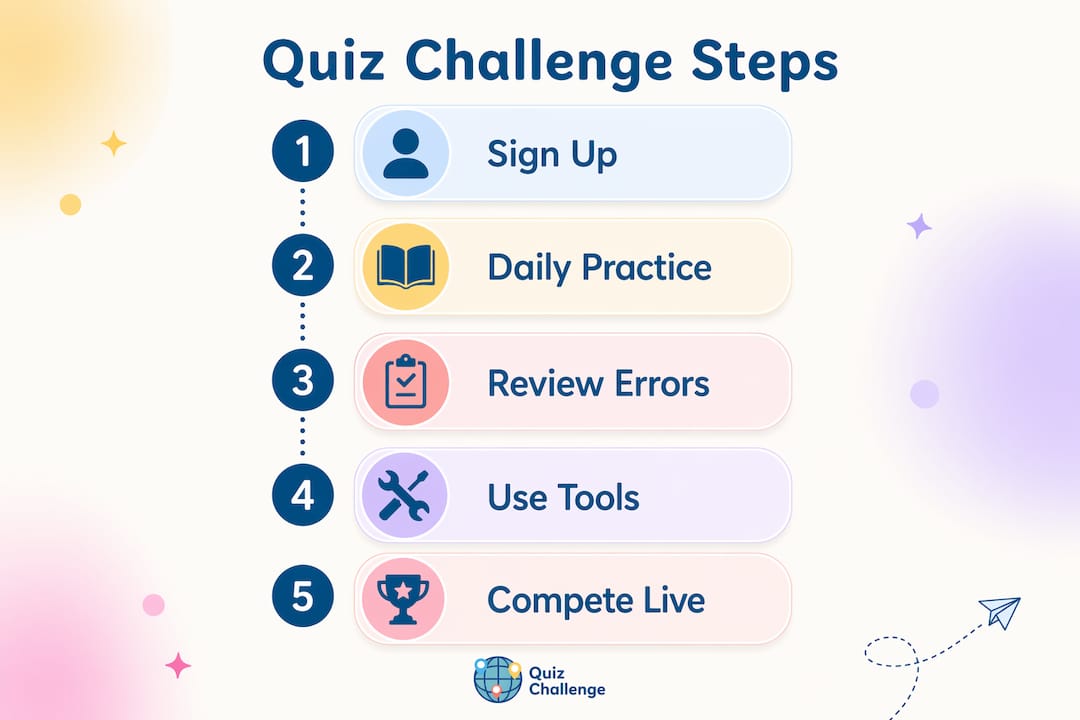
- Register or log in. Many daily quizzes don’t require an account, but creating one lets you track streaks and scores. If a platform offers a free account, use it.
- Read the rules before the timer starts. Check the question count, time limit, and whether you can go back to previous questions. Some quizzes lock your answer the moment you click.
- Allocate time per question. For a 10-question quiz with a 10-minute limit, that’s 60 seconds per question. Don’t spend 3 minutes on question 2 and rush through the last five.
- Use the process of elimination. On multiple-choice questions, cross out the two answers that are clearly wrong first. Your odds jump from 25% to 50% on a guess.
- Submit and review. If the platform shows correct answers after submission, read every explanation, not just the ones you got wrong. Context sticks better than isolated facts.
- Set a weekly improvement goal. Aiming for one more correct answer per week is specific enough to track and realistic enough to hit.
Here’s how different participation strategies compare in practice:
| Strategy | Best for | Risk | Payoff |
|---|---|---|---|
| Speed-first (answer fast, don’t overthink) | Short casual quizzes | Careless errors on easy questions | High score on familiar topics |
| Elimination-first (rule out wrong answers) | Mixed-topic quizzes | Slightly slower pace | Better accuracy on unfamiliar topics |
| Timed allocation (set seconds per question) | Competitive formats | Rigid, less flexible | Consistent, avoids time-outs |
| Review-focused (study feedback after each round) | Long-term improvement | Slower short-term gains | Steady score growth over weeks |
For serious online quiz tournaments, preparation shifts. Live buzzer rounds require oral recall and buzzer speed, not just reading comprehension. That’s a different skill set entirely. If you’re aiming beyond casual daily play, practice saying answers out loud under a timer.
One more thing worth knowing: large-scale competitions use automated eligibility checks that disqualify participants who don’t verify age or residency early. If you ever plan to join a national or global event, confirm your eligibility before the deadline, not the night before.
You can also study common quiz night topics to get ahead of the categories that appear most often across daily and tournament formats.
What common mistakes hurt your score, and how do you fix them?
The biggest score killers in daily trivia aren’t hard questions. They’re avoidable habits.
Common mistakes to watch for:
- Rushing past the question stem. Players often read only the last few words of a question and pick the wrong answer. Read the full question every time.
- Overthinking familiar topics. Your first instinct on a topic you know is usually right. Second-guessing yourself on geography or history questions you’ve seen before costs points.
- Skipping the review phase. Submitting and closing the tab immediately means you lose the learning moment. The feedback screen is where improvement actually happens.
- Playing when tired or distracted. Quiz fatigue is real. A tired brain retrieves information more slowly and makes more impulsive choices.
- Ignoring weak categories. If you always skip geography questions mentally, your score in that category never moves.
Daily trivia sharpens memory and problem-solving skills when done consistently. The key word is consistently. Playing three times a week beats playing seven times in one weekend and then stopping for two weeks.
Motivation dips are normal. The fix isn’t willpower. It’s lowering the barrier. A 10-question quiz takes less time than a coffee break. Framing it that way makes it easier to show up on the days you don’t feel like it.
Pro Tip: Set a two-minute timer before you start each quiz and use it to take three slow breaths and mentally list five geography facts you know. This primes your recall and reduces the mental freeze that hits on the first question.
The science behind daily quiz habits shows that regular participation builds cognitive flexibility over time, not just trivia knowledge. You’re training a skill, not just collecting facts.
Key takeaways
Competing in daily online quiz challenges improves your score and geography knowledge when you combine consistent practice, strategic time management, and deliberate review of your mistakes.
| Point | Details |
|---|---|
| Know your format | Daily quizzes have 10 questions and free access; tournaments run for months with eligibility checks. |
| Prepare your setup | Stable internet, a distraction-free space, and a note-taking habit are the three non-negotiables. |
| Use elimination first | Ruling out two wrong answers before guessing doubles your odds on unfamiliar questions. |
| Review every session | Reading feedback after each quiz, including correct answers, is where real improvement happens. |
| Practice consistently | Daily engagement reveals question patterns and builds recall speed within weeks. |
Worldlecity: a daily geography quiz worth competing in
Geography quizzes are some of the most satisfying to get right. Worldlecity turns that into a daily ritual worth showing up for.
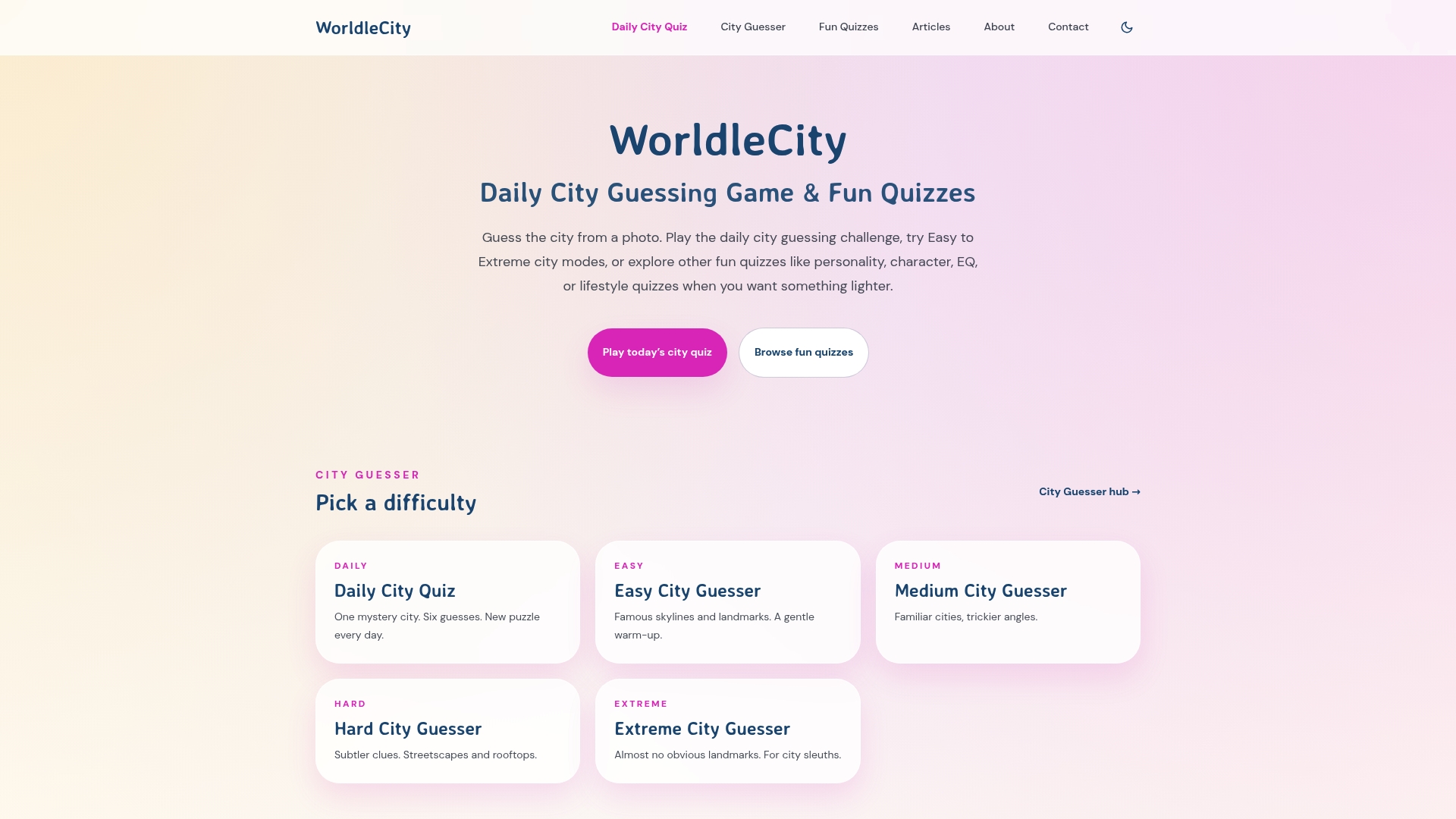
Each day, Worldlecity gives you a photograph of a mystery city and six attempts to identify it. Every guess tells you how close you are and which direction to adjust. It’s the kind of immediate feedback loop that makes learning geography feel less like studying and more like solving a puzzle. If you want the multiple-choice format this guide covers, the geography quiz library adds four difficulty modes so you can play at your own pace or push yourself harder when you’re ready. No account required. No paywall. Just a sharp daily challenge that gets your brain working from the first guess.
FAQ
How many questions are in a typical daily online quiz?
Most daily trivia quizzes include 10 multiple-choice questions and are free to play. They typically take under 10 minutes to complete.
How do daily quizzes differ from online quiz tournaments?
Daily quizzes are casual, 10-question formats with no registration needed. Online quiz tournaments involve multi-stage formats with screening rounds and live finals that can span 2–4 months.
How do I improve my geography quiz score quickly?
Log every geography question you miss, review those topics the next morning, and play consistently. Recognizing recurring patterns in question logic is the fastest path to a higher score.
Do I need to create an account to participate in quiz games?
Many platforms let you play without registering. Creating a free account is worth it if the platform tracks your score history and topic performance over time.
What should I do if I want to join a competitive quiz tournament?
Verify your eligibility early. Large competitions use automated eligibility systems that disqualify participants who miss age or residency requirements, and deadlines are strict.