60–90 Second Bridge Check to Identify Cities for City Guessing Players
Use a 60–90-second Bridge types checklist and a three-point routine to identify cities fast. Practice drills and WorldleCity exercises sharpen timing and skill.
- bridge type identification
- city guessing visual clues
- bridge architecture by region
- geolocation clue reading
- famous bridge landmarks
- WorldleCity photo challenge practice
On this page
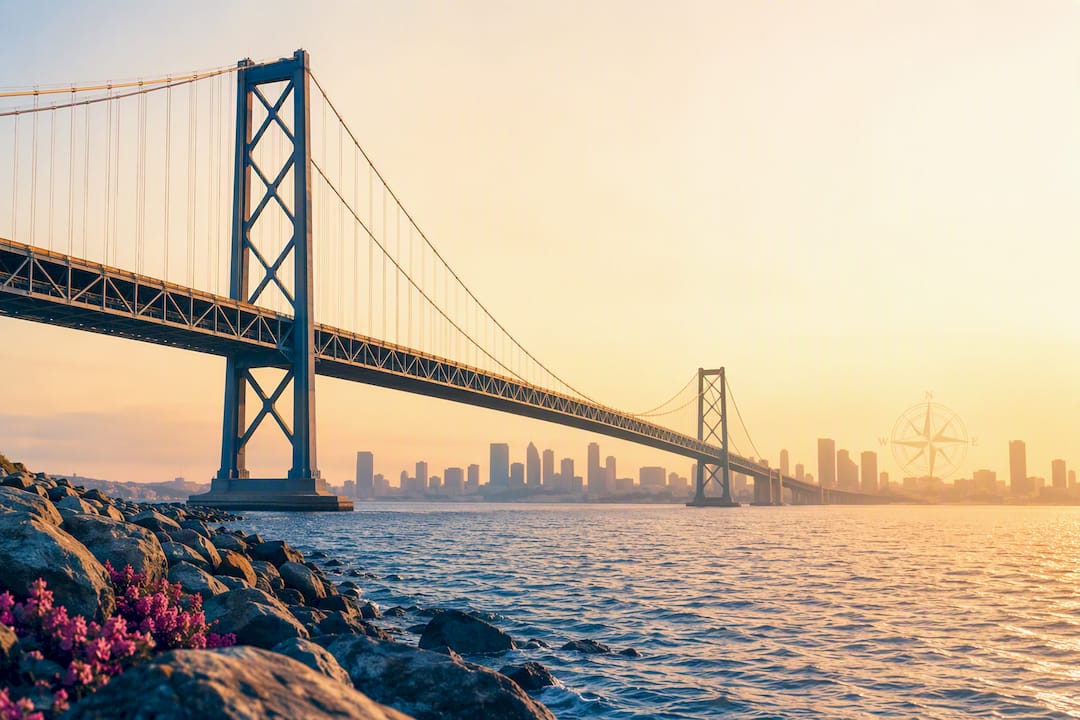
Classify the bridge type first. That single move cuts your candidate list of cities dramatically, since suspension, cable-stayed, arch, and truss bridges cluster in different regions for structural and historical reasons. Lock nothing in yet, though. Confirm with two more clue categories, like a skyline landmark and a street sign or plate, before you commit to a guess. Two matching clues beyond the bridge type means high confidence. One clue means keep guessing.
TL;DR:
- Bridge type helps narrow candidate regions, but secondary clues like signage and skyline landmarks are necessary to confirm the city.
- Recognizable structures such as iconic bridges or distinctive silhouettes can speed up identification significantly once memorized.
- Regional clues from vehicle plates, road markings, or architecture are often more reliable than generic design features for pinpointing exact locations.
- Use of satellite maps and Street View expedites verification, making the final city identification possible within two minutes.
- Practicing systematic analysis through daily quizzes improves instinctive pattern recognition for quick, accurate geolocation.
How to identify a city based on bridge type: the checklist
Every bridge type gives off a different visual signature, and once you’ve seen a few hundred photos, you start clocking them the way you’d clock a friend’s walk from across a parking lot. Here’s the fast version, the one you actually use mid-round when the clock is ticking.
- Suspension: long, sweeping span with two tall towers and vertical suspender cables dropping straight down like a curtain. Common at wide harbor mouths and major strait crossings. Think big water, big towers.
- Cable-stayed: cables run in a fan or harp pattern straight from the tower to the deck, no big looping main cable. This is the look of choice for newer river crossings in cities built or rebuilt over the last few decades. If the bridge looks like it belongs in a skyline render, it’s probably cable-stayed.
- Arch: a curved structural arch, either below the roadway or rising above it, carrying the load. Arches show up a lot in older European river cities and in inland spots where the terrain called for a stone or steel curve instead of towers.
- Truss: a visible lattice of triangles, usually steel, running along the sides. Truss bridges skew industrial and older, and they’re everywhere along working rivers in the US Midwest and Rust Belt.
- Cantilever and draw or covered bridges: mechanical lifting sections, swing spans, or fully enclosed wooden structures. These are rarer, but when you spot one, it narrows your guess hard, since these designs cluster in specific regions and eras.
Run this as a 15 to 30-second scan: shape of the main support, cable or truss pattern, deck height over the water, then move on to your other clues.
Secondary clues that rule out lookalikes
Bridges lie. Not on purpose, but plenty of cable-stayed river crossings look nearly identical whether they’re in Rotterdam or Guangzhou, so you need backup evidence before you lock a guess.
- Signage and script: alphabet, diacritics, sign shapes, and color coding are the strongest single clue you’ll find for narrowing a country. A Cyrillic sign kills half your guesses instantly.
- License plates and vehicles: plate color, shape, and the mix of cars or taxis on the road (boxy sedans vs. compact hatchbacks, yellow cabs vs. black cars) all carry regional fingerprints.
- Road markings and driving side: which side cars drive on, plus lane paint style, tells you a lot before you even read a sign.
- Architecture and facades: roof pitch, balcony railings, window shutters. This is less about the bridge and more about what’s on either side of it.
- Infrastructure details: lamp post design, bollards, curb style, and utility poles are boring until you realize they’re basically a city’s fingerprint.
- Vegetation and terrain: palm trees vs. bare deciduous trees, flat coastline vs. mountain silhouette in the background.
Academic research on geo-informative visual elements backs this up directly: features like window grilles, balcony railings, and street signage concentrate by city and often carry more identifying power than a famous landmark does. A landmark tells you the country. A window railing might tell you the exact neighborhood.
Pro Tip: Separate what you’re actually seeing from what you’re assuming. A readable plate or sign is evidence. “This looks European” is a hunch. Weight the evidence higher.
The three-point check: your repeatable guessing routine
Under a timer, guessing is messy unless you give yourself a routine. This one takes maybe 60 to 90 seconds and works on almost any bridge photo.
- Classify the bridge and name 2 to 3 candidate regions. Suspension bridge with a wide harbor behind it? Think major coastal port cities. Truss bridge over a narrow brown river? Think older industrial river towns.
- Find a fixed landmark or skyline silhouette. Look for a distinct tower, hill shape, or unusual rooftop in the background that matches one of your candidates. This is your second anchor point.
- Verify with street-level detail. Check signage, plates, road markings, or vegetation against your leading candidate. If two of your three anchor points- bridge type, skyline, and street-level detail- line up on the same city, that’s a high-confidence guess.
If only one anchor point matches, don’t lock it in. Widen back out and look for a fourth clue before you commit. Practical geolocation guessing works with this kind of systematic clue cataloging, treating road markings, signage, and structural details as primary evidence rather than as an afterthought after the “vibe” of a photo.
Verifying fast with maps, Street View, and reverse image search
Once you’ve got a candidate city, verification should take under two minutes, not twenty.
- If the bridge looks genuinely famous, try a reverse image search or a landmark identifier first. Recognizable structures often turn up an exact match instantly.
- If it’s more generic, jump to satellite or 3D map view and try to match the skyline orientation and the angle of the river or coastline against your candidate.
- Use Street View to check facades, sign fonts, and lamp post style against street level. Line up the same building shapes and distances you see in the photo, and the match either clicks or it doesn’t.
- For candidates in Russia or parts of Eastern Europe, Yandex Maps often has better street-level coverage than Western alternatives. For some coastal regions, Bing Maps fills in gaps too.
This mirrors what most applied geolocation guides recommend: start broad, gather your highest-value visual clues, then verify with satellite and Street View before you finalize anything. Sometimes a single storefront sign matched in Street View is enough to pin down not just the city but the exact block, which is as close to a smoking gun as this hobby gets.
Practice drills to build the skill
Reading a bridge photo fast is a trained skill, not a talent you’re born with. These three drills build it in short bursts.
- Drill 1, type ID (30 seconds): pull up 10 bridge photos and classify structural type only. No guessing the city yet.
- Drill 2, two-clue verification: classify the type, then find exactly one skyline clue and one street-level clue before naming a city.
- Drill 3, timed full check: run the entire three-point workflow in under two minutes on a fresh photo.
WorldleCity’s daily photo challenge and its city guesser quizzes are built for exactly this kind of repetition. If you want a deeper dive into reading skylines specifically, our guide to identifying European cities from skyline photos pairs well with the bridge drills above.
Why certain bridges became city icons
Some bridges got famous because they solved a genuinely hard engineering problem, and the city built its identity around that solution. The Golden Gate Bridge wasn’t just a suspension bridge, it was a bet that a mile-wide, fog-choked strait with brutal currents could be spanned at all, and San Francisco turned the finished structure into its visual shorthand almost overnight.
Tower Bridge in London did something similar but for a different reason: London needed a crossing that wouldn’t block tall-masted ship traffic into the busy Pool of London, so engineers built a bascule bridge, one with lifting sections, and wrapped it in Victorian Gothic towers to match the nearby Tower of London. The mechanism became the landmark.
Sydney Harbour Bridge tells a third kind of story. It’s a steel through-arch built to connect a harbor city that had outgrown its ferries, and its stocky gray arch is now inseparable from the Opera House sail curves next to it in nearly every skyline shot of Sydney. In each case, the bridge type wasn’t decorative. It was a direct answer to the geography the city was stuck with, which is exactly why it still works as an identification clue today.
Famous bridges with unmistakable architectural tells
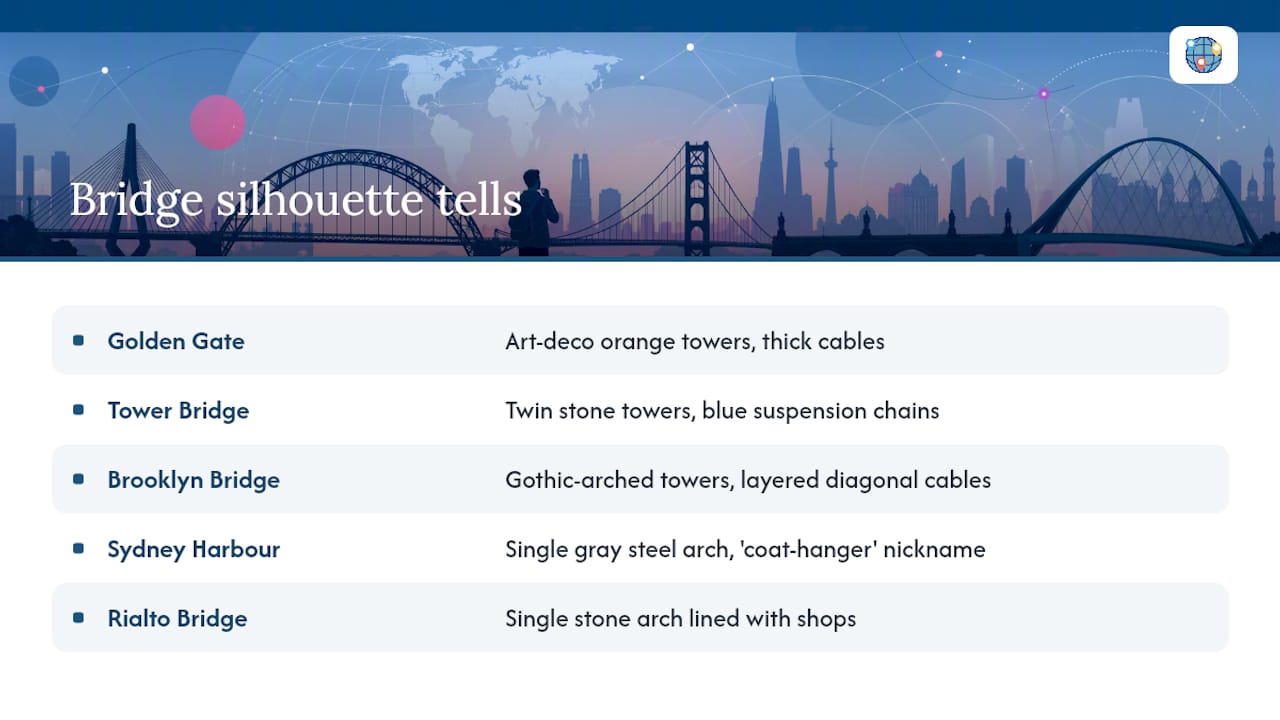
A handful of bridges are basically cheat codes if you’ve memorized their silhouette. The Golden Gate’s art deco orange towers and thick main cables are unmistakable even in bad lighting. Tower Bridge’s twin stone towers with the blue suspension chains between them look like nothing else on Earth, and the bascule lift in the middle is a dead giveaway if you catch it mid-motion.
The Brooklyn Bridge mixes Gothic-arched stone towers with a web of diagonal cables layered over vertical suspenders, a hybrid look that separates it instantly from a pure suspension design. Sydney Harbour Bridge’s single gray steel arch reads as heavier and more industrial than most arch bridges, almost like a stretched-out coat hanger, which is actually its local nickname.
Then there’s the Rialto Bridge in Venice, a single stone arch lined with shops along its span, a design so specific to its canal-city context that it barely resembles a bridge at all in photos, more like a covered market that happens to cross water. Pre-memorizing five or six of these silhouettes speeds up your region guessing more than almost any other single habit, since you’re matching shape instantly instead of reasoning it out.
What construction materials and design trends reveal
Material choice is a time stamp as much as a location clue. Stone and masonry arches point toward older European river cities, or older colonial-era construction anywhere European engineering firms built infrastructure. Riveted steel truss bridges, with their visible bolted joints, tend to date from the late 1800s through the mid 1900s and cluster along older industrial rivers in the US and parts of Europe.
Cable-stayed bridges, by contrast, are a newer trend almost everywhere. The design became popular starting in the 1950s and exploded from the 1990s onward because it’s cheaper to build over long spans than a full suspension bridge and looks sleeker for a modern skyline. If you see a cable-stayed bridge with a stark white or brightly lit tower next to glass skyscrapers, you’re very likely looking at a newer Asian, Middle Eastern, or Gulf-region city that built or rebuilt its waterfront in the last 30 years.
Concrete box girder bridges, plain and unglamorous, are the default workhorse almost everywhere, so they tell you the least. When you see one, don’t treat it as a clue at all; just shift your attention to what’s around it instead of trying to force meaning out of a genuinely global design.
Reading the water and terrain around the bridge
The geography a bridge sits in narrows your guess almost as much as the bridge itself. Wide, calm harbor mouths with suspension bridges tend to mean a major port city, since that combination of terrain and structural demand only happens where deep water needs a serious crossing. Narrow, muddy, or fast-moving rivers with truss or arch bridges usually mean an inland industrial or historic river town instead.
Coastline orientation matters too. If the water stretches out flat to the horizon behind the bridge, you’re likely looking at an open sea or major bay, not a river. If hills or mountains rise sharply just past the far bank, that’s a strong hint you’re in a city built into a valley or fjord; think coastal cities in Norway, Japan, or parts of South America where flat land was never an option.
Even water color and clarity carries information. Muddy brown rivers often mean heavy inland sediment from farmland or industry upstream. Turquoise or deep blue water usually signals a coastal or tropical setting. None of this replaces the bridge-type check, but stacked together with terrain, it’s often enough to knock your candidate list down to two or three cities before you’ve even glanced at a street sign.
When festivals and local events give the bridge away
Some bridges only reveal themselves when there’s a crowd on them, or lights strung across them for a reason a local would recognize instantly. Sydney Harbour Bridge lit up with fireworks reflections is a dead giveaway for New Year’s Eve coverage. The Golden Gate’s occasional lighting displays tied to anniversaries or civic events are another tell if you catch the timing right.
River festivals are a strong signal too. Photos showing decorated boats, lantern displays, or crowded riverbanks near a bridge often point to a specific cultural calendar date, which can narrow your guess by season and region at once. A bridge draped in flags or banners for a national holiday, or lined with vendors for a known local market day, tells you something a bare structural photo never could.
This kind of clue won’t show up in every round, but when it does, treat it the same way you’d treat a readable sign: as hard evidence, not atmosphere. A crowd, a light display, or a seasonal decoration is context a bridge type alone can’t give you, and it’s often the fastest way to jump from “somewhere on this coastline” to a single named city.
Practice bridge ID and track your streak with WorldleCity
Reading about bridge types only gets you so far. The actual skill builds from reps, seeing enough real photos that your brain starts pattern-matching cable-stay towers and truss webs on instinct instead of conscious effort.
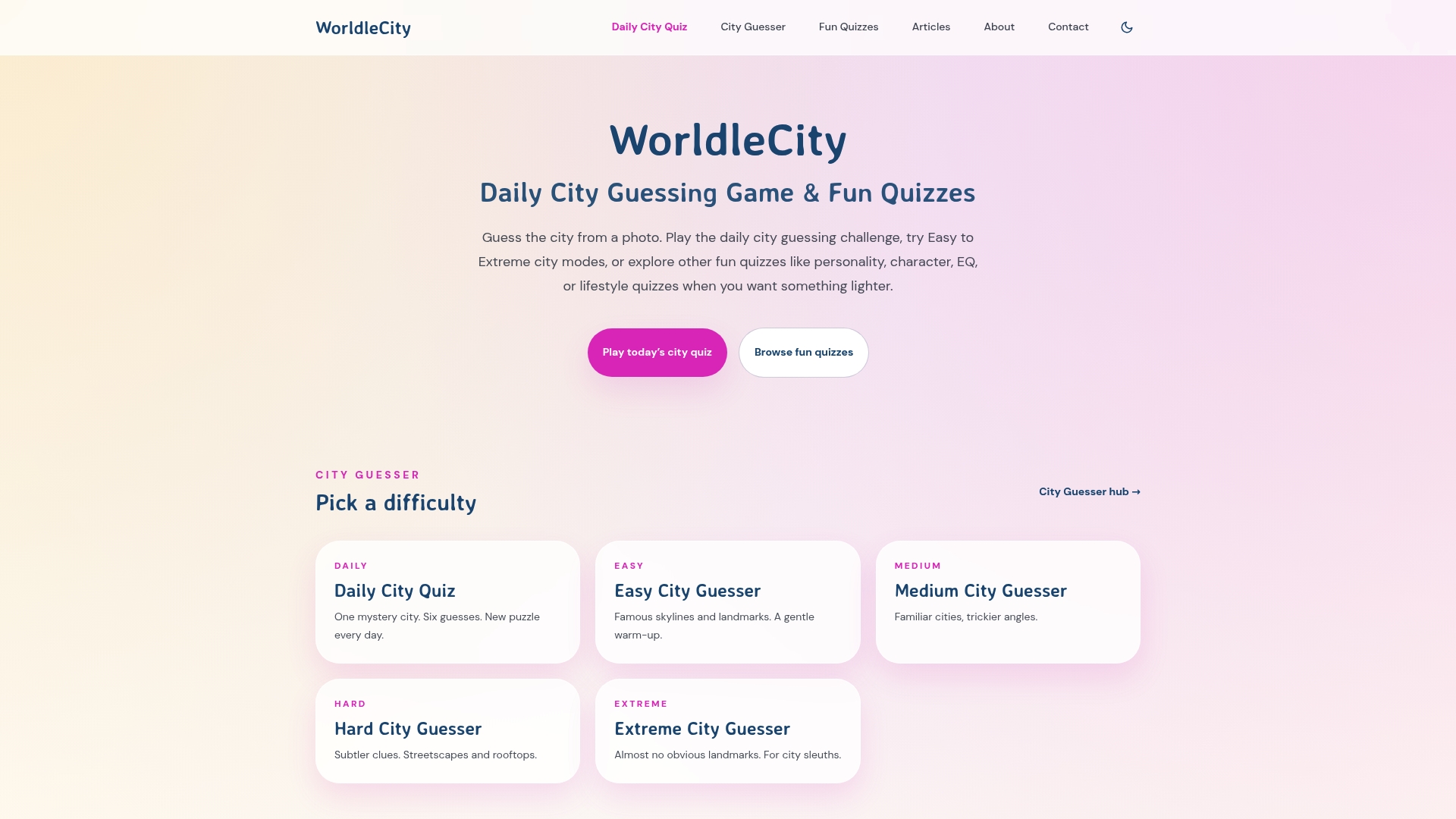
WorldleCity’s daily photo challenge drops you into a real mystery city photo and gives you six guesses with proximity and direction feedback after each one. That feedback loop is exactly what turns “I think that’s cable-stayed” into “that’s definitely cable-stayed, and the skyline behind it means Rotterdam, not Guangzhou.” Prefer to set your own pace? The city guesser quizzes stack four difficulty modes so you can practice bridge and skyline reading without a clock breathing down your neck, and none of it requires creating an account. Head to WorldleCity and run today’s photo through the three-point check you just learned.
Sources
- What makes Paris, Paris? — study on geo-informative visual elements (Inria/Doersch et al.)
- GeoGuessr image location clues (ReverseImageLocation blog)
FAQ
Can I identify a city from the bridge type alone?
Rarely with full confidence. Bridge type narrows your candidate regions fast, but you need at least one or two secondary clues, like signage, architecture, or a skyline landmark, before locking a guess.
What’s the single most reliable secondary clue?
Readable signage and script tend to be the strongest single clue, since alphabet and sign style narrow a country almost instantly, more reliably than architecture or vegetation alone.
Should I ignore concrete box girder bridges as clues?
Mostly, yes. Plain concrete girder bridges are common worldwide and rarely carry regional signal, so shift your attention to the surrounding skyline, signage, and terrain instead.
How fast should I move through the three-point check?
Aim for under two minutes total: a few seconds to classify the bridge type, then roughly a minute split between finding a skyline landmark and confirming a street-level detail.
Where can I practice this skill regularly?
WorldleCity’s daily city guessing game and its four-difficulty city guesser quizzes are built for this exact kind of visual-clue practice, and both are free to play without registering.