Famous Landmarks and Monuments in Indian Cities
Discover iconic landmarks in Indian cities with our quick guide. From the Taj Mahal to the Gateway of India, find out what defines each city!
- Famous landmarks and monuments in various cities in India
- heritage sites in India
- iconic Indian structures
- historic buildings in India
- famous sites in Indian cities
- Indian architectural styles
On this page
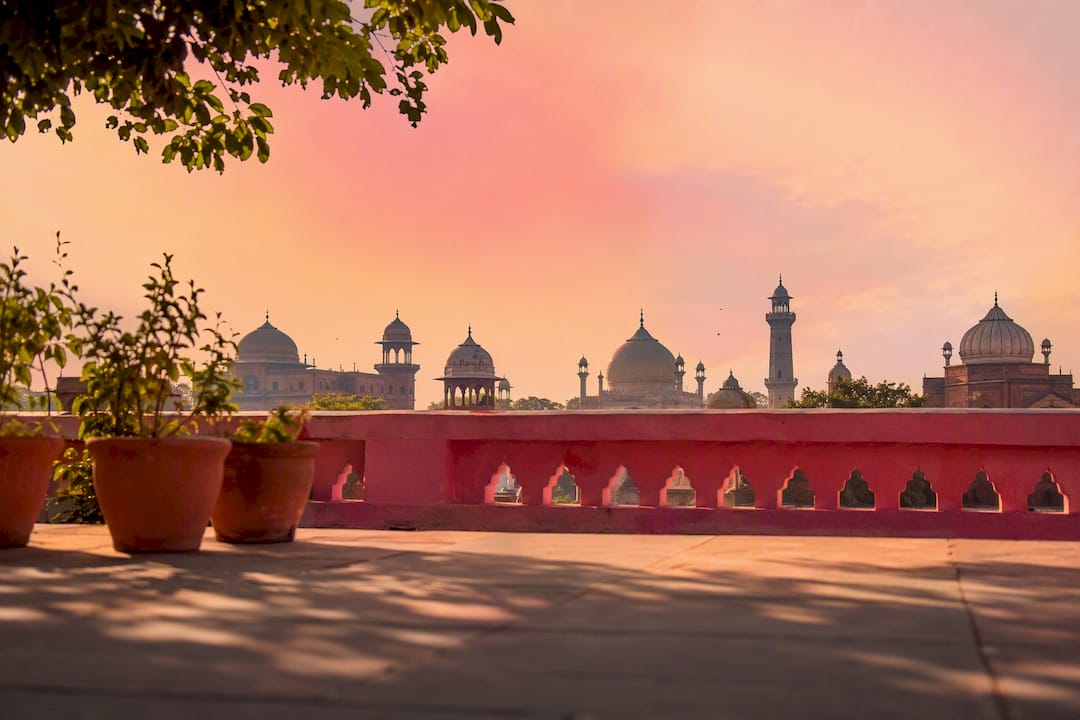
One landmark, one city, zero guesswork: the Taj Mahal means Agra, the Gateway of India means Mumbai, and a Charminar skyline means Hyderabad, full stop. If you’re trying to get quick at spotting famous landmarks and monuments in various cities in India from a single photo, here’s your answer key before we go deep on any of them.
- Delhi — Red Fort or India Gate. Red sandstone walls or a sandstone war memorial arch.
- Agra — Taj Mahal. White marble dome, perfect symmetry.
- Jaipur — Hawa Mahal. Pink honeycomb facade, 953 tiny windows.
- Mumbai — Gateway of India. Basalt arch facing the Arabian Sea.
- Amritsar — Golden Temple. Gold-plated dome floating on a water tank.
- Kolkata — Victoria Memorial. White marble, colonial dome, looks like a mini Taj gone British.
- Hyderabad — Charminar. Four minarets, one square, always crowded below.
- Bengaluru — Vidhana Soudha. Granite, Neo-Dravidian, a dome that means business.
- Chennai — Kapaleeshwarar Temple gopuram. Riotously painted, stacked like a sculpted wedding cake.
- Ahmedabad — Adalaj Stepwell or Sabarmati Ashram. Carved stone descending underground, or quiet whitewashed simplicity.
Keep that list handy. Now let’s break down why each one looks the way it does, and how you use those clues in the wild — or in a landmark identification quiz.
Key Takeaways
Recognizing famous landmarks and monuments in various cities in India comes down to reading material, silhouette, and setting together, not memorizing names alone.
| Point | Details |
|---|---|
| Match material to era | White marble signals Mughal or colonial; red sandstone signals Mughal forts; granite signals southern Dravidian sites. |
| Read the silhouette | Domes and minarets mean Mughal or Indo-Saracenic; curved towers mean Nagara; tall carved spires mean Dravidian. |
| Use the setting as a tiebreaker | Sea views point to Mumbai or Chennai; flat inland terrain with a lone spire usually points to a temple town. |
| Time your shot around light | Sunrise favors white marble and red sandstone; late afternoon favors coastal arches like the Gateway of India. |
| Practice the pattern, not the list | Applying material, shape, and setting rules works across new photos better than memorizing a fixed city list. |
Famous landmarks and monuments in Delhi, Agra, and Jaipur (the Golden Triangle)
This trio gets called the Golden Triangle for a reason — it’s the fastest way to see 800 years of Indian architecture in one trip. Three cities, three empires’ worth of flex.
Delhi carries the weight of multiple dynasties. The Red Fort Complex is a UNESCO World Heritage Site, and UNESCO describes it as a fusion of Islamic, Persian, Timurid and Hindu traditions at the zenith of Mughal creativity — its red sandstone ramparts and garden layout shaped how later builders across northern India thought about palace design. Nearby, the Qutub Minar is a 73-meter fluted sandstone tower from the Delhi Sultanate era, older and more austere than anything Mughal. Humayun’s Tomb predates the Taj by roughly sixty years and basically previews it: a domed mausoleum sitting inside a symmetrical charbagh garden. Then there’s India Gate in New Delhi, a 42-meter sandstone arch built as a colonial-era war memorial, standing alone on a ceremonial boulevard with nothing crowding its silhouette.
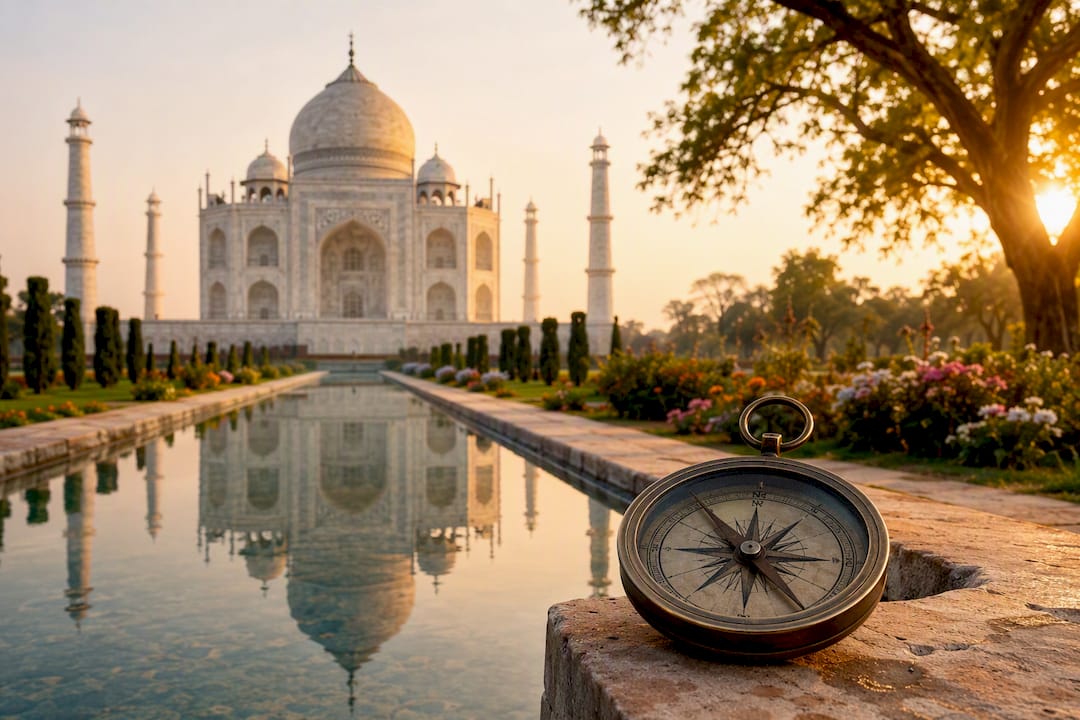
Agra has one job and it does it perfectly. The Taj Mahal is a white-marble mausoleum built between 1631 and 1648, and UNESCO calls it a masterpiece of Indo-Islamic architecture. What makes it instantly recognizable isn’t just the marble — it’s the bulbous central dome, the four flanking minarets tilted slightly outward, and the mirror-image reflecting pool out front. Nothing else in India matches that specific silhouette. Nearby Fatehpur Sikri, a red sandstone ghost city built by Akbar and abandoned within decades, offers a rougher, more fortress-like Mughal look if you want contrast.
Jaipur, the Pink City, swaps marble for sandstone painted terracotta pink. Hawa Mahal is a five-story honeycomb facade with 953 small windows, built so royal women could watch street life unseen. It reads almost two-dimensional in photos, like a stage backdrop. A few miles out, Amber Fort climbs a hillside in pale yellow and pink sandstone with Rajput-Mughal detailing, all ramparts and courtyards stacked against a ridge.
Pro Tip: Shoot the Taj Mahal at sunrise. The crowds are thinner, the light turns the marble soft pink-gold, and you get that mirror reflection in the pool before the wind picks up and ripples it.
A quick architectural cheat sheet for this cluster:
- Mughal (Taj, Red Fort, Humayun’s Tomb): domes, symmetry, red sandstone or white marble, garden layouts.
- Sultanate-era (Qutub Minar): plainer stone, verticality, minimal ornamentation.
- Rajput (Amber Fort, Hawa Mahal): hillside forts, pink/yellow sandstone, jali (lattice) screens.
- Colonial/national (India Gate): freestanding arches, ceremonial axes, no surrounding clutter.
Mumbai and Maharashtra’s landmarks: Gateway of India, Elephanta, and the cave temples
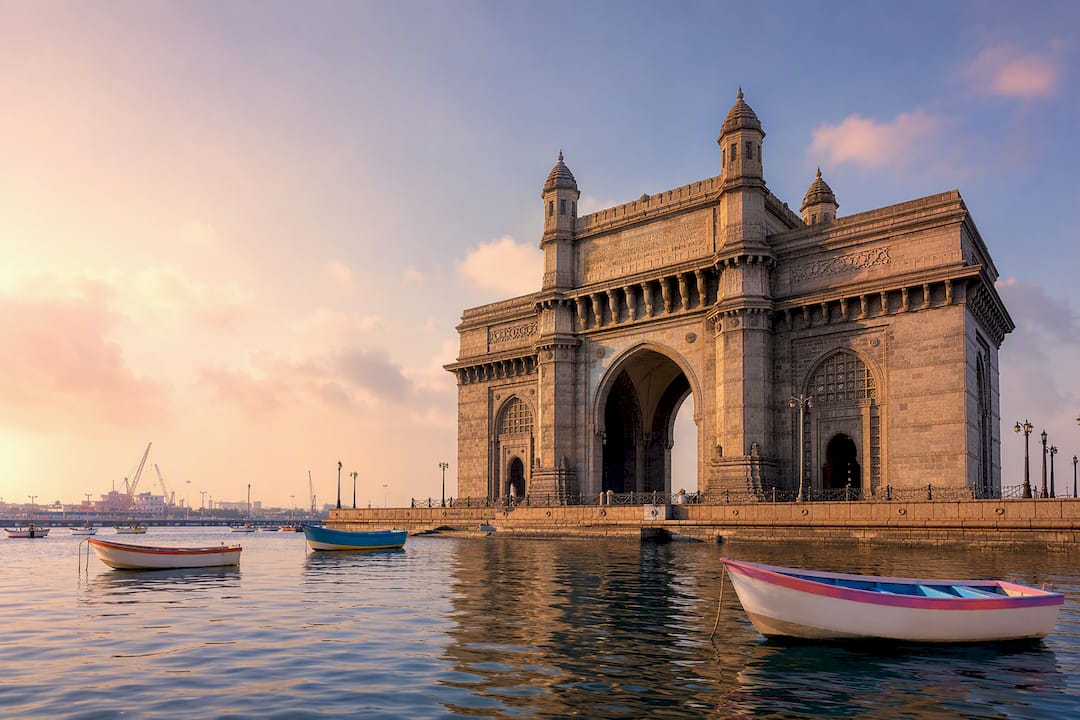
Mumbai’s skyline announces itself with water. The Gateway of India is a basalt arch built in 1924, mixing Indo-Saracenic detailing with colonial proportions, and it sits right on the harbor facing the Arabian Sea. That combination — stone arch plus open water plus boats in the foreground — is basically Mumbai’s visual signature. Right across from it stands the Taj Palace Hotel, a domed Edwardian pile that anchors half the city’s postcard shots even though it’s not a monument in the historical sense.
A short ferry ride out, the Elephanta Caves hold rock-cut sculptures of Shiva carved straight into basalt cliffs on an island in Mumbai harbor. No domes, no minarets, just carved cave mouths and stone pillars that look ancient because they are.
Head inland to Aurangabad and you hit Ajanta and Ellora, inscribed by UNESCO as two separate World Heritage Sites in 1983 and together the most significant rock-cut complexes in the country. Ajanta’s caves hold painted Buddhist murals inside horseshoe-shaped entrances. Ellora goes bigger: the Kailasha temple there is carved from a single mountain of rock, top to bottom, a monolithic structure that looks built rather than carved until you realize nothing was ever assembled.
- Gateway of India: basalt arch, sea-facing, boats and Taj hotel dome in frame.
- Elephanta Caves: bare rock, cave mouths, sculpted pillars, no paint.
- Ajanta: painted interiors, curved cave entrances cut into a cliff face.
- Ellora (Kailasha): one monolithic temple carved downward into a hillside.
Pro Tip: Photograph the Gateway of India from the hotel side of the plaza. It separates the arch from the densest crowds and gives you a cleaner sightline to the sea behind it.
Kolkata, Hyderabad, Bengaluru, Chennai, and Ahmedabad: what makes each skyline distinct
These five cities rarely get grouped together, but each one has a landmark so specific it works as a single-frame answer key.
Kolkata’s Victoria Memorial is a white marble monument built under British rule, and it looks almost like a European interpretation of Mughal domes: a central dome flanked by smaller cupolas, set in formal gardens. Add a Howrah Bridge silhouette or the Hooghly River waterfront in the background and there’s no mistaking the city.
Hyderabad reads instantly through its minarets. Charminar has exactly four, one on each corner of a square monument built in 1591, and the streets around it are always dense with market stalls and traffic, which is its own visual tell. A few miles away, Golconda Fort sprawls across a granite hill with massive fortification walls, more sprawling ruin than single structure.
Bengaluru doesn’t have one dominant ancient monument, which is itself a clue. Its signature is Vidhana Soudha, a granite legislative building in Neo Dravidian style with a heavy stepped dome, plus Bangalore Palace, a Tudor-style mansion that looks oddly transplanted from the English countryside.
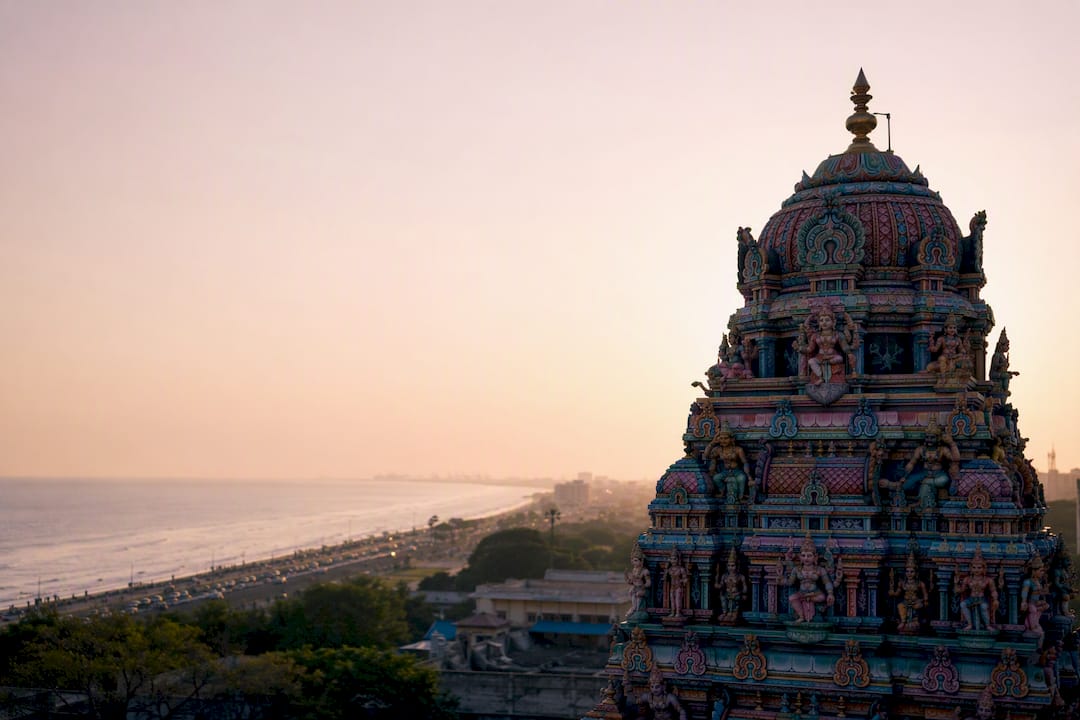
Chennai’s identity runs through temple gopurams — the tall, densely sculpted gateway towers seen at Kapaleeshwarar Temple. They’re painted in bright, almost cartoonish colors, stacked with hundreds of carved figures, and unmistakably Dravidian. The Marina promenade along the Bay of Bengal adds a coastal cue if the gopuram alone doesn’t seal it.
Ahmedabad hides its best monument underground, just outside the city. Adalaj Stepwell descends in carved stone tiers, cool and shadowed even at noon, an engineering feat as much as an artwork. Contrast that with the plain whitewashed simplicity of Sabarmati Ashram, Gandhi’s former home, which looks nothing like a “monument” at all and that’s exactly the point.
Quick recognition triggers:
- Charminar: four minarets, one square, market noise implied.
- Vidhana Soudha: granite, stepped dome, government-building weight.
- Kapaleeshwarar gopuram: painted, sculpted, stacked like a tiered cake.
- Victoria Memorial: white marble, central dome, colonial garden setting.
- Adalaj Stepwell: carved stone descending below ground level, no dome in sight.
Pro Tip: If a photo shows a painted, sculpture-covered tower, it’s almost always Tamil Nadu. If it’s plain carved stone underground, think Gujarat’s stepwells.
South and central India: Hampi, Mysore, Khajuraho, and Konark
South and central India swap Mughal domes for something entirely different: soaring, sculpture-packed towers built to be seen from a distance across flat terrain.
Hampi’s Vittala Temple has the single most photographed detail in South Indian architecture: a stone chariot carved so precisely its wheels look like they could turn. Thanjavur’s Brihadishvara Temple, Britannica notes, is a textbook Chola-era Dravidian structure with a central vimana (tower) rising roughly 60 meters, built from massive granite blocks. The 80-ton octagonal cupola sitting on top of that tower is a genuine engineering puzzle. Britannica notes that by legend it was hauled into place along a gently sloping ramp some 4 miles (6 km) long, since no crane of the era could have lifted it that high.
Madurai’s Meenakshi Temple takes the gopuram concept to its extreme: multiple towering gateway spires, each covered in thousands of painted sculpted figures, visible above the city from almost any direction. Khajuraho, in Madhya Pradesh, flips the style entirely — Nagara architecture here means curvilinear shikhara towers with intricate stone carving, a completely different silhouette from the straight-edged Dravidian vimana. Konark’s Sun Temple in Odisha was designed as a giant stone chariot with carved wheels pulling toward the sun, one of the strangest and most literal architectural metaphors in the country. And Mysore Palace rounds out the region with Indo-Saracenic domes, arches, and colored glasswork built for the Wadiyar royal family.
- Dravidian (Hampi, Thanjavur, Madurai): tall vimana or gopuram, dense carving, flat surrounding terrain.
- Nagara (Khajuraho): curvilinear shikhara, rounded silhouette, less blocky than Dravidian towers.
- Konark: literal chariot form, carved wheels, coastal Odisha setting.
Pro Tip: A tall, densely sculpted spire rising over flat land is almost always a signal for South India. Rounded, curved towers point toward central India instead. Architectural Digest’s rundown of India’s historic buildings is a solid reference if you want to compare these silhouettes side by side.
How do you guess an Indian city from a photo?
This is basically the whole game, so here’s the actual checklist. Every skyline or landmark photo gives you at least three usable clues: material, shape, and setting.
Material first. White marble usually means Mughal (Taj, Humayun’s Tomb) or colonial (Victoria Memorial). Red sandstone means Mughal fort architecture (Red Fort, Fatehpur Sikri). Granite, often unpainted, points south (Brihadishvara, Vidhana Soudha). Painted stone almost always means Tamil Nadu gopurams.
Shape second. Domes and minarets say Mughal or Indo-Saracenic. Curvilinear towers say Nagara (Khajuraho). Tall, straight-edged, densely carved towers say Dravidian (Madurai, Thanjavur, Hampi). A plain arch standing alone says colonial memorial (Gateway of India, India Gate).
Setting third. Water in the frame narrows things fast — sea means Mumbai or Chennai, a river or lake means Kolkata or Udaipur-adjacent cities. Flat inland terrain with a lone spire usually means a temple town. Dense market activity around the base of a monument is a strong Hyderabad or old-Delhi tell.
Architecture writers sometimes describe this as a city’s period of power showing up in its DNA — Mughal centers built inward-facing fortress compounds, while colonial port cities built outward-facing civic facades meant to be seen from the water. That distinction alone solves a surprising number of guesses.
- Ignore foreground crowds and traffic; they’re the least reliable clue.
- Do look for skyline anchors: a single dome, a cluster of spires, an arch against open water.
- Do check material and color before shape; it narrows the era faster.
- Don’t assume “big and old” automatically means Delhi. Hampi and Thanjavur are just as ancient.
If you want to stress-test that instinct, WorldleCity’s visual clues in quizzes breakdown covers the same logic applied across dozens of cities worldwide, and the same rules carry over if you’re comparing European skylines too.
Put the material, shape, setting method to work on Worldlecity
Reading a photo for material, silhouette, and setting is exactly what Worldlecity asks of you. Every day you get one photograph of a mystery city and six attempts to name it, with distance and direction feedback after each guess, so a wrong answer still teaches you something. There is no options list to eliminate your way through. You look at the stone, the skyline, and the surroundings, and you commit. No account, no subscription, and a daily round you can finish in under two minutes. Play today at Worldlecity

To those looking for a bit more than a daily dose, Worldlecity offers city guesser library with four difficulty levels, ranging from casual gameplay to genuinely humbling. There is a good proportion of Indian cities scattered in those quizzes. Try Worldlecity and find out whether the cheat sheet at the top of this article actually stuck.
When to visit and how to photograph these landmarks respectfully
Light changes everything at these sites, and so does timing. Sunrise works best for white marble (Taj Mahal, Victoria Memorial) since the low angle warms the stone without blowing out highlights. Morning light also does wonders for red sandstone forts, deepening the color and pulling out carved detail that flattens under harsh midday sun. Coastal arches like the Gateway of India photograph cleanest in late afternoon, when the water catches gold light behind the structure.
Temples need a different approach entirely. Many restrict photography inside inner sanctums, and some ask visitors to remove shoes or cover shoulders before entering. A quick etiquette checklist:
- Check for no-flash or no-photography signs before shooting inside any temple.
- Ask before photographing people at prayer, even in public courtyards.
- Respect roped-off buffer zones at UNESCO sites — they exist to protect the structure, not to block your shot.
- Budget extra time at popular sites; ticketed entry and security lines eat into golden-hour light fast.
Pro Tip: For a genuinely recognizable shot, get one clean foreground anchor (a pillar, a gate, a reflecting pool), keep the full silhouette in frame, and shoot in consistent light. That’s the same formula that makes a landmark instantly guessable in a photo quiz.
More landmarks worth knowing: Mysore Palace, Charminar, and India Gate
A few landmarks deserve a second look because they show up constantly in roundups and quizzes, yet get flattened into one-line mentions elsewhere.
Mysore Palace in Mysuru is the seat of the former Wadiyar royal family, built in Indo-Saracenic style with domes, arches, and stained glass that lights up in fantastic color during the evening illumination, when the entire facade is outlined in bulbs. It’s one of the most-visited palaces in the country and a useful reminder that “royal” architecture in South India often borrows just as much from Islamic and colonial styles as it does from Dravidian temple design.
Charminar in Hyderabad turns 435 years old in 2026, and its four minarets still anchor the old city exactly as they did when built to commemorate the end of a plague outbreak. The structure sits at the intersection of four historic roads, which is part of why the surrounding market district feels so dense in every photo taken from ground level.
India Gate in New Delhi stands apart from religious or royal architecture entirely. It’s a war memorial, built in sandstone and granite, and its power comes from isolation rather than ornamentation — a single arch on an open lawn, with nothing competing for attention. That bare, ceremonial simplicity is its own kind of visual fingerprint, and it’s exactly why it works so well as a quick answer in a city-guessing round.
Sources
For verified detail beyond this guide, these are worth bookmarking:
- Gateway of India — Mumbai City Government
- Red Fort Complex - UNESCO World Heritage Centre
- Brihadishvara Temple | Britannica
- Historic buildings in India — Architectural Digest
FAQ
What are 10 famous landmarks in India?
The Taj Mahal, Red Fort, Qutub Minar, Gateway of India, Hawa Mahal, Amber Fort, Golden Temple, Charminar, India Gate, and Victoria Memorial cover the ten most recognized sites across major Indian cities.
What are seven famous monuments in India?
A tight seven would be the Taj Mahal, Red Fort, Qutub Minar, Golden Temple, Charminar, Mysore Palace, and Konark Sun Temple, each representing a different architectural tradition.
What is India’s most famous landmark?
The Taj Mahal, a white-marble Mughal mausoleum in Agra, holds that title by most measures, recognized by UNESCO as a masterpiece of Indo-Islamic architecture.
What are five famous monuments in India?
The Taj Mahal, Red Fort, Gateway of India, Golden Temple, and Charminar each anchor a different city and architectural style, making them a solid starter set for visual recognition.
How can you tell which Indian city a photo shows?
Check material first (marble, sandstone, or granite), then silhouette (domes versus spires versus arches), then setting (coastal, riverside, or inland), since those three clues together narrow the city faster than any single landmark name.