Dubai, Doha, and Riyadh Lead the Skylines of the Middle East
Explore the stunning skylines of the Middle East as Dubai, Doha, and Riyadh compete for architectural supremacy. Discover their unique styles!
- Skylines of the Middle-east
- Middle East city skylines
- Tallest buildings in Middle East
- Skyscrapers of Middle Eastern cities
- Architectural landmarks in Middle East
- Famous skylines in Dubai
On this page
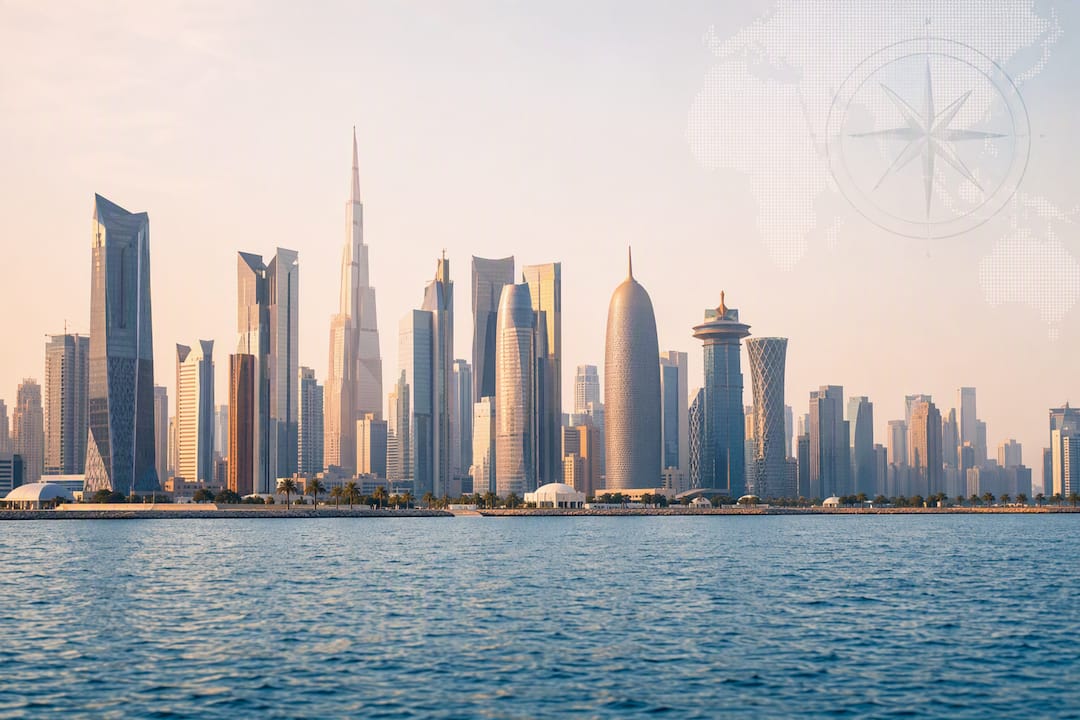
Dubai, Doha, and Riyadh lead Middle Eastern skyline drama, each for a different reason. Dubai wins on supertalls and sheer glass density, Doha wins on compact modern polish, and Riyadh wins on speed, since the city is adding towers faster than almost anywhere else on the planet. Abu Dhabi and Kuwait City round out the region’s top tier, one for its skyline-meets-mangrove setting, the other for a skyline that’s been quietly tall since the 1970s.
That’s the short version. The rest of this guide breaks down:
- Quick stats on skyscraper counts and heights, sourced from real tracking databases
- Eight city profiles built for scanning, not skimming
- Where to actually stand for the best photo
- A side-by-side comparison table for the numbers people
- How these skylines got built, and what’s coming next
Key Takeaways
Dubai, Doha, and Riyadh anchor the Middle East’s most recognizable skylines, each distinguished by a different combination of height, density, and architectural identity rather than a single shared formula.
| Point | Details |
|---|---|
| Dubai leads on supertalls | The Burj Khalifa and a dense cluster of towers along Sheikh Zayed Road drive Dubai’s global skyline rankings. |
| UAE tops regional skyscraper counts | The UAE has a leading number of completed buildings over 150 meters in the Middle East, notably more than Qatar and Saudi Arabia. |
| Doha wins on cohesion | West Bay’s sculptural towers create a compact, visually unified skyline rather than a scattered one. |
| Riyadh is the fastest mover | Vision 2030 megaprojects mean Riyadh’s skyline stats will likely look different within a few years. |
| Photo timing beats gear | Golden hour and blue hour consistently outperform midday light for skyline shots, regardless of camera quality. |
Skylines of the Middle East in the global skyscraper race
The tall-building world isn’t just Manhattan and Shanghai anymore. The Council on Tall Buildings and Urban Habitat has tracked this shift for over a decade: skyscraper construction keeps spreading into new regions, and the Gulf has been one of the biggest beneficiaries of that spread.
The numbers back it up. CTBUH’s own Skyscraper Center country database puts the UAE at roughly 345 completed buildings over 150 meters, third in the world behind China and the United States, as Gulf News reported from the same dataset. Qatar follows with 57 and Saudi Arabia with 49. Those two sit well down the global table, but inside the region they are the only countries anywhere near the UAE.
Israel, Egypt, and Azerbaijan don’t chase supertall counts the same way, but each has built a skyline with real visual identity. Tel Aviv leans into Mediterranean modernism. Cairo mixes Nile-front towers with a skyline that’s still mostly low-rise and historic. Baku built a skyline almost from scratch on oil money, and it shows.
So how do you actually compare skylines instead of just vibes? Four metrics do most of the work:
- Number of 150m+ buildings — the CTBUH/Skyscraper Center threshold for what counts as a proper skyscraper
- Tallest building — the single tower that anchors the skyline’s silhouette
- Skyline density — how tightly clustered the towers are, since one tall building surrounded by low-rise sprawl reads differently than a packed cluster
- Night-time visibility — lighting design and glass reflectivity, which is why some skylines photograph better after dark than during the day
A 2026 ranking by Radical Storage, reported by Euronews, works along similar lines. It shortlisted the top 100 cities from the Skyscraper Center’s 150m+ counts, then scored them on the average height of each city’s ten tallest buildings, night-time skyline visibility, skyscraper density, and the number of award-winning high rises. Dubai finished second worldwide behind Shenzhen, the only non-Asian city in the top three.
Eight Middle Eastern skylines worth knowing
Here’s the region’s skyline lineup, city by city. Each profile sticks to the same format: what it looks like, one sourced fact, and where to stand for the shot.
1. Dubai
Dubai’s skyline is the region’s spectacle play — a forest of supertalls packed along Sheikh Zayed Road and Dubai Marina, with the Burj Khalifa piercing everything else at nearly 830 meters. Euronews ranked Dubai among the top skylines worldwide for 2026, citing its supertall density as the deciding factor.
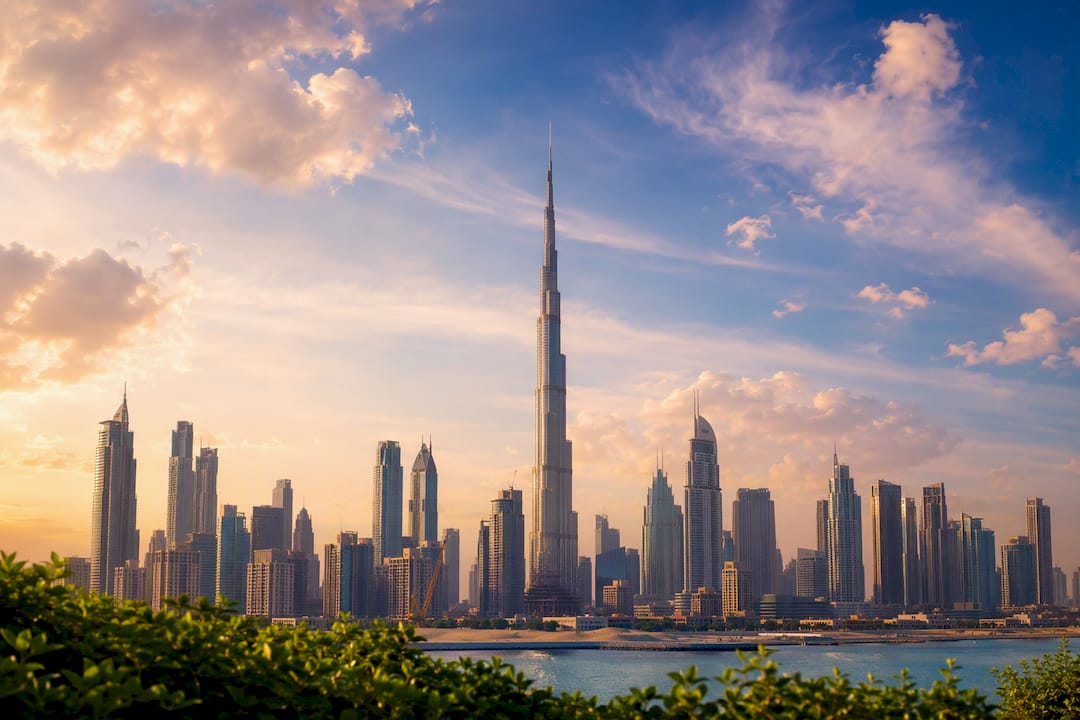
Pro Tip: Skip the observation deck queue and shoot from street level instead. The north side of Al Sayorah Bridge frames the Marina towers, the moored yachts, and the canal curve in a single shot, it is free, and it is a short walk from JBR. For a Sheikh Zayed Road angle with the Burj Khalifa in the distance, Level 43 Sky Lounge sits 43 floors up at Four Points by Sheraton. Visit Dubai’s skyline viewpoint guide lists more options.
2. Doha
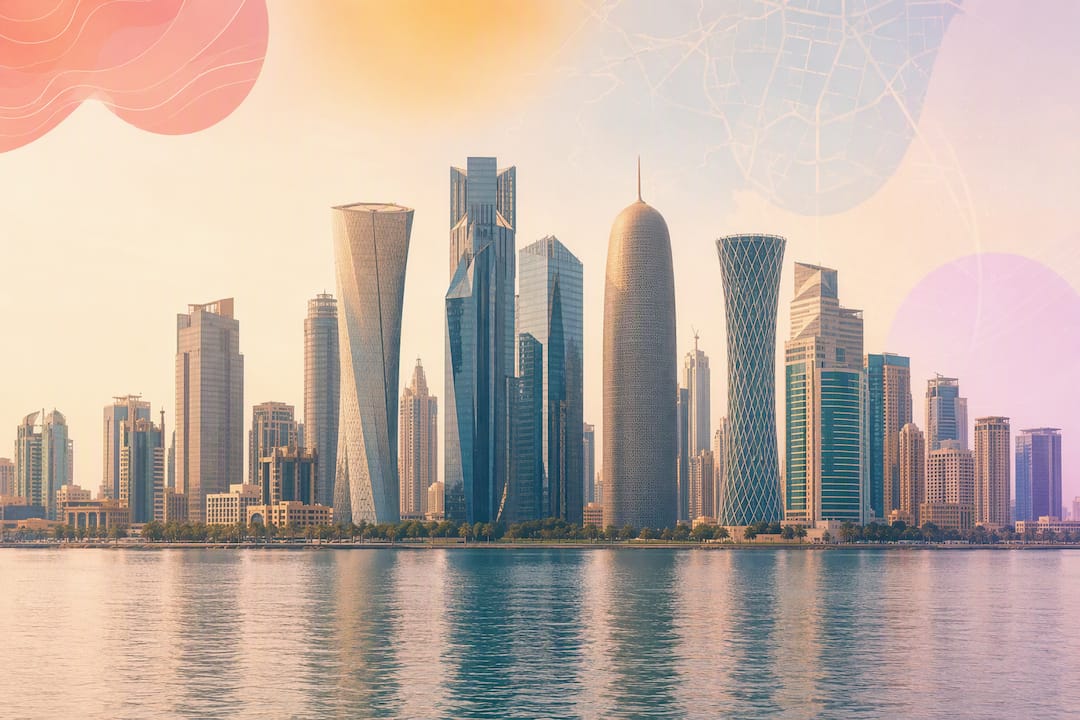
Doha’s West Bay district is the opposite move: fewer towers than Dubai, but each one is architecturally distinct, curved glass and sculptural forms clustered along the Corniche waterfront. It’s the region’s best example of quality over quantity.
3. Riyadh
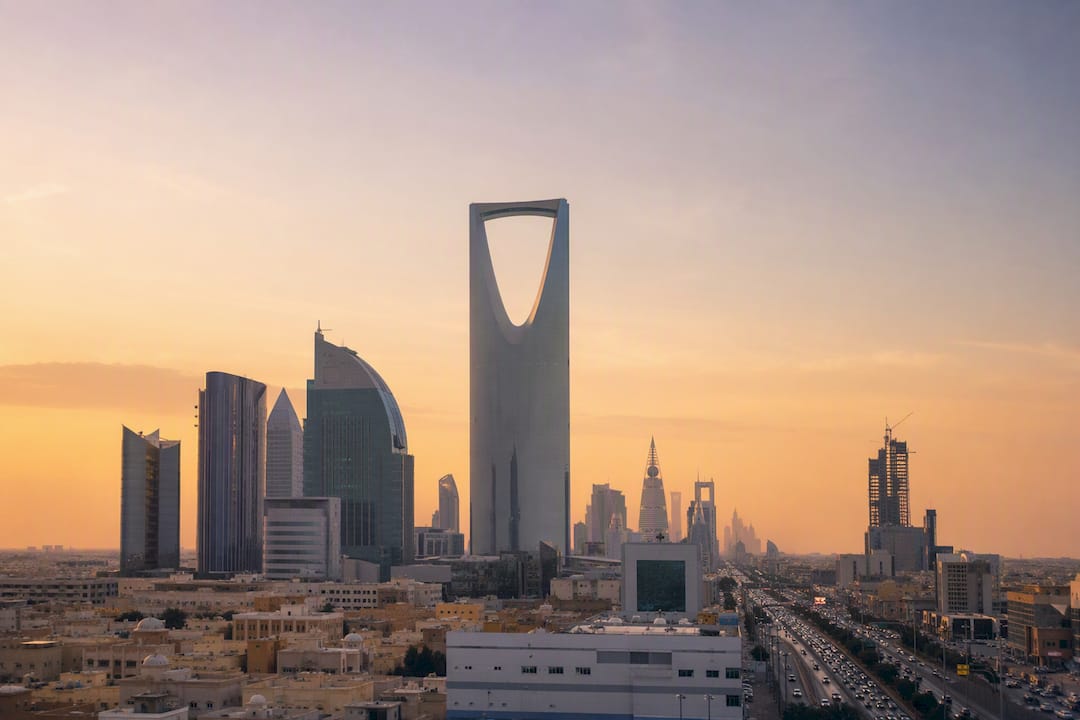
Riyadh is the growth story. Saudi Arabia’s 49 completed skyscrapers over 150 meters are just the starting point, since Vision 2030 megaprojects are adding towers to the skyline on a rolling basis. The Kingdom Centre and its keyhole opening still anchor most postcard shots even though the 385m PIF Tower overtook it on height back in 2021, and that gap is only going to widen.
4. Abu Dhabi
Abu Dhabi’s skyline reads calmer than Dubai’s, with towers rising directly out of the water along the Corniche and a mangrove backdrop that softens the whole scene. The tilted Capital Gate tower gives it one genuinely unique silhouette.
5. Kuwait City
Kuwait City has been vertically ambitious since long before the Gulf boom. The Kuwait Towers, completed in 1979, still define the skyline’s silhouette even though newer towers around them have gotten taller.
6. Manama
Manama’s skyline is smaller in scale but distinctive in shape, thanks to the twin-tower Bahrain World Trade Center with its wind turbines mounted between the towers, an early and still rare example of a skyscraper generating its own power.
7. Tel Aviv
Tel Aviv skips the supertall race entirely and goes for density instead. Its skyline is a tight cluster of mid-rise and high-rise towers packed close to the Mediterranean coast, giving it a compact, almost European skyline feel unlike anywhere else on this list.
8. Cairo
Cairo’s skyline is the region’s historical outlier: a mostly low-rise, sprawling city with newer towers concentrated along the Nile Corniche and in the New Administrative Capital project east of the city. It’s less about height and more about scale and age.
Where and when to shoot these skylines
Timing matters more than gear. Golden hour (roughly an hour before sunset) gives you warm light on glass facades without the flat glare of midday. Blue hour, the 20 minutes right after sunset, is when skyline lighting starts to compete with a still-visible sky, which is usually the sweet spot for skyline photography.
A few vantage points worth knowing:
- Dubai Marina — shoot from within the “canyon of glass” for scale, not from a distance
- Doha Corniche — the West Bay cluster read across the water, best in the twenty minutes after sunset
- Abu Dhabi Corniche — wide waterfront views with towers reflecting off the water at dusk
Pro Tip: Frame the skyline’s tallest tower slightly off-center and include foreground context, water, a palm-lined promenade, a low-rise heritage block, since an isolated tower shot is far less identifiable than one with a landmark to anchor it.
Rooftop bars and hotel sky lounges often beat official observation decks for both cost and crowd size. Just confirm dress codes and reservation policies ahead of time, and check permit requirements if you’re bringing professional gear like a tripod or drone.
Comparing Middle Eastern skylines by the numbers
The metrics change the story depending on what you’re measuring. Dubai wins on raw supertall count. Doha wins on visual cohesion. Riyadh wins on trajectory. Here’s how the main contenders stack up.
| City | Tallest building | Skyline density | Best viewing time | Known for |
|---|---|---|---|---|
| Dubai | Burj Khalifa, nearly 830m | Very high, clustered along Sheikh Zayed Road | Night, for lighting and reflections | Supertall spectacle |
| Doha | Aspire Tower (The Torch), 300m | High but compact | Dusk over the Corniche | Sculptural modernism |
| Riyadh | PIF Tower, 385m, with taller towers under construction | Medium, expanding | Golden hour | Rapid vertical growth |
| Abu Dhabi | Burj Mohammed bin Rashid, 381m | Medium, waterfront-spread | Sunset over the Corniche | Coastal silhouette |
| Kuwait City | Al Hamra Tower, 413m | Low to medium | Evening | Historic verticality |
Heights are CTBUH architectural heights and refer to the tallest completed building in each city, not to towers still under construction.
A few things the table doesn’t fully capture:
- Density and height tell different stories: Dubai’s cluster is taller, but Tel Aviv’s is arguably tighter per square mile.
- Night-time visibility is subjective until you’ve seen it yourself. Photos of Doha at dusk consistently outperform daytime shots, while Dubai holds up in both conditions.
- “Best-known-for” labels matter more than raw stats for casual visual comparison, which is exactly why this guide leads with descriptors, not just numbers.
How Middle Eastern skylines actually got built
Most of this region’s skylines are younger than you’d think. Kuwait City was arguably the pioneer, with its Kuwait Towers going up in 1979 on the back of early oil wealth, decades before Dubai had anything resembling a modern skyline.
Dubai’s transformation started in earnest in the 1990s and accelerated hard after 2000, once the emirate leaned into tourism and finance as a hedge against declining oil reliance. The Burj Khalifa, completed in 2010, was less a building project than a statement: Dubai wanted to own the “tallest in the world” title, and it still does.
Doha and Abu Dhabi followed a similar but later arc, using gas and oil revenue through the 2000s and 2010s to fund West Bay and the Corniche district, respectively. Riyadh is the most recent chapter, with most of its skyline growth happening in the past ten to fifteen years and continuing right now under Vision 2030.
Tel Aviv and Cairo took different paths entirely. Tel Aviv grew steadily through mid-rise density rather than a single supertall push, while Cairo’s historic core stayed largely low-rise, with new height concentrated in purpose-built districts outside the old city. Baku’s skyline is one of the newest additions to this list, built rapidly in the 2000s and 2010s on Azerbaijan’s oil economy.
What shapes the look of a Middle Eastern skyscraper
Middle Eastern towers borrow heavily from global modernist and postmodern design, but they rarely copy it wholesale. Local firms and international architects alike tend to work in climate response; heavy sun exposure and desert heat mean glass facades often come with shading elements, angled fins, or perforated screens inspired by traditional mashrabiya lattice work.
The Burj Khalifa’s tri-lobed footprint draws from the desert flower Hymenocallis, while Doha’s towers in West Bay favor sculptural, almost abstract forms that stand apart from the boxy glass towers common elsewhere. Abu Dhabi’s Capital Gate leans into structural showmanship. It’s tilted 18 degrees, more than four times the lean of the Tower of Pisa, purely as an engineering flex.
Bahrain’s World Trade Center took a different tack entirely, integrating wind turbines between its twin towers as both a design statement and a functional power source, an early example of a skyscraper trying to generate its own energy rather than just consume it.
Cairo and Tel Aviv show less uniformity, since both cities built up over longer stretches without a single unifying master plan. That gives their skylines a patchwork quality: older mid-rise buildings sitting beside newer towers, without the coordinated silhouette you get in a planned district like West Bay or Dubai Marina.
Why some Gulf cities keep building taller
Oil and gas revenue explains the first wave of Gulf skyline growth, but it doesn’t explain why the building hasn’t stopped. Tourism, finance, and economic diversification are the real drivers now, particularly in cities trying to reduce dependence on energy exports before reserves run down or global demand shifts.
Dubai leaned into this earliest, positioning itself as a global hub for finance, logistics, and tourism, with its skyline functioning as a literal advertisement for that ambition. Riyadh is following the same playbook under Saudi Arabia’s Vision 2030 plan, which explicitly ties megaproject construction to a broader push away from oil dependency.
Cultural pride plays a role too. A supertall isn’t just an office building. It’s a national signal, competing for the “tallest in the region” or “tallest in the world” title has real prestige value for governments funding these projects. That’s part of why Kuwait City’s early skyline mattered so much locally, and why Riyadh’s current building boom carries similar weight today.
Doha and Abu Dhabi took a slightly different cultural approach, prioritizing architectural distinctiveness over raw height. A skyline full of memorable, photogenic buildings can do as much for a city’s global image as one record-breaking tower, arguably more, since it gives visitors more than one thing to photograph.
Government planning behind the skylines
None of this happens without deliberate government policy. Dubai’s rapid vertical growth was driven directly by state-backed master plans and free-zone development policies designed to attract foreign investment and construction capital. Districts like Dubai Marina and Downtown Dubai were purpose-built, not organic growth.
Qatar took a similarly top-down approach with West Bay, a planned district built specifically to house Doha’s financial and diplomatic towers in one cohesive cluster. Saudi Arabia’s Vision 2030 initiative goes even further, functioning as a national economic strategy that happens to include skyline transformation as one of its most visible outcomes.
Regulatory frameworks matter just as much as the money behind them. Building codes, zoning rules, and infrastructure investment (utilities, transit, roads capable of supporting dense high-rise districts) all have to be in place before a skyline can grow this fast. Cities that skip this step end up with isolated towers rather than a cohesive skyline, which is part of why Cairo’s newer development is being built as a separate administrative capital rather than layered onto the existing city.
Expect this pattern to continue. Riyadh’s ongoing megaprojects, along with newer Gulf development plans, suggest the region’s skyline rankings will keep shifting over the next decade as government-backed construction keeps outpacing more organic growth elsewhere in the world.
Now go find these skylines in the wild. Worldlecity’s daily city guessing game hands you one real photo and six guesses, no account needed, and the city guesser library scatters the Middle East right across its difficulty tiers. Doha, Riyadh, and Tehran are all sitting in Medium 2, while Medium 3 puts Dubai, Cairo, and Kuwait City in one round and Medium 1 covers Abu Dhabi, Manama, and Muscat. There is a surprise city in Extreme 3. Let us know if you find it and why not challenge a friend if they found it as well. Matching a silhouette to a city is the whole premise of a landmark identification quiz, where one tower is the only clue you get. So go and see how far this guide actually got you. Did Doha’s curved glass, Riyadh’s keyhole tower, or Manama’s wind turbines give the city away, or did you burn every guess getting there?
Sources
- Countries by number of 150m+ buildings — The Skyscraper Center (CTBUH)
- UAE surpasses US in supertall skyscrapers, ranks second globally — Gulf News
- The world’s best skylines have just been named – and none of the top 10 are in Europe — Euronews
- Best places for Dubai skyline views — Visit Dubai
FAQ
What is the Dubai skyline known for?
Dubai’s skyline is known for its concentration of supertall buildings, led by the Burj Khalifa at nearly 830 meters, along with a dense cluster of towers around Dubai Marina and Sheikh Zayed Road.
What is the tallest skyscraper in the world?
The Burj Khalifa in Dubai has held the title since it opened in 2010, standing at nearly 830 meters. Saudi Arabia’s Jeddah Tower is being built to clear 1,000 meters and passed its 100th floor in 2026, so the record is expected to stay in the Middle East but move from Dubai to Jeddah once that tower is finished.
What are the top skylines in the world?
Rankings shift by methodology. A 2026 Radical Storage ranking reported by Euronews placed Dubai second worldwide, behind Shenzhen, with eight of the top ten spots going to Asian cities.
Which country has the most skyscrapers in the world?
Globally, China and the United States lead in total skyscraper counts. Within the Middle East, CTBUH’s Skyscraper Center puts the UAE far ahead with roughly 345 completed buildings over 150 meters, against 57 for Qatar and 49 for Saudi Arabia.