What Is a Knowledge Quiz? Definition, Types, and Benefits
Discover what is a knowledge quiz, its types, and benefits. Learn how this assessment tool can enhance your understanding and retention.
- knowledge quiz examples
- how to create a knowledge quiz
- benefits of knowledge quizzes
- knowledge quiz definition
- types of knowledge quizzes
- what is a knowledge quiz
On this page

A knowledge quiz is an assessment tool that tests what you know through questions with objectively correct answers, producing a score that reflects your mastery of the material. Unlike personality quizzes, which generate profiles based on preferences, a knowledge quiz has a single correct answer for each question. Educational bodies define these quizzes as formative assessment tools designed to measure learning retention and verify understanding. If you have ever wondered what separates a scored trivia challenge from a “which character are you” quiz, the answer is simple: one measures knowledge, the other measures personality.
What is a knowledge quiz, exactly?
A knowledge quiz tests learning retention with objectively correct answers and produces a 0–100% score. That score tells you and anyone evaluating you exactly how much of the material you have absorbed. The knowledge quiz definition, at its core, is straightforward: questions have correct and incorrect answers, and your final score reflects how many you got right.
Knowledge quizzes typically contain 5–30 questions, though shorter versions called knowledge checks often run just 5–12 questions. They appear in classrooms, corporate training programs, online courses, and even casual trivia nights. The format is flexible, but the scoring logic stays consistent: right answers count, wrong answers do not.

What makes this format powerful is its objectivity. There is no interpretation of your answers, no personality profile to debate. You either know the capital of France or you do not.
How does a knowledge quiz differ from personality quizzes and tests?
The clearest distinction is between knowledge quizzes and personality quizzes. Personality quizzes lack right answers and produce profiles rather than scores. A personality quiz might tell you that you are “a creative thinker” based on your preferences. A knowledge quiz tells you that you scored 75% on a geography test.
“If you’re assessing knowledge, use a knowledge quiz; if you’re engaging or segmenting, use a personality quiz.” That distinction matters when you are choosing the right format for a specific goal.
Knowledge quizzes also differ from tests and exams in meaningful ways. Quizzes are brief and low-stakes, focusing on specific topics, while tests and exams are longer, higher-stakes assessments covering broader content. Tests and exams often contribute significantly to final grades or certification status. A quiz rarely carries that weight.
| Assessment type | Length | Stakes | Scope | Scoring |
|---|---|---|---|---|
| Knowledge quiz | 5–30 questions | Low | Narrow topic | Automated, immediate |
| Personality quiz | 5–20 questions | None | Preferences | Profile, no score |
| Test | 20–50 questions | Medium | Broader content | Graded, delayed |
| Exam | 50+ questions | High | Full course | Formal, high-impact |
The table above shows why mixing these formats causes confusion. Using a personality quiz format when you want to assess learning produces useless data. Using an exam-length quiz when you want a quick check creates unnecessary pressure.
What question types and structures do knowledge quizzes use?
Knowledge quizzes rely on a handful of proven question formats. Multiple-choice, true/false, short answer, and scenario-based questions are the most common. Each format serves a different cognitive level.
Here is how the main question types break down:
- Multiple choice: Presents one correct answer among several options. Fast to complete and easy to score automatically.
- True/false: Tests basic recall with binary answers. Best for checking foundational facts.
- Short answer: Requires the learner to produce an answer without prompts. Tests deeper recall.
- Scenario-based: Places the learner in a real-world situation and asks them to apply knowledge. The most demanding format.
Scenario-based questions are worth highlighting separately. Scenario questions simulate real-world context, which pushes learners beyond memorization into genuine application. A question like “A customer complains about a billing error. What is your first step?” tests whether someone can actually use what they know, not just recite it.
For quiz creators exploring different quiz formats for learning, mixing recall and application questions produces the most accurate picture of mastery.
Pro Tip: Keep your knowledge quiz between 5 and 15 questions for most learning contexts. Longer quizzes increase anxiety and reduce completion rates without meaningfully improving the accuracy of your assessment.
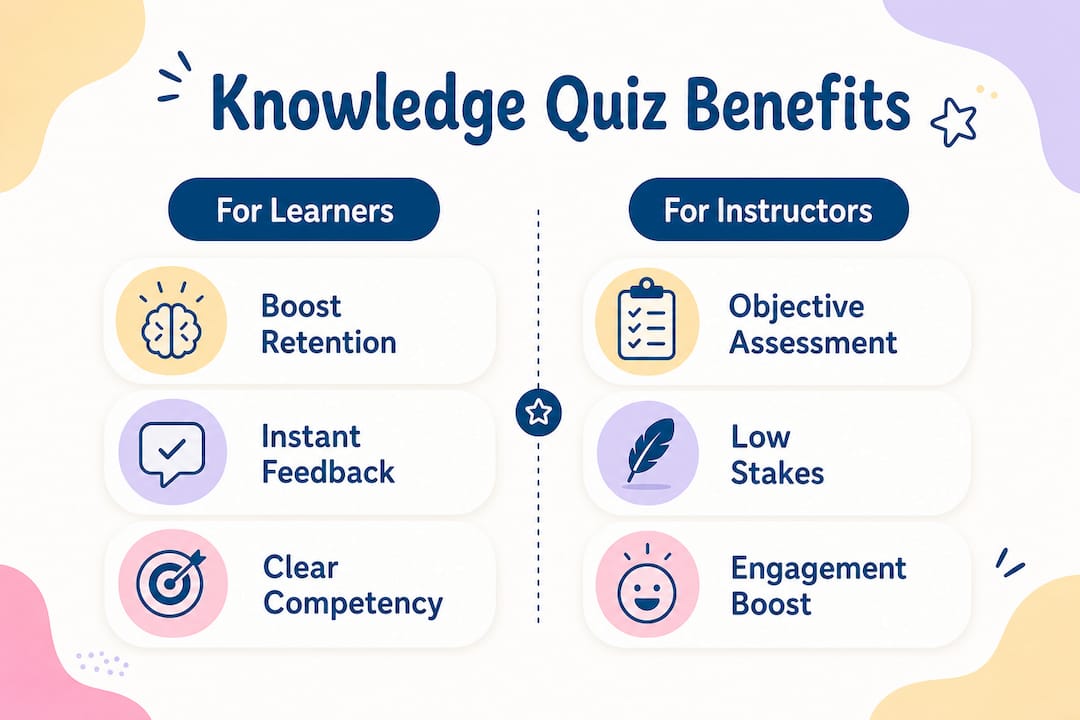
What are the benefits of knowledge quizzes for learning?
Knowledge quizzes work because they force active recall. Passive review, like rereading notes, feels productive but produces weak memory traces. A quiz makes you retrieve information, and that retrieval process strengthens the memory itself.
“Quizzes as low-pressure, short assessments increase knowledge retention when used as stepping stones immediately after learning. Short, frequent quizzes reinforce memory far more effectively than a single high-stakes review session.”
Using knowledge quizzes right after learning boosts retention considerably compared to passive review. The timing matters. A quiz given immediately after instruction captures the learning while it is fresh and reinforces it before it fades.
The feedback loop is equally important. Knowledge quizzes provide instant feedback, allowing both instructors and learners to identify knowledge gaps for timely remediation. That diagnostic function is what makes quizzes formative tools rather than just grading mechanisms. You do not just find out your score. You find out exactly where your understanding broke down.
In training contexts, passing thresholds are often set at 80% to confirm competency. That threshold creates a clear, objective standard. Either you have mastered the material or you need another pass at it. There is no ambiguity.
For a deeper look at why this format works so well, the research behind quizzes as educational tools is worth your time.
How do you create an effective knowledge quiz?
Creating a good knowledge quiz starts with one question: what should the learner be able to do after completing this material? That goal shapes everything else. Vague goals produce vague questions. Clear goals produce questions that actually measure something useful.
Follow these steps to build a quiz that works:
- Define your learning objective. Write one sentence describing what the learner should know or be able to do. Every question should connect directly to that objective.
- Choose the right question formats. Use multiple choice for broad recall, true/false for foundational facts, and scenario questions for application. Mix formats to test different levels of understanding.
- Keep it short and timely. Deliver the quiz immediately after instruction, while the material is fresh. Aim for 5–15 questions. A knowledge check should be short and low-stakes; making it longer or more formal transforms it into a test, which increases anxiety and reduces effectiveness.
- Set a clear passing threshold. An 80% threshold is standard for competency checks. Define it before you deploy the quiz, not after you see the results.
- Enable automated scoring and instant feedback. Learners should see their results immediately. Delayed feedback breaks the connection between the question and the learning moment.
- Review and refine. After the first round, check which questions most learners got wrong. A question that everyone fails may be poorly worded, not a sign that everyone failed to learn.
Balancing question difficulty is one of the most overlooked steps in quiz design. Too easy and the quiz tells you nothing. Too hard and learners disengage before you get useful data.
Pro Tip: Avoid loading your quiz with trick questions or overly complex wording. The goal is to measure what learners know, not to catch them out. Clear, direct questions produce more accurate results and keep motivation high.
Misusing quiz formats, such as mixing personality-style questions into a knowledge quiz or making a knowledge check too long and high-pressure, undermines the whole exercise. Low stakes and clear goals are what sustain both motivation and accurate assessment.
Put your knowledge to the test on Worldlecity
Worldlecity turns knowledge quizzes into something you actually want to do again tomorrow.
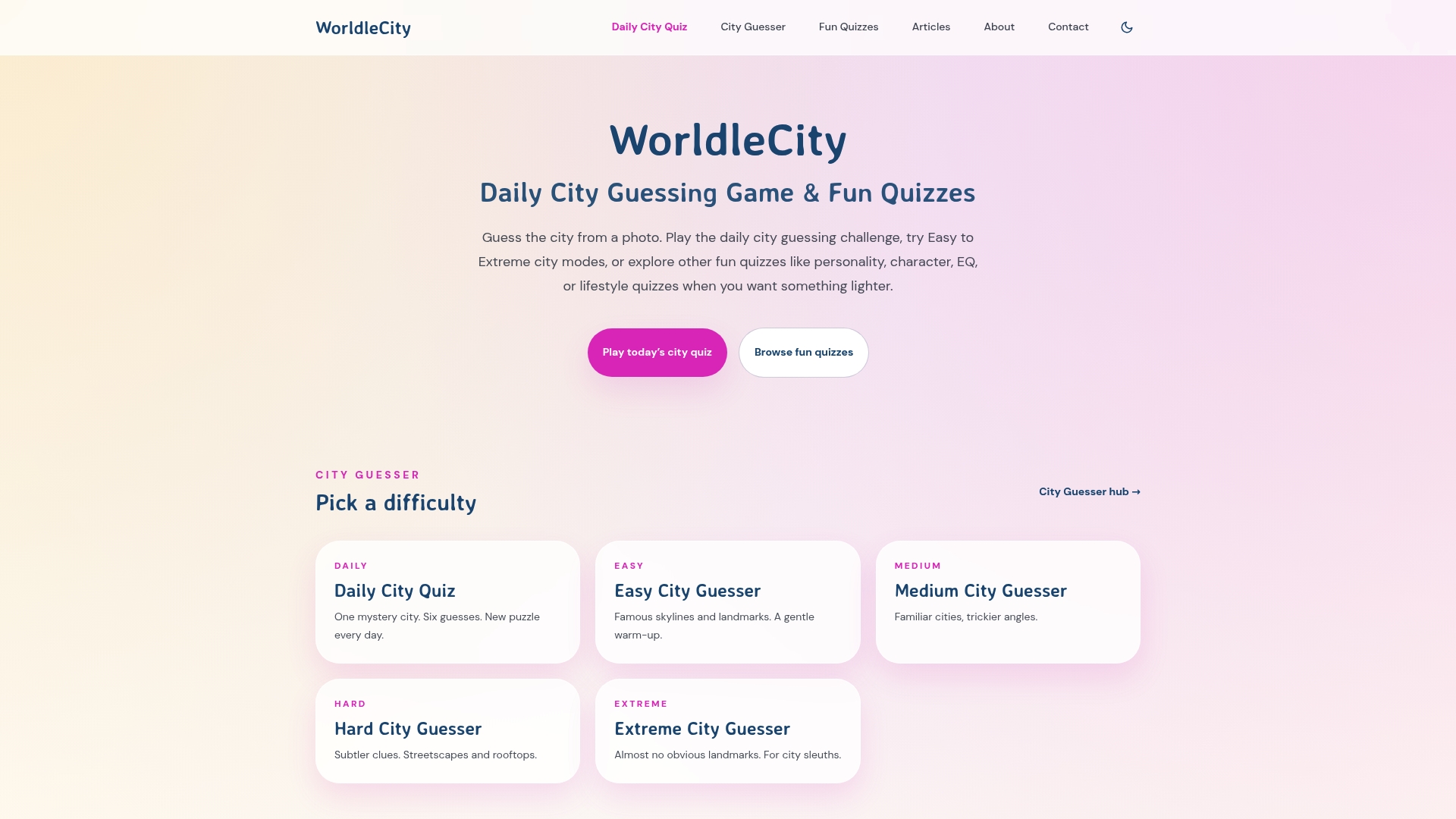
The daily city guessing game gives you a photograph of a mystery city and six attempts to identify it. Each guess returns directional feedback, so you are actively retrieving and applying geographic knowledge with every round. That is the active recall loop that makes knowledge quizzes effective, wrapped in a format that feels like a game. Worldlecity also offers scored quizzes, with four difficulty modes and no account required. You get instant feedback, a shareable score, and a genuine sense of how much you know.
FAQ
What is the knowledge quiz definition?
A knowledge quiz is an assessment with objectively correct answers that produces a score, typically ranging from 0–100%. It measures learning retention and mastery of specific material.
How many questions does a knowledge quiz usually have?
Knowledge quizzes typically contain 5–30 questions. Shorter knowledge checks run 5–12 questions and are designed for immediate post-instruction use.
What is the difference between a knowledge quiz and a personality quiz?
A knowledge quiz has right and wrong answers and produces a score. A personality quiz has no correct answers and generates a profile based on your preferences or responses.
What passing score is standard for a knowledge quiz?
An 80% passing threshold is the standard benchmark for competency checks in training and educational contexts.
Why are knowledge quizzes better for learning than passive review?
Knowledge quizzes require active recall, which strengthens memory more effectively than rereading notes. Immediate feedback also helps learners identify and address gaps right away.
Key takeaways
A knowledge quiz is the most direct tool for measuring what someone actually knows, and its effectiveness depends on keeping it short, scored, and immediately tied to instruction.
| Point | Details |
|---|---|
| Core definition | A knowledge quiz has objectively correct answers and produces a 0–100% score. |
| Key distinction | Knowledge quizzes score mastery; personality quizzes generate profiles with no right answers. |
| Best length | Keep quizzes to 5–15 questions to reduce anxiety and maintain accuracy. |
| Timing matters | Deliver quizzes immediately after instruction to maximize retention benefits. |
| Feedback is the point | Instant scoring lets learners and instructors identify knowledge gaps while they can still act on them. |