How to Identify Nordic Cities From the Skyline
Discover how to identify Nordic cities from their unique skylines. Look for key features like civic spikes and muted lighting for quick recognition.
- how to identify Nordic cities from the skyline
- Nordic architecture skyline clues
- famous Nordic city landmarks
- Nordic night skyline lighting
- Nordic vs Scandinavian cities
- identifying cities by skyline
On this page
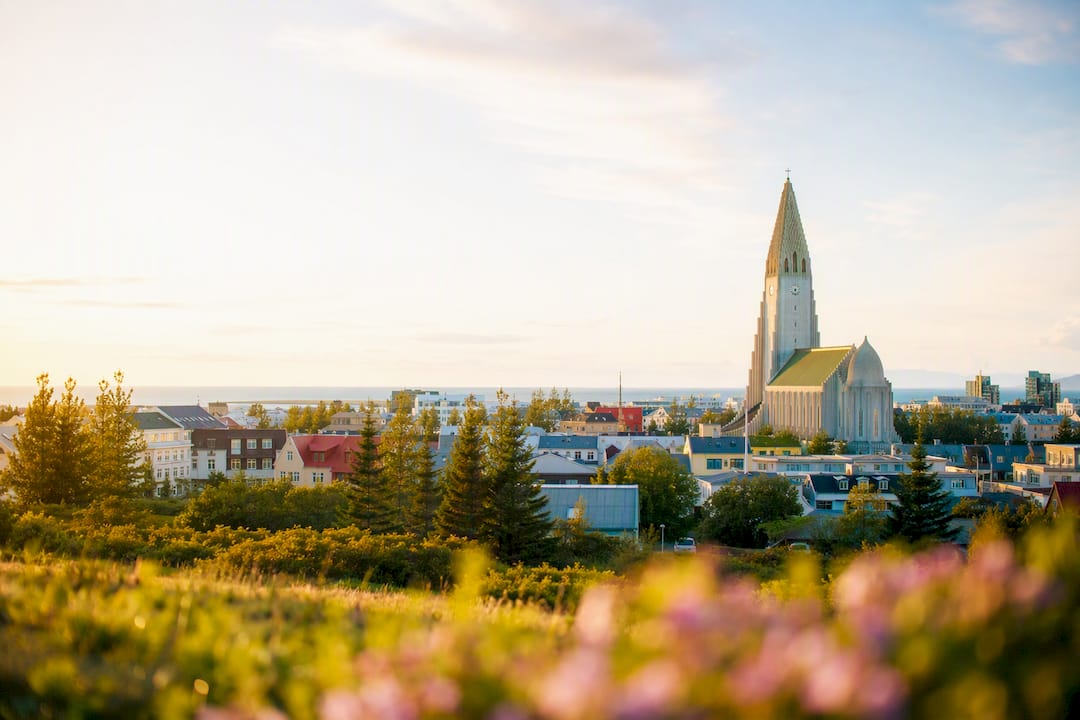
Look for a low, gentle horizon with one civic spire, water in the frame, cool-toned roof materials, and muted night lighting. That combination is the fastest way to identify Nordic cities from the skyline, and it works whether you’re looking at a tourist photo, a satellite crop, or a game screenshot. Day shots reward you for reading shapes and terrain; night shots reward you for reading light.
TL;DR:
- Most Nordic skylines feature low, spread-out building clusters with a single tall spire or civic landmark, often a church or historic tower.
- Night scenes are characterized by low luminance, selective lighting on heritage buildings, and water reflections, with minimal bright signage or floodlighting.
- Recognizable landmarks include Hallgrímskirkja in Reykjavik, Turning Torso in Malmö, and distinctive features like Oslo’s opera house and Helsinki’s cathedral domes.
- Climates influence architecture with steep roofs and snow guards, while historic planning prioritizes church-centered height dominance and restrained modern design.
- Terrain and water shape the skyline, with archipelago cities showing water threading through urban scenes, unlike dense, skyscraper-centric skylines elsewhere.
What are the fastest visual cues for identifying a Nordic skyline?
Start with the tallest thing in frame. In most Nordic cities, that’s a church spire or a single civic landmark, not a cluster of glass towers. A skinny stone or copper spire almost always beats a boxy modern high-rise as your best clue, because so many Nordic downtowns kept their skylines low on purpose.
Next, check the cluster pattern. Cities like Frankfurt or Dubai pack their tall buildings into a tight financial district. Nordic capitals tend to spread things out, or anchor the whole scene around one landmark rather than a skyline “wall.” That’s not an accident. As Nordregio’s analysis of Stockholm points out, the city’s horizon has historically followed its islands and hills rather than fighting them with height. However, newer high-rise development is starting to nudge that silhouette upward.
Water and terrain narrow things down fast. Ask yourself: is the city sitting on visible islands, wrapped around a harbor, or backed by hills? A skyline with water threading through the middle of it, rather than just bordering one edge, points toward archipelago cities like Stockholm or Helsinki. A single dominant waterfront with low bridges suggests Copenhagen. Landlocked with mountains in the distance rules out most of the classic Nordic capitals entirely.
Finally, look at materials and rooflines:
- Pitched, steep roofs in slate gray, copper green, or terracotta, common across older Nordic quarters.
- Pale masonry and plaster facades instead of dark brick or heavy stone.
- Sparse glass curtain walls compared to the all-glass towers you’d see in a major Asian or North American financial hub.
- Copper roofing that’s oxidized green, especially on churches and civic buildings.
Pro Tip: If you can’t tell whether a spike is a church or a radio tower, look for a small cross or clock face near the top. Nordic churches almost always carry one, and it’s often the giveaway a low-resolution photo won’t otherwise show you.
How does night lighting change the way a Nordic skyline looks?
Night photos flip your whole approach, because Nordic cities are noticeably darker than skylines of similar size elsewhere. That’s a planning choice, not a lack of infrastructure.
Research on Scandinavian night-time cityscapes found that municipal lighting policy in cities like Stockholm, Copenhagen, and Malmö deliberately favors low luminance and selective accent lighting over bright branding or blanket floodlighting. Instead of lighting up an entire tower, planners pick specific heritage buildings, bridges, or public squares to highlight and leave the rest comparatively dim.
That produces a distinct visual signature. Here’s what to scan for:
- Scattered interior window points rather than solid lit facades. Rows of individually lit apartment windows on a residential tower often read brighter than any architectural floodlight nearby.
- Selective accent lighting on one or two heritage buildings, with everything else left dark.
- Reflections on water carrying more of the visual interest than the buildings themselves.
- Minimal neon or billboard glow, since large-scale commercial signage is rarer in Nordic downtown cores.
Satellite light-pollution data cited in that same Scandinavian lighting study show Stockholm, Copenhagen, and Malmö all maintain comparably subdued central brightness relative to each other, the result of deliberate planning measures rather than infrastructure gaps. If a night skyline looks like it’s competing with Times Square, you’re not looking at a Nordic city. A quick sanity check: if you can spot a few stars or a visibly gray, non-orange sky glow behind the buildings, that low-luminance pattern is a strong regional tell.
Which landmarks help you name Nordic cities on sight?
Five cities cover most of what you’ll encounter in photo quizzes and travel shots, and each one has at least one anchor you can memorize.
- Reykjavik. Hallgrímskirkja dominates every angle of the city. Iceland’s capital has no real high-rise cluster, so that basalt-column-inspired spire acts as the visual anchor almost by default. Pair it with sparse, low buildings and a coastal, mountain-backed frame, and you’ve basically confirmed the city.
- Stockholm. Look for an islanded silhouette, church towers poking above a generally low roofline, and a horizon that bends around water rather than cutting straight across it. Nordregio’s own analysis flags that this smooth, historic profile is starting to shift as new high-rises get built, so don’t be thrown if you spot one modern tower breaking the pattern.
- Copenhagen. A flatter, more horizontal profile than Stockholm, with lakes and harbor reflections doing a lot of visual work. Copenhagen’s night scenes lean on subtle accents, low building massing, and the occasional bit of local neon around Nyhavn, which is worth knowing since it’s the one Nordic capital where you will spot some commercial signage.
- Malmö. One giveaway: the Turning Torso, a twisted residential tower that stands almost alone against a low-rise backdrop. Nothing else on this list looks remotely like it, which makes Malmö one of the easiest calls once you know the shape.
- Oslo and Helsinki. Both mix waterfront modernism with distinctive cultural buildings, like Oslo’s angular opera house or Helsinki’s cathedral domes. The catch: they can overlap visually with other northern European ports like Tallinn or Gdansk, so treat these two as your trickiest calls and lean harder on the water and lighting cues to confirm.
How can you practice identifying Nordic skylines?
Reading a skyline is a pattern-recognition skill, and like any skill, it gets sharper with repeated, structured practice rather than passive scrolling.
- Pick the dominant silhouette first. Is it a single spike, a twisted tower, or a low horizontal spread? Name your best guess before you look at anything else.
- Check water and terrain second. Islands, a single harbor, lakes, or hills each point toward a different shortlist of cities.
- Confirm with a map or reverse-image tool. A quick 3D map view or reverse-image lookup validates your guess and shows you exactly where you were right or wrong. It’s the same instinct experienced skyline spotters rely on: read the silhouette first, then confirm against the setting.
Run that loop on a timer. Give yourself 20 seconds per photo, guess, then check. Start with obvious anchors like Hallgrímskirkja or the Turning Torso, then move to trickier sets like Oslo versus Helsinki once the easy ones feel automatic.
Pro Tip: Keep a running note of which cue fooled you each time, whether it’s mistaking a radio tower for a church spire or misreading a lake for a harbor. That short list becomes your personal cheat sheet faster than any general guide can.
For structured reps, WorldleCity’s difficulty-based quiz modes work well because you get real photos and immediate right/wrong feedback instead of guessing in a vacuum.
What color palettes and building styles show up in Nordic cities?
Nordic facades tend to run cooler and paler than what you’ll see in Southern or Central Europe. Think whitewashed plaster, pale gray stone, and soft pastel yellows and ochres in older residential quarters, rather than the warm terracotta and deep ochre common in Mediterranean towns.
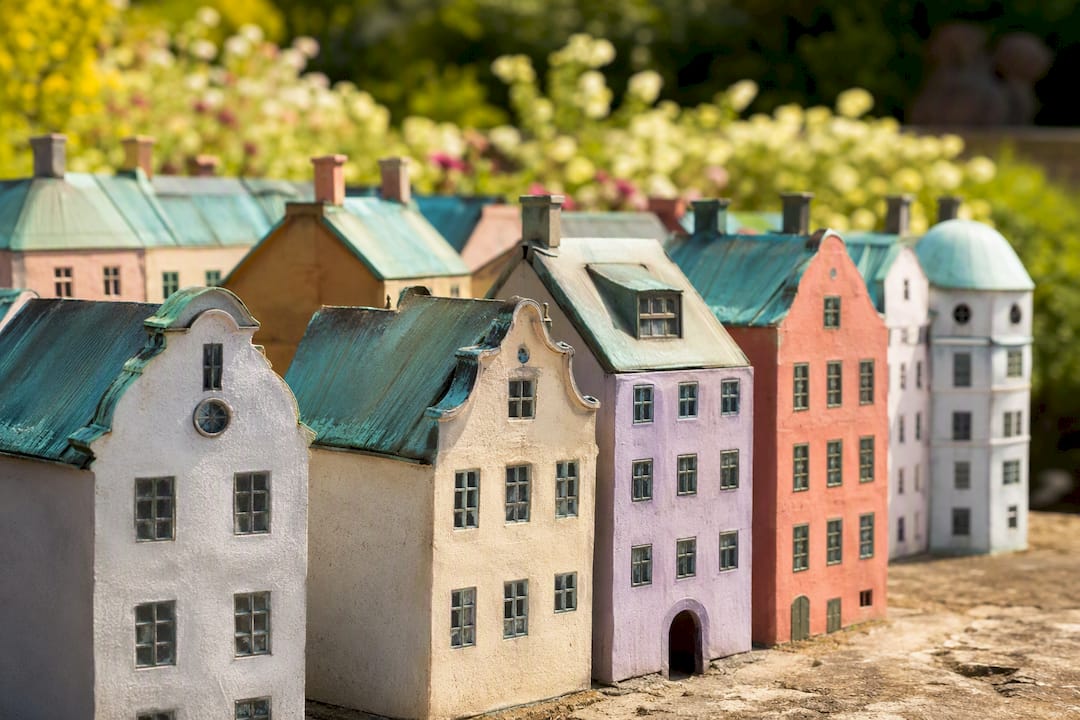
Copper shows up constantly, especially on churches, city halls, and older civic buildings, and it oxidizes to that distinctive green patina over decades. Stockholm’s City Hall and plenty of church towers across the region carry that greenish tint, and it’s one of the more reliable material clues once you know to look for it.
Wood facades are another regional signature, particularly in Norway and parts of Finland, often painted in deep reds, blacks, or muted blues rather than left natural. In denser urban cores, that gives way to rendered masonry in cream, white, or soft gray tones.
Glass and steel do appear, especially in newer waterfront developments and business districts, but they’re generally used as accents on a handful of buildings rather than wrapping an entire skyline the way they might in a Gulf or East Asian financial center. The contrast between one or two glassy statement buildings and a sea of pale, low-rise masonry is itself a strong regional tell.
What climate-driven design details show up on Nordic rooflines?
Winter shapes Nordic rooflines in ways you can actually spot from a distance. Steep roof pitches are the most obvious adaptation, since a sharper angle sheds snow load faster and reduces the risk of a roof collapsing under heavy accumulation.
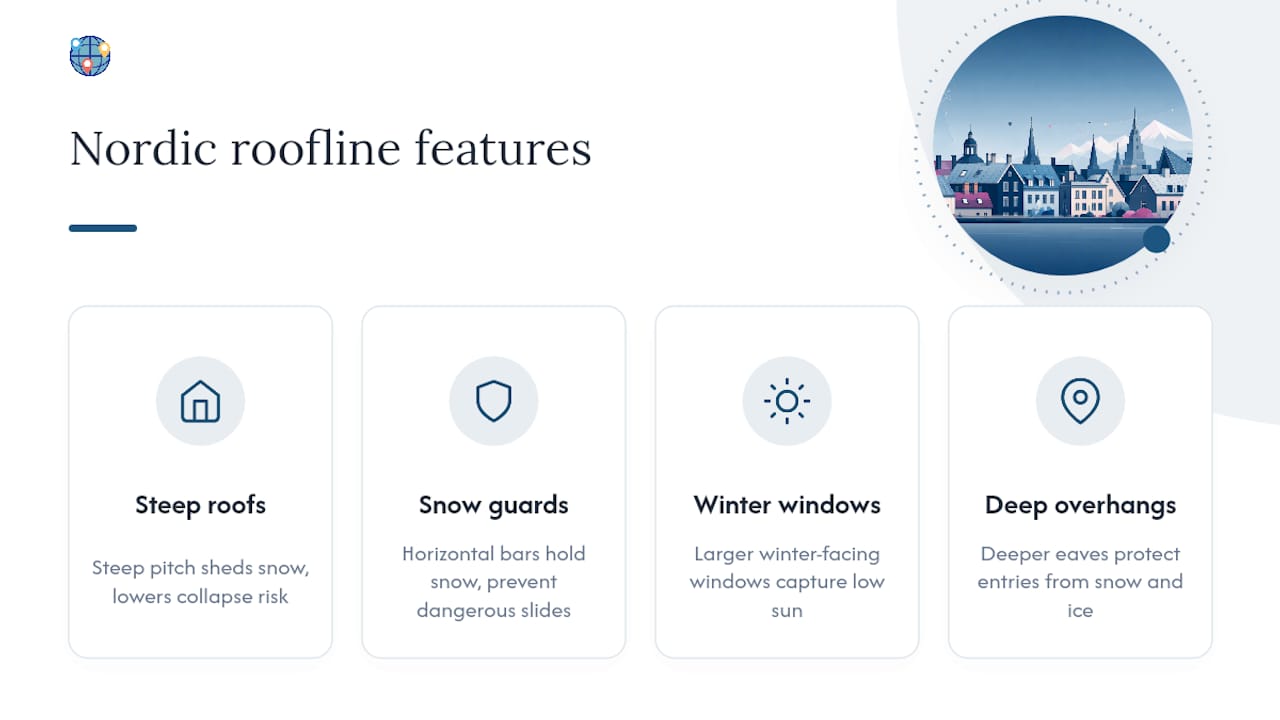
Look closer, and you’ll often catch small horizontal bars near the roof edge. Those are snow guards, and their job is to hold snow in place so it doesn’t slide off in one dangerous sheet onto the sidewalk below. They’re common on older buildings across Norway, Sweden, and Finland, and they show up as a subtle textured line just above the gutter in a zoomed-in photo.
Window placement is another clue. Nordic buildings tend to favor larger windows positioned to catch low winter sun, a practical response to short daylight hours rather than a purely aesthetic choice. You’ll also notice deeper overhangs on some rooflines, built to protect entryways from snow and ice buildup.
None of these details alone confirms a Nordic city. Plenty of alpine and Baltic cities share similar climate pressures and similar solutions. But stack a steep pitched roof, visible snow guards, and generous winter-facing windows on top of the silhouette and water cues you’ve already checked, and your confidence in an identification should climb fast.
What historical influences shape Nordic urban skylines?
A lot of what reads as “Nordic” today traces back to church-centered town planning that predates modern zoning by centuries. Before industrial-era high-rises existed anywhere, a cathedral or parish church was already the tallest, most visually dominant structure in most Nordic towns, and civic building codes have often protected that visual hierarchy ever since.
That’s part of why a single spire still reads as the tallest thing in cities like Reykjavik or across much of provincial Sweden and Norway. It’s not that these places couldn’t build taller. Height restrictions and heritage protections in historic cores have kept modern towers pushed to the edges or clustered in newer districts, away from the old church-anchored center.
Scandinavian design movements of the 20th century added another layer, prioritizing function and restraint over ornament. That aesthetic favored clean lines, muted colors, and modest scale, values you can still see echoed in newer buildings that sit respectfully low next to centuries-old landmarks rather than overpowering them. The result is a skyline where old and new coexist without one drowning out the other, which is unusual compared to cities that demolished their historic cores for postwar towers.
How does a Nordic skyline compare to other world skylines?
Put a Nordic skyline next to Manhattan, Shanghai, or Dubai, and the difference is immediate. Those skylines are built around density and height competition: dozens of towers racing skyward, floodlit facades, and a light footprint that reads as a bright dome from space.
Nordic cities do the opposite. A single landmark carries the identity, the rest of the skyline stays low, and the overall brightness at night drops off sharply outside a few highlighted zones. Even Southern European cities with a strong historic core, like Rome or Lisbon, tend to run brighter and more visually cluttered after dark, thanks to denser signage and warmer streetlighting.
The closest comparisons are other northern European or Baltic cities like Tallinn, Riga, or Gdansk, which share some of the same low-rise, church-anchored layout and cooler palette. That overlap is exactly why terrain and water context matter so much: a spire-and-low-rise pattern alone won’t separate Helsinki from Tallinn, but the specific shape of the harbor, the islands, or the bridge layout usually will.
Sharpen your eye with WorldleCity’s daily skyline challenge
Reading about spires and snow guards only gets you so far. The fastest way to actually lock in these cues is repetition against real photos where you find out immediately whether you were right.

Worldlecity’s daily city guessing game gives you one mystery photo a day and six guesses, with proximity and direction feedback after each try, so you’re not just guessing blind. If you want more volume, the site’s quiz modes stack four difficulty levels, which means you can start with obvious landmark shots and work up to trickier waterfront and night-lighting photos as your pattern recognition improves. Because the game runs on real photographs rather than illustrations, the lighting and material cues you just learned actually show up the way they would on a real trip. No account needed, no cost, just a fast daily rep. Head to WorldleCity and try today’s mystery city, then check tomorrow whether that low-luminance, single-spire instinct held up.
Sources
- Night-time cityscapes: the case of Scandinavian cities
- Stockholm’s famous skyline is changing - Nordregio
- A closer look at Hallgrímskirkja — Iceland’s basalt-inspired church
FAQ
Which US state is most like Sweden?
Minnesota gets cited most often for its Scandinavian immigrant heritage, cold climate, and lake-heavy landscape, though the comparison is cultural and geographic rather than architectural. Its skylines don’t share the low-rise, church-anchored profile covered here.
Why isn’t Finland considered Scandinavian?
Scandinavia technically refers to Norway, Sweden, and Denmark, tied by shared linguistic and historical roots on the Scandinavian Peninsula. Finland, Iceland, and the Faroe Islands fall under the broader “Nordic” umbrella instead, which is why this guide uses “Nordic” rather than “Scandinavian” throughout.
Can you tell a Nordic city from a Baltic city like Tallinn or Riga just from the skyline?
Not from the skyline alone. Tallinn, Riga, and Gdansk share the same low-rise, church-anchored silhouette and cool palette as the Nordic capitals. Water and terrain are the tiebreakers: the exact shape of the harbor, the islands, or the bridge layout is what actually separates a city like Helsinki from Tallinn.
What is the prettiest Nordic city?
That’s subjective, but Stockholm’s islanded silhouette, Copenhagen’s waterfront, and Reykjavik’s Hallgrímskirkja backdrop are the three most frequently singled out for their visual character. If you want to test your own opinion against real photos, all three do come up in Worldlecity’s daily rotation.