5 Step Roof Styles Workflow for Photo Guessing Players and Educators
Master a 5 step workflow to read roof pitch, material, and clues in photos. Quick checklist, 60 second drills, and Worldlecity practice.
- roof identification for city guessing
- reading roof styles in photos
- roof pitch and climate clues
- roofing material geography
- geolocation visual clues
- WorldleCity photo guessing practice
On this page
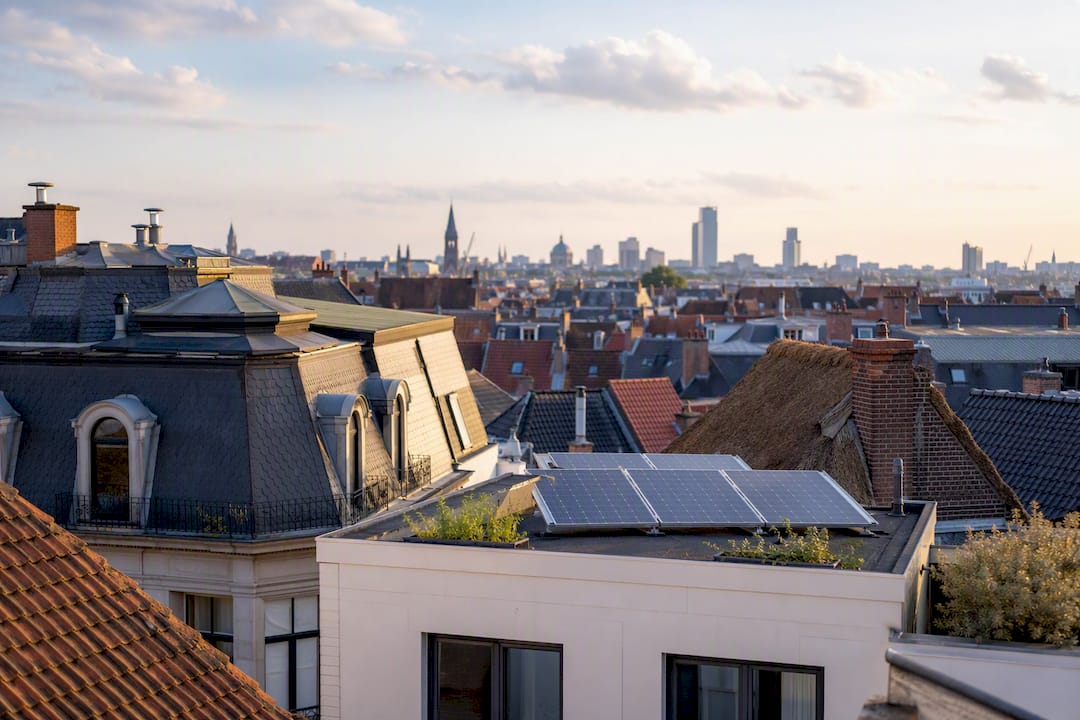
Pitch tells you climate, material tells you region, and form tells you era, in that priority order. Steep roofs mean cold or wet, flat roofs mean dry, and the Cambridge study on climate and house diversity backs that up hard. Stack pitch, then material, then ornament, and you’ll cut your guessing pool fast, whether you’re grinding through a Worldlecity round or teaching a classroom to read a skyline.
TL;DR:
- Steep roofs are typical in high-rain or snowy regions like Scandinavia, Switzerland, and the Pacific Northwest, as they efficiently shed water and snow.
- Flat or low-pitched roofs commonly appear in dry climates such as the Middle East, North Africa, and the American Southwest, often serving as outdoor living or water tank spaces.
- Roofing materials like clay tiles, slate, and corrugated metal cluster regionally, with clay around the Mediterranean, slate in Europe, and metal in tropical zones, aiding geographic identification.
- Modern roof features like solar panels, satellite dishes, and green roofs can indicate recent construction or renovation, often within the last 15 to 20 years, depending on the feature.
- Analyzing roof aging, chimneys, and rooftop activity provides clues to historical building practices, climate adaptation, and era, especially when verifying guesses in time-sensitive identification exercises.
Why this roof styles guide starts with the roofline, not the walls
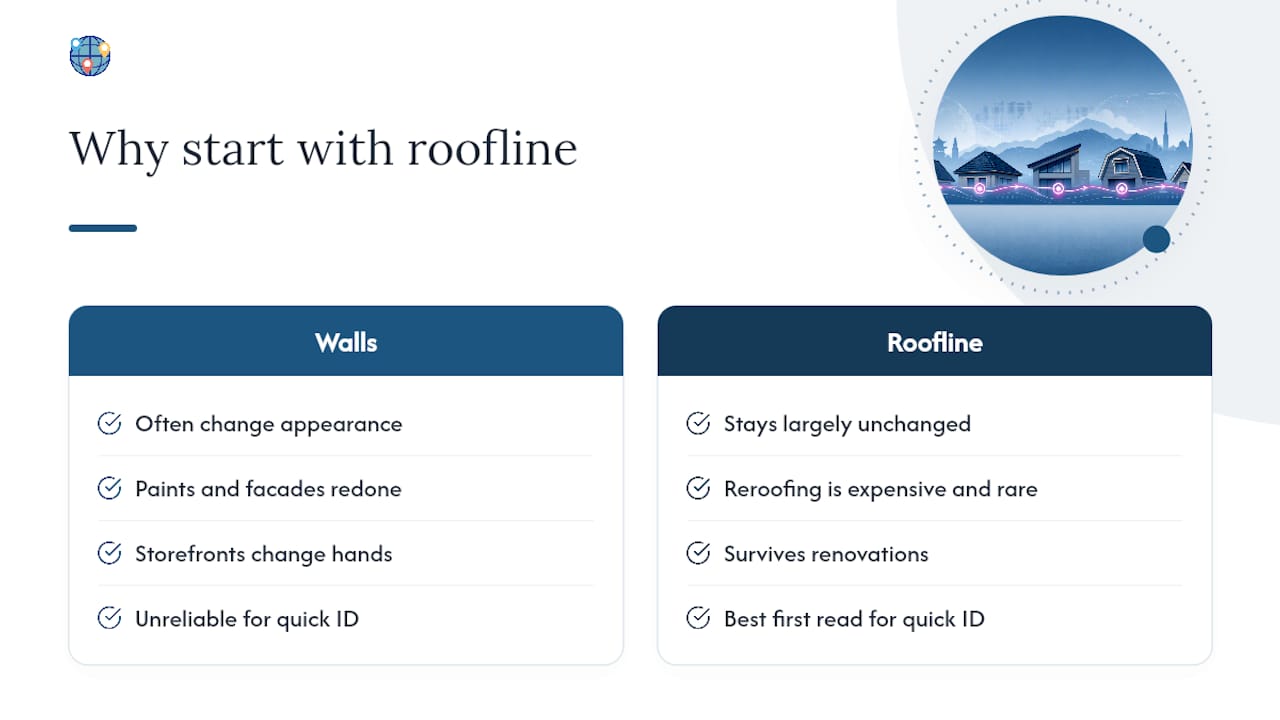
Walls lie. Paint gets redone, facades get renovated, storefronts change hands. Roofs are stubbornly honest, because reroofing an entire building is expensive and rare.
That’s why field guides like InspectApedia’s architectural style dictionary treat the roofline as the first read, not an afterthought. It survives renovations that wipe out every other visual clue. If you’re playing a geography guessing game and you’ve only got a few seconds before your next guess, the roof is where your eyes should land first.
This is also the gap that a lot of casual “roofing styles explained” content misses. Most of it is written for homeowners picking shingles. You’re not choosing a roof, you’re reading one, and that’s a completely different skill.
Quick roof-features checklist (what to spot fast in a photo)
Before you even think about the country, run this mental scan. It works whether you’re staring at a zoomed satellite crop or a street-level shot with laundry hanging off a balcony.
- Pitch and angle. Steep triangular roofs shed snow and heavy rain fast. Shallow or flat roofs mean the builder never worried about snow load.
- Eaves and overhang. Deep, wide overhangs block sun or kick rain away from walls, common in hot or monsoon climates.
- Ridge complexity. A single long ridge line usually signals rural or vernacular building. A jumble of gables, dormers, and cross ridges often means denser, wealthier urban construction.
- Surface texture and color. Terracotta orange, slate gray, corrugated silver sheen, or shaggy thatch, each has a distinct visual signature even from a distance.
- Rooftop activity. Chimneys, water tanks, laundry lines, terraces, and solar panels all tell you something about climate, era, and daily life up there.
Pro Tip: Scan the roofline before you scan anything else in the photo. Your brain wants to jump to signage or cars, but those change constantly. The roof rarely does.
How roof forms map to world regions
Certain shapes cluster on certain parts of the map, and once you’ve seen the pattern a few times, it sticks.
Steep-pitched roofs dominate alpine zones, Central and Northern Europe, and high-rain mountain belts. The Cambridge research is blunt about the mechanism: steep roofs shed snow and heavy precipitation before it accumulates into a structural threat. A photo full of sharp 45-degree A-frames is pointing you toward Switzerland, Bavaria, Scandinavia, or the Pacific Northwest, not the Mediterranean.
Flat or near-flat roofs cluster in the Mediterranean, the Middle East, North Africa, and the American Southwest. Dry climates don’t need drainage urgency, and flat roofs double as usable space, drying laundry, sleeping outdoors in summer, storing water tanks.
A few regional snapshots worth memorizing:
- Scandinavia: steep gables, dark tile or metal, often with grass or sod roofing on older rural cabins.
- Cairo: flat concrete roofs crowded with water tanks, satellite dishes, and unfinished rebar sticking skyward.
- Oaxaca: low-pitched clay tile in warm terracotta tones, often paired with whitewashed or brightly painted walls below.
Clay tiles and terracotta cluster around the Mediterranean basin, much of Latin America, and parts of South and Southeast Asia. Slate and stone show up in Western Europe’s older cities and mountain regions where quarries sit nearby. Corrugated metal dominates tropical, rural, and rail-connected areas, a pattern the RoofNet material dataset confirms across its geographic clustering data. If you’re building region-specific instincts, our guide to identifying European cities from a skyline photo walks through more of these local patterns.
Materials and texture: does the cladding confirm your guess?
Form gets you a shortlist. Material either confirms it or throws a flag that something’s off, maybe a stylistic import, maybe a modern copy built somewhere the original form doesn’t belong.
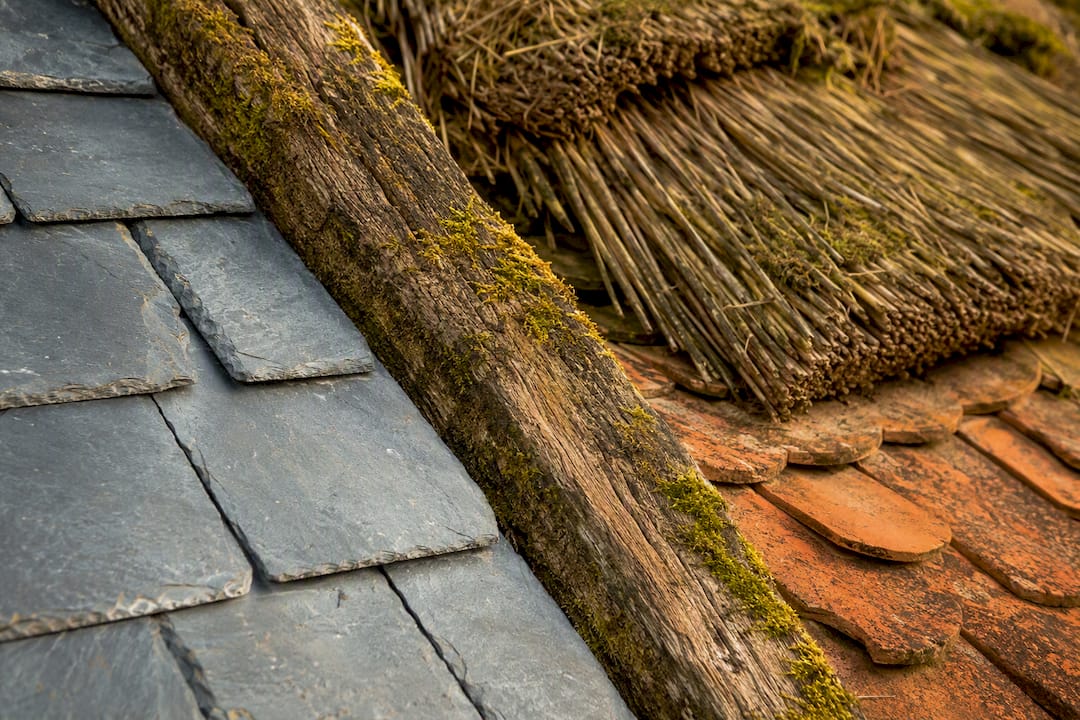
Clay tile shows up as warm orange to deep red, with visible curved or S-shaped edge profiles you can often make out even in a mid-resolution photo. Slate and stone read as flat, low-gloss, dark planes, usually clustered near old quarry regions where the material was cheap to haul short distances.
Asphalt shingles and manufactured tiles are the giveaway for modern suburban sprawl, especially in North America and parts of Australia, where uniform gray or brown shingle patterns stretch across entire subdivisions. Thatch stands out immediately with its shaggy, irregular texture and rounded ridgelines, no straight edges anywhere. Metal sheeting has its own tells: corrugation rhythm, a reflective sheen when sunlit, rust streaking down seams, and patched repairs where a storm tore something loose.
The RoofNet dataset catalogs 14 distinct roofing material classes and finds strong geographic clustering, metal sheeting turns up disproportionately in tropical regions, clay tile clusters hard around Mediterranean and Latin American cities. That clustering is exactly what makes material such a strong secondary clue once pitch has narrowed your options. Local resource availability drove a lot of this historically too. StudioMatrx’s research on traditional roofing materials notes that fired-clay tile dominates heavy-monsoon regions and slate shows up in mountain zones, patterns echoed elsewhere by corrugated metal’s own spread through tropical areas connected by colonial-era rail lines.
How roof styles change over time, and what that reveals
Roofs age in patterns, and reading that aging tells you almost as much as reading the shape.
A whole street with identical, obviously new roofing usually marks a re-roofing wave, often triggered by a storm, an insurance payout cycle, or a government subsidy program. Older cities show the opposite: a patchwork of eras stacked side by side, which itself is a clue you’re looking at an older, less centrally planned neighborhood.
Chimneys tell a heating story. A dense cluster of old brick chimney stacks, especially capped or clearly unused ones, points to a city that once ran on coal or wood heat before switching to gas or electric systems mid-century. When you spot a Mediterranean-style tile roof sitting somewhere cold, like a red-tile roof in a snowy climate, look closer. It’s often a revival style or an import, and the pitch or underlying material has usually been quietly adjusted to actually survive the local winter.
Contemporary rooftops give away the decade fast:
- Solar panel arrays suggest the last 15 to 20 years, more in sun-heavy, incentive-driven markets.
- Satellite dishes cluster in the 1990s through 2010s before streaming reduced demand.
- Rooftop patios and green roofs signal recent urban density push, especially in cities retrofitting older stock.
Pro Tip: If chimneys are visible but clearly capped and unused, you’re likely looking at a city built before the mid-20th-century fuel transition, which narrows your era guess even when the architecture itself looks ambiguous.
Photo-identification workflow: your step-by-step method
Here’s the repeatable process, the same one that works whether you’ve got sixty seconds in a classroom drill or six guesses on a daily challenge.
- Silhouette scan. Look at the outline first. Is it steep, flat, gabled, hipped, mansard, domed? Lock in the basic form before anything else distracts you.
- Material read. Zoom on color, texture, and reflectivity. Note any repair patches, rust streaks, or uniform newness.
- Rooftop activity. Check for chimneys, water tanks, terraces, solar panels, or laundry lines. Each hints at climate and era.
- Immediate context. Glance at street density, vegetation type, visible signage language, and vehicle style. These support or contradict your roof read.
- Confidence score. Pick your top two candidate regions or cities, and jot down the three clues that got you there.
That last step matters more than people think. Writing down your three justifying clues, even mentally, forces you to notice when you’re guessing off vibes instead of evidence.
| Step | What you’re checking | Fast signal example |
|---|---|---|
| Silhouette scan | Pitch and overall form | Steep A-frame vs. flat concrete slab |
| Material read | Color, texture, reflectivity | Terracotta curve vs. corrugated metal sheen |
| Rooftop activity | Chimneys, tanks, panels | Capped chimney = older heating era |
| Immediate context | Streetscape, vegetation, signage | Palm trees plus flat roof = warm, dry region |
| Confidence score | Top two candidates, three clues | “Flat roof, water tank, Arabic signage” |
For a classroom drill, try a 60-second timed exercise: flash a cropped roof photo, no ground context, and have students call out pitch and likely material before the context loads. It’s a fast way to train the instinct that visual clues in guessing quizzes rely on, and our breakdown of how visual clues sharpen city guesses digs deeper into why isolating one clue at a time builds sharper instincts. If you want to go beyond rooflines into full-scene reading, our practical guide to identifying cities from photos covers the rest of the toolkit. Readers who want the deeper architectural backstory behind these forms can also check Visual Trick’s primer on architectural style history for broader context on how regional building styles evolved.
Practice roofs on Worldlecity
Worldlecity is where you turn this checklist into muscle memory, without needing an account or a textbook. Every day brings a new real photo of a mystery city, six guesses, and instant feedback on your proximity and direction, which is exactly the fast-loop practice roof-reading rewards.

Prefer to set your own pace? The city guesser quizzes stack four difficulty modes: start on easy when you specifically want to isolate roof forms without street clutter distracting you, then move to hard once you’re confident, since those rounds strip away obvious context and force you to lean on subtler cues, like pitch angle and material sheen, the exact skills this guide just walked through. Head to Worldlecity and run today’s photo through the five-step workflow before you lock in your first guess.
Sources
- Climate, climate change and the global diversity of human houses (Cambridge)
- RoofNet: global roof material dataset and geographic distributions (arXiv)
- Traditional roofing materials: regional patterns (StudioMatrx)
FAQ
What’s the single most useful roof clue for identifying a region?
Pitch angle, because it maps directly to climate. Steep roofs point toward snowy or high-rain regions, while flat roofs point toward dry, warm ones, a pattern confirmed by the Cambridge climate and housing study.
Can roof material alone tell you the country?
Not alone, but it narrows things fast when paired with pitch. The RoofNet dataset shows strong regional clustering, clay tile around the Mediterranean and Latin America, metal sheeting across tropical zones, but local variants exist everywhere.
Why do some roofs look imported or out of place?
Stylistic imports happen when a form travels without its original climate logic, like a Mediterranean tile roof appearing in a cold city with an adjusted pitch or swapped material underneath to actually handle snow.
How does Worldlecity help with practicing this skill?
Worldlecity’s daily photo challenge and four difficulty modes give you real, varied roof imagery to test the pitch-material-form workflow against, with instant proximity and direction feedback after every guess.
Are chimneys still a useful clue in modern cities?
Yes. Capped or disused chimney stacks usually mark a city built before mid-20th-century fuel transitions away from coal and wood heat, which helps narrow both era and sometimes region.