What Is a Landmark Identification Quiz? How It Works
Discover what a landmark identification quiz is and how it helps improve your geography skills through fun visual challenges and engaging gameplay!
- what is a landmark identification quiz
- interactive landmark quiz
- famous landmark identification
- landmark recognition test
- quiz on world landmarks
- how to identify landmarks
On this page

A landmark identification quiz is an interactive game that asks you to recognize famous monuments, natural wonders, or city sites from images, clues, or descriptions. You see a photo or a hint, and you name the place. Simple premise, genuinely addictive. Worldlecity’s daily city-photo guesser is a perfect live example: a real street-level photo appears, and you get six attempts to name the city, with each guess telling you how close you are.
What is a landmark identification quiz, exactly?
At its core, this type of quiz tests visual-to-place association. You’re not memorizing a list — you’re training your brain to connect what something looks like with where it actually is. Inputs can be a full photograph, a tight crop, a silhouette, a text riddle, or a map snippet. Outputs are usually a landmark name, a city, or a country.
The game loop is straightforward: you see a prompt, make a guess, get scored, receive a quick fact or answer reveal, then move to the next round. That feedback cycle is what makes these quizzes stick. You learn something every time, even when you’re wrong.
Here’s what you’re typically working with on any given round:
- Photo prompts: full-frame or zoomed-in shots of a structure or skyline
- Silhouette clues: outline-only images that strip away color and detail
- Text/riddle clues: historical facts, local nicknames, or architectural descriptions
- Map snippets: a pinned region with no label, asking you to name the site
- Multiple-choice options: four possible answers, one correct
Pro Tip: When you’re stuck on a photo clue, look at the silhouette and color palette first. The brain processes outlines and coarse visual features faster than fine detail — so the shape of a tower or the tone of surrounding stone often unlocks the answer before you consciously register why.
Scoring varies by platform. Some use straight points per correct answer. City-guessing formats like Worldlecity use distance-based scoring — the closer your guess to the actual city, the more points you earn. Timed rounds add a streak bonus for consecutive correct answers.
Which quiz formats suit different players?
Not every landmark quiz feels the same. Format shapes the whole experience, from how hard it is to how social it gets.
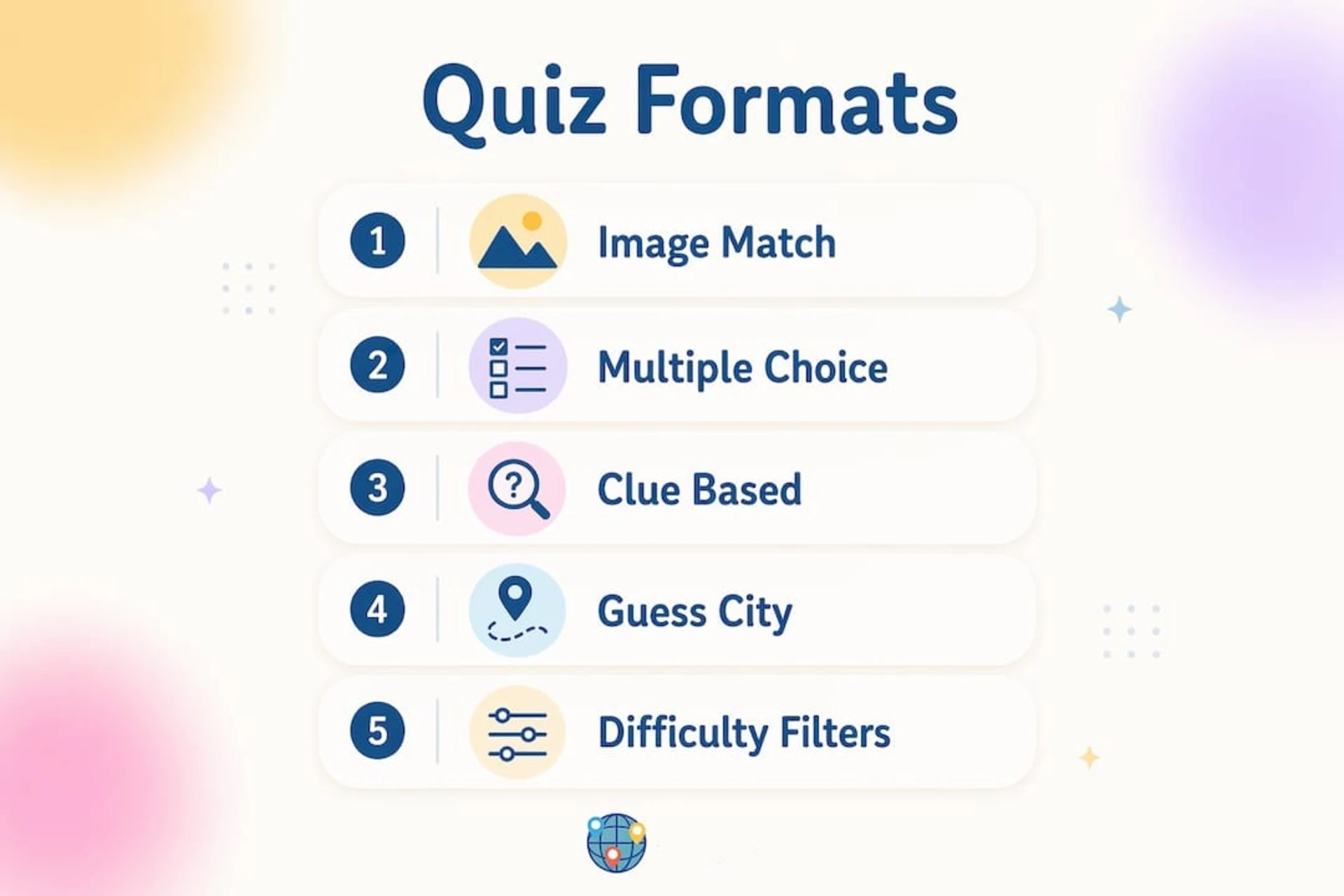
| Format | How it works | Best for | Skill level | Scoring style |
|---|---|---|---|---|
| Image matching | Match a photo to a name or location | Casual players, visual learners | Beginner–intermediate | Points per correct answer |
| Clue-based (text/riddle) | Read a description or nickname, name the place | Classroom use, pub quizzes | Intermediate–advanced | Points, sometimes timed |
| Map/city-guessing | Drop a pin or type a city name based on a photo | Hardcore geography fans | Intermediate–advanced | Distance-based |
| Multiple choice | Four options, pick one | Newcomers, parties | Beginner | Points per correct answer |
| Mixed format | Rotates image, text, and map rounds | All-ages groups, replay value | All levels | Combined scoring |
For classroom use, multiple-choice and clue-based rounds work well because they’re low-pressure and easy to pace. Party settings favor image matching or mixed formats — fast, visual, and fun to argue about. If you want a deeper challenge, map-based quiz games push your spatial reasoning in ways a standard trivia round never does.
Region filters and difficulty settings are now standard on most platforms. World Landmarks Quiz features like continent filters (Europe, Asia, Africa, Americas, Oceania) and easy/medium/hard modes let you narrow the scope or raise the stakes depending on your group.
Why playing these quizzes actually builds your geography skills
Landmark quizzes work for learning because they force a visual-to-place connection rather than rote memorization. You see the Hagia Sophia’s distinctive half-dome silhouette enough times, and Istanbul becomes a permanent mental anchor. That’s harder to achieve by reading a textbook.
Neuroscience research confirms that silhouette outlines and coarse visual features are the brain’s primary anchors for fast scene recognition. Quizzes that use cropped or outline-only images are, somewhat accidentally, optimized for how human visual memory actually works.
Beyond geography, these quizzes build cultural and historical context. Identifying the Colosseum isn’t just about Rome — it’s a hook for Roman history, architecture, and the stories behind the structure. You can discover new destinations through quizzes in a way that sticks because the learning is attached to a visual memory, not a bullet point.
How difficulty settings and region filters keep it accessible
A well-designed quiz doesn’t leave beginners behind or bore experts. The key is layered difficulty and smart filtering.
Region filters let players focus on what they know. Starting with North American landmarks before jumping to Southeast Asia lowers the entry barrier without dumbing anything down. Choosing the right quiz difficulty level matters more than most hosts realize.
Here’s how difficulty typically breaks down:
- Easy: iconic shots at standard angles — think the Eiffel Tower straight-on at dusk
- Medium: tighter crops, unusual angles, or environmental context clues (surrounding vegetation, building materials)
- Hard: local nicknames, historical-event clues, or obscure natural landmarks with no obvious visual signature
Accessibility matters too. Good platforms include alt text for images, adjustable time limits, and language options so non-native English speakers aren’t disadvantaged. For in-person events, reading clues aloud covers players who have visual impairments.
Pro Tip: Mix difficulty within a single session rather than grouping all easy questions at the start. Two iconic items, two medium, one hard per round keeps every player engaged — beginners feel capable, experts stay challenged.
Try these sample clues right now
Test yourself before reading the answers. No peeking.
Easy:
- I’m the iron lattice tower on the Seine. Name the city.
- My reflection pool sits in front of a white marble mausoleum in India.
Medium:
- You can see terracotta-colored rooftops, a river, and a distinctive dome from this Tuscan hilltop. Name the city.
- This structure’s interlocking basalt columns look almost too geometric to be natural. It’s on the northern coast of an island nation.
Hard:
- Locals call it “The Big Smoke’s Eye.” It sits on the south bank of a river and opened at the turn of the millennium.
Answers: Paris / Agra / Florence / Giant’s Causeway, Northern Ireland / London (the London Eye)
How to host or create your own landmark quiz
Running a landmark quiz for a class, party, or online group is straightforward once you have a plan.
- Pick your format and scope. Decide: image-based, clue-based, or mixed? Global or one region? Ten questions or thirty?
- Source your images. Use license-free libraries like Unsplash or Wikimedia Commons. In the U.S., fair use covers educational, non-commercial use of landmark photos, but for public events or published quizzes, stick to Creative Commons or public-domain images to stay safe.
- Write clue progressions. Start with an easy visual, then add a text hint, then a historical clue. Players who don’t get it on the photo often get it on the third clue.
- Set a warm-up round. Two or three unmissable questions build confidence and get everyone focused.
- Time each question. Thirty seconds for image rounds, sixty for text clues. Tighter limits raise the energy.
- Score and reveal together. Read the answer, share one quick fact, then move on. That micro-learning moment is what separates a good quiz from a great one.
- Plan a tiebreaker. A single sudden-death image clue works perfectly.
Pro Tip: For remote play, use a shared screen for images and a chat box for answers. Audience polling tools let everyone submit simultaneously, which prevents early answers from spoiling the round for slower readers.
Long-format question banks with hundreds of entries give you the variety you need for repeatable sessions without recycling questions too soon. For pacing inspiration, timed clue-driven formats used in online puzzle experiences are worth studying — they nail the tension-and-reveal rhythm that keeps players locked in.
Where you can play a landmark quiz right now
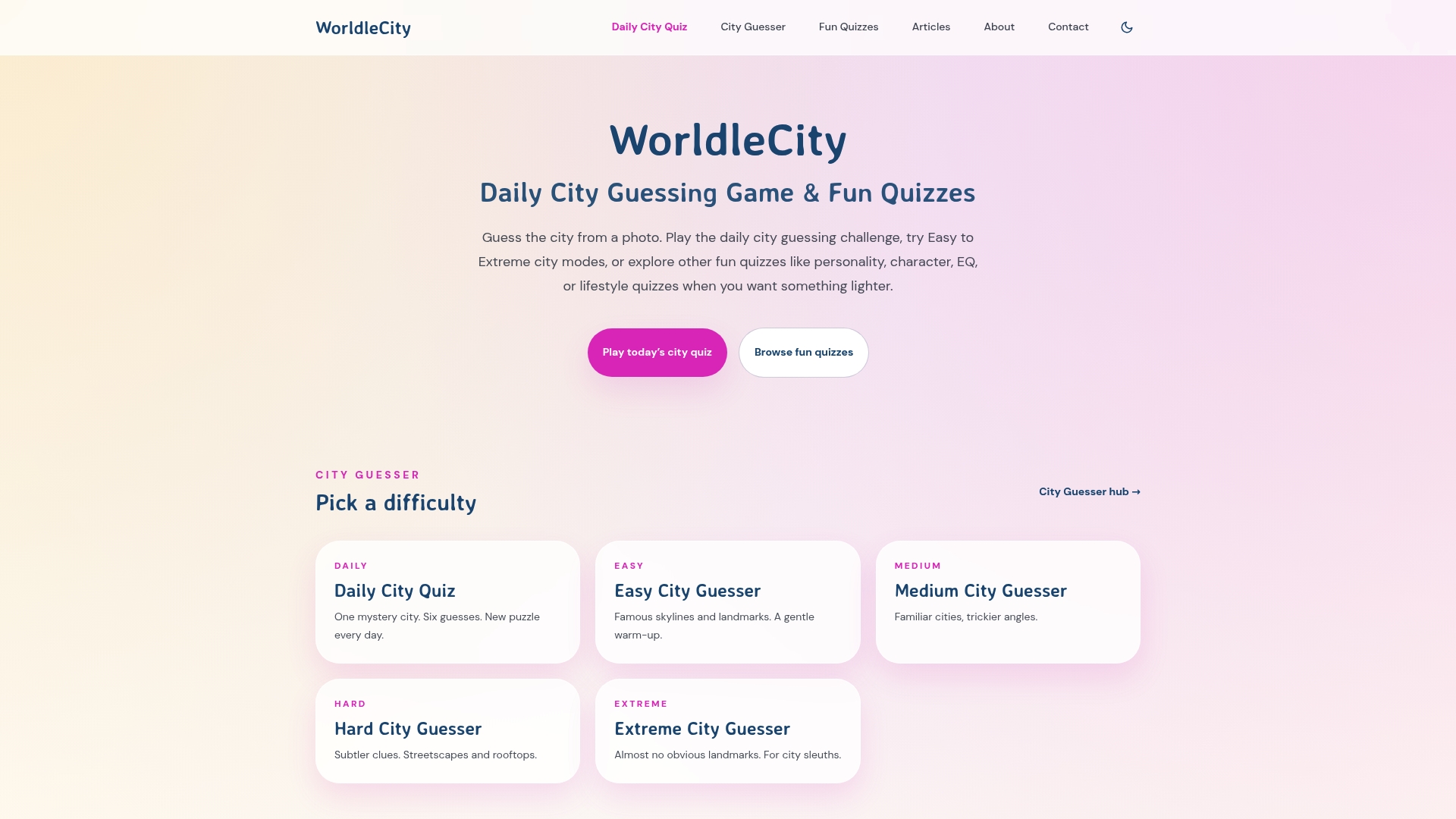
Worldlecity is the most direct place to start. The daily city-photo guesser drops a new real-world photo every day, gives you six guesses, and shows your distance and direction after each one. No account needed. Beyond the daily puzzle, the city-guess quizzes add four selectable difficulty modes so you can ease in or go straight to hard mode. The city-guess quiz library adds a different challenge for players who want variety beyond the daily puzzle.
| Platform category | Region filters | Multiplayer | Registration required |
|---|---|---|---|
| Daily photo guessers (e.g., Worldlecity) | Yes | Community sharing | No |
| Map-quiz suites | Yes | Yes (some) | Often yes |
| Downloadable classroom packs | Varies | In-person only | No |
| Mobile trivia apps | Limited | Yes | Usually yes |
For players who want to verify a guess or learn more after a round, both iPhone’s Visual Look Up and the Google app’s Places feature can identify landmarks from a photo in seconds — handy for post-round deep dives.
Key Takeaways
A landmark identification quiz is the fastest way to build real geographic literacy because it ties visual memory to place, not just a name on a page.
| Point | Details |
|---|---|
| Core definition | A quiz that asks you to name a landmark, city, or country from an image, clue, or map prompt. |
| How it helps | Forces visual-to-place associations that build lasting geographic memory better than rote study. |
| How to start playing | Try Worldlecity’s daily city-photo guesser — no registration, six guesses, instant feedback. |
| How to host one | Pick a format, source license-free images, mix difficulty per round, and always include a warm-up. |
| Worldlecity | Offers a daily photo challenge plus a full quiz library with four difficulty modes, all free to play. |
Worldlecity: play a real landmark quiz today
Geography knowledge you actually retain starts with a photo and a guess. Worldlecity gives you a real city photograph every day and six attempts to name it, with distance and direction feedback after each guess so you’re learning even when you’re wrong. Beyond the daily, the city-guess quiz library adds four difficulty modes, so it works whether you’re a casual player or a geography nerd who can spot a city from its skyline alone.
No account. No subscription. Just a daily challenge you can finish in under two minutes and share with friends. The quiz library adds more formats for when you want more than one round. Whether you’re prepping for a quiz night, studying for class, or just killing time with something that actually teaches you something, play today at Worldlecity and see how many cities you can place.
Useful sources
- 100+ World Famous Landmarks: Visual Identification Guide | WhereIsThisPlace — primary source for visual recognition techniques (silhouette, palette, environment cues)
- Journal of Neuroscience — silhouette recognition research — neuroscience basis for why outline-first recognition works
- World Landmarks Quiz | TripMemo — example of region filters and difficulty settings in a live quiz platform
- 230 Famous Landmark Quiz Questions | EarthsAttractions — large question bank reference for hosting guidance
- Identify Landmarks on iPhone | TechSavvy — Apple Visual Look Up feature for post-round verification
- How to Identify Landmarks on Android | Tom’s Guide — Google app Places feature for Android users
- Worldlecity — Daily City Guessing Game — playable example and primary recommended platform
FAQ
What is a landmark identification quiz?
It’s an interactive game where you identify famous monuments, natural wonders, or city sites from photos, silhouettes, or text clues. Answers are typically a landmark name, city, or country.
How does scoring work in a landmark quiz?
Scoring depends on the format: image-matching quizzes award points per correct answer, while city-guessing formats like Worldlecity use distance-based scoring where closer guesses earn more points.
Can beginners play landmark quizzes without much geography knowledge?
Yes. Region filters and easy-mode settings limit questions to iconic, widely recognized landmarks, so newcomers can build confidence before tackling harder clues.
Where can I play a landmark quiz for free right now?
Worldlecity offers a free daily city-photo guesser with no registration required, plus a quiz library with four difficulty modes you can play any time.
How do I make my own landmark quiz?
Pick a format, source license-free images from Wikimedia Commons or Unsplash, mix two easy, two medium, and one hard clue per round, and always include a warm-up question to get players focused.