What Is a World Capitals Quiz? Your Complete Guide
Discover what a world capitals quiz is, how it challenges your geography skills, and why it's the perfect brain workout for trivia lovers.
- what is a capital city quiz
- interactive capitals quiz
- learn world capitals
- test your capital knowledge
- capital city quiz online
On this page
A world capitals quiz is an interactive educational game that tests your ability to match sovereign countries to their official capital cities, typically covering all 194 UN member states. Think of it as a geography challenge and a brain workout rolled into one. You get a country name, and your job is to name its capital. Simple concept, surprisingly tricky execution. Whether you’re brushing up for a trivia night or just curious how well you actually know the globe, a capital city quiz cuts right to the point.
What is a world capitals quiz, exactly?
A world capitals quiz is a structured geography test that challenges players to identify the official administrative seat of government for each country. The keyword is “official.” These quizzes don’t ask for the biggest city or the most famous one. They ask for the capital, which is often a completely different place.
Standard quizzes cover 194 nations aligned with UN member state lists as of the date. That number matters because some quiz platforms include observer states or disputed territories, pushing the count to 195 or higher. If you finish one quiz and find a different country count on another, that’s why. It’s not an error. It reflects different international perspectives on sovereignty.
The format is accessible by design. Most online quizzes are free, browser-based, and require zero account registration. You open a tab and start playing. That low barrier is intentional. The goal is learning, not gatekeeping.
Common quiz formats and difficulty levels
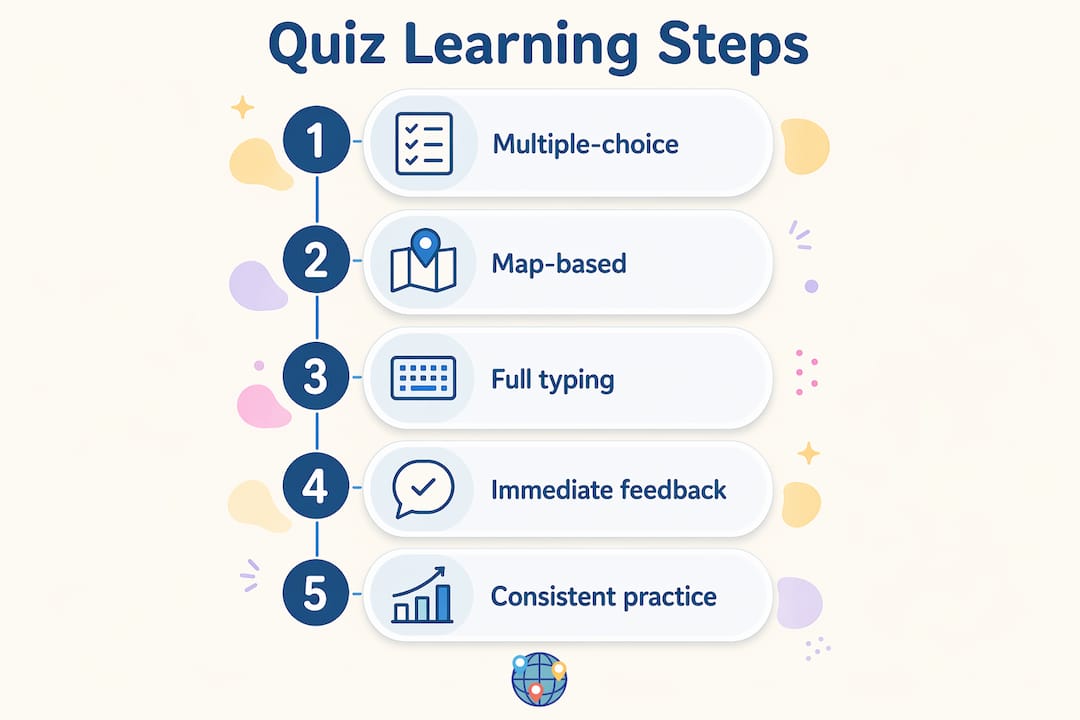
Not all capital city quizzes work the same way, and that’s a good thing. Difficulty levels range from easy multiple-choice to hard full-typing modes, with several stops in between. Here’s how the main formats break down:
- Multiple-choice: You see a country name and pick the capital from four options. Great for beginners or warm-up rounds.
- First-letter hints: You get the first letter of the capital as a clue. A solid middle ground that nudges your memory without giving the answer away.
- Full typing: No hints, no options. You type the capital name from scratch. This is where things get real.
- Map-based identification: You click on a country’s location on a blank map, or identify a capital by its geographic position. Spatial thinking required.
- Flag guessing variations: Some quizzes pair a country’s flag with a capital city question, adding a visual layer to the challenge.
Beyond format, timed challenges and streak multipliers push engagement further. A 15-minute limit with a scoring system turns a casual quiz into something you actually want to replay. Combo streaks reward consecutive correct answers, which makes the whole thing feel more like a game than a study session.
Pro Tip: Start with multiple-choice mode to build a mental map of which capitals you already know. Then switch to full-typing mode for the ones you keep getting wrong. Targeted repetition beats grinding the full list every time.
Choosing the right difficulty matters. If you jump straight into full-typing mode on your first attempt, you’ll get frustrated fast. Match the mode to your current knowledge level, then push up a tier once you’re scoring consistently.
Why getting capitals wrong is more common than you think
Capital city misconceptions are extremely common, and they follow a predictable pattern. Learners consistently mistake the most populous or well-known city for the capital. The logic feels reasonable: big city equals important city equals capital. Except geography doesn’t work that way.
Classic examples trip up even experienced quiz players:
- Australia: Sydney is the largest city and the one everyone pictures. The capital is Canberra, a planned city built specifically to settle a rivalry between Sydney and Melbourne.
- Turkey: Istanbul is iconic, historically significant, and massive. The capital is Ankara, located in the interior of the country.
- South Africa: This one is genuinely complicated. South Africa has three capitals: Pretoria (executive), Cape Town (legislative), and Bloemfontein (judicial). Most quizzes standardize on Pretoria as the primary answer to keep things consistent.
- New Zealand: Auckland is the largest city. Wellington is the capital.
- United States: New York City is the most famous American city globally. Washington, D.C. is the capital.
The pattern is clear: economic hubs and capitals are often different places. Governments frequently choose interior or neutral cities as capitals to avoid giving one major city too much political power.
Pro Tip: Build a mental “famous but not capital” list. Sydney, Istanbul, Auckland, Mumbai, and São Paulo are all cities that people regularly guess incorrectly. Knowing what the capital is NOT helps you remember what it actually is.
Quizzes that use authoritative geopolitical datasets validated as of 2026 handle these edge cases clearly. They tell you upfront which answer they expect, so you’re not penalized for knowing too much about a complicated situation.
How interactive quizzes actually improve your memory
Passive reading about capitals doesn’t stick. Interactive quizzes do. The reason comes down to how memory works.
Linking capitals to their geographic position on a map strengthens retention far more than reading a list. When you see Nairobi highlighted on an outline of Kenya, your brain stores the capital alongside a visual anchor. That spatial connection gives your memory two hooks instead of one.
Active recall through typing full capital names takes this further. When you retrieve a fact from memory rather than recognize it from a list, you reinforce the neural pathway that stores it. Multiple-choice is easier, but typing is stickier. The effort is the point.
Here’s a quick comparison of how different quiz modes affect learning:
| Quiz mode | Learning mechanism | Best for |
|---|---|---|
| Multiple-choice | Recognition | Building initial familiarity |
| First-letter hint | Partial recall | Bridging recognition to full recall |
| Full typing | Active recall | Deep retention and long-term memory |
| Map-based | Spatial anchoring | Visual learners and geographic context |
| Timed challenge | Pressure-tested recall | Reinforcing knowledge under stress |
The most effective approach combines modes. Start with map-based quizzes to build spatial awareness, then move to full-typing mode to lock in the names. Mixing quiz types for different learning styles keeps your brain engaged and prevents the plateau that comes from doing the same format repeatedly.
Immediate feedback is the other key ingredient. When a quiz tells you instantly that Canberra, not Sydney, is the answer, the correction lands while the question is still fresh. That timing accelerates learning in a way that reviewing a wrong answer hours later simply doesn’t.
How to get started with world capitals quizzes online
Getting into a quiz on capital cities takes about 30 seconds. Here’s a practical approach that actually builds knowledge rather than just burning through questions:
- Pick your starting difficulty. If you can name capitals for most of Europe and North America, skip easy mode. Start at medium and see where your gaps are. Honest self-assessment saves time.
- Do a full run first. Complete the entire quiz without stopping to look anything up. Your wrong answers are your study list. Don’t cheat yourself out of that data.
- Note the surprises. The capitals that genuinely shock you are the ones worth focusing on. Write them down or flag them in the quiz if the platform allows it.
- Switch modes for your weak spots. Once you know which regions trip you up, switch to map-based mode for those areas. Spatial context helps where name memorization alone fails.
- Set a timed goal. Give yourself a 15-minute session. A time limit creates just enough pressure to make the quiz feel like a challenge rather than a chore.
- Repeat with variety. Come back the next day with a different format. Discovering new destinations through quizzes works best when you vary the approach rather than grinding the same mode.
The no-registration aspect of most platforms removes every excuse to delay. You don’t need an account. You don’t need to download anything. Open a browser, pick a quiz, and go. Map-based quiz games are especially good for building geographic intuition alongside capital knowledge, so they’re worth adding to your rotation.
Consistency beats intensity here. Ten minutes a day across a week will outperform a two-hour cram session every time. Your brain needs repetition spaced out over time to move information from short-term to long-term memory.
Worldlecity brings world capitals to life
Knowing a capital’s name is one thing; recognizing it on sight is the next level. Worldlecity offers free, no-registration quizzes covering geography and city identification, with multiple game modes and difficulty settings built for every skill level.
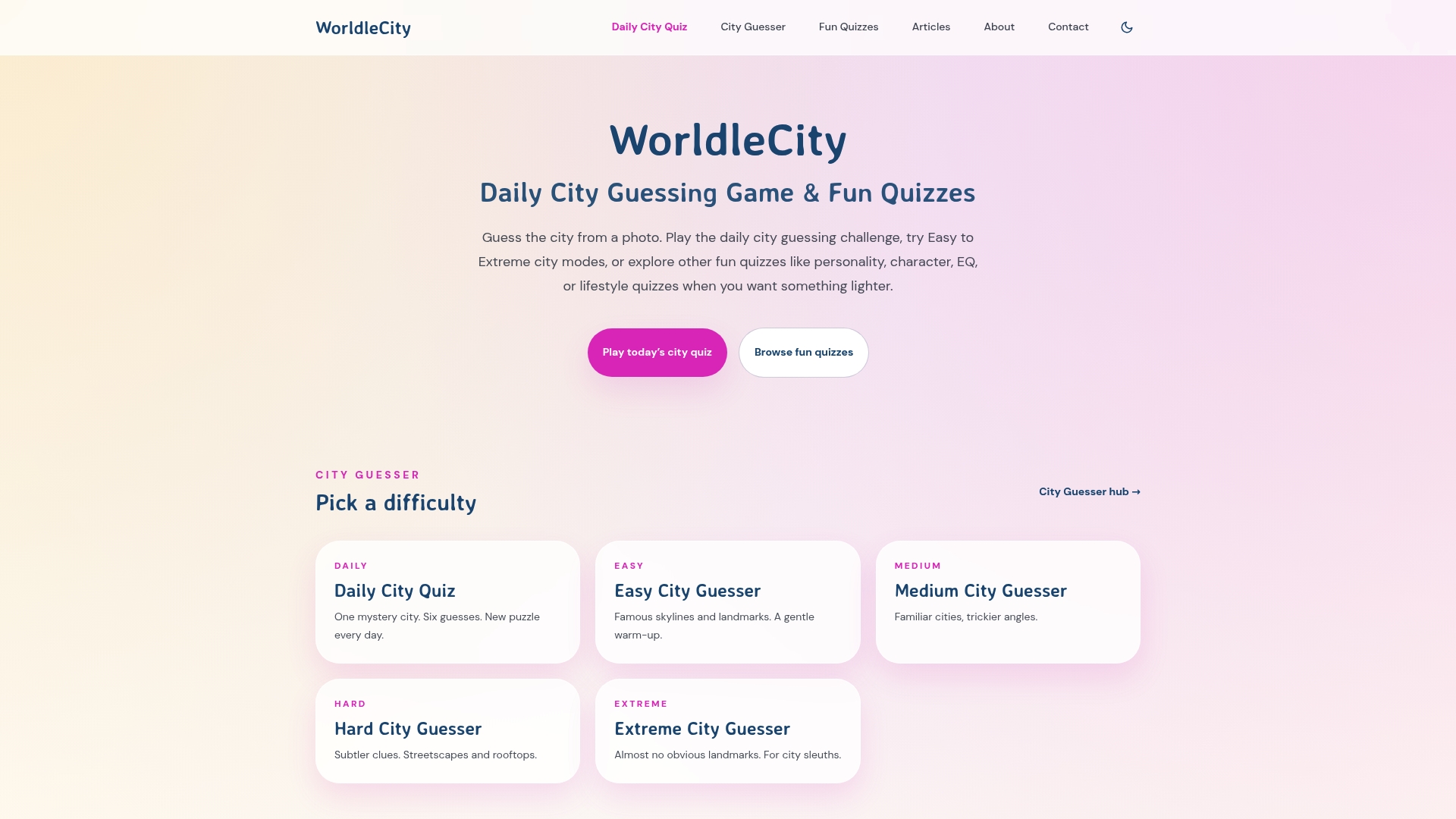
The daily city guessing game gives you a mystery city photo and six attempts to identify it, with directional feedback after each guess. It’s a fresh challenge every day, which means you never run out of reasons to come back. The city guesser quizzes stack four difficulty modes, so you can ease in or go straight to the deep end. Play on Worldlecity for free, share your results with friends, and see how your geography knowledge holds up against a daily global challenge.
FAQ
What does a world capitals quiz cover?
A world capitals quiz tests your knowledge of the official capital cities for sovereign countries, typically covering 194 UN member states. Some quizzes include observer states or disputed territories, which can push the country count higher.
Do I need to create an account to play a capitals quiz online?
No. Most capital city quizzes are free and browser-based with no sign-up required. You can start playing immediately from any device with an internet connection.
Why do quizzes sometimes list different numbers of countries?
Country counts vary between 194 and 195 or higher depending on whether a quiz includes observer states, territories, or disputed regions. The difference reflects varying international perspectives on sovereignty, not an error in the quiz.
What is the best quiz mode for actually learning capitals?
Active recall modes like full typing produce stronger long-term retention than multiple-choice recognition. Combining typing mode with map-based quizzes gives you both name recall and spatial context.
How do quizzes handle countries with multiple capitals?
Quizzes standardize on the primary capital, typically the executive seat of government. South Africa, for example, is usually answered with Pretoria rather than Cape Town or Bloemfontein.
Key takeaways
A world capitals quiz is the most direct way to identify and close gaps in your geography knowledge, and active recall modes produce stronger retention than passive recognition formats.
| Point | Details |
|---|---|
| Standard quiz scope | Most quizzes cover 194 UN member states, though some include observer states or disputed territories. |
| Biggest misconception | The largest or most famous city is often not the capital. Sydney, Istanbul, and Auckland are classic examples. |
| Best learning mode | Full-typing active recall builds deeper memory than multiple-choice recognition. |
| Spatial learning works | Linking capitals to map positions creates stronger memory anchors than name memorization alone. |
| No barriers to entry | Free, browser-based quizzes require no account and are accessible instantly from any device. |