Sharpen Your Quiz Instincts Daily in 5 Minutes
Discover how you can sharpen general quiz instincts daily in just 5 minutes! Boost retention and speed with effective microlearning.
- sharpen general quiz instincts daily
- daily quiz practice
- improve quiz skills
- quiz strategy tips
- daily trivia challenges
- sharpen trivia skills
On this page

Five minutes of daily retrieval practice, paired with immediate review, will measurably sharpen your quiz instincts. That’s not a motivational claim — it’s how spaced microlearning actually works. The daily plan: one short session on Worldlecity or a similar platform, immediate review of every wrong answer, two quick drills, and one logged takeaway. That’s it.
Why short daily quizzes beat cramming
Retrieval practice — actively pulling an answer from memory rather than rereading notes — produces better retention and faster response times than passive review. Multiple studies confirm this across timed test formats, including multiple-choice settings where speed matters as much as accuracy.
Spaced microlearning compounds that effect. DailyBrainz estimates that a consistent five-minute daily habit can accumulate around 1,800 retained facts over a year. Small sessions, done every day, add up faster than a single two-hour cram session ever could.
Immediate feedback is the third piece. Reviewing a wrong answer right after you get it wrong closes the knowledge gap while the question is still fresh. Skip the review and you lose most of that benefit.
For city-guessing games specifically, these mechanisms build cue recognition (spotting a skyline detail and knowing the region), elimination habits (ruling out continents before narrowing to a country), and response speed under pressure.

Pro Tip: Set a one-minute timer after each session just for review. Don’t skip it — that minute is where the actual learning happens.
A practical 5-minute daily routine you can follow today
Start this exact routine today. No setup required.
The daily schedule:
- Minute 1 — Warm-up recall. Name five capital cities or countries from memory, no looking.
- Minutes 2–3 — Focused drill. Play one round on Worldlecity or work through a daily trivia challenge in your chosen category.
- Minute 4 — Immediate review. Check every wrong answer. Read the explanation. Don’t just note the correct answer — note why it’s correct.
- Minute 5 — One-line log. Write one fact you didn’t know before. A city, a landmark, a geographic clue.
The 4-week progression (narrow-then-broad):
DoQuizzes recommends mastering one focused category before expanding — and it works. Here’s how to apply it:
- Week 1: Pick one region (Southeast Asia, South America, etc.). Every session stays in that zone.
- Week 2: Add one adjacent region. Keep reviewing Week 1 material.
- Week 3: Expand to a full continent. Mix in timed rounds to build speed.
- Week 4: Go broad — mixed geography, any continent. Track your accuracy against Week 1.
Session rules:
- Do: review wrong answers before closing the app
- Do: log one new fact per session
- Don’t: extend sessions past 7 minutes — longer isn’t better here
- Don’t: skip the warm-up recall; it primes retrieval
Pro Tip: Keeping sessions under 5 minutes isn’t laziness — it’s the point. Shorter sessions done daily outperform longer sessions done occasionally, because consistency is what builds the habit.
Quick drills that build city-guessing instincts
Do these drills to turn facts into fast instincts. Each one targets a specific skill that transfers directly to Worldlecity-style rounds.
- Landmark-clue flash. Find a photo of a famous landmark (not labeled). Give yourself 10 seconds to name the city and country. Check, then note what visual clue you used or missed.
- Silhouette-to-city. Look up country or city silhouettes online. Identify them without labels. This trains shape recognition — useful when a city photo shows a distinctive coastline or skyline edge.
- Lat/long elimination. Pick a city. Estimate its latitude band (tropical, temperate, polar) and hemisphere from context clues alone. Narrow from continent to country before guessing the city.
- Neighbor-chain drill. Name a country, then list all its neighbors from memory. Check a map. Repeat with the first neighbor you missed. This builds the spatial web that makes proximity clues in Worldlecity click faster.
- Write-your-own-question drill. For your weakest category, write one quiz question about a city or fact you keep missing. Forcing synthesis this way locks in retention far better than rereading.
Each drill takes 60–90 seconds and is similar in focus to popular escape room tips that actually get your posse out that emphasize teamwork and problem-solving under pressure. You can run two or three back-to-back in the drill slot of your daily routine. For geography quiz speed, the lat/long and neighbor-chain drills are the highest-return pair.
Pro Tip: When you get a Worldlecity round wrong, screenshot the city and add it to a micro-flashcard list. That image becomes tomorrow’s landmark-clue flash drill.
How to review mistakes so the learning actually sticks
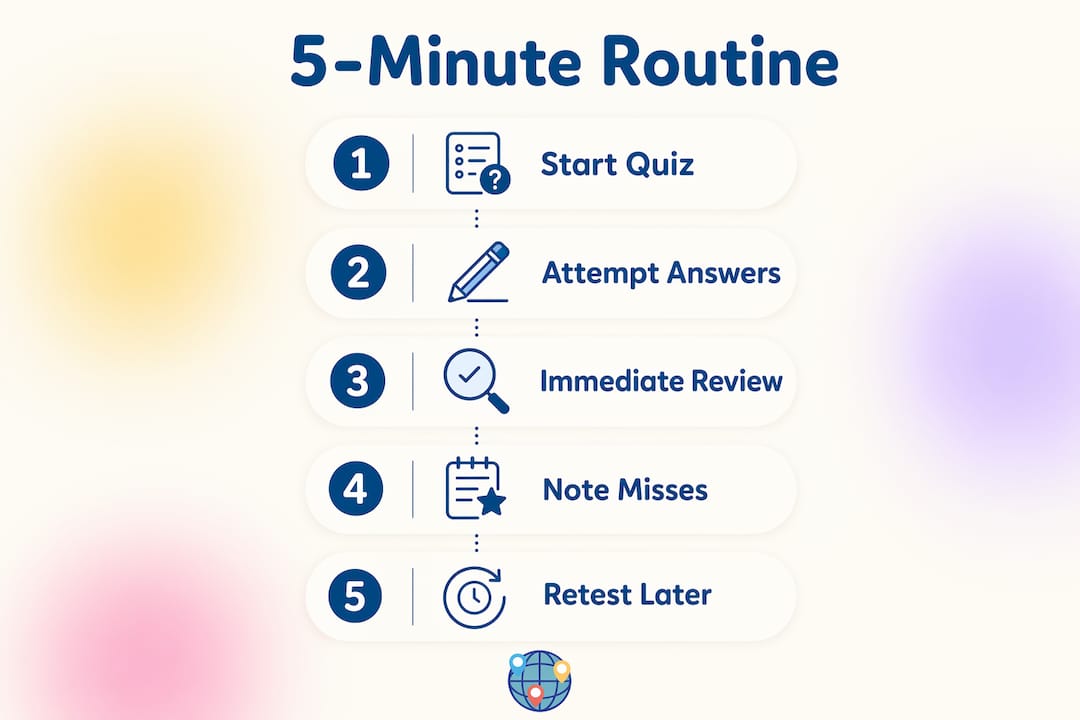
Immediate review plus a scheduled retest is the non-negotiable part of every session. Reviewing right after the quiz is good. Retesting 24–48 hours later is what makes it permanent.
Here’s the workflow:
- Record unknowns. After each session, write down every item you missed or guessed on.
- Look them up. Find one concrete fact about each — a geographic detail, a visual landmark, a neighboring country.
- Make a one-sentence clue. “Lagos sits on the Bight of Benin, Nigeria’s southwest coast.” Short, specific, memorable.
- Schedule a retest. Review those items at 24–48 hours, then again at 7 days, then at 21 days. If you fail a retest, reset the clock — treat it as a new item.
- Weekly spaced check. Every Sunday, run through your full list of logged unknowns. Anything you nail three times in a row can be retired.
NAQT recommends keeping a pocket notebook at practice to list unknowns and convert them into one-line clues. A notes app works just as well. The key is having a single place where your misses live, so nothing falls through the cracks.
When picking practice sources, favor platforms with clear performance feedback. Item-discrimination metrics reveal whether a question set actually tests your knowledge or just rewards lucky guessing — low-quality question sets can misclassify your skill level and slow your progress.
Pro Tip: Keep your unknown list in a notes app pinned to your home screen. If it takes more than two taps to open, you won’t use it consistently.
How do you track progress without overcomplicating it?
Track three metrics only: streak, recall accuracy, and median response time. That’s enough to see real improvement without turning practice into a spreadsheet project.
- Streak: Days in a row you completed a session. Motivates consistency more than any other single number.
- Recall accuracy: Percentage of questions you answered correctly without guessing. Tracks genuine knowledge gain, not luck.
- Median response time: How long your middle answer takes. Dropping this number means your instincts are getting faster.
Simple tracker template:
| Date | Streak | Correct (%) | Median time (sec) | Category |
|---|---|---|---|---|
| Day 1 | 1 | — | — | SE Asia |
| Day 7 | 7 | 60% | — | SE Asia |
| — | — | — | — | SE Asia + E Europe |
| Day 28 | 28 | — | 7 | Mixed |
Checkpoint schedule:
- Week 2: If accuracy hasn’t moved, add one new drill type. If response time is stuck, try timed practice rounds at least twice a week.
- Week 4: Compare Day 1 and Day 28 accuracy. A 10–15 percentage point gain is realistic with consistent daily sessions. If you’re not seeing it, check whether your practice source has good question quality.
Common pitfalls that undo fast players — and what to do instead
Here are the traps that catch even experienced quizzers, especially under time pressure.
The pitfalls:
- Option fixation. You read the answer choices before forming your own answer, and one option hijacks your thinking.
- Single-clue lock. You fixate on one detail in the question and ignore other context clues that would point you somewhere else.
- Time bleed. One hard question eats 30 seconds while five easier ones wait.
- Panic spiral. A difficult question triggers stress, and the next two answers suffer for it.
The hacks:
- Form your own answer first. Before reading the options, say (or think) your answer. Research shows that changing an answer is only beneficial when you have a specific recall or logic reason — not when you’re second-guessing yourself.
- Flag-and-move rule. If a question takes more than 10 seconds and you’re stuck, flag it and move on. Return only if time allows.
- Micro-elimination script. Wrong hemisphere? Gone. Wrong climate zone? Gone. Narrow fast, then commit.
- Two-breath reset. Before a timed round, take two slow breaths and consciously drop your shoulders. Mid-round, if panic rises on a hard question, one breath before answering. A calm mind scans; a stressed mind reacts. For difficult quiz questions, this reset is the fastest fix.
Pro Tip: Practice the flag-and-move rule in low-stakes sessions so it becomes automatic. You won’t remember to use it for the first time under real pressure.
Key takeaways
Five minutes of daily retrieval practice with immediate review and spaced retest intervals is the most efficient way to sharpen quiz instincts for geography and city-guessing games.
| Point | Details |
|---|---|
| Daily 5-minute sessions | Consistent short sessions accumulate around 1,800 retained facts in a year, outperforming occasional cramming. |
| Retrieval practice first | Actively recalling answers before checking options builds faster instincts than passive rereading. |
| Immediate review is non-negotiable | Reviewing wrong answers right after a session closes knowledge gaps while the question is still fresh. |
| Narrow-then-broad progression | Spend weeks 1–2 on one region, then expand — this builds connected knowledge that accelerates recall. |
| Worldlecity as your practice field | Worldlecity’s daily city-guessing round and instant feedback map onto this routine, and the quiz library’s four difficulty modes let you scale it up. |
Worldlecity fits your 5-minute routine perfectly
You’ve got the routine. Now you need a practice field that doesn’t waste your five minutes on setup.
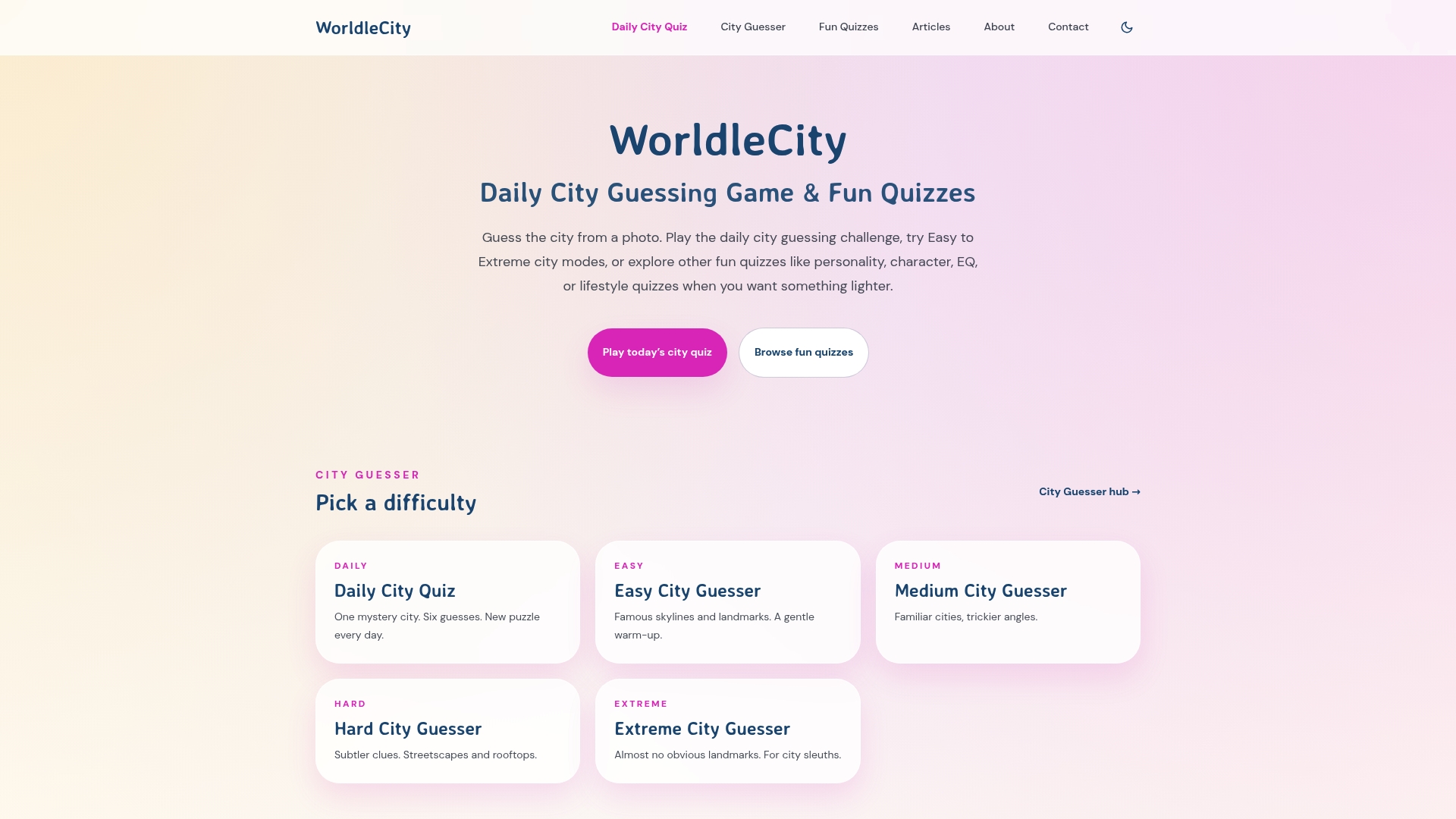
Worldlecity gives you a daily city-guessing round built around exactly this format: one mystery city photo, six attempts, and proximity feedback after every guess. That’s retrieval practice and immediate review baked into the same mechanic. When you want to apply the narrow-then-broad progression, the city-guess quiz library adds four difficulty modes so you can start on easier rounds and push into harder ones as your instincts sharpen. No account required. You can play the daily city game right now, log your result, and have your one-line takeaway written before your coffee gets cold.
Useful sources
These sources back the routine and the science — read them if you want depth on any specific piece.
- DailyBrainz — The source for the 1,800 facts/year microlearning estimate. Good for understanding what consistent daily practice accumulates.
- GetQuizSolve — MCQ Strategies — Evidence-based breakdown of retrieval practice, timed drills, and flag-and-move strategy for multiple-choice settings.
- DoQuizzes — How to Win at Trivia — The source for narrow-then-broad category practice and timed round stamina. Practical and direct.
- NAQT — Improving as a Player — Competitive quiz players’ guide to notebooks, question-writing, and converting unknowns into durable knowledge.
- SimpleQuizMaker — Writing Good Quiz Questions — Explains Bloom’s taxonomy and distractor quality; useful for evaluating whether your practice source is actually training you.
- Kryterion — Item Discrimination — How to identify high-quality question sets and avoid practice sources that misclassify your skill level.
- ResearchGate — Answer Changing in Testing — The metacognition research behind the “form your own answer first” rule and when answer-changing actually helps.
FAQ
How long does it take to see improvement from daily quiz practice?
Most players notice faster recall and better cue recognition within two weeks of consistent daily sessions. A full four-week cycle typically shows a measurable accuracy gain, especially when combined with immediate review of wrong answers.
What’s the best way to avoid option fixation during a quiz?
Form your own answer before reading the choices. Research on answer-changing shows that switching answers only helps when you have a specific recall or logic reason — not when you’re second-guessing on instinct.
Does Worldlecity work for a 5-minute daily practice routine?
Yes. Worldlecity’s daily city-guessing round takes roughly five minutes and delivers immediate proximity feedback after each guess, and the quiz library’s four difficulty modes let you follow the narrow-then-broad progression described in this routine.
How do you use wrong answers to actually improve?
Write down every miss, look up one concrete fact about it, and retest yourself at 24–48 hours, then 7 days, then 21 days. NAQT recommends keeping a running list of unknowns and converting each one into a one-line clue you can quiz yourself on later.
Is 5 minutes really enough for daily quiz practice?
Yes, when the session uses retrieval practice rather than passive review. Spaced microlearning in short daily bursts builds retention more effectively than longer, infrequent sessions — and consistency is what drives long-term improvement.